SEO pricing is three billing models, not a number: how a technical B2B founder should turn retainer, project and hourly quotes into a per-page, per-fix, exit-and-ownership comparison they can check
Normalize any SEO quote by pages, fixes, and what you keep.

SEO pricing is a comparison of billing models. For a technical B2B founder, comparing quotes starts with three things that can be checked. Those are the pages published, the technical fixes completed, and the assets the buyer owns when the work ends. Together, they reveal what the fee buys and what remains after the payments stop.
Why published SEO price ranges tell a technical buyer almost nothing
Published price ranges combine providers selling different work. A freelancer handling local citations and a boutique agency running technical remediation, content, and link acquisition may appear in the same survey, but their fees do not describe interchangeable purchases. Scope and seniority disappear into the average. What looks like a market benchmark is therefore a weak guide to a specific buying decision.
GoodFirms’ 2026 survey of 300+ agencies illustrates the problem with a common monthly retainer band broad enough to cover substantially different engagements. The range offers little help with the harder question. What will this particular fee produce? A founder comparing three proposals is usually comparing different quantities of different things, so the missing step is normalization.
The three billing models and what each one structurally buys
A monthly retainer pays for ongoing work on content production, technical maintenance, and link acquisition. Ahrefs’ 2026 data finds that 78.2% of providers use it as their primary model. It is the default commercial structure for work whose value develops over time. Its weakness is an undefined output. Without named deliverables, a recurring fee pays for work without saying what must get done.
A project fee pays for work with a clear endpoint. A technical audit, site migration, or one-time content overhaul can have a clear handover, while “grow organic revenue” cannot serve as an equally bounded scope. The risk sits at the boundary. If the project ends without anyone responsible for subsequent work, the handover leaves a gap while competitors continue publishing.
Hourly consulting pays for an expert’s time. For a founder with a marketing team and a developer, a small monthly block of strategic hours can be better value than paying an agency to execute work already covered in-house. But hours alone do not establish a proactive program. Adding to the scope causes friction when the buyer needs work to keep moving.
These models can also work in sequence. A project can fix the technical baseline before a retainer pays for ongoing content and links. That combination avoids forcing a bounded problem into an indefinite engagement, or expecting a finished project to supply ongoing capacity.
Converting any quote into a per-page cost
The first conversion divides the monthly fee by the number of pages the contract guarantees will be published or meaningfully updated that month. That gives an implied per-page cost. It is a common denominator that helps buyers examine production cost and other services, including technical work and links a retainer may also fund, within the total.
The denominator needs as much scrutiny as the fee. Does “content production” mean published pages, or drafts awaiting work that the buyer must supply? Does optimization mean a meaningful update, or an unspecified activity? The buyer should ask, “How many pages will be published or meaningfully updated each month under this contract? If the answer is absent from the contract, the lesson is to treat the retainer as a strategy-only engagement and price content separately.
Volume is only part of the comparison. A low fee that promises many pages may mean very short, low-quality work or too few hours to deliver what was promised. But answer-first pages, comparison content, and entity-rich assets can cost more than commodity blog posts because passage structure and factual density take work. A GEO-oriented proposal should spell out that work. Otherwise, the buyer cannot tell whether a higher per-page price reflects a different deliverable or simply a higher charge.
Converting any quote into a per-fix cost for technical remediation
Technical work needs its own denominator because bundling hides its cost. “Technical SEO” inside a monthly fee does not distinguish an initial repair from ongoing maintenance. Nor does it show whether technical debt is shrinking. A named deliverable, such as schema deployment, provides a clearer unit because the buyer can ask what completing it costs.
To expose that cost, ask the agency to price the technical scope as a standalone project and then price ongoing monthly maintenance separately. The project quote establishes a comparison for the initial remediation. The maintenance quote shows what the continuing fee purchases after those repairs are complete. If the agency cannot separate the two, the proposal does not support an auditable comparison.
That separation does not make continuous technical work unnecessary. Periodic review is a different purchase from continuous maintenance with developer pairing, and the proposal should say which it includes. For a B2B SaaS site with an engineering team, a one-time technical project followed by lightweight maintenance may be structurally cleaner than repeatedly paying for implementation the team can handle. The contract test is straightforward. Does it name fixes to be completed, or merely promise an ongoing service?
The exit-and-ownership question every retainer contract must answer before signing
The third conversion asks what survives termination. A page that the buyer owns and a page available only while an agency is paid are not the same economic asset, even if their production prices match. Ownership changes what the fee has purchased.
Content is an obvious place to examine this distinction. Pages hosted on an agency’s CMS or supplied under a restrictive licensing arrangement may become unusable when the engagement ends. The contract must say whether the published pages pass to the buyer in full and can still be used, so the buyer knows the terms before the contract ends.
The same test extends beyond the pages. Earned links, schema markup, and entity or knowledge-graph work need an explicit account of what remains with the buyer. Organization schema, Wikidata entries, and sameAs properties should be documented and transferable wherever the engagement creates assets for the client. Project work has a cleaner structure when ownership passes at handover, but the written terms still establish what that handover includes.
Before signing, the buyer should ask what they will own if the contract ends in six months. A precise answer distinguishes owned assets from services such as “strategy and recommendations. Those can be valuable services, but they are not substitutes for property. For a founder building a site that answer engines can retrieve, chunk, and cite repeatedly, owned pages and an owned entity footprint can keep working after the retainer ends. That compounding potential makes ownership the most consequential conversion.
Why GEO and AEO work is a structurally separate line item, not an SEO upsell
GEO and AEO work targets how AI answer engines retrieve, chunk, and cite content alongside how Google indexes and ranks it. That changes the scope of production. Passage-level structure, entity consistency, and schema depth each need attention beyond what standard on-page optimization can be assumed to cover. GoodFirms’ survey found that 37% of agencies raising prices in 2025–2026 cited GEO and AEO services as the primary reason, making it the most common single reason, with the work often charged separately.
The work spans two distinct content surfaces. On the owned domain, clean heading hierarchies and focused passages help make pages suitable for retrieval and citation. A paragraph mixing three ideas is a poor chunk. Off-domain work concerns the corroborated entity footprint, including Wikidata entries, Wikipedia presence, and accurate sameAs properties linking organization schema to profiles such as LinkedIn and Crunchbase. A proposal covering page structure alone leaves that second surface unaddressed.
The proposal also needs to say which engines the work covers. The major engines draw from different source sets, so work aimed at one does not establish a complete GEO program. To apply the framework, the buyer should request per-page and per-fix equivalents for passage structuring, entity work, and schema deployment, then confirm ownership at exit. Measurement belongs in the contract too. Tracking whether ChatGPT, Claude, Gemini, and Perplexity name and cite the brand is a deliverable to specify before production is underway.
What a multi-stage AI content pipeline changes about per-page cost
Agentic SEO workflows can compress the ideation-to-draft stage by 60–80%, shifting the bottleneck from creating a draft to controlling its quality. That is not an equivalent reduction in the cost of a finished page. Research, review, and publication still need to be distinguished from drafting when the buyer evaluates a lower quote.
The savings depend on what follows the draft. Human review needs to cover named authorship, genuine first-person experience signals where relevant, factual claims, and E-E-A-T compliance. These are not optional finishing touches. Without them, faster production can turn a cost advantage into reputational and ranking risk, leaving the buyer with more pages but a weaker asset base.
A two-pass review is the minimum viable gate. One editorial pass addresses structure and clarity, while a factual pass examines claims, calculations, citations, and legal sensitivity. Those passes make quality control a defined stage rather than an assurance that someone will look things over. The vendor should be able to document both.
For a proposal comparison, the practical questions concern the pipeline, its named human reviewer, and the human time budget per page. Those details show whether costs are lower because drafting takes less time or because the work gets less scrutiny. A vague promise of “AI-assisted” work explains neither. AI-assisted cost compression requires the right architecture of production to create a durable asset.
Applying the three-unit framework to a real proposal comparison
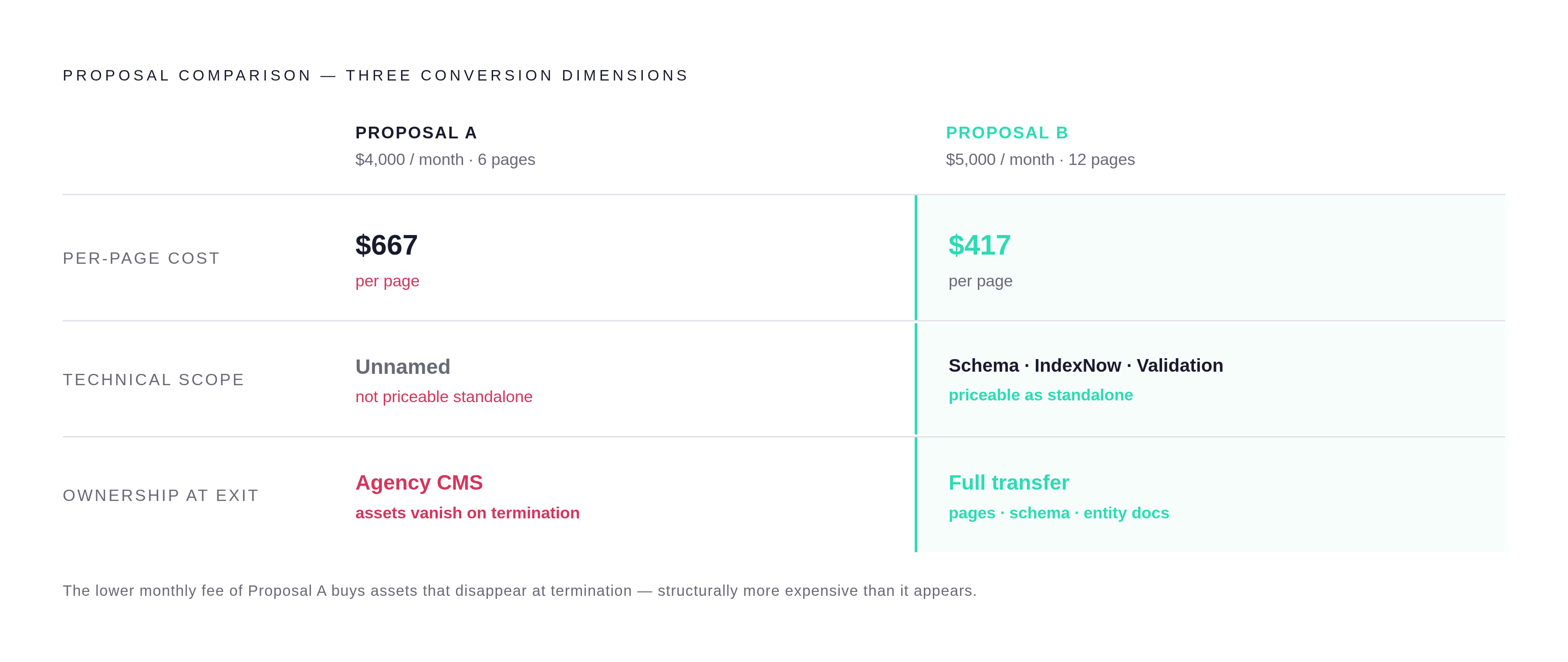
Consider two hypothetical proposals using illustrative numbers. Proposal A charges $4,000 a month and promises six pages, while Proposal B charges $5,000 and promises twelve. A is a traditional SEO retainer. B names AI-pipeline production, passage-level structuring, and entity work, so the buyer can check how it plans to produce the extra content.
The first conversion produces a higher implied per-page cost for A than for B. The per-page comparison offers a partial basis for judging the engagements, because both fees may include other services. It does establish the next questions, including whether B documents its review gates and whether A’s other work explains the difference.
The technical conversion reveals a second distinction. A includes technical SEO without naming monthly fixes, so its per-fix cost cannot be calculated from the proposal. B names schema deployment, IndexNow setup, and structured data validation, and can price that scope as a standalone project. That makes the technical portion of the recurring charge available for comparison.
The ownership conversion then changes the economic picture. Suppose A’s pages sit on the agency’s CMS under terms that remove access at termination, with no documented transfer of entity work. B transfers published pages, schema files, and entity documentation to the buyer.
Quoted hours at the stated rate can be tied to expected page and fix outputs, while project fees can be assessed against named deliverables and ownership at handover. The practical output is a simple spreadsheet table that a founder can build in under an hour. With each proposal’s fee, guaranteed pages, implied per-page cost, priced technical scope, and exit ownership side by side, the vendor conversation becomes a discussion of checkable commitments rather than a negotiation over an isolated monthly number.