SaaS marketing strategies are a unit-economics query, not a channel list: how a technical founder should compute effort-per-customer against price, instrument each test to paid conversion, and let a weekly job decide what to kill
Price and churn set what a customer can cost before you test a channel.

SaaS marketing strategy starts with what a customer can repay. For a technical founder, the useful sequence is to compute an acquisition limit from price, retention, and payback tolerance, then test channels against it. Every experiment needs a paid-conversion signal, and a weekly job should use that evidence to surface what to pause before it consumes more runway.
Why channel selection is a math problem, not a menu
A channel list asks which tactics look promising. A computation asks which tactics the business can afford. What the business can afford comes before what it prefers to write, sell, or run as ads. A low-price tool cannot absorb the cost structure of outbound sales development representatives simply because outbound works for another company. Likewise, a high-annual-contract-value product cannot count on broad consumer social to reach the buyers it needs to cover its costs.
The founding error is treating tactics as universal. Each channel has a cost floor, while each product has a limit on what acquiring a customer can cost. Payback tolerance adds another constraint because an acquisition can eventually be profitable yet take too long to repay its cost. Narrowing “Which channels work?” means identifying which channels can work at this price, with these customers, before the business runs short of cash.
The formula: computing the CAC ceiling before picking a channel
Start with price and lifetime value at known churn. The operating test is LTV:CAC with a payback window attached, and a 3:1 ratio is the consensus floor for sustainable B2B SaaS unit economics. At that floor, maximum defensible CAC is LTV divided by three. Payback then imposes a second limit. A channel must satisfy both the lifetime-value test and the time the business can tolerate waiting for repayment.
Consider a hypothetical low-price monthly tool. Its monthly price and the retention it has seen set the lifetime value it can use to pay for acquisition. Dividing that value by three sets the first bound, while gross margin and the acceptable payback window constrain how much can be spent now. That spending limit may rule out a sales motion that takes a lot of work before any campaign starts.
Now consider a hypothetical high-ACV annual tool. Its larger contract can support a higher acquisition cost, provided retention and payback justify it. That does not make every expensive channel sensible. SMB, mid-market, and enterprise CAC occupy different ranges, so a blended average obscures the comparison the founder needs.
The measurement underneath both examples is the same. Channel-level CAC is the total cost of a channel divided by the number of customers it brings in, with both the work involved and ad spend counted in the cost. Once that calculation narrows the field, the recommended starting rule is one outbound and one inbound channel. A small team spread across six channels ends up with six systems that partly work, leaving it short of the one reliable system it needs for growth.
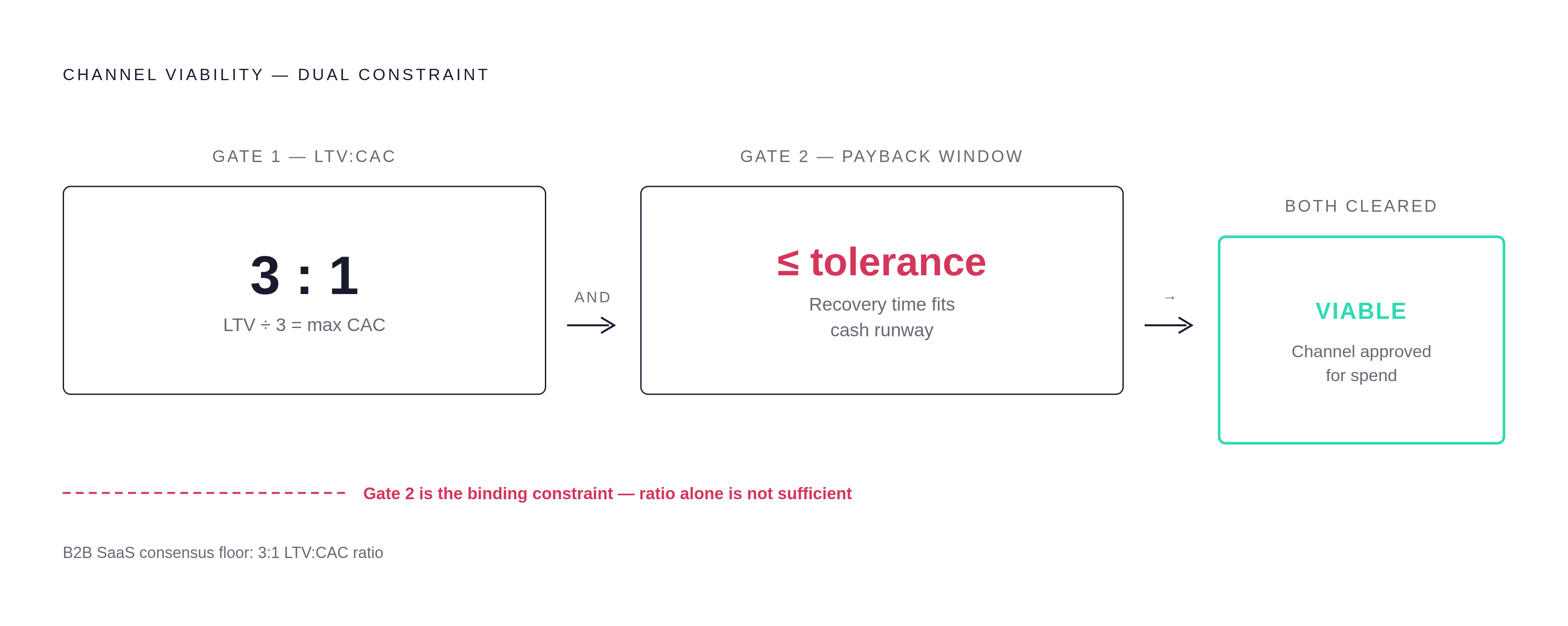
How price point and churn rate together determine which channels are structurally off the table
Customers at lower price tiers churn more heavily, while mid-market and enterprise retention can support costs that would be untenable in SMB. A source of cheap leads can therefore produce expensive customers if those accounts leave early. Low cost per lead is not protection. What matters is how much lifetime value is left after those leads become paying accounts.
But does volume help early on, when growth is hard to come by? Only if the acquired customers support the underlying economics. Volume at the wrong price-and-churn combination consumes runway faster than slower acquisition of customers who stay. Paid distribution amplifies the existing pattern, including churn. Before allocating budget, the practical test is whether a channel’s 90-day cohort retention supports the assumed LTV.
Net Revenue Retention should be one of marketing’s main KPIs because campaigns bring in the accounts that may later renew, expand, or leave. Benchmarkit’s 2025 benchmarks put expansion CAC at roughly half the cost of new-customer CAC. Bringing in customers who can expand costs less as a way to grow revenue than replacing accounts that keep leaving.
Channel cost rankings and what they imply about sequencing
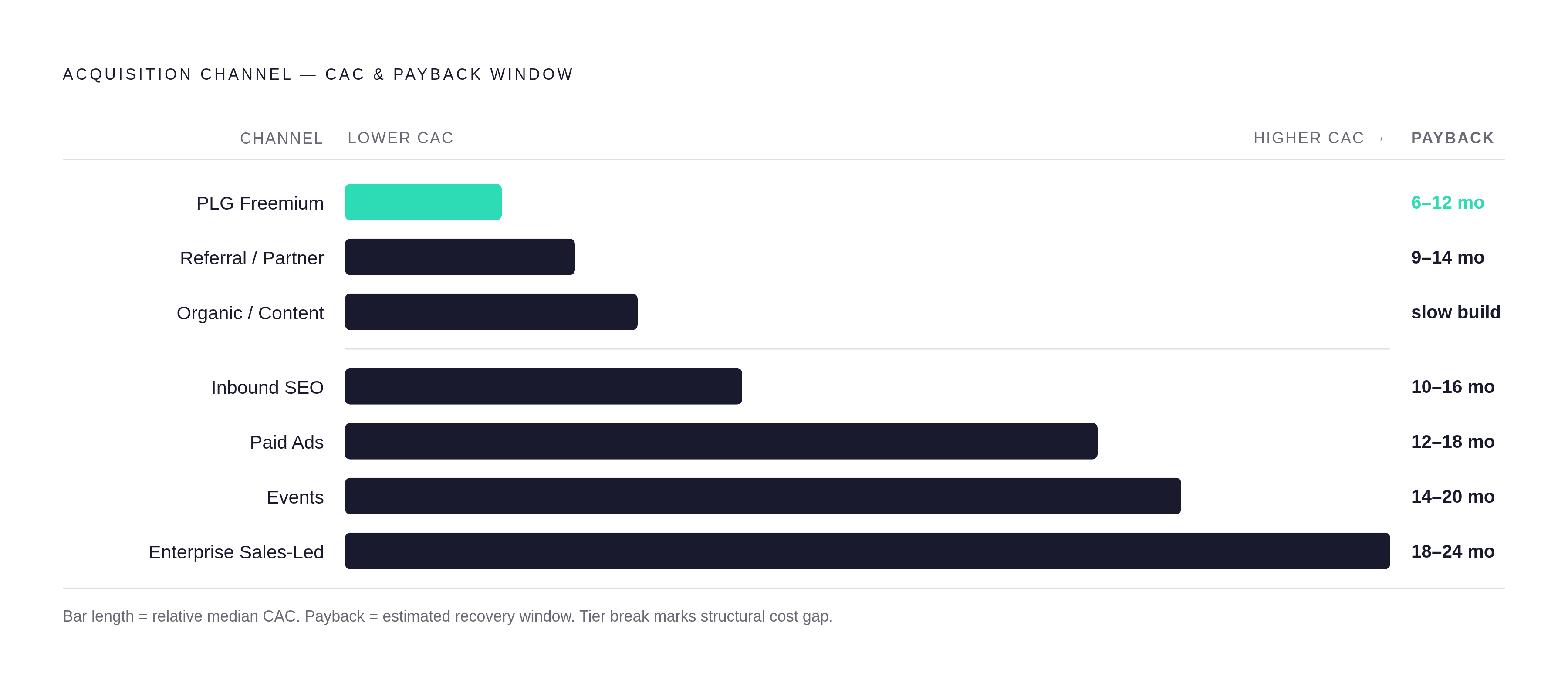
The ranking that follows from these constraints differs from a default instruction to start with paid. PLG freemium sits at the low end of median CAC, with payback in the 6–12-month range, while enterprise sales-led motions can stretch to 18–24 months. Whether either is defensible depends on the segment and the repayment window already established.
Among acquisition channels, referral and partner routes cost less than most, with inbound SEO costing a little more. Paid ads and events sit materially higher. Organic and content acquisition can also have low CAC, but they take longer to build. Time changes the sequence. A founder who needs evidence in weeks cannot treat a slow-ramping channel as an immediate substitute for a faster test.
That tradeoff makes organic work a complement. As paid-search costs rise, an approach that once stayed within a product’s acquisition allowance may now cost too much. No channel earns a permanent place because it used to work.
PLG has its own conversion constraint between free use and payment. A credit-card requirement distinguishes opt-out trials from opt-in trials, and the notes identify that gate as a test a founder can run in a week. The useful outcome is paying customers acquired through the change at a defensible cost, with retention that sustains the original calculation.
Wiring every experiment to a single conversion signal
That calculation is only as good as its inputs. Tracking cost per lead without following marketing-qualified leads through sales qualification and close leaves the central question unanswered. A cheap lead may never pay. The measurement system needs multi-touch attribution linked to CRM closed-won data so it can tie channel costs to the customers won as well as track activity in the funnel.
Paid conversion is the outcome that all experiments share. Intermediate measurements explain why that outcome changes, but they do not replace it. Landing-page conversion belongs inside channel instrumentation because paid performance depends on what happens after the click. Without that connection, a weak page can look like a weak acquisition source. The cost calculation needs the whole path.
Lead response time is another variable within that path. Responding within minutes leads to much higher close rates than waiting many hours, and a simple automation can cut that wait. Measuring the interval helps distinguish channel quality from the handling of incoming demand. Otherwise, a team may blame the source for a failure downstream. The architecture should expose that difference before allocation changes.
Each test still needs one conversion signal. Retention, margin, and diagnostic measurements still have a place alongside that one signal. It means avoiding several competing definitions of success when the weekly decision arrives. Leads, clicks, and trial starts can explain performance, while paid conversion supplies the outcome used to compute acquisition cost.
The weekly kill job: a scheduled decision that surfaces what to cut before it bleeds runway
The weekly job closes the loop between measurement and allocation. Its inputs are closed-won customers by channel, cohort retention across early lifecycle intervals, and payback projections based on current CAC and gross margin. Its decision rule comes from the earlier computation. A channel that cannot demonstrate acquisition cost and payback consistent with the product’s limits gets paused or cut.
The retention gate belongs in that scheduled process. Paid budget should not increase until 90-day retention from the channel’s cohort validates the LTV assumption. Instead, it can enforce the waiting condition automatically, rather than allowing spend to rise while retention remains unresolved. The schedule governs decisions while evidence becomes available at its own pace.
What does killing a test mean in practice? It means pausing spend, moving budget toward a channel whose cohort clears the payback constraint, and preserving the test data. A different price point or ideal customer profile may justify a later retest. Pausing records that the current combination has not earned continued funding.
This discipline is uncomfortable because founders invest narrative as well as effort. A channel can become part of the company’s imagined future before its customers repay their acquisition cost. The scheduled job makes the conflict explicit. It uses the agreed inputs to reach a decision, so each poor result does not lead to another attempt to read it in a hopeful way.
AI answer-engine visibility as a channel test with its own CAC logic
AI answer-engine visibility belongs inside that framework, but not merely as an SEO subcategory. Buyers use ChatGPT, Claude, and Perplexity to compare architectures, pricing, and alternatives before speaking to sales. An absent brand can miss that research stage. Yet appearing in those answers depends on citation selection that is not identical to traditional organic ranking.
Ahrefs’ March 2026 analysis found that most AI Overview citations did not come from pages ranking in the traditional top ten. Measuring this channel requires tools that query the actual engines and record brand mentions and citations. Traditional rank trackers cannot supply that evidence. Citation visibility is the channel-specific measurement, while paid conversion remains the economic outcome.
The cost structure also extends beyond publishing on the brand’s own domain. AI answers draw overwhelmingly on third-party sources, including industry publications, software review sites, analyst briefings, and community platforms. The distinction is between being the subject of an answer and being the source that grounds it. A brand may need coverage that readers can trust on other sites so engines have evidence from more than one source when they recommend options.
That creates acquisition effort with its own cost floor. Credible quotations, statistics, supporting citations, original research, and quantified case studies can help earn inclusion, but their production is not free. The channel test must account for the cost of that effort. More citations alone cannot demonstrate a defensible CAC. Their economic value depends on whether the measurement system can connect the channel to paying customers.
Producing citation-grade content at the cadence the measurement system requires
When AI visibility earns more funding in the weekly allocation system, the team needs content to keep testing it. The content operation must deliver useful, verifiable material consistently enough to support continued testing. Generic volume cannot meet that requirement. Original research, quantified case studies, views from experts, and examples specific to SaaS give engines more to draw on and cite than opinion content of the same length.
Producing those properties at speed requires a structured pipeline. The strategic work includes topic selection, audience, and angle, and remains human-led. The mechanical work includes outlining, drafting, and formatting, with AI assistance subject to human review. The weekly job’s output feeds the strategic layer by showing which topics and channels deserve further effort. It should not become an instruction to publish more of everything.
Review checkpoints protect the quality of that output. Brief review occurs before drafting, editorial review before scheduling, and an accuracy check after publication. Automated factual-consistency checks and accuracy flags help with this process, while a human must sign off on high-risk content. Automation does not replace the editorial decision. Unreviewed AI output can fail to earn citations and dilute domain credibility over time.
The loop then has a defined path back to production. Measurement identifies which topics and formats earn citations, paid conversion establishes their acquisition economics, and the weekly job reallocates effort. The pipeline produces the next round of material against that evidence. For a technical founder, the useful system can withhold the next unit of effort when the last has not justified its cost.