"Claude Code for product managers" as a managed service: what a technical founder should test before trusting a vendor that runs signup walkthroughs, feature audits and release drafts from your repo
A founder should vet the operator's access, review and incident controls first.

A managed “Claude Code for product managers” service promises signup walkthroughs, feature audits and release drafts drawn from your repo. For a technical founder, the decision is less about judging the AI than judging the operator. Before any credential is shared, the vendor needs to show how it limits access, reviews outputs and responds when something goes wrong.
What Claude Code actually does when it touches your repo
Claude Code is a terminal-based CLI agent that can read and write files, execute shell commands, make git commits and connect to external services. It searches the working directory on demand without pre-indexing the codebase. Its scope extends across the project tree, with MCP servers connecting it to other systems. This is not simply another chat window. Unlike a browser assistant reacting to pasted text, the agent operates within an environment where its permissions determine what it can do.
Claude Code reads .claude/settings.json and can execute hooks, so project configuration is part of its operating surface. Signup walkthroughs, feature audits and release drafts also draw on PRDs, commit history and configuration files. The workflow name does not establish its permissions. An audit can be scoped to read-only access, while a draft written back into the repo needs write access, and neither arrangement should be left implicit.
Why the PM productivity case for Claude Code creates a vendor market worth scrutinising
Instead of writing a PRD, waiting for a sprint and reviewing a mockup, a PM can direct an agent to build a clickable prototype in an afternoon. That gives the PM something concrete to assess sooner. The agent can also work directly with project files to produce repo-sourced audits and release drafts. A managed service offers that benefit without asking the PM to become the person who installs and operates the tooling.
There is real setup work to remove. Claude Code requires terminal access and a paid Claude Pro, Max, Team or Enterprise subscription, or a Console API key. Node.js is required for the npm installation path, but not for the native installer. Beyond installation, the operator needs to be comfortable directing an agent. The vendor proposes to handle plugin selection, CLAUDE.md configuration, MCP server wiring and human-review orchestration, then return usable outputs.
That is a legitimate division of labour. It also means the client is delegating decisions about permissions, executable instructions and approval stages. The convenience and the exposure come from the same capabilities. A particular vendor must therefore account for the access behind that benefit to a PM.
The access model a vendor must have before credentials are shared
The first gate is a written account of permissions. A founder should ask what minimum permission set applies to each workflow and how that limit is enforced. A read-only feature audit and a write-enabled release draft should not receive the same access simply because they use the same agent. Least privilege needs a task-level explanation. If the vendor cannot make that distinction, an impressive sample output does not resolve the gap.
Credentials need an equally clear lifecycle. The written response should cover credential scope, rotation policy, permission audit trails and revocation when the engagement ends. It should also state how quickly credentials are invalidated and whether the vendor retains cached repo content. These are questions to settle before onboarding.
That response should also list the configuration and connectors in use. Ask how CLAUDE.md and .claude/config.json are reviewed before entering a pipeline, because instructions embedded in a pull request or dependency can redirect the agent. Anthropic’s product-management plugin includes connectors for Slack, Linear, Notion, Figma, Amplitude and other services. Each active MCP server adds another credential and another blast radius. The vendor should identify every active server and its scope, rather than treating “integration access” as a single permission.
Known failure modes in Claude Code that a vendor's controls must account for
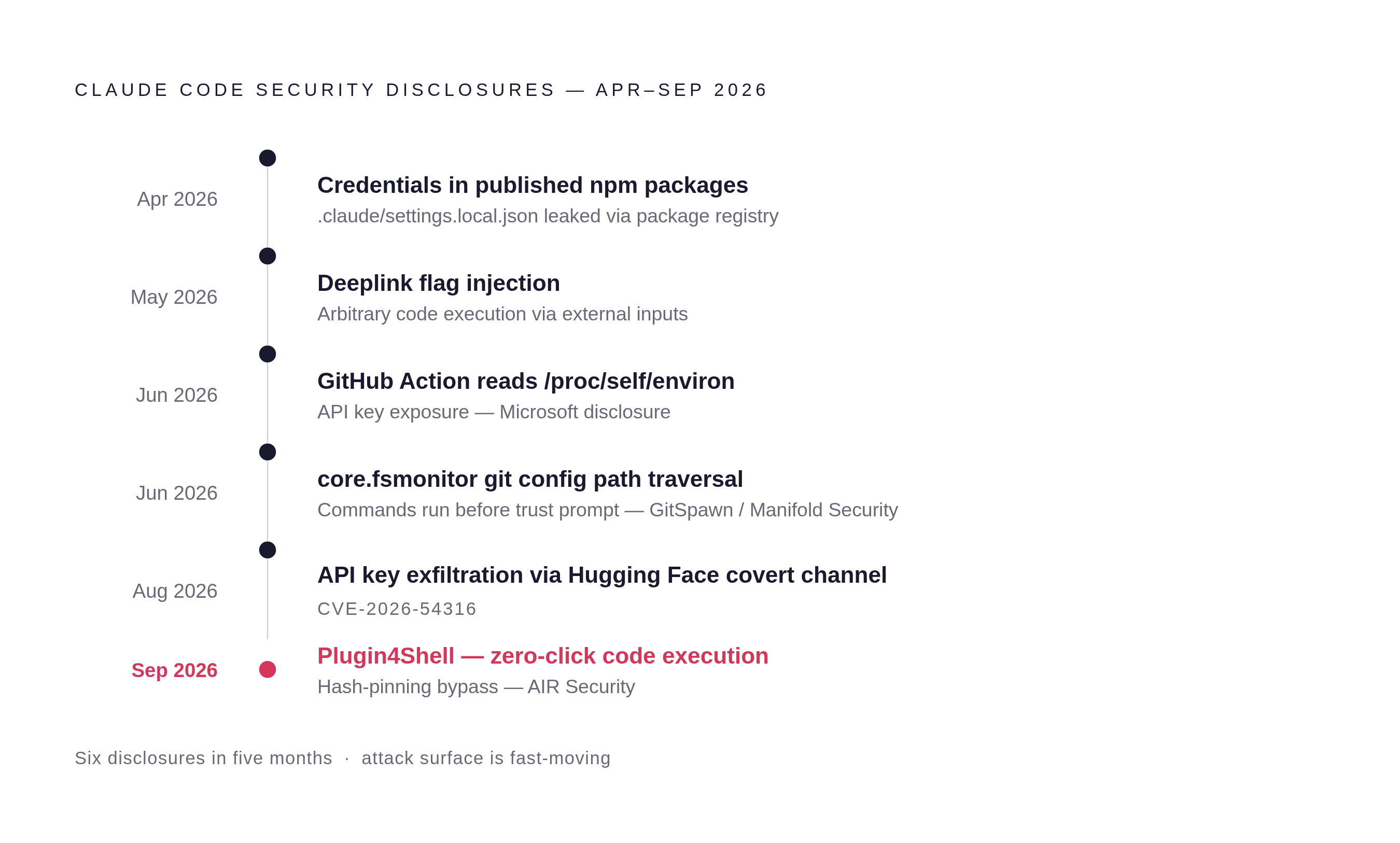
GitGuardian’s 2026 research found that AI service credential leaks surged 81% year-over-year. Against that backdrop, a vendor should explain its credential handling and, more importantly, its response to specific Claude Code issues. A disclosure shows that the way the service is run must allow for things to go wrong. The founder needs informed answers.
The April 2026 finding involved credentials in .claude/settings.local.json inside published npm packages. A vendor should demonstrate that this file is excluded from shared or published artifacts. The May 2026 issue involved deeplink flag injection enabling arbitrary code execution, which is relevant when external inputs from issue trackers, PR comments or Slack reach the agent. One concerns what leaves the environment, while the other concerns what incoming material can cause the agent to do.
Microsoft’s June 2026 disclosure described the Claude Code GitHub Action reading /proc/self/environ and exposing API keys. That is directly relevant to vendors running the agent in CI/CD pipelines. Manifold Security’s June 2026 GitSpawn disclosure concerned a core.fsmonitor path in git configuration running commands before the trust prompt. A vendor that clones a repo and starts the agent without auditing git configuration has overlooked that attack vector. Both findings require answers about the execution environment as well as the text sent to the model.
The August 2026 CVE-2026-54316 involved API key exfiltration through a Hugging Face download-counter covert channel. GITHUB_TOKEN was exposed in the related attack chain, rather than being the specific credential tracked by that CVE. AIR Security’s September 2026 Plugin4Shell disclosure described a cryptographic hash-pinning bypass enabling zero-click code execution. The distinction between these mechanisms is important. A competent response identifies which disclosures affected the deployment and what changed, while also explaining how the vendor detects malicious instructions embedded in repositories, pull requests or dependencies.
What a credible review gate looks like for repo-sourced outputs
Access controls address what an agent can touch. They do not establish whether its release note is accurate, whether an audit overstates a feature, or whether a walkthrough fits the brand. Those questions need human judgment at a stage that is set out in writing. A managed service should name who supplies it. Without that stage, the offer is automation with a managed-service price tag.
A credible gate includes named reviewers, a diff between the AI draft and the approved output, and a written policy for hallucinations found after publication. The practical test is evidence of that process. A founder should request a redacted past diff and the name of the person who approved it. If no record exists, the review claim is nominal. Approval must be an accountable decision even when a draft needs no correction.
Signup walkthrough copy and release notes have different blast radii, so applying one undifferentiated policy to every artifact leaves that distinction unexplained. The vendor should describe who reviews each type and what happens when a published claim proves wrong. Automation shifts where judgment is applied. It does not remove the need to assess accuracy, brand fit and nuance before an output represents the client.
How to evaluate the vendor's plugin and skill provenance
The security review must also examine what the vendor installs to operate with those permissions. An unreviewed community skill is an instruction file running with the agent’s full access. Provenance therefore belongs in the security review. A plugin inventory needs to distinguish Anthropic-published material, community collections and the vendor’s own skills, rather than grouping everything under “approved tools.”
Anthropic’s official knowledge-work-plugins and anthropics/skills repositories are documented, source-available and maintained by Anthropic. Community collections can change often without a security review or an audit trail, and the vendor’s own SKILL.md files need to be checked directly. A founder should be able to read every SKILL.md file that is installed. The vendor should also provide every skill, plugin and subagent’s source repository and version pinning. Installing community collections without reviewing each skill is a security finding that needs more than a note in the inventory.
Plugin4Shell shows why pinning alone is an incomplete answer. The vendor must show both version pinning and hash verification, because a pinned version alone does not prove that the code installed was the code intended. Generated skills need scrutiny too. The skill-creator plugin in anthropics/skills can generate and modify skills programmatically. A vendor using it should show that generated skills pass through the same review gate as human-written ones.
The GEO consequence: how vendor-generated content affects your brand's AI visibility
There is a second blast radius beyond infrastructure. A weak access model can expose the project, while weak published content can harm how the brand is shown and found. Release drafts and feature audits can help or hurt GEO when they feed the material used in AI-generated answers. This remains a vendor-quality question. Producing more text is not the same as producing content that an answer engine can clearly attribute.
AI answer engines retrieve and cite passages. A passage without named authorship, inline citations or verifiable claims gives an engine little basis for connecting a useful statement to the brand. The result can be a generic sentence extracted without attribution. A Princeton/IIT Delhi study found that content with added statistics and quotations achieved 30–40% higher visibility in AI-generated responses than unmodified content. That finding supports attention to evidence in the writing.
Consistency across outputs is another part of that work. Content produced at scale without entity markup, structured data or named authorship can create cross-source drift between vendor outputs and the canonical site. Inconsistent brand information gives models conflicting signals to reconcile. The sample test is straightforward. A founder should request past release drafts and examine whether they contain named authors, primary-source citations and quotable conclusions.
Measurement must match the promise being sold. Google rank tracking alone does not show whether ChatGPT, Claude, Gemini or Perplexity names and cites the client after publication. The vendor should explain how it tracks those results. As with the access model, the useful evidence is a defined process and an observable result.
The written questions to send before signing anything
The request can be sent in plain language. What minimum permissions does the agent hold for each workflow, including read-only audits and write-enabled drafts, and how are those limits enforced? Please share the credential rotation policy and the format of the permission audit trail for the client environment. Which MCP servers are active, and what scope does each have? How are CLAUDE.md and .claude/config.json reviewed before entering a pipeline, and how quickly does offboarding invalidate credentials and remove any retained repo content?
The security response should address the disclosed mechanisms directly. Which Claude Code vulnerabilities disclosed from April through September 2026 affected the deployment, and what controls changed in response? How is .claude/settings.local.json excluded from shared and published artifacts? What controls address CI credential exposure and git configuration that can execute commands before a trust prompt? How are prompt-injection attempts in pull requests, issue comments and dependencies detected and blocked?
Please provide every skill, plugin and subagent installed in the client environment, with source repository, version pinning and hash-verification practices. Are community skill collections installed, and how is each skill reviewed before it is installed? Can the client read every proprietary SKILL.md file? Do generated or modified skills pass through the same review gate as human-written ones?
Please provide a redacted AI-draft-to-approved-output diff, identify the responsible reviewer for each output type and supply the policy for a hallucination found after publication. Do release drafts and audit outputs include named authors, inline citations and structured data, and can a sample demonstrate that? How is any increase in client citations in ChatGPT, Claude, Gemini or Perplexity measured? A vendor that cannot answer these questions in writing has already told you what you need to know.