"Demos from buyers who already know you": what a technical SaaS founder should test before trusting a done-for-you demand generation service that runs LinkedIn, ads and outreach in your name
Five questions and proof tests reveal whether a provider has judgment or just capacity.

Done-for-you demand generation services promise technical SaaS founders “demos from buyers who already know you.” Before trusting one to run LinkedIn, ads and outreach in your name, test the judgment and evidence behind that promise. The best providers can show in writing how they protect your voice, qualify pipeline and measure AI visibility. Execution capacity alone is not enough.
Why founders are buying done-for-you demand generation now
Paid acquisition now costs more, fewer senior buyers reply to cold outreach, and AI answer engines now handle research queries that once belonged to SEO. For a founder heads-down on product, building an internal response looks expensive and slow. Outsourcing offers an appealing way around that work. The most seductive promise is not more content or more messages, but a buyer who arrives already understanding the product and ready to discuss buying it.
A buyer asks ChatGPT which tool fits a particular use case, sees a brand named, Googles it two days later and books a demo. Branded search gets the attribution credit, while the AI mention that started the journey goes unseen. This makes the promise credible, but also difficult to audit. A provider must show more than the final booking to demonstrate its contribution.
What a legitimate DFY demand gen service actually does, and what it subcontracts to algorithms
A well-run service separates mechanical execution from judgment. Content drafting, ad copy generation, sequence scheduling and CRM hygiene can be systematised, as can meeting summaries and lead scoring passes. Automation is not itself the weakness here. The weakness appears when a provider treats decisions about buyers, positioning and timing as if they were just more production tasks.
The contract should reflect that distinction. Choosing which accounts to prioritise, which topic to build a category around and when to put brand-building ahead of conversion campaigns requires human judgment. So does deciding what to give up when meeting a pipeline target could harm the founder’s reputation. The founder is buying those decisions as well as output. A provider that cannot explain its sequencing logic and human review layer is selling execution without showing who steers it.
LinkedIn outreach adds a separate constraint because it operates through the founder’s account. LinkedIn prohibits third-party automation and restricts accounts that exceed connection request volumes. The account risk sits with the founder. The provider should make clear what automation it uses and explain its daily limits, including how much it sends through the account. Sustainable limits do not make prohibited automation compliant, so a claim of cautious use is not an answer to the policy question.
The five questions to ask before trusting a provider with your LinkedIn presence and brand voice
First, ask who writes the first draft of posts and messages, and what brief they receive. Ask to see the actual brief or prompt template. A useful one names specific pain points, buying triggers and the vocabulary buyers use. “Fintech CTOs” is not a sufficient brief. If the answer stays at that level, the provider has described an audience label without showing how it will speak credibly to that audience.
Second, ask how your point of view enters the content. A good answer identifies an enrichment step where a human, possibly the founder, adds proprietary opinions, real customer quotes and accurate product claims. An AI pipeline cannot safely make those inputs up. Ask about the sources of those inputs and their entry into the workflow. An answer about generating content that “sounds like you” dodges the harder question of whether it represents anything you actually believe.
Third, ask what human review gate exists before anything goes live. The provider should name who reviews material, what that person checks and whether the founder has final approval or is opted out by default. The gate must cover posts and outbound messages. Reassurance about polished writing is not equivalent to a review process, because fluent prose can still misstate a product’s capabilities or put an unsupported opinion in the founder’s mouth.
Fourth, ask how the provider manages LinkedIn account limits and where compliance risk sits. A concrete answer gives specific daily limits for connection requests and message sends, discloses automation and acknowledges the client’s account risk in writing. Vagueness leaves the founder exposed to consequences they cannot assess. Ask what happens if LinkedIn restricts the account. A deflection at that point is more revealing than a general assurance that the agency is careful.
Fifth, ask what happens to AI-generated citations and factual claims. Ask for a citation-verification protocol distinct from the editorial pass. A fabricated citation can look structurally convincing and survive a grammar check. The provider should show how claims and sources are checked. These five questions fit a 30-minute vendor call and test how the provider handles the founder’s identity, beyond its skill at making samples look good.
What proof of pipeline performance actually looks like, and what to ask for instead of a case study PDF
Protecting the founder’s voice establishes a process standard, but it does not prove commercial performance. A case study PDF, testimonial reel or activity dashboard alone cannot show that a service brings in demos with buyers who truly want to buy. Ask for direct client references instead. A founder or head of revenue should be able to talk through demos booked, demos qualified and deals influenced, as well as what the campaign put out.
The next test is the attribution methodology. That distinction is difficult and necessary. Buyers research through LinkedIn DMs, Slack communities and podcast recommendations that often leave no trail a provider can track. A credible provider acknowledges those gaps rather than presenting every inbound booking as a cleanly attributable result.
To check that reporting independently, add source attribution to the demo process. A “where did you hear about us” field can offer discrete options including “LinkedIn,” “referral” and “AI search/ChatGPT/Perplexity,” while the demo conversation supplies qualitative detail. Self-reporting adds to the numbers, which are still needed. Also ask for an ongoing scorecard showing the provider’s reporting cadence. Weekly or bi-weekly reporting gives the founder a chance to spot problems early, while monthly reporting is too slow for a channel as dynamic as LinkedIn outreach.
The AI visibility claim most DFY providers make but almost none can demonstrate
The AI-led version of “buyers who already know you” depends on answer engines naming or citing the brand before the buyer visits its website. This layer involves optimising for answer engines and generative engine optimisation, or GEO. It requires a different kind of work. When ChatGPT or Perplexity answers a tool-selection question, the engine draws on content, structured data and third-party citations it has indexed, making a place in that answer a content and infrastructure job.
A service can therefore run LinkedIn and ads without addressing the source of the pre-education it promises. It may warm buyers closer to conversion while leaving the AI-answer layer uncontested. Ask for evidence specific to that layer. The provider should show its tracked prompt set, the engines it monitors and a baseline Share of Model measurement taken before the engagement began. Share of Model is the fraction of AI responses to a target query cluster that mention the brand.
That baseline also needs to distinguish platforms. Major AI engines get their citations from very different sources, so showing up in one does not mean a brand shows up in another. The founder needs to know whether the provider tracks the engines used by buyers who fit the ideal customer profile, or ICP, and whether its content program works on the sources those engines cite. An AI visibility claim needs both measurement to back it up and a structured content program to earn the result.
How to measure AI-answer visibility in a way that isn't anecdote
A single prompt run produces an example. AI responses change, so a screenshot of one favourable mention cannot show how often buyers see the brand. Run each tracked prompt three to five times on each engine every week. Aggregate the results into citation rates and share-of-voice figures for each engine and prompt, then roll them into a weekly brand-level scorecard. Repeated weekly sampling smooths non-deterministic variance, while monthly checks are too slow to follow changes tied to indexing cycles.
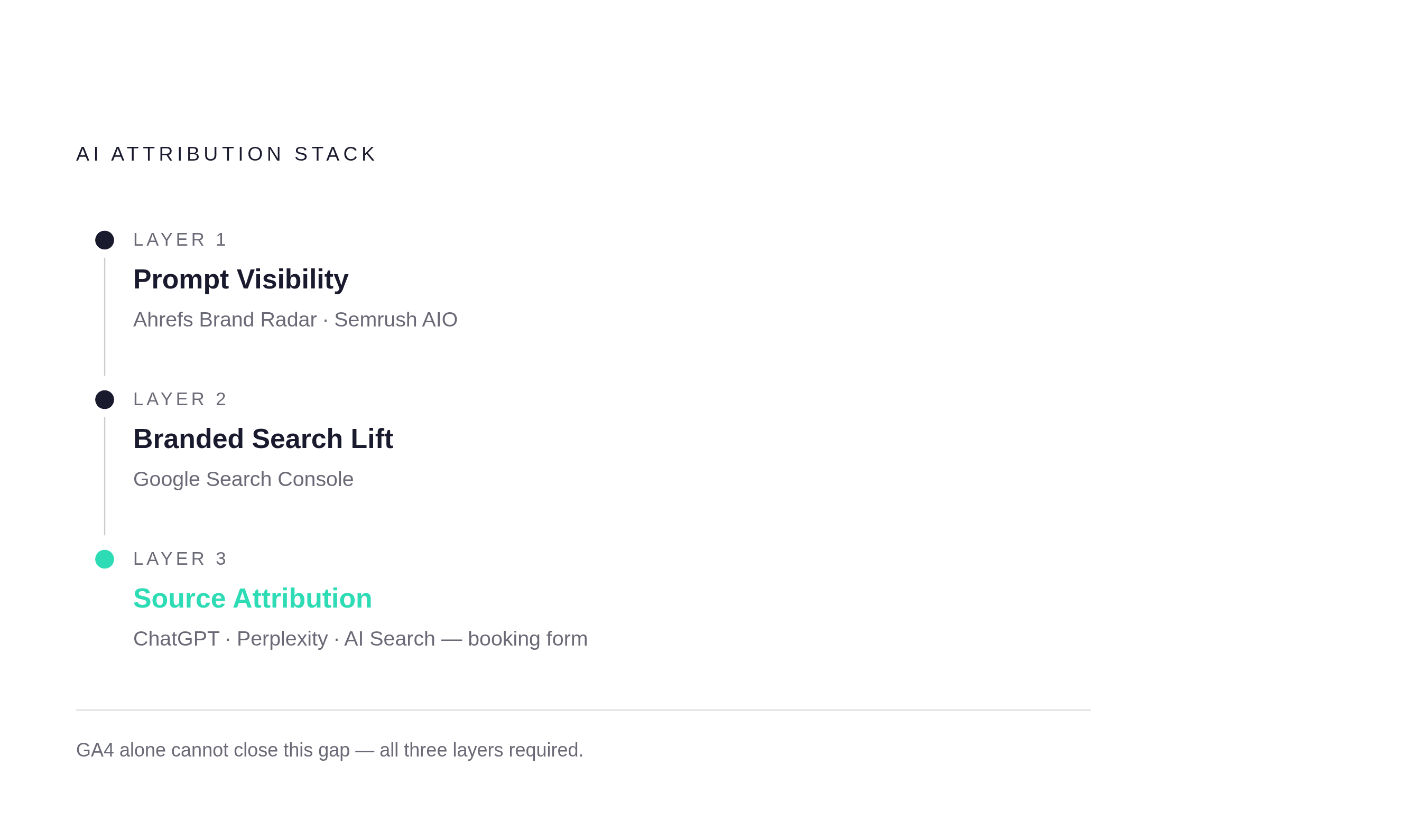
The attribution stack should bring together three views of how the buyer got there. The first is prompt-level visibility across the engines relevant to the ICP, using tools such as Ahrefs Brand Radar or Semrush AIO for monitoring. The second is branded search lift in Google Search Console, which can signal that AI mentions are prompting named-brand lookups. The third is source attribution tied to demos, with “ChatGPT,” “Perplexity” and “AI search” captured as discrete choices in the booking form.
GA4 alone cannot cover that journey. Most LLMs strip referrers, and an AI citation may appear inside a conversation that never sends a click. The buyer can later arrive through a branded search, leaving the initiating mention outside the traffic report. For an independent audit, ask to see the category prompt library, the engines queried, per-engine citation rates over a recent defined period and the sampling method. If the provider cannot produce those records, it cannot substantiate the AI visibility claim in its sales pitch.
The warning signs that indicate a DFY provider will not survive first contact with a technical buyer
A 45-minute vendor call or proposal review should expose the most consequential gaps. Reports that stop at activity measures such as impressions, connection acceptance rates or email open rates cannot show whether the service brings in qualified demos. Selling on MQL volume creates a related incentive problem, because the provider can optimise toward its reported number at the expense of pipeline influence. Commercial accountability that ends with activity measures is a warning sign.
A missing human review gate is a more immediate reason to walk away. AI-assisted content published under the founder’s name without enrichment and citation verification exposes the brand to hallucinated claims and fabricated sources. Ask for the protocol. Treat evasiveness about LinkedIn limits and account restrictions with the same seriousness, because the founder bears that risk. A provider that will not explain the exposure has not given the founder enough information to accept it.
Campaign sequencing offers another test of judgment. A proposal that starts with demo-request ads before building a warm audience pool skips the preparation that conversion campaigns depend on and risks training the platform algorithm against the campaign. Ask why that sequence fits the plan. If the provider cannot explain the choice, the proposal suggests that it either has poor judgment about the channel or cares more about short-term activity numbers. More ad copy will not fix either weakness.
One engine or one prompt run cannot support a broad claim about what buyers see, and missing per-engine citation rates over multiple weeks leave that claim unproven. Content coverage is just as revealing. A service that manages only the owned domain while ignoring G2, Reddit, earned media and category directories leaves the third-party “phantom layer” of AI citation sources unaddressed. The constructive standard is a provider that answers with documented decisions, review protocols and sampled results, so the founder can judge the operation without having to trust the promise.