When a growth service says agents draft and humans approve: what a technical B2B buyer should ask to see before the first weekly call
Five artifacts show whether "humans approve" is a working control.

A growth service’s promise that “agents draft, humans approve” is only as strong as the system behind it. Before the first weekly call, technical B2B buyers should ask for evidence of how decisions, reviews, publication, and measurement work.
Why "agents draft, humans approve" needs to be treated as an engineering claim, not a sales promise
“Humans approve” names an activity but leaves its architecture unspecified. It might mean a named editor rewrites the lede, checks the evidence, and authorizes publication. It might also mean someone clicks Approve on a 1,200-word post in 11 seconds. A weekly summary can make them look the same because it shows that work is done without showing how someone judged it.
Unlike a workflow router, an agent may choose which sources to trust, whether a statistic needs verification, when to cut a section, and when to escalate. Those choices compound as output grows. Brand voice drift, hallucinated specifics, and content that gets published unread are therefore risks that engineers as well as editors must address. The buyer’s task is to establish where the system constrains those decisions and which human answers for them.
What the multi-stage pipeline should actually look like, stage by stage
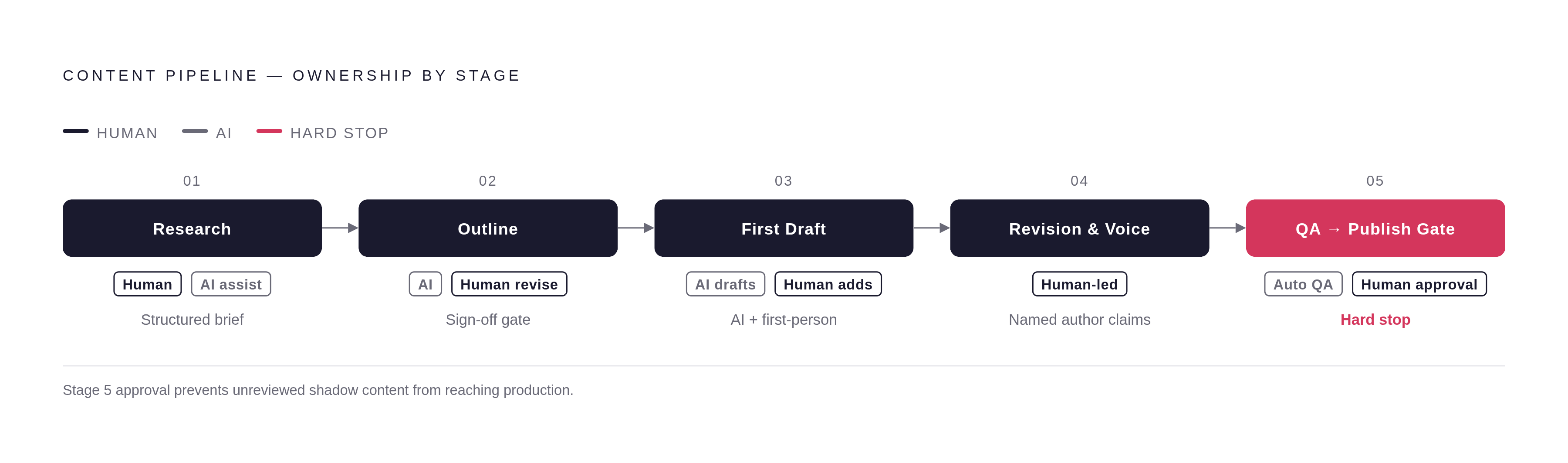
A reference architecture can split the work into five stages, each with its own owner. It is one possible design and a standard to test a vendor against. Research comes first and should be human-led, with AI assisting synthesis. A human selects the topic and angle, while AI turns transcripts, sales call data, competitive content, and internal documents into a structured research brief. The output is a brief that still requires review before publication, because a hallucinated statistic introduced here can poison every downstream stage.
AI generates a structure from the approved brief, and a human editor revises it for operator framing, audience fit, and chapter sequence. Explicit sign-off is the gate to drafting. Without it, the pipeline can produce a piece that is structurally tidy but strategically wrong. Reviewing the outline is therefore a decision about the argument.
The first draft needs a further split between non-Experience and Experience sections. AI can draft definitions, frameworks, comparison tables, and mechanical how-to instructions, but it cannot supply experience it does not have. First-person experience must come from a human. An account of running a B2B SaaS engagement is fabricated unless a human operator wrote or verified it. That boundary protects both reader trust and the piece’s E-E-A-T signal.
Revision and experience injection should then be human-led. The named author adds genuine experience claims, operator specifics, and voice alignment. This is where authorship becomes more than attribution. It also addresses credential drift, in which generated prose adopts a generic expert voice that does not match the actual author. A polished draft is not enough if its authority is borrowed from an invented persona.
The final stage combines automated QA, human editorial review, and a publish gate. PII detection, toxicity scoring, factual consistency checks against source documents, and format validation should catch clear failures before the draft gets to the final reviewer. Human attention then goes to argument quality, accuracy, and audience fit. Publication still requires human approval, even when metadata handling is automated. That hard stop prevents “shadow content,” or unreviewed AI output, from leaking into production through a bypass.
The approval UI and audit trail: what to ask to see, not just to hear about
Approval theater is the central failure mode to probe. Even with an approval layer, reviewers can rubber-stamp work because they have too little time, rely on an agent-written summary, or approve almost everything out of habit. A verbal description cannot establish that the gate works. To test it, the buyer should request a live walkthrough of the approval UI. The reviewer must see the action that will execute and be able to distinguish it from the agent’s account of it.
The screen should be generated from the structured action. It should expose the tool, the target, and the literal arguments being executed, so the reviewer can assess the operation. An immutable log should store the exact action record approved, and the system should execute only that record. Asking where the log lives and who can query it turns “there is an audit trail” into a claim the buyer can examine.
The buyer should be able to see approval rate and review time for each content type, because near-100% approval with very short reviews should raise concern rather than be taken as proof that the drafts are very good. Speed alone says little about editorial care. Approval fatigue is also an architectural problem, and a credible design reduces needless prompts through action classes, policy-permitted automatic approval of safe repeated actions, batching, and sampling low-risk work. These measures should preserve the human publish gate.
The buyer should also request the tiered approval policy in writing. It should spell out which content is low-risk or high-risk, what calls for two-reviewer sign-off, and when a stale review expires so it cannot block the pipeline forever. That policy makes the trade-offs visible. Without it, the service is asking the buyer to trust that reviewers will somehow balance attention, risk, and throughput on their own.
How to read a RACI matrix and a prompt library as proof of pipeline maturity
The approval gate establishes who can authorize an action, but a RACI matrix shows ownership across the whole pipeline. It should identify who is Responsible for executing each stage, whether that is an agent, a human role, or both. It should name the Accountable human who signs off and whose name is on the output. Responsibility and accountability are not interchangeable. The matrix should also identify who is Consulted on escalation and who is Informed when a stage completes or fails.
Each human role must have a person attached. A job title alone cannot supply accountability when a key reviewer leaves or the client’s workload grows. A service operating from tribal knowledge may describe its process fluently while struggling to produce this record. A credible matrix also changes from stage to stage, reflecting the different divisions of labor in research, drafting, revision, and publication.
The prompt library is the second useful artifact. Parameterized templates stored in version control make generation logic testable and allow changes to be compared, reviewed, and rolled back. The buyer should ask whether the library lives in Git or a system that does the same job, and whether someone reviews changes before they go into production. A shared Google Doc or a team member’s personal account is a single point of failure.
Versioned prompts do not, by themselves, create a learning loop. When a reviewer rejects a draft, those notes should feed back into the agent so the next output is better informed. Otherwise, the workflow is just a conveyor belt. Asking how rejection notes enter subsequent work exposes whether human review changes generation or merely cleans up its results.
What GEO and AEO actually require of the content the pipeline produces
For a content growth service in 2026, that output must support discovery through AI-driven answers as well as blue-link rankings. Buyers are delegating top-to-middle-funnel research to agents that build shortlists. Absence from those shortlists can exclude a brand from consideration before its sales team has a chance to help. A sample article should therefore be examined for both fluent prose and the answer surfaces it is meant to serve.
The buyer should look for a structured first-token answer in the first 40–60 words of the page. The service should also show its implementation priorities for FAQPage, HowTo, and Article (BlogPosting) schema, along with quoted, attributed expert sources. These are inspectable features of the output. An llms.txt file at the site root is an optional recommendation across all AI engines. Its presence should not stand in for evidence that the content itself is answer-ready.
That evidence must be specific to the intended engine. ChatGPT and Perplexity are not interchangeable targets, so the service should explain which engines each piece is designed for and how it makes that choice. A generic optimization label is not enough. The buyer should be able to connect the vendor’s stated goal to the sample it supplies, rather than accept that every page serves every engine equally well.
AI-generated prose covers ground models have already absorbed from millions of sources, while original evidence gives a piece something harder to reproduce. Original survey data, proprietary case studies, and opinions from named experts in real conversations give a piece that edge. The buyer’s question is what the sample contributes beyond a competent synthesis. A service producing only AI-drafted prose has not shown how it will earn citations through evidence that other pages lack.
Why the off-site entity graph is part of the pipeline, not a separate workstream
Original evidence on the company’s site is only part of the credibility picture. AI agents also draw on analyst reports, trade publication coverage, and verified review platforms when they judge vendors. Their role extends beyond link equity. They are independent inputs into whether a brand is recommended. An owned-site-only program leaves a structural gap in its GEO strategy.
The buyer should therefore ask for an off-site distribution plan and a third-party citation acquisition workflow, each as its own deliverable. They need different skills and production cadences from blog content, even though they support the same discovery goal. Separate deliverables should not mean disconnected planning. Reddit participation, LinkedIn thought leadership, review platform profiles, and guest posts on industry publications can strengthen the entity signal that helps make on-site content citable. The service should be able to explain how those channels connect to the content it publishes.
When several thin pages compete on one topic, they split authority and make it harder for AI to choose which page to cite. Consolidating them into one strong page addresses a weakness that technical fixes alone cannot resolve. The buyer does not need to become an off-site strategist to test whether the vendor has one. How is the off-site entity graph being built, at what cadence, and how does it connect to the on-site calendar through specific channels, content types, and a named review owner?
How AI visibility should be measured and what a credible weekly call actually shows
The measurement layer must test the discovery outcome that the pipeline promises. Traditional rank trackers cannot show AI citation exposure, so keyword rankings and organic traffic alone leave the central question unanswered. Production counts do not close that gap. The buyer should establish the measurement method before the first call, rather than discover this limitation after work is underway.
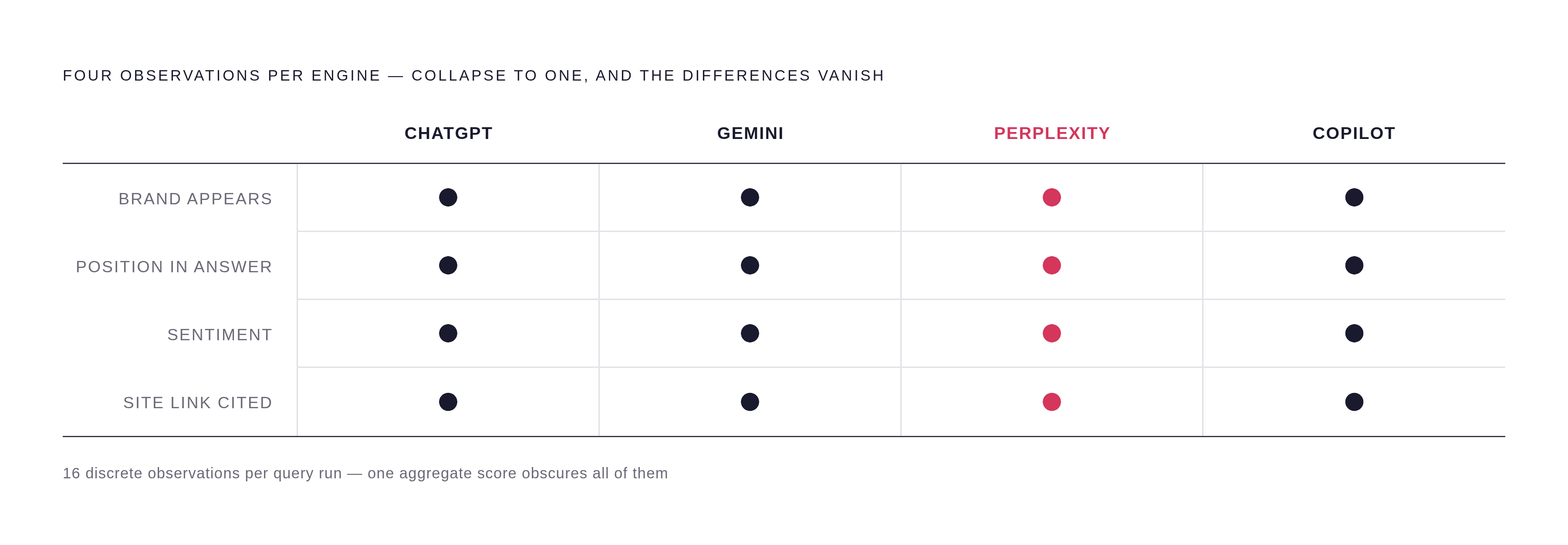
A credible method uses a fixed set of buying-intent prompts run on a schedule against ChatGPT, Gemini, Perplexity, and Copilot. For each answer, it records whether the brand appears, its position, the sentiment of the mention, and whether the answer cites a link to the site. Those observations measure distinct aspects of success. The buyer should be able to see results for each engine because the platforms differ in what they cite. A single aggregate score conceals the differences the buyer needs to judge performance.
Before the first weekly call, the buyer should request a live dashboard with prompt-level data. That view connects the promised outcome to the questions buyers actually ask. Without it, the service can report its own production while leaving the client’s AI visibility unmeasured. A production system should be able to show both how work was approved and whether the resulting content appears where buyers are looking.