Dev marketing for a developer product: what a founder selling to developers should check before handing it to a service, and how to instrument it yourself
Audit discovery and docs first, so any agency gets a measurable spec.

Developer marketing for a developer product starts with a way to measure discovery before looking for an agency. Before handing it off, a founder needs readable docs, a technical discovery audit, and a baseline for search rankings and AI citations. That work turns an open-ended marketing brief into a defensible spec, whether a service executes it or the founder runs the pipeline.
Why developer marketing for a developer product is an engineering problem before it is an agency problem
Consider the founder who signed an agency contract, received reports full of impressions, and still could not tell whether anything improved. What was the engagement supposed to change? Without an activation metric or a discovery baseline, success becomes something to negotiate after the work arrives. The engagement needed a spec.
For a developer product, that spec must connect discovery to a business number such as signup-to-first-API-call or time-to-first-value. It must also account for an audience that reads the code and runs the samples. Technical accuracy is part of the product’s credibility. A generalist can write convincing words without being able to verify them, and no amount of developer relations creates demand for something engineers do not want.
The founder’s first job is therefore to instrument discovery. In practice, that means checking whether machines can read the site, whether the docs answer real technical questions, and whether search engines and AI assistants show information that is correct. Those checks give a future hire something concrete to improve.
What Google rank and AI citation are measuring separately, and why a dev-tool founder needs to track both
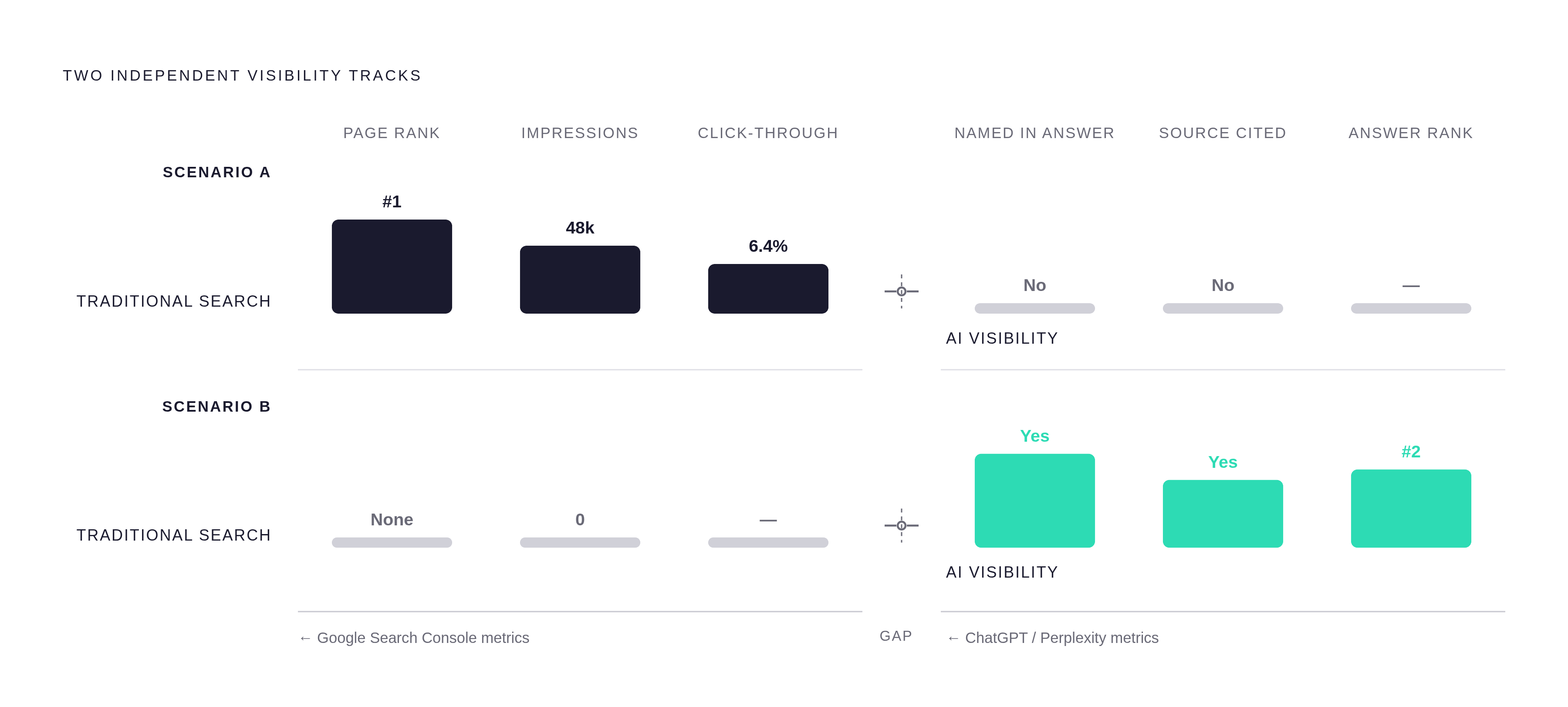
A developer who searches Google takes a different route from one who asks an AI assistant to shortlist tools. Traditional rank measures a page’s position in search results, while impressions record its exposure there. AI visibility concerns whether an answer names the product and cites its content. One does not stand in for the other.
A product can rank first on Google for a query and be absent from the ChatGPT answer to that same query. The reverse can happen too, with a product cited in Perplexity despite having no organic rankings for the category.
For a founder, the consequence is two measurement tracks and two content strategies. Both need to be in the baseline before work with an agency starts. Otherwise, an agency can report progress on the surface it measures while leaving the other unexamined.
The technical infrastructure a founder should audit before any agency sees the site
Start with an afternoon of pass-or-fail checks. Can the relevant bot get in? Some sites introduced blanket bot blocks in 2023 and never revisited them. Inspect robots.txt for rules affecting GPTBot, OAI-SearchBot, PerplexityBot, ClaudeBot, and Claude-SearchBot, while distinguishing their roles. ClaudeBot controls training data, and Google-Extended is a robots.txt control token.
Next, check what the crawler can actually read. Client-side-only rendering may leave it facing an empty shell, so server-side rendering is a prerequisite check. Structured data and schema need to be checked in the same audit. Pricing in a table is more reliably citable than pricing buried in paragraphs, while numbered steps and code blocks give machines consistently parseable content.
The product’s name, description, founding year, and services should match exactly across the website, LinkedIn, and industry directories, because drift gives AI systems conflicting facts. Add llms.txt as supporting infrastructure for coding assistants such as Cursor and Claude Code, alongside readable pages, structured data, and answer-first content. Recency needs an explicit signal as well. Clear version labels and deprecation notices on every page help counter older documentation’s greater prevalence in training data and its tendency to remain semantically relevant even after it becomes obsolete.
What the documentation layer needs to do for AI citation specifically
Once a crawler can reach the site, what answer does it find? For a developer tool, the docs are the primary citation asset, yet pages designed for a person skimming may not provide a direct answer an assistant can extract. A grounding page gives the documentation a fixed point of reference. It should define the product, the problem it solves, what it is not, and how it compares with named alternatives.
Error-message coverage makes this requirement concrete. A developer pastes an error or stack trace into ChatGPT or Perplexity, looking for help. A canonical docs page that answers that specific error gives the assistant a reason to surface the tool. That is a documentation job before it is a marketing job. Auditing which errors have answers exposes a tractable gap before an agency touches the site.
Commercial questions need equally useful documentation. Comparison content earns citations when people make commercial queries, while migration guides reach developers who are already thinking of switching. Freshness is also a measurable citation signal, with updated content receiving more citations than stale material. The docs cannot be a one-time publication. README quality and presence in curated GitHub “Awesome” lists extend this work into docs-adjacent assets that assistants use when evaluating tools.
How off-domain presence multiplies citation probability without replacing the canonical source
A strong canonical source gives distribution something reliable to amplify. A post kept on the brand’s domain gives one chance for a citation, while correctly syndicated copies on Dev.to, Hashnode, and Medium give it chances to be cited across multiple domains. Each copy should point back to the canonical URL. When canonical tags are set correctly, the original gets credit as the source, and republishing makes it more likely that a crawl will find the content.
Distribution is not limited to republishing posts. Comparison pages, directory profiles, G2 reviews, guest contributions, and original quotes in analyst or journalist pieces all expand the surfaces where a product can appear. A link is not the only useful signal. Unlinked brand mentions on authoritative domains also contribute citation weight, which makes the accuracy of those descriptions worth auditing.
The founder’s practical task is to map where the product is named, where it should be named, and whether each description matches the main site’s entity definition. That map can reveal citation drift as well as missing coverage. Proprietary benchmarks, survey findings, and original measurements have some of the highest citation rates across AI engines, so a real product benchmark gives an agency something to share without having to make up a claim.
How to measure whether AI assistants are actually naming and citing the product
Before an agency engagement begins, run the category queries a developer would use to shortlist tools through ChatGPT, Claude, Gemini, and Perplexity. Record whether the product appears, where it appears in the answer, and how it is described. Keep track of citations as well as mentions.
From that baseline, track share of voice in AI answers rather than treating “AI presence” as a general impression. But frequency alone is not enough. An answer that names the product while getting its pricing, capabilities, or positioning wrong is a flagged measurement event. The same record should track how good the citations are and how often they appear.
The measurement cadence should follow the publishing cadence. Post-publish checkpoints can track AI citations together with rank and impressions, showing which content is being picked up and which is not. Old pricing, deprecated features, or a previous product name should lead back to a check of the docs and the entity-consistency audit. A founder who can show the current citation baseline and define a better one has converted a vague brief into a testable spec.
What to verify about an agency's technical credibility before the first call
With that spec in hand, agency evaluation becomes a question of who can execute it. The daily.dev agency list is a starting point. The decisive evidence concerns technical credibility. Who writes the content, and who checks it?
Ask for names and backgrounds, along with a sample containing code that can actually be run. Establish whether an engineer writes or reviews the work, rather than a generalist paraphrasing documentation they do not fully understand. Then ask for results tied to a named client, including signups, activations, GitHub stars, or SDK installs. Impressions-only case studies leave the product outcome unresolved. No engineers on the team and no way to verify technical claims is a disqualifying gap.
A proposed launch offers another useful test. A credible answer names venues such as Hacker News, Reddit, Dev.to, Stack Overflow, and developer newsletters, explains the sequence, and distinguishes what cannot be bought. Finally, ask how it measures AI share of voice. An answer about impressions and CTR does not address the discovery surface in the spec.
What the contract must protect before the engagement starts
AI-assisted work raises questions that an older agency contract may not cover. The agreement should state which work involves AI tools and which a person completes from start to finish. It should name the person who checks AI-assisted output before it is delivered or published, and say whether customer data, brand files, or unpublished plans go into third-party AI tools. Ownership needs an explicit answer too. The contract must establish who owns the finished work when AI helped produce it.
That protection should extend to everything created under the engagement, including source code, designs, documentation, credentials, domains, and third-party accounts. These must be the client’s property, with ownership and exit rights secured before work starts. Keeping work in accounts the agency owns creates lock-in. A paid discovery phase before full commitment can also expose communication style, technical fit, and process before the relationship becomes harder to unwind.
Get the deliverables, formats, and schedule in writing. “Full-service developer marketing” is a vague description of the service. The contract should also define the response to underperformance, including who reviews the account, what changes, and whether leadership steps in. Technical instrumentation, credible reviewers, and protected ownership together produce the real deliverable of this preparation. The founder has shipped a defensible spec.
How to run the content pipeline yourself when the agency is not ready or the budget is not there
The same spec can guide an internal pipeline when an agency is premature or unaffordable. Its durable structure is a set of coordinated stages for research, drafting, editorial review, and publishing, with the CMS as the source of truth. Human review belongs at every meaningful boundary. The founder should control which actions require approval and which may run unsupervised, rather than treating “set and forget” autonomy as a productivity goal.
Work still has to pass technical review before it is published. Grounding features that draw on internal data that has been checked lower the risk of hallucination but cannot rule it out. A person still needs to check every factual claim, pricing detail, and code sample. This is the same standard an agency would have to meet.
After publication, track rank, impressions, and AI citations per article, then feed underperformance back into the brief pipeline. Those findings can lead to changes in brand voice, additions to the entity dictionary, or freshness triggers, so later work can build on what was learned from earlier work. Portability deserves attention as well. Every capability should be accessible both to an agent through an API and to a person through a UI, so the pipeline can work with a later vendor or in-house stack. When handoff becomes worthwhile, the agency receives a working proof of concept and its measurement baseline, rather than an invitation to define success after the fact.