What developer tool documentation actually signals about your marketing stack
Docs are your first sales surface with developers, not just a support cost.

Developer tool documentation reveals what a marketing stack is built to understand. Its structure, publishing process, and measurement show whether a team can see how developers actually evaluate a product. Docs are a growth channel. Owning that channel means owning the answers buyers find, the sources AI systems cite, and the signals that connect evaluation to conversion.
Why documentation is the actual sales surface for developer tools
Most teams staff and budget documentation as an engineering cost center, even though it often hosts the first commercial conversation. Can the reference answer a precise question? Is the source code clear, and does the path to a useful result make sense? Those questions test the product more directly than a sales deck can.
Developers judge tools by how good the documentation is, how clear the source code is, and how quickly they get value from them, as well as by brand materials. That makes docs the deciding layer before a sale. A team that budgets only for explaining features risks overlooking the commercial work those explanations already do.
What documentation engagement reveals about a marketing stack's blind spots
A stack built around form fills, email clicks, and ad impressions assumes that a buyer leaves a trail marketing can see. Developers often find their way through private Slack groups, Discord servers, and word-of-mouth instead. Much of that discovery is invisible to standard attribution. Familiar marketing metrics are useful for describing a different journey from the one the team needs to understand.
What happens when a developer arrives after a private recommendation, reads the reference, and decides against the product? A team that relies on marketing-qualified leads may never see that the developer weighed up the product. When a lead does appear, the stack may be measuring only the back half of a decision already shaped in the docs, on GitHub, or in a Slack thread. This is a structural blind spot. It puts what marketing can count on one side and what helps explain a purchase on the other.
A page count cannot distinguish basic setup from a deeper investigation of how the product works. Documentation depth offers a stronger leading signal because developers who move beyond setup, or visit multiple unique documentation pages in a first session, are more likely to convert. The evidence comes from path depth, code-snippet copy events, internal search queries, and the order in which pages are visited. A standard Google Analytics setup needs instrumentation built for this to show the whole picture.
The six surfaces where developers actually make their evaluation decisions
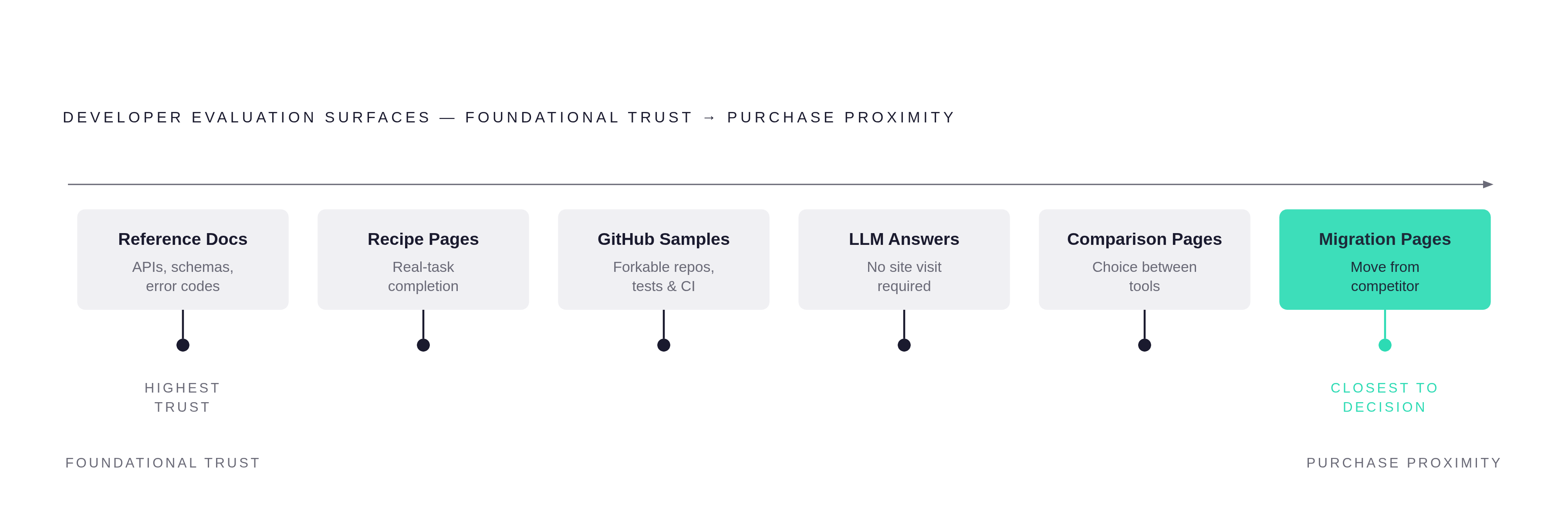
The territory extends beyond the blog and homepage. Its six surfaces are reference docs, recipe pages, LLM answers, GitHub code samples, comparison pages, and migration pages. Each serves a different part of the evaluation, so coverage across them is more useful as a strategic unit than the number of pages published. A large archive on one surface cannot answer every kind of buyer question.
Reference docs are the highest-trust part of this map. API references, schemas, error codes, and rate-limit pages give developers the exact details they check before they trust a product. Recipe pages sit next to that reference layer but answer a different question, namely how to complete a real task. What people ask in support tickets and internal search queries should take priority over keyword research as sources for their topics. The distinction is between describing what exists and showing how to use it.
GitHub samples connect those explanations to usable code. Real repositories with tests and CI give engineers something they can fork and ship from, while links from doc snippets to sample files keep the explanation connected to its implementation. LLM answers form another evaluation surface when an engineer asks ChatGPT, Claude, or a code assistant how to do a job. The answer may introduce the product without bringing the engineer to its website first.
Comparison and migration pages help buyers who already have a competitor in mind. Comparison pages support the choice between tools, while migration pages address the move from one to another. Both sit close to a decision. The measurement implication is broader than assigning more pages to marketing. Instrumentation needs to follow evaluation across all six surfaces, rather than stopping at the boundaries of the pages the marketing team already owns.
How doc architecture now determines whether AI answer engines cite your brand
Search rank and AI citation are separate channels. Generative engine optimization, or GEO, concerns how content is structured so platforms such as ChatGPT, Google Gemini, and Perplexity can cite it in generated answers. Traditional SEO concerns visibility in search results. Content built for one does not automatically succeed in the other, even when both channels serve a similar buyer question.
The overlap is narrower than a search dashboard might suggest. Only 17–38% of AI-cited pages also rank in the organic top ten for their keywords. A large majority of brands have no mentions in AI search results at all. That gap makes a practical question unavoidable. If a brand ranks for a topic but is absent from the answer a developer receives, how much of the evaluation is its search report actually showing?
Engine differences complicate the picture further, because ChatGPT, Google AI Overviews, and Google AI Mode disagree on brand recommendations in a majority of cases across the same queries. Success on one is not evidence of success on another. For developer tools, Claude citations skew toward brand sites structured like documentation, including reference-grade product, comparison, and “how it works” pages. Reddit has essentially no weight in Claude citations. A surface that contributes to one strategy cannot simply be assumed to work across every engine.
Clear reference should guide the architecture. AI systems synthesize from docs, blog articles, forum threads, review sites, and structured data files, which makes the relationship between those sources part of the architecture. Entity consistency is essential within that network. The brand name, description, and product details need to match exactly across the website, LinkedIn, industry directories, and structured data sources. When descriptions disagree, an LLM has conflicting accounts to draw on as it works out what the product is and how to explain it.
Why the off-site content layer — the phantom-site layer — determines AI citation outcomes
A well-structured domain is only part of that network. Major LLMs draw on trusted domains to ground their answers, and a large majority of AI citations come from earned media, with brand-owned pages and paid placements accounting for a smaller share. Better docs alone cannot bring the independent coverage that a website-only strategy lacks.
The phantom-site layer gives that off-site work a deliberate shape. It places a brand’s claims, comparisons, and reference material across third-party editorial coverage, developer community threads, structured data registries, and adjacent technical publications. It is a publishing strategy for the sources AI systems already draw from, running in parallel with the primary documentation site. The aim is genuine presence in relevant sources.
For teams building this layer, the task begins with identifying which publications in their vertical the engines treat as authoritative and earning genuine mentions there. Recognition also depends on structured sources. A missing Wikidata entry can significantly reduce entity recognition across major LLMs, which draw on Wikidata, Wikipedia, schema markup, and consistent third-party coverage. That makes accurate identification a separate concern from persuasive copy. The off-site layer needs its own surface map, publishing cadence, and measurement rather than being treated as a PR campaign with a new label.
How to build the content pipeline that produces doc-grade output at scale without quality collapse
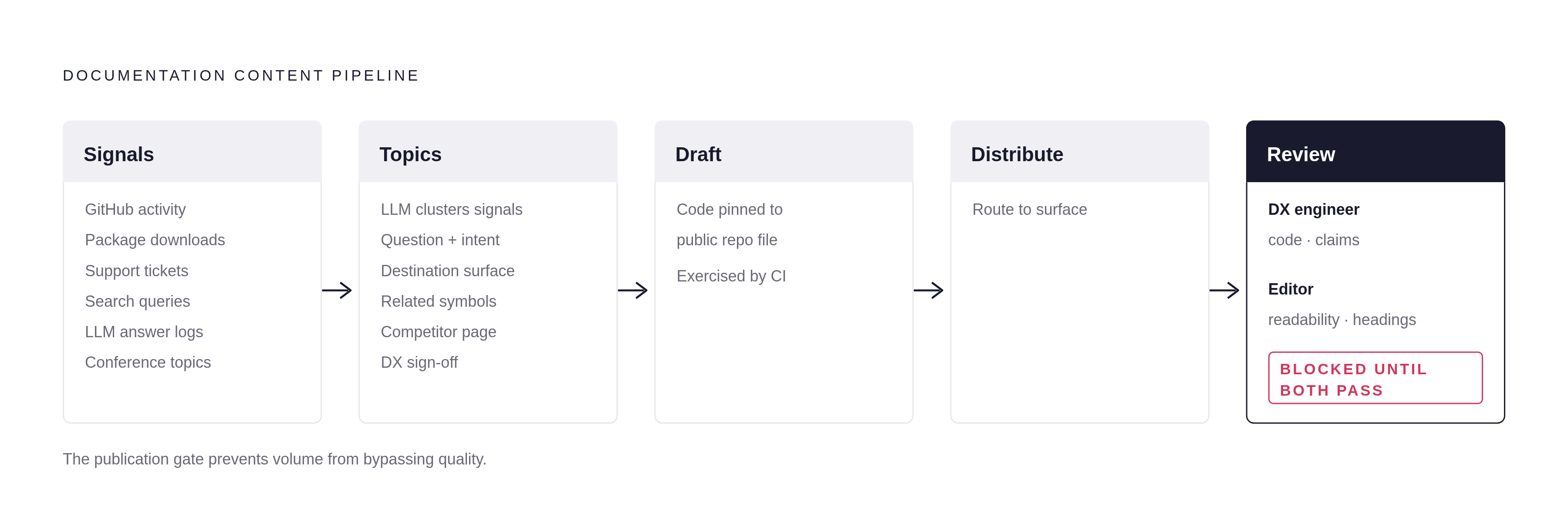
How can a team increase output without filling the map with explanations that engineers cannot trust? A staged pipeline offers a way to pursue speed and quality together by making the inputs, handoffs, and checks explicit. Its five stages are signals, topics, draft, distribute, and review. The topic decision and the developer experience review are where the process earns much of its trust, because they establish whether the question deserves an answer and whether the answer works.
The signals layer gives the pipeline a memory of real questions. Its inputs include GitHub activity, package registry downloads, support tickets, docs search queries, LLM answer logs from support tools, and conference talk topics. Without those inputs, topic selection can default to whatever a keyword tool presents as trending. An LLM can cluster the signals into a topic map, but each topic needs more than a title. It needs the actual question, intent, destination surface, related symbols and error codes, and the closest existing competitor page, followed by a DX engineer’s sign-off before drafting.
Every code block should point to a real file in a public repository, be pinned to a version, and be exercised by CI. Untested snippets turn a technical explanation into a marketing artifact at precisely the point where the reader expects proof. The publication gate then requires two different kinds of judgment. A DX or platform engineer checks code, claims, and footguns, while an editor checks readability, headings, and example flow. Public publishing stays blocked until both pass.
Those checks need a reliable handoff between stages. Strapi’s Inki multi-agent documentation pipeline uses a document format that stays the same and that humans and AI can both read, so it can hold a work order, a reviewer’s reasons, and an agent’s input. That shared format lets a human take over at any stage and still know the context of the task. The architecture gives review and rewriting a defined place, preventing volume from bypassing them and producing the low-attribution, low-specificity content that weakens trust on AI citation surfaces.
What to measure — and how — to know whether your docs are actually earning AI citation
A publishing pipeline is not yet a measurement system. Only a small minority of marketers track AI citations, despite a large share calling AI visibility a core strategy. Without that tracking, teams cannot tell whether their documentation and off-site work are visible on the answer surface. Rank tracking cannot answer the question on its own. The channel needs a repeatable test of the questions buyers actually ask.
The practical standard is a fixed set of 15–50 buying-intent prompts, run on a schedule against ChatGPT, Copilot, Gemini, and Perplexity. Each run should log mention rate, citation rate, sentiment, recommendation position, and share of voice. These describe different outcomes, from appearing in an answer to being cited as its source. Using the same prompt set makes it easier to understand what has changed. Testing multiple engines avoids mistaking one platform’s response for a view of the whole channel.
A single snapshot is not a dependable baseline. In active categories, a large share of cited domains shifts monthly, so citation drift can change the picture between tests. Traffic still deserves attention, but it is not the only payoff. AI citation click-through rates used to be low, but recent 2026 data shows that rates for top citation positions can exceed organic click-through rates.
GEO is therefore better understood as a brand management discipline than as a performance channel alone. Its goal is presence in the answer when a buyer asks a question the brand should be able to answer. For documentation teams, that outward view needs to sit beside measures of depth, including path depth per session, snippet copies, internal search queries, and page sequence. Together, they connect visibility with evaluation before CRM data arrives. Docs were already the sales surface, and treating them as a measurement surface makes that channel something a team can own.