The content marketing stack, not the content marketing checklist
Connect production, discovery, and measurement into a working feedback loop.

Content marketing for technical founders and developer-marketing teams is a systems problem. A useful content marketing stack connects production, discovery, and measurement so that each layer improves the next. The difference from a checklist is not how many activities it includes, but whether those activities form a working feedback loop.
Why a checklist and a stack are different objects
A 101-tip content marketing checklist can cover the work in full, group it with care, and be easy to use. It can cover strategy, planning, production, distribution, and measurement without leaving an obvious gap. That is the strength of the format. Someone looking for a forgotten task can find it, and someone starting out can see the range of work involved. But even a thorough list cannot show how those activities depend on one another.
A checklist answers “What do I do next?” through a finite set of tasks, while a stack answers “How does this component connect to the next?” through defined relationships. Completing a checklist means reaching its end. Running a stack means keeping a system in operation, with outputs that can be measured and used as inputs elsewhere. The same activities may appear in both, but they are organized around different questions.
A checklist can record that production and measurement both happened, but it cannot represent how unreliable production weakens the meaning of the measurement. That requires a model of the dependency. Technical teams already use this distinction when they build products as instrumented infrastructure. Applied to content, the stack model offers composability, observability, and compounding, which come from connections.
Why tool accumulation is not the same problem as missing a stack
Most content teams already have too many tools and too little integration, so another product can expand the toolkit without making the work more coherent. A bloated toolkit is the software version of the long checklist. It has tools for each kind of work, but that alone says nothing about whether the parts work together. The team needs an architecture.
That distinction changes how modernization is judged. In 2026, time to launch, confidence in the data, and measurable lift are the tests of a marketing tech stack. A capability has value within that system only when its role is clear. What does it accept, what does it produce, and which component depends on that output? Without those answers, a team can know what every tool does and still have no process it can count on.
The architectural alternative is fewer integrated layers, each with a clear job, a defined output, and a way to measure its performance. “Which tools should be added?” becomes “What primitives belong together, and what does each owe the next layer?” This is a question of design before procurement. For content marketing, three layers make the relationship concrete, namely a gated production pipeline, a citation architecture for discovery, and a measurement layer that feeds results back into production. Their boundaries show what each layer does and where its job ends.
Layer one: the production pipeline as a gated workflow, not a drafting step
AI-assisted drafting is one activity inside a much larger workflow. That workflow includes the brief, research, drafting, verification, editorial review, compliance, publication, and post-publication monitoring. Each stage has a distinct purpose. Treating the chain as “generate and post” removes the control points that distinguish a usable draft from publishable work. The resulting “AI slop” is therefore not simply evidence of a weak model, but of a process that lets unreviewed work advance.
A pipeline without gates is a script with no error handling, because nothing defines when the work must stop or return for correction. A content pipeline instead has discrete states, permissions, and recovery paths. Its design determines who can advance the work and what must be true before that happens. Drafting speed cannot substitute for those rules.
Four gates give that design its substance. The factual gate requires every claim to be verified, labelled, or removed before the draft advances. The editorial gate checks voice, structure, clarity, and audience fit against the brief, while the risk and compliance gate checks legal, regulatory, brand, and policy constraints. High-tier content does not bypass that review. Finally, the publication gate establishes that the final artifact is the reviewed version, with the correct metadata, links, and destination.
Human review also has a regulatory role. The EU AI Act’s transparency rules, which apply from 2 August 2026, have an exemption for AI-generated or manipulated text published to inform the public on matters of public interest if it has been through substantive human review or editorial control and a natural or legal person has editorial responsibility. The regulator’s finalised guidelines make clear that spell-checking or cursory sign-off does not suffice. The requirement makes substantive editorial control important specifically when relying on that exemption.
Does every piece need the same degree of intervention? The gate model allows different levels of review without erasing the distinction between drafting and approval. Most of the work on routine content can be automated with light human review, while thought leadership and original research need humans to set the strategy and AI to carry it out. Sensitive topics require expert review throughout. Agentic systems can monitor competitors, identify gaps, research topics, and surface finished drafts for approval, but moving the human away from drafting does not turn approval into rubber-stamping.
Internal data identifies cadence and review discipline, rather than AI sophistication, as the variable separating compounding content programs from those that stall. That shifts attention from the model to the workflow. The output is not merely more text, but published content with a known quality floor. The next layer needs that predictability because discovery depends on having reliable material to work with.
Layer two: structuring content so AI answer engines can cite it
Reliable publication does not automatically produce AI visibility. Search engine optimization aims to bring traffic to a website through rankings, while generative engine optimization aims to get a brand into AI-generated answers. Those answers can reach people before any click. Only a minority of AI-cited pages also rank in the organic top ten, so search ranking and AI visibility are not interchangeable signals. This makes citation architecture a distinct job, rather than another name for SEO or paid distribution.
The architecture has two complementary parts. Owned grounding content gives retrieval systems clear material to extract through answer-first structure, clear headings, concise opening paragraphs, and explicit factual claims. Off-site citation seeding aims to get mentions in third-party publications that have authority in a field and that AI systems trust as sources. A link is not always the decisive feature. An unlinked mention on a Tier 1 site can be more valuable for citation than a link on a low-authority blog.
These parts need a consistent account of the entity they describe. A brand’s name, description, founding, and services need to match across its website, LinkedIn, industry directories, and, where applicable, Wikipedia and Wikidata. Developer-marketers can recognize this as a data normalization problem. If the records disagree, a model cannot reliably identify and cite the brand, and cross-source drift becomes material for hallucination.
Major AI engines cite very different sources, and only a small share of the domains they cite are the same across engines. One platform cannot stand in for all the others. A strategy built around a single engine can miss large parts of the citation landscape, even when the underlying content is strong. The discovery layer thus needs an entity footprint across platforms, with more than one route to visibility.
Could schema markup solve the problem more simply? It can make content easier for machines to parse, but its direct effect on AI citations remains unproven. Parsing is not the same as being selected. The stronger architectural claim is that owned content, third-party mentions, and consistent entity records reinforce one another across platforms. This layer establishes intentional content positions across owned and third-party surfaces, from which citations and mentions become the raw material for measurement.
Layer three: measuring AI answer-engine presence as a first-class signal
A production pipeline and a citation architecture without measurement form a system with no observability. Most teams still lack systematic instrumentation for this layer, relying instead on sporadic manual checks. Those checks cannot close the feedback loop. The relevant engineering analogy is monitoring and alerting infrastructure, because the purpose is to expose changes that can guide the next round of work. Measurement acts as the stack’s control plane.
The first distinction is between a brand mention and a source citation. A mention occurs when an AI explicitly names the brand, while a citation visibly attributes a page as a source. The two can coexist in one answer. But counting them as the same event hides whether the brand is being discussed, its content is being used as evidence, or both. A useful monitoring methodology preserves that distinction rather than flattening presence into a single undifferentiated count.
Platform behavior also affects how results can be interpreted. ChatGPT’s base model has a training data knowledge cutoff, but its built-in web search can find content from after that cutoff on its own. If a brand had little web presence before the cutoff, that may still limit whether it appears, however good its current content is. Gemini, by contrast, is integrated with Google’s live index, making SEO performance a meaningful driver of its visibility. These differences mean that presence on one platform is not a reliable proxy for presence on another.
Without this layer, the team cannot tell whether production or citation architecture is working. With systematic monitoring, the team can use gains and losses in citation share to shape the brief. That tighter brief can then guide reviewed content toward gaps in the citation architecture. The loop, rather than the report itself, is what allows the program to compound.
How the three layers connect and why the connections are the point
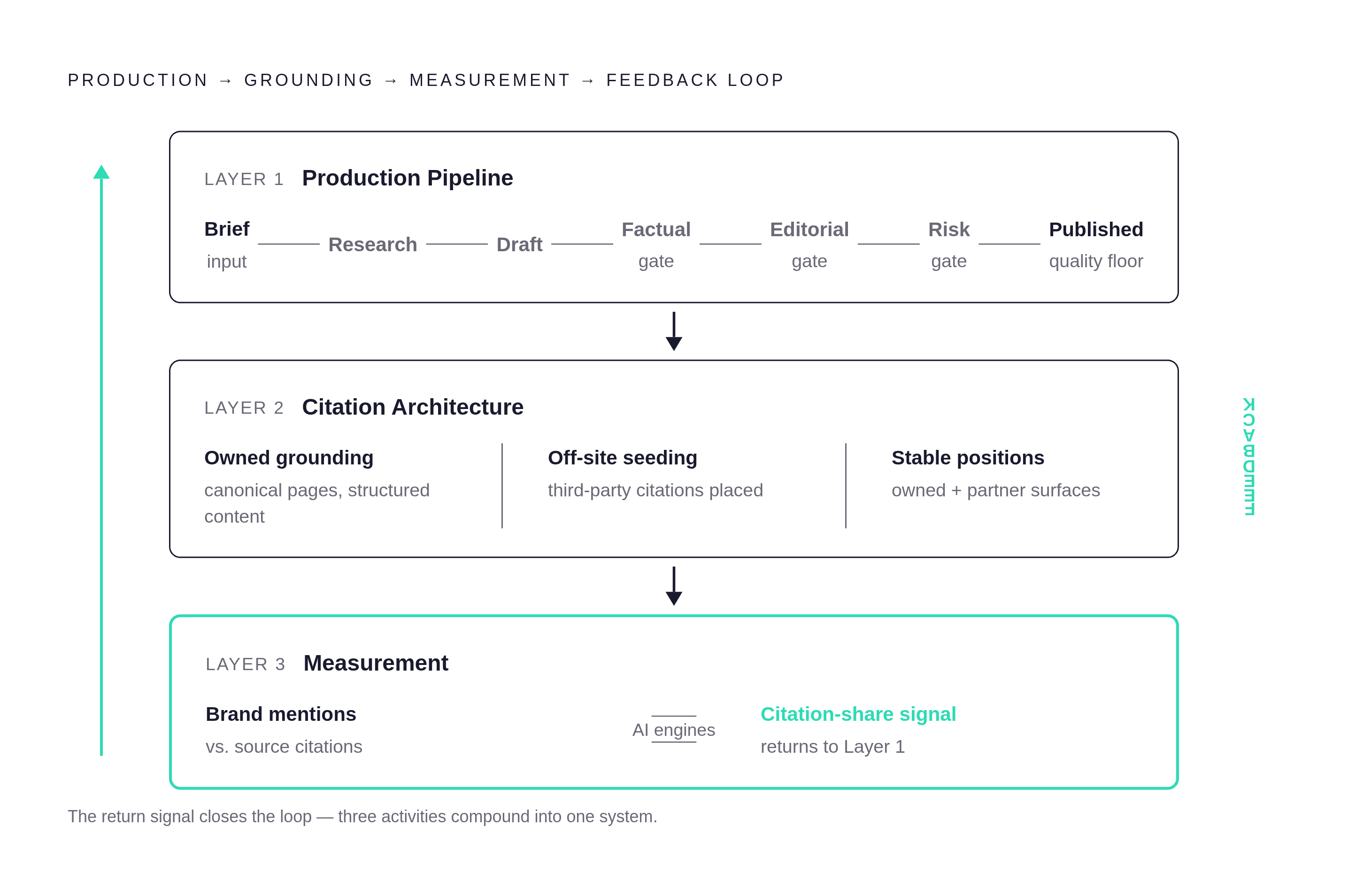
Production gives citation architecture reviewed content with a known quality floor that it can count on. Discovery establishes stable, intentional positions across owned and third-party surfaces so that measurement can track change meaningfully. Measurement then returns a signal about gains and losses in citation share to production.
A checklist can document every one of those activities. What it cannot encode is the dependency that makes inconsistent production weaken measurement, or makes citation architecture operate blindly when monitoring is absent. Small primitives, defined interfaces, observable outputs, and continuous operation describe the same kind of infrastructure they build into products.
Within that architecture, the next task follows from the signal. Measurement shows a gap, production fills it, and citation architecture gives the new content a route to discovery. Tips can still help with individual activities, but they no longer have to organize the whole program. A stack that runs continuously, measures its outputs, and feeds the signal back into production is an asset that grows. A checklist completed is a task to repeat.