Keyword Gap Analysis Is a Legacy Frame: What Computational Marketing Replaces It With
AI answer engines now reward citation share over keyword rankings as the primary visibility signal.
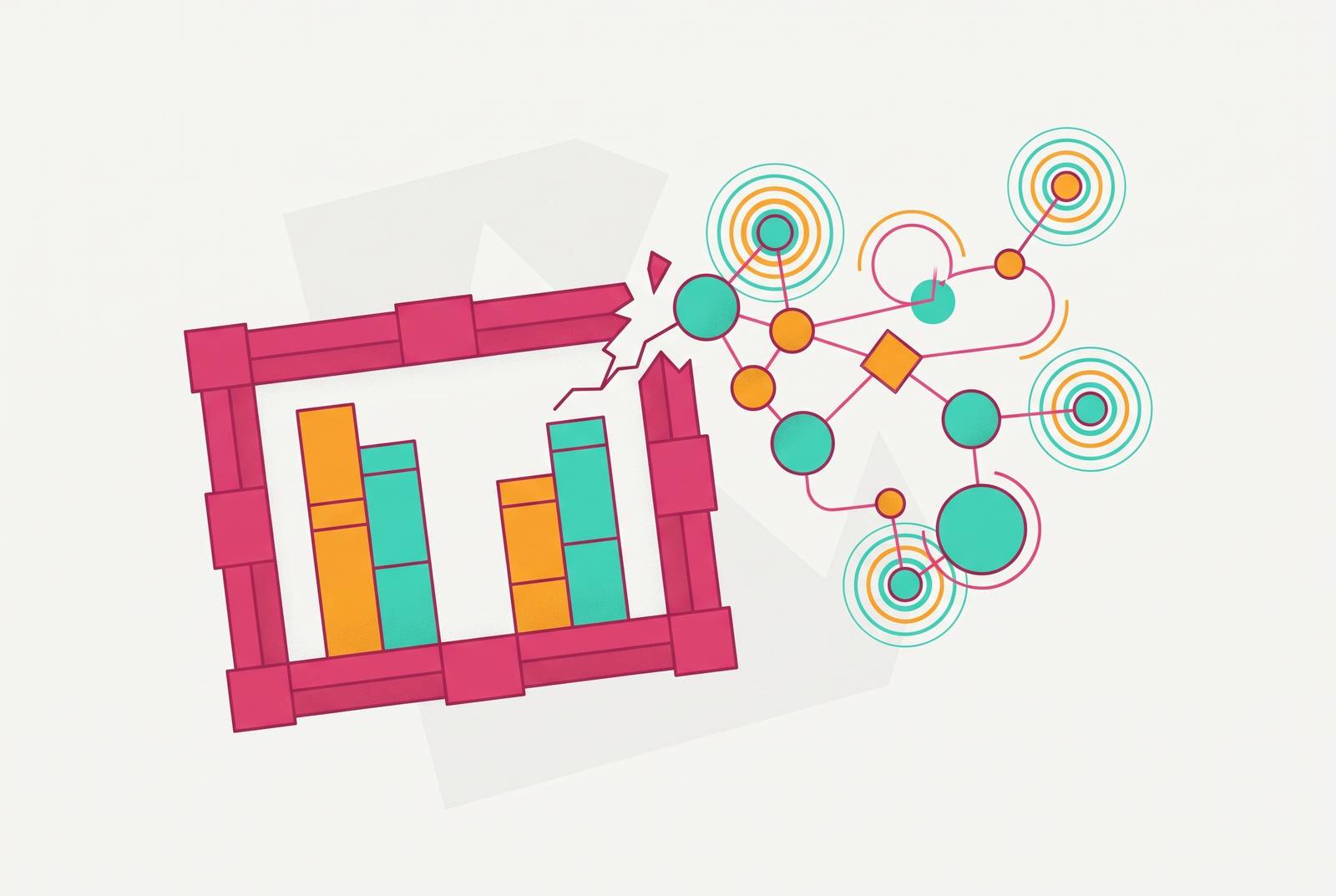
Keyword gap analysis measures where a site is missing from search results. Computational marketing asks whether a brand appears in the answers people get. As AI engines synthesize information instead of simply pointing to pages, citation share becomes the primary signal to improve through a continuous loop of measurement, content work, and verification. Keyword research remains useful, but it no longer supplies the whole strategy.
Why keyword gap analysis was a reasonable proxy — and what made it break
Keyword gap analysis had a sound relationship to discovery. When ranked blue links were the main way people searched, finding queries that competitors ranked for showed where a team could reach readers. A team could publish content, improve its position, and measure the clicks that followed. The proxy was useful because the steps connected. Domain comparisons and traffic-potential scores were built to inventory that ranked landscape, and they remain good at that job.
The connection weakens when an answer replaces the click. AI Overviews now appear in a large share of searches, and when they appear, clicks to the top organic result drop by roughly 58%. Closing a keyword gap can now bring far less traffic than the same opportunity would have two years ago. At the same time, discovery is spreading across engines that synthesize information. These changes compound each other. Even a first-place page can miss out on the visit while the answer engine cites a fact from another source.
What AI answer engines actually do when they choose a source — and why ranking is not the selection criterion
Answer engines take passages from sources, put the information together, and add citations to the answer. That creates a different selection problem from ordering whole pages. A passage needs to be extractable and supported. Only a small share of Google AI Overview-cited pages also appear in Google's top organic results.
The engines also differ from one another. ChatGPT's base model draws on training data with a knowledge cutoff, so a thin pre-cutoff web presence can limit brand recognition regardless of current rankings. That constraint is specific to the base model. Perplexity's Help Center states that it sources web content in real time and includes numbered citations linking to original sources. Those links make its answers directly trackable for referral attribution.
But Gemini uses Google's index, so doesn't SEO still count? Yes, as an input to that engine. It does not become a universal measure of visibility across platforms with different retrieval behavior. Across those surfaces, useful source properties include standalone answer sections, structured comparisons, named sources, and original data or perspective. These properties help an engine extract and ground a claim, which is a different task from assigning a page its search position.
Citation gap as the right unit of analysis — what it measures that keyword gap cannot
A citation gap exists when a competitor appears in an AI-synthesized answer to a relevant query and the brand does not. Keyword gap analysis asks which queries competitors rank for that the brand misses. Citation gap analysis asks whose information or brand makes it into the answer. A brand could rank first without being cited, while a page on page three could supply an extractable passage that appears consistently.
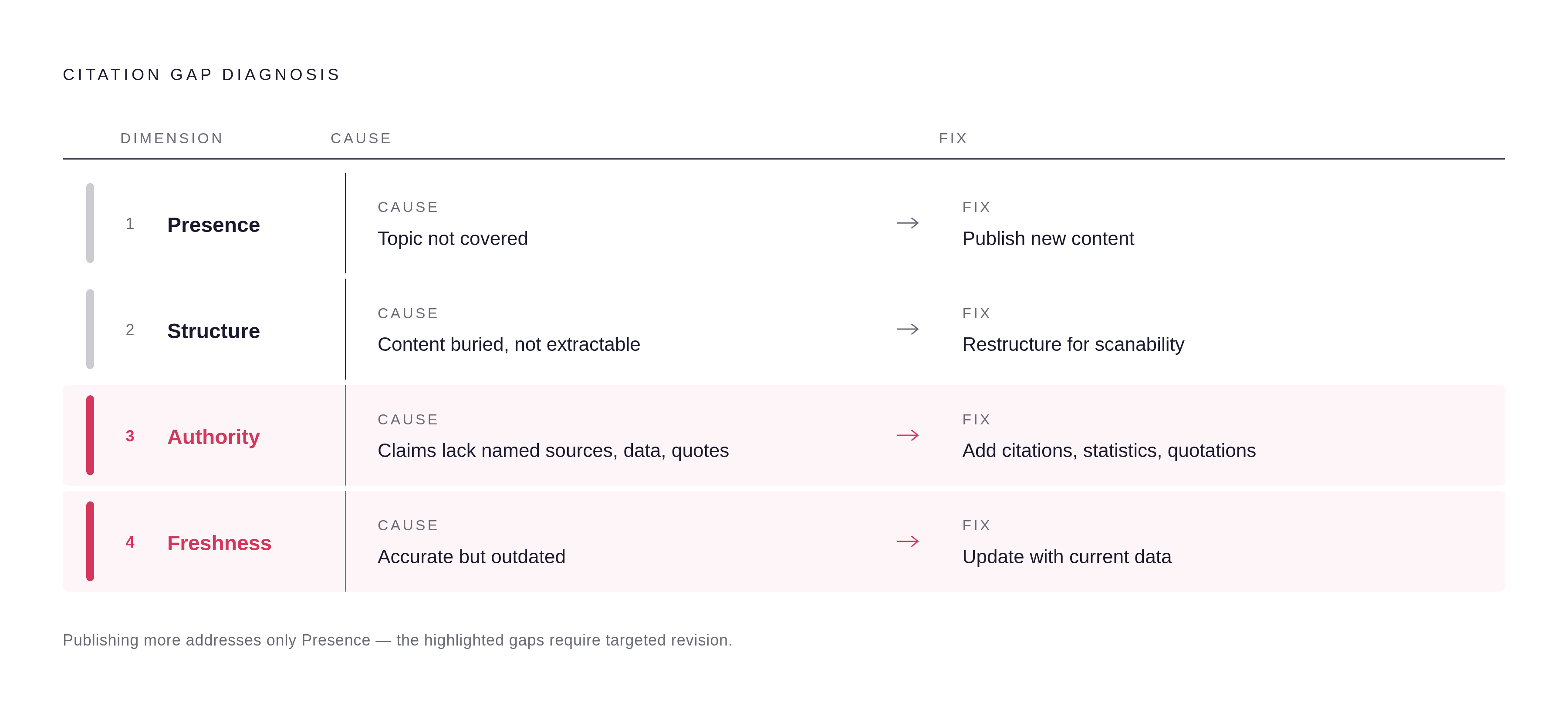
The diagnosis has four dimensions, beginning with presence. A presence gap concerns missing relevant content or coverage that could support inclusion. A structure gap means the content exists but is not arranged for extraction into a standalone answer. An authority gap means its claims lack corroboration through named sources, statistics, or quotations. A freshness gap means the information is accurate but dated, making an ongoing publishing cadence more useful than a one-time rewrite.
These distinctions keep the diagnosis from collapsing into “publish more.” More pages will not necessarily repair unsupported claims. Likewise, reformatting cannot supply information the brand has never published. The target is Information Gain, meaning unique data or perspective that a model cannot easily generate from consensus. Citation analysis makes room for that contribution in a way that a report of missing query positions cannot.
Why measuring citation share requires a different instrument than a keyword rank tracker
A traditional rank tracker queries search engines and records positions. It does not measure whether a generated answer names a brand, how that brand is described, or which competitor appears instead. To measure citation share, a team needs to collect outputs from the engines themselves.
Those outputs also vary for identical prompts. One run can show whether a brand appears, but it cannot show how often the brand is included or left out. To measure that, the team needs to run each relevant prompt more than once and track the inclusion rate across those runs.
That measurement layer tracks mention rate by engine and prompt category, competitive share of voice, and the sentiment and positioning around each mention. Being named is not necessarily being recommended. Referral traffic and conversion behavior add another layer, with Perplexity referrals trackable in GA4 and ChatGPT's links with tracking parameters offering more direct attribution. An engine-level breakdown distinguishes a platform-specific deficit from absence across all monitored surfaces.
Semrush introduced the LLM Gap Analyzer to its App Center in April 2026, developed by TopicRanker to surface AI visibility gaps. Its purpose reflects a need that keyword reports do not cover. Advanced teams also use a Revenue Visibility Gap to estimate revenue at risk from missing citations. That remains an estimate, but it connects visibility measurement to a business planning question rather than treating every mention as equally valuable.
What a continuous citation-gap loop looks like in practice versus a periodic keyword audit
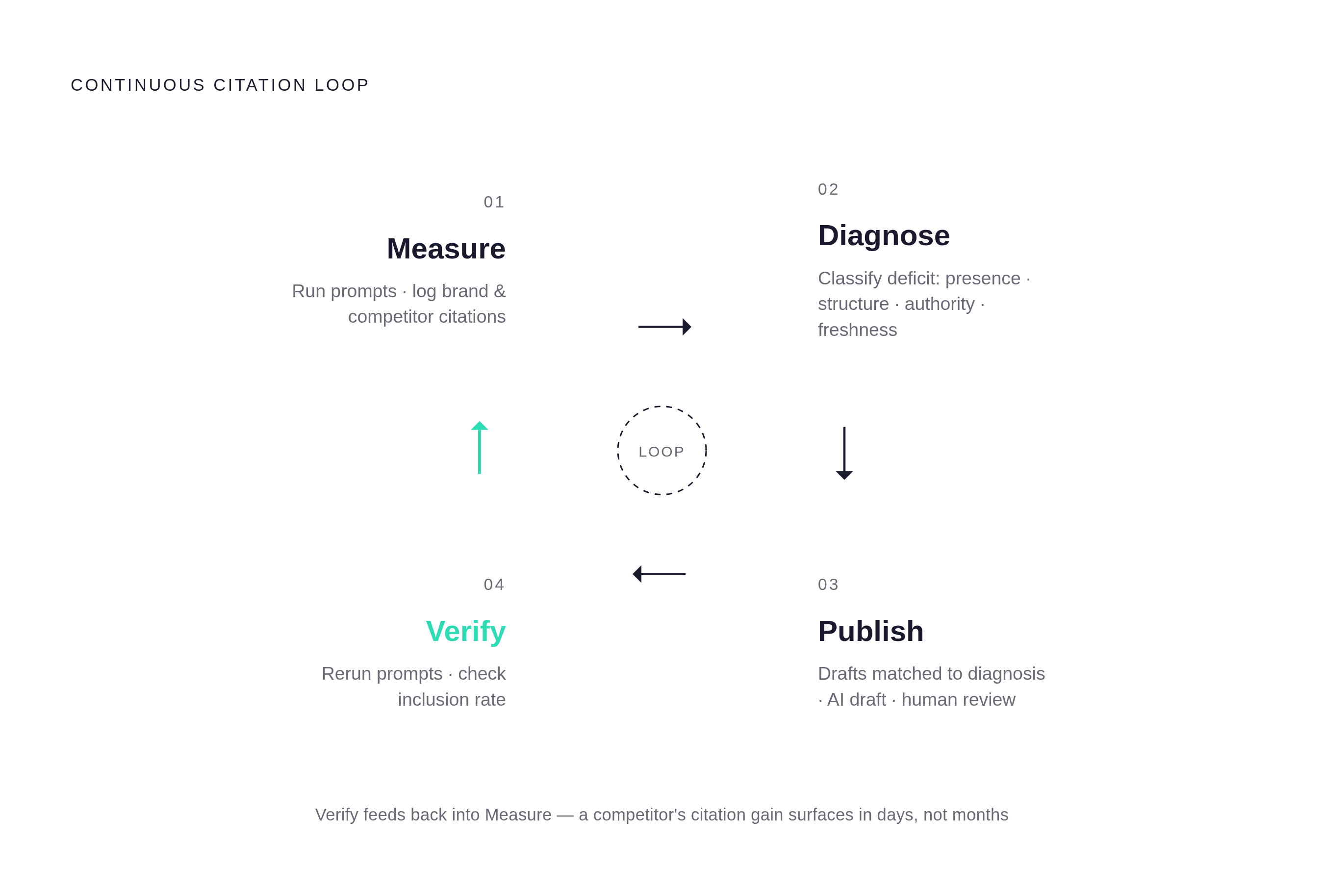
A periodic keyword audit produces a report, a content plan, and a wait for rankings to move. Its quarterly or annual rhythm is poorly matched to shifting citations, content freshness, and model behavior. A continuous loop can detect a competitor gaining citation share within days, while a periodic audit can discover the deficit months later. The measurement becomes a trigger for work.
In practice, standing watchers run relevant prompts across target engines on a set cadence and log brand and competitor citations. Diagnosis then classifies the deficit as presence, structure, authority, or freshness, so that it reaches the right remedy. Publishing replaces a calendar fixed months ahead with a queue of drafts and revisions that responds to that diagnosis. Verification reruns the same prompts after publication and checks whether the inclusion rate moves. Publication is an intermediate output.
To sustain that cadence, the pipeline pairs AI-assisted drafting with human review. Moving fast without checking the facts puts citations at risk, because even claims that read well can fail a fact-check. Human review checks whether the citations hold up, as well as the tone and grammar. Each piece needs added value, extractable structure, corroborating evidence, and freshness before it moves forward. The same diagnosis that initiated the work gives reviewers a reason to approve it beyond the fact that another page is ready.
How to structure content so answer engines can extract and cite it
Answer engines extract passages rather than read a page as a person would, carrying context from the introduction through every later section. Content should therefore make each H2 section usable as a standalone answer snippet. Its topic sentence states the claim, and the supporting evidence sits in that same section. Earlier context cannot do all the work. A section that depends on an unexplained reference to something above it is less self-contained than one that names its subject and supports its claim locally.
For information that fits a structured format, the practical principle is tables first, prose second. Engines more reliably extract information from comparison tables, numbered lists, and definition pairs than from narrative paragraphs with the same information. Prose still has a clear explanatory role. It can connect the evidence and explain a distinction without forcing the engine to reconstruct a comparison from scattered sentences.
The highest-leverage artifact is a grounding page, a structured factual reference about the brand. It contains one verifiable claim per sentence, linked to primary sources and arranged for machine extraction. That is different from an /ai-instructions/ page prescribing how a model should describe the company. Instructions are still self-claims unless there is evidence to back them up. A grounding page instead gives the engine facts it can use and a provenance trail it can follow.
Where keyword gap analysis still belongs — as a filtered input, not a strategy
The strongest defense of keyword gap analysis is that it still supplies useful signals about demand and missing coverage. That defense is sound. Keyword tools can generate the query list, while citation analysis establishes what content would need to contribute to an AI answer. The topical, keyword-level, intent, and depth gaps those tools expose can inform the diagnosis of presence and freshness gaps.
A sharper objection concerns the word “gap” itself. It suggests a measurable hole that a team can fill, yet AI citation is probabilistic, engine-specific, and only partly observable. A team can guarantee that a URL is published. It cannot guarantee that an answer engine will cite that URL for a particular prompt, or that one favorable result will recur.
An audit based on one run can mistake variation for a change in how competitors are doing, while inclusion rates from repeated runs of a prompt give a stronger signal about share of voice. Even then, the result describes only the prompts and engines being measured. Computational marketing is therefore an ongoing probabilistic audit connected to action.
What a team running computational marketing actually does differently on Monday morning
For a team adopting this approach, Monday begins with citation inclusion rates by engine and query category, compared against named competitors. Rank position and organic traffic remain available, but they no longer guide the team's weekly priorities. The team asks which relevant answers include the brand and which name a competitor instead. When the team has revenue estimates, the Revenue Visibility Gap helps show what being absent could cost. The dashboard directs attention toward a deficit that the team can investigate.
When a watcher shows that a competitor has gained on a priority query cluster, the team checks that cluster to find the cause. The next task depends on the cause. Content that is missing can go into the drafting queue that week, while a page with an extraction problem can have its structure changed without being replaced. An authority gap calls for corroboration, and a freshness gap calls for updated publishing. The content calendar does not have to expire before any of that work begins.
Before publication, a human reviewer checks added value, structure, evidence, and freshness, including whether each claim survives verification. After publication, the piece returns to measurement through repeated runs of the same prompts. Each stage produces an output the next stage can examine. This is the engineering discipline behind computational marketing, distinct from both periodic keyword planning and unreviewed AI publishing at volume.
One deficit has a diagnosis, another draft is held for evidence, and a published revision is awaiting its next inclusion-rate reading. Nobody treats the new URL as the finished result. The next decision waits for evidence from the answer engines.