When ChatGPT picks your accounting software: what AI-driven buying decisions mean for how you build your marketing stack
AI now shapes which vendors buyers consider before they visit your site.

AI-driven software buying changes what a marketing stack must do. When a chatbot supplies a shortlist before a buyer visits a vendor’s site, earning a citation becomes the new top of funnel. For technical marketing teams, the response is a system that makes proof retrievable, measures where it appears, and supports the human scrutiny that follows.
How AI chatbots collapsed the B2B software discovery funnel
A buyer types “accounting software for small business” into ChatGPT and receives a named shortlist in seconds. The buyer has not opened a vendor’s homepage or worked through competing product pages. Yet the consideration set is already taking shape. Research that once involved weeks of finding and comparing sources can now begin with a single prompt.
That is the move from reference to inference. Instead of asking where to look, buyers ask a system to synthesize what it finds and make a selection. This is already part of software buying. The consequence is that a buyer’s first impression of a brand, its category, and its competitors can form somewhere the vendor does not control. A site visit now follows that first judgment.
What AI actually returns — and how it decides who appears
What does that judgment look like in practice? For accounting software, ChatGPT strongly favors QuickBooks Online as its top choice, which reflects how much content there is about it. That placement is not a neutral inventory of the market. For other accounting software vendors, the question is whether the system names them as alternatives at all. Product quality alone does not settle that question.
The model also draws on what it repeatedly encounters as an authoritative answer. Reviews, comparisons, directories, and citations help decide which brands show up. For the “accounting software for small business” query cluster, review and comparison sites dominate the cited sources. A vendor absent from those third-party lists is therefore functionally absent from the shortlist for that query.
However, there is no single shortlist shared by every platform. Different training data and retrieval logic produce different recommendations from identical prompts. What ChatGPT favors does not show what another system will return or which product is the best fit for every buyer. Placement reflects the available citation infrastructure as well as the product. A brand’s reputation in the market thus tells a different story from how often it shows up on each platform.
Why most vendors have no idea whether AI mentions them
Most marketing teams lack a system for answering that question. Google Analytics, organic rank tracking, and marketing-qualified lead counts track what buyers do after they leave the AI window or reach another touchpoint that can be measured. They do not reveal what the chatbot said. A team can thus see traffic and leads without knowing whether its brand made the first shortlist.
Brand stature provides some direction, but not a measurement. Global household names appear in a strong majority of relevant answers, established mid-market brands appear less often, and niche brands appear only in a small fraction. Even that pattern does not make visibility stable. Citation volumes for the same brand can differ by orders of magnitude between platforms, and repeated prompts do not reliably preserve the same brands. Being prominent in Perplexity offers no guarantee of appearing in Gemini.
What would a team optimize if it could not observe the system’s output? A strong Google ranking cannot show whether a chatbot recommends the brand, and one answer in its favor cannot show whether it appears consistently. Without repeated, platform-specific observations, teams are spending against an unmeasured part of the funnel. By the time their existing metrics register a buyer, the first filter has already run.
The content and citation signals that determine AI visibility
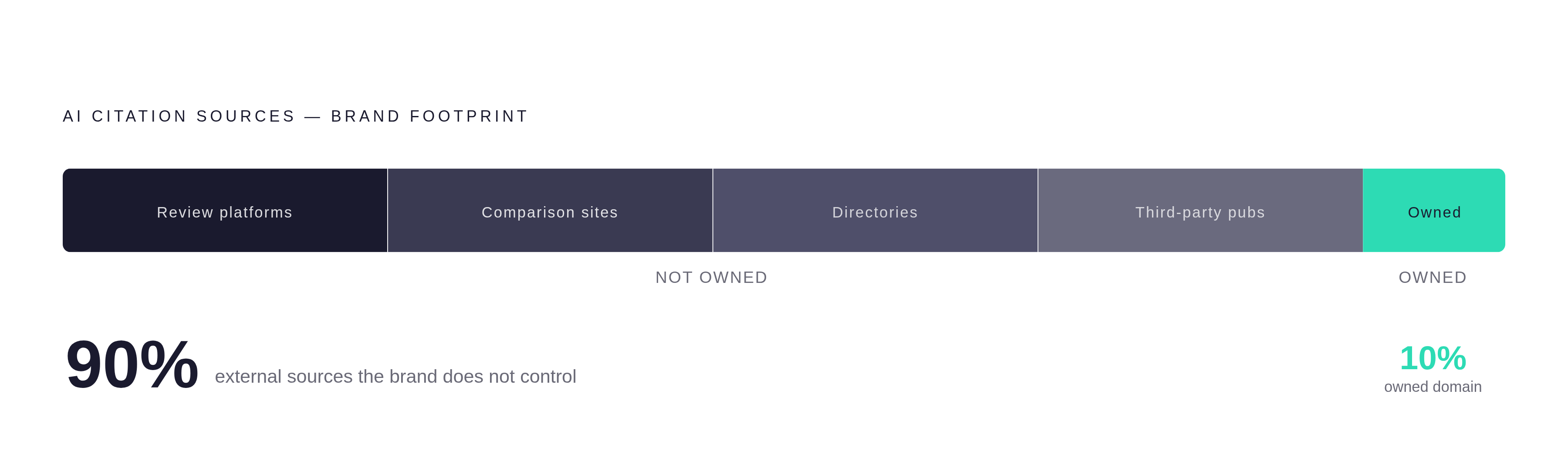
The first signal lies outside the vendor’s domain. AI visibility depends a great deal on branded mentions, with or without links. Ahrefs found that branded web mentions correlate much more strongly with Google AI Overview visibility than backlinks do. Even so, it casts doubt on the idea that getting links and improving a brand’s own pages does all the work needed to help buyers find it.
The wider citation pattern reinforces that distinction. Roughly nine in ten AI citations about a brand come from sites the brand does not own. Review platforms, comparison sites, directories, and third-party publications therefore serve as upstream marketing infrastructure. G2, Capterra, and TrustRadius profiles are more than administrative boxes to tick. They add to the external body of material from which systems can construct an answer.
A mention establishes presence, while structure helps a system retrieve a useful passage about the brand. In accounting software, ranked “best-of” lists account for the largest share of AI citations. Their format matches the buyer’s request for a selection. This helps explain why content organized around a buying question is needed alongside a polished homepage.
The third signal is distribution across external publications. Structured material published only on the vendor’s domain has a narrower footprint than material available across a range of relevant sources. Distribution gives the citation system more places to encounter the brand. These signals address different parts of the problem, namely presence, extractability, and reach. They can work independently, but together they make the brand’s evidence easier to find and use.
Where AI discovery ends and human validation begins — and why both must be served
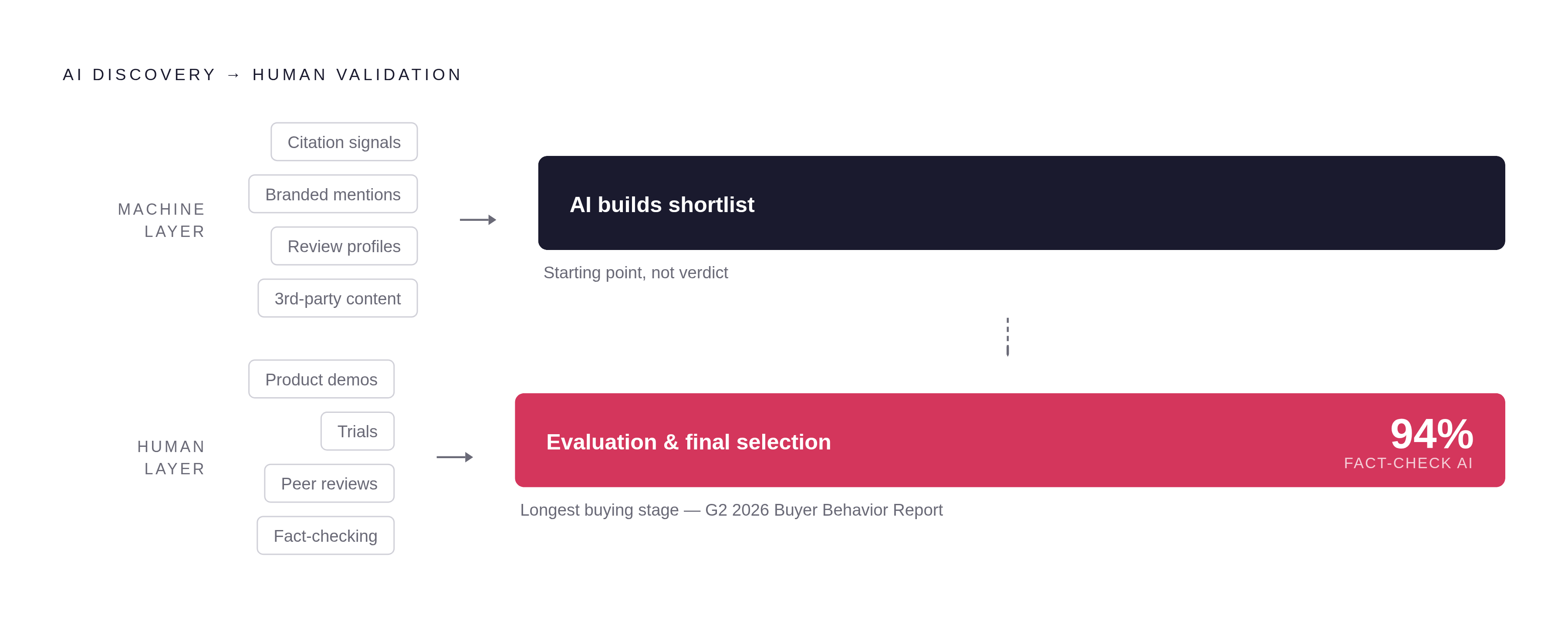
Does this mean marketing should optimize entirely for machines? The strongest objection is that appearing in an answer does not close a deal. TrustRadius’s 2026 B2B Buying Disconnect Report found that 94% of buyers who use AI during their purchase journey fact-check its responses at least some of the time. Buyers treat the answer as a starting point.
G2’s 2026 Buyer Behavior Report found that evaluation is now the longest stage of the buying journey for the largest share of buyers, ahead of research and decision. AI has cut the time spent on discovery, but buyers still have to work through approval. IT security review, budget approval, and implementation planning remain sources of friction after shortlisting. Product demos, free trials, prior experience, and user reviews remain influential in vendor selection. The human layer still requires concrete proof.
That objection argues for two layers: machines help with research to narrow the options first, and people then test the ones that remain. Chasing every AI surface at the expense of review density, demo quality, and peer validation leaves the second layer poorly served. Likewise, even strong proof of a product’s worth cannot help buyers assess a vendor they never consider. Both layers need attention and measurement.
The same report places a boundary around buying agents. Buyers will let agents gather information and suggest vendors, but higher-stakes actions still require a human in the loop. For a technical marketing team, the lesson is to structure evidence so that machines can retrieve it and people can assess it.
What rebuilding the marketing stack actually looks like for a technical team
The first layer is structured, retrievable material published at a steady cadence, rather than a homepage refresh or a one-time SEO audit. Each passage needs to back up a claim that helps the buyer, using statistics, quotations, and external citations where they fit. Schema makes entity claims machine-readable. Recency and frequency of mention also influence visibility, so publishing once and stopping limits how quickly the citation footprint can grow.
A multi-stage AI content pipeline provides a practical division of labor. AI can handle briefs, outlines, first drafts, and metadata, while humans retain responsibility for facts, positioning, expert judgment, final approval, and brand-sensitive decisions. Review should follow the risk. Social and short-form content gets a brand voice check, while blog content gets fact-checking and strategic alignment review. Thought leadership and regulated content need sign-off from a subject matter expert and the legal team, so the time spent on review should vary with the kind of content.
The second layer extends publication beyond the owned site. Review profiles, directories, comparison placements, partner content, and third-party publications belong within the architecture. Review volume and recency correlate with AI citation frequency, so those profiles serve both model inputs and buyer validation. Their value is not confined to referral leads. For query clusters where comparison lists dominate, a brand needs to be in those lists to have a chance of being found.
A team should poll ChatGPT, Claude, Gemini, and Perplexity against a consistent query set on a cadence, then log the results over time. Repetition is essential because answers vary between runs. The core measures are Brand Mention Rate in AI outputs and Citation Share of Voice versus named competitors. These sit beside traditional SEO metrics and describe a distinct activity.
To connect discovery with business outcomes, the measurement layer should also track AI referral traffic conversion rate and the relationship between citation frequency and changes in branded search volume. Attribution remains difficult. Because citations change when the same prompts are repeated, it is hard to tie revenue directly to a given effort to earn citations. The honest approach is to treat visibility as a leading indicator and compare it with downstream pipeline signals. That preserves a useful feedback loop without presenting correlation as proven causation.
For a team starting from zero, sequencing begins with an audit. A consistent query set across the major platforms establishes a baseline for Brand Mention Rate and Citation Share of Voice before spending begins. Review platform presence is the next near-term lever because it serves discovery and validation together. Structured content then targets the query clusters buyers are actively prompting, with passage-level retrieval, external distribution, and machine-readable markup built into publication. Finally, the baseline testing becomes a recurring measurement operation, so changes in citation frequency are visible before they appear in pipeline.
This architecture does not require abandoning the back half of the funnel. The team must keep working on review density, demo quality, trials, and peer validation as part of the system. Otherwise, increased visibility delivers buyers to weak evidence. Human approval remains the test that a machine-generated shortlist cannot perform on its own.
The first principle the rebuilt stack runs on
The rebuilt stack runs on a different unit of entry. Search marketing sought a click into the vendor’s site, while AI discovery first needs the brand to be mentioned in someone else’s answer. That makes retrievability a requirement before the homepage can do its work. The accounting software buyer may arrive with a consideration set already formed. A vendor cannot assume that being easy to find through search means being included in that set.
The actionable principle is to make credible proof retrievable wherever selection happens. This is not a claim that the most visible brand has the best product, or that machine legibility can replace product quality. It is a recognition that evidence must enter the decision process before anyone can weigh it. A technical marketing team can measure that entry through Citation Share of Voice, relate it to pipeline, and adjust publication and distribution on evidence. Without that observation, the team is optimizing the buyer’s arrival while remaining blind to the selection that made it possible.