Content marketing at early-stage startups: why the editorial agency model breaks down before you hit product-market fit
Founder-led experimentation beats agency retainers when product and message are still in flux.

Content marketing before product-market fit is a way to learn. For technical founders, the editorial agency model breaks down because it commits resources to a message that is still changing. The better fit is founder-led experimentation supported by a programmable, measurable content system that the company owns and can change as quickly as its product.
Why the editorial agency model assumes things pre-PMF startups don't have
The editorial agency model assumes a repeatable assignment. It needs a reasonably stable ideal customer profile, a message that bears repeating, and enough time for a publishing plan to work. Before product-market fit, all three are live variables. The customer profile shifts with conversations, the message changes with the product, and the planning horizon contracts to weeks. An agency can execute its brief well while the brief itself becomes obsolete.
Brand voice guidelines, editorial calendars, and pillar pages guide what gets made based on a settled view of the business. But what happens when the founder discovers that a different customer needs help more urgently? Work built around the old positioning becomes a sunk cost. Paying for a strategy around a product that may pivot in three months can mean paying again to replace it.
A company with a validated message may need help producing more content. A company still discovering its message needs a way to test assumptions cheaply. The same publishing operation cannot solve both problems simply by changing the number of articles it delivers.
What pre-PMF content is actually for
If the customer and message are unknown, what should publishing accomplish? It should produce evidence about which audience responds, which framing resonates, and which channel reaches those people. Cadence is not the goal at this stage. A post is useful because of what the founder learns from its reception.
That changes the time horizon and the budget. Tests need to run over weeks, with room to revise the next piece in response to the last one. The budget should stay small until something works. Once a message and channel show promise, there is a reason to invest in repeating that result. Before then, more production can merely multiply an untested assumption.
This is why post-product-market-fit plays can be so wasteful when used too early. A brand redesign, an elaborate calendar, or an agency retainer organizes effort before the startup knows where that effort belongs. The output may be polished and still teach little. Content without a learning purpose fills a page before the founder knows what the page should say.
The value of pre-validation content depends on the feedback it produces. A piece that exposes a weak assumption can be useful even if its message is abandoned, while a library of unread articles offers little basis for the next decision.
Why founder-led content is the structurally correct pre-PMF substitute
Founders have three strengths that help when so much is unknown: domain expertise, an authentic voice, and the ability to change direction right away. Their expertise gives them something useful to explain about the problem. Their voice connects that explanation to a person responsible for the product. And when a customer conversation changes their understanding, the next piece can reflect it without waiting for a new brief.
The feedback loop is the real advantage here. Replies, direct messages, and shares reveal which descriptions of a problem prompt recognition and which pass unnoticed. Social content therefore serves as market research before a framing becomes the basis of a 12-month editorial calendar. It gives the founder more evidence to bring into customer conversations. The author and the person making product decisions remain close to the response.
Does that mean the founder has to write everything forever? No, but delegation needs something proven to reproduce. Hiring a content team before the founder-led program works gives the company a way to make content before it knows how to get a response. The practical heuristic is to prove the program solo for several months, then scale it.
The retainer's hidden cost is not the monthly fee — it's the lock-in during a pivot
A multi-month retainer can outlast the assumptions behind it. Mid-market content retainers cost a lot each month, which is easier to justify when the message has already been validated. Before that point, the startup is buying execution capacity while its central problem is still deciding what to execute. The contract and the product run on different clocks.
The timing of outside help follows from that distinction. A marketing partner typically becomes useful when the founder can no longer handle marketing alone and the business has reached some message stability. Below that threshold, a fractional content marketer or freelancer can fit an early-stage budget better at a fraction of the retainer cost. An engagement without lock-in can stop when the pivot happens.
The larger expense is the opportunity forgone. Money spent on production cannot also pay for customer development conversations that would show what customers need to read about. What about the objection that content is needed to test messaging? Founder-led LinkedIn posts are free to publish, can change within days, and give the founder feedback. A polished agency calendar is a commitment to execution, whereas the startup needs permission to discard the plan.
Why AI answer engines change the content architecture problem for technical founders
Google rankings and AI citations are different outcomes. Generative Engine Optimization, or GEO, means structuring content and building brand authority so AI-powered platforms select, cite, and surface a brand in their responses. Answer Engine Optimization, or AEO, is the narrower work of making a source easy to extract as a direct answer. It applies across ChatGPT, Perplexity, Gemini, Claude, AI Overviews, and voice assistants. An SEO blog post does not meet either goal just by being published.
The difference extends beyond how the prose reads. Topical depth, author credibility, and resolution of the query contribute to citation selection, so strong backlinks alone do not guarantee inclusion. Founder attribution connects the earlier learning model to this new visibility problem. A named human expert gives useful content an identifiable source of expertise. Attribution is one signal in citation selection.
There is also no dependable equivalent of publishing once and assuming continued visibility. Only a minority of brands stay visible from one AI answer to the next, with an even smaller share present across consecutive runs of the same query. Citation coverage needs ongoing work beyond a check now and then. Yet an editorial service built around Google rankings may neither optimize for this outcome nor measure it.
The content architecture that earns AI citations — and why it requires owning the stack
Grounding pages give answer engines evidence they can use. These are dense, encyclopedic pages with clear facts in the visible HTML body. JSON-LD schema alone cannot compensate for empty prose. Kevin Indig's analysis found that citations came disproportionately from the first portion of a page, making the location of claims a consideration in page design.
Entity consistency makes it clear that the same owner is behind that evidence. Organization schema can state the accurate name, URL, and logo, with same-as properties connecting the organization to Wikidata, LinkedIn, and Crunchbase. A Wikidata entry can help recognition and confident attribution, though its absence does not prevent a model from identifying a brand through contextual signals. Consistent descriptions across independent sources add corroboration.
The data-node strategy offers a stronger alternative to generic blogging. Proprietary research tied to the product's dataset gives the company original evidence about trends that an answer engine may need to explain. The company owns both the underlying information and the wording. That creates a reason to cite the source. It also changes what editors ask, from what else can be published to what evidence the product can uniquely supply.
Those choices require access to the publishing infrastructure. Shops that only do editorial work deliver articles, while specialist technical or entity-SEO agencies may also handle schema, Wikidata, and cross-platform corroboration. The founding team still needs to own the system and have programmatic control because pages, entity signals, and publishing cadence must change together when positioning changes.
What a programmable content pipeline actually looks like at early-stage scale
A programmable pipeline uses multiple specialized AI agents against a CMS that serves as the source of truth. Human review gates determine which work advances and which work stops. The founder controls which actions need approval and which can run unsupervised. Its value is speed and reversibility with the ability to say no.
Before a draft ships, a human needs to check its factual accuracy and brand voice and look for unsupported claims and generic AI output. Subject matter experts contribute at the brief stage to shape the substance, then return at review to catch technical errors. That involvement prevents execution speed from becoming a substitute for expertise. Automation handles work within the boundary rather than deciding that the boundary no longer applies.
An industrial B2B supplier with safety-critical product specifications provides a concrete example of this design. Between December 2025 and August 2026, 68 articles from its AI content pipeline were published with zero retractions. A small team that could not staff a content operation published expert-level articles every week, each checked against verified specifications and reviewed by a human before it went live. The pipeline stopped at draft, and a person published.
AI collapses the execution layer around a single human touchpoint, while the founder reviews and approves work at each stage gate. Output can then follow what the founder is learning.
Measurement as the architectural requirement that makes everything else defensible
A programmable pipeline needs evidence that its output works. Without instrumentation, faster publishing only makes an uncertain activity faster. For AI visibility, the measurement layer needs standing watchers that query ChatGPT, Claude, Gemini, and Perplexity on a cadence, record whether the brand is named and cited, and surface changes as they are detected. Checks need to happen again and again because one favorable answer cannot show that coverage will last.
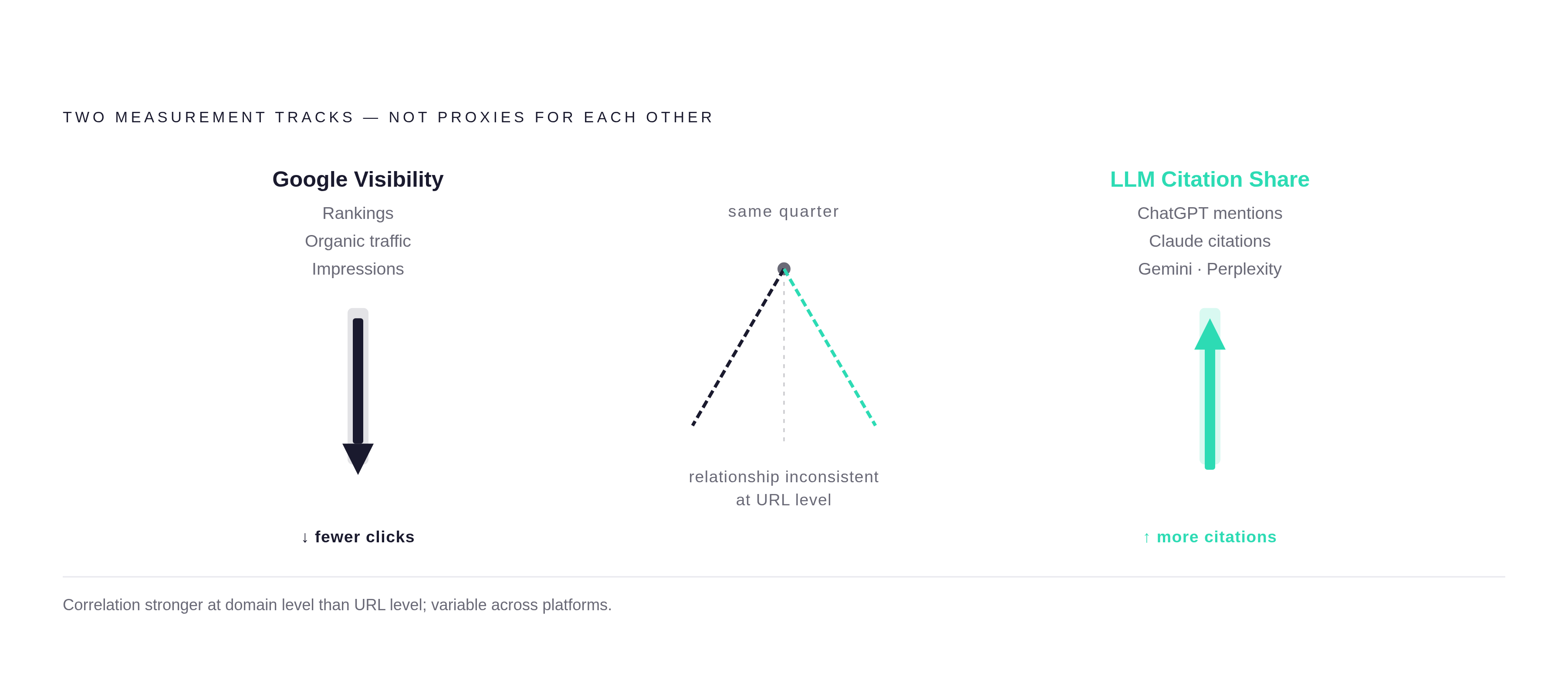
Google visibility and LLM citation share each need their own measures. Rankings, traffic, and impressions show how content does in search, while citation share shows how often it appears in generated answers. Their relationship is inconsistent, stronger at the domain level than at the URL level and variable across platforms. A page may get fewer Google clicks and more LLM citations in the same quarter. One dashboard cannot treat the first movement as proof that the second is also falling.
This exposes a limitation in the conventional agency reporting model. Traffic and rankings are readily available from the SEO toolchain, while equivalent instrumentation for AI citation share has not yet been widely adopted. A report can therefore look complete while omitting an important visibility surface.
Treat content with the rigor applied to product telemetry. Instrument the system, measure its response, and change it on evidence. Ownership makes that possible through a single account, one source of truth, and metered content actions the company can inspect. Before product-market fit, the defensible asset is not a fixed library built around yesterday's positioning, but a system that helps the founder decide what to say next.