How to rank in Microsoft Copilot: what the new AI answer race means for technical marketing teams
Technical marketers must optimize for Bing ranking and page-level grounding settings.

Ranking in Microsoft Copilot is an infrastructure problem. For technical marketing teams, the task is to make useful evidence crawlable, structured, linked and current, then measure whether Copilot selects it. The same discipline that produces dependable engineering can produce citation-ready content, provided the team understands which parts of the system it can control.
Why Copilot visibility is a different problem from Google SEO
Microsoft 365 Copilot is part of the tools enterprise buyers already use. Buyers do not have to visit a search page to encounter it. Microsoft’s July 29, 2026 earnings call reported that the product had passed tens of millions of paid seats, making that exposure an operational concern for B2B marketing teams. Copilot finds the buyer within their working environment, rather than waiting for the buyer to seek out a search engine.
That changes the encounter, but not the need for an index. Copilot grounds its web answers in Bing’s index. The interface is conversational. The underlying access requirement is familiar. A page must be legible to a crawler before its content can enter the pool from which an answer draws.
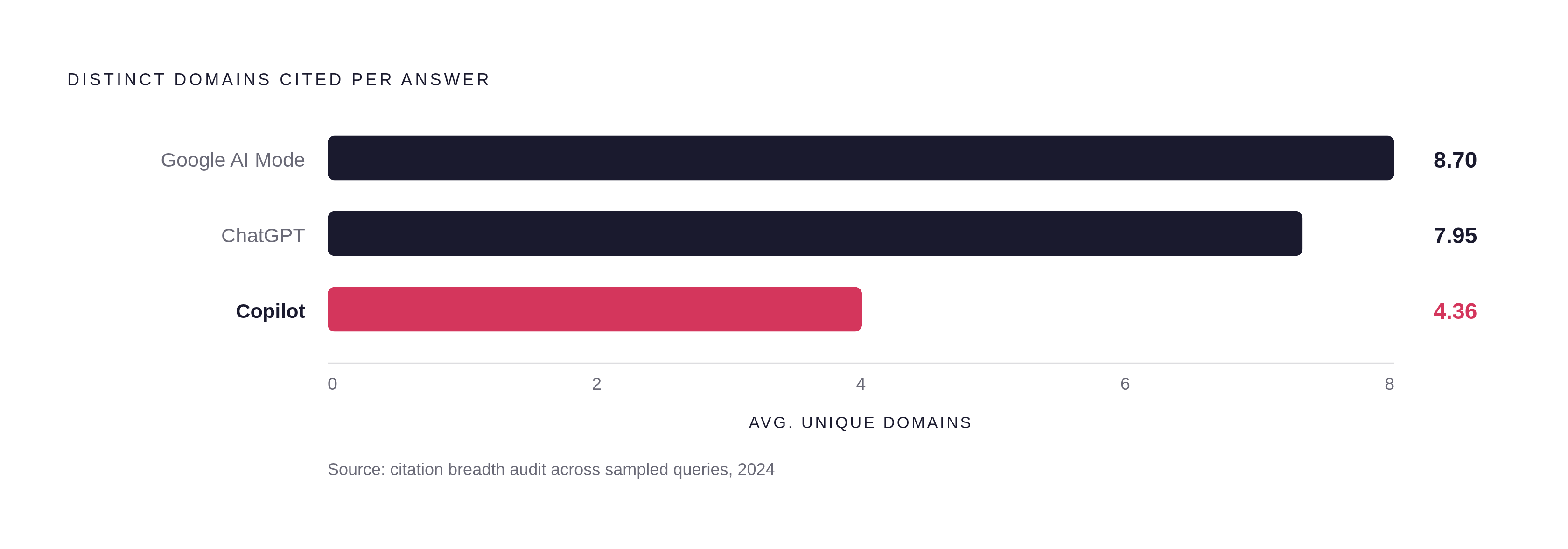
The pool also narrows sharply at the answer itself. Omnia’s citation database puts Copilot’s average at 4.36 distinct domains per answer, roughly half the citation breadth of ChatGPT or Google AI Mode. How much room does that leave for another source? Not much, which makes eligibility the first objective. A strong Google position does not by itself establish that a brand is present in the index and results Copilot uses.
How Copilot actually selects and cites sources, layer by layer
Bing search grounding is how the system gets its sources by default for nearly every product and recommendation query. It draws from Bing’s index, and indexing signals can influence it within days. This is the externally influenceable part of the system. Bing rank for buyer queries is therefore the biggest citation signal, while a gap between a brand’s Bing and Google positions can explain visibility that otherwise seems puzzling.
Microsoft Graph serves a different purpose inside Microsoft 365 Copilot. It supplies per-user enterprise context from sources including emails, calendar and SharePoint. Marketing teams outside the enterprise cannot change that private context. Nor does it drive external vendor recommendations, so access to enterprise work tools should not be confused with a separate route for getting a vendor’s public content cited.
Microsoft’s October 30, 2026 announcement adds a page-level control over grounding, with preferences named Allow, Disallow and DisallowExtended. Microsoft warns that selecting either restrictive option will “significantly reduce your content's visibility in AI-generated experiences, without affecting eligibility for Bing search results.” Search eligibility and grounding permission are distinct. There is no site-wide robots.txt grounding preference, because these controls apply at the page level only.
The transition has its own dates and defaults. The new preferences replace NoArchive and NoCache for grounding and training, with the preferences honoured from February 1, 2027 and the old controls retired after March 1, 2027. Temporary settings open in Bing Webmaster Tools on December 15, 2026, only for sites using NoArchive or NoCache as of that date. If those sites record no temporary preference by March 1, 2027, the affected pages default to Allow for grounding until Microsoft recrawls them and discovers their new preference.
The two technical conditions that must be true before any content optimization matters
The pre-flight check starts with readability and crawler access. Can the crawler read the page, and has it visited? Content structure cannot compensate for failure at either gate. The diagnostic step is to check server logs for bingbot and ChatGPT-User, keeping their roles distinct rather than treating evidence of one as evidence of the other. Their absence is a reason to resolve access before investing in further optimization.
IndexNow submission helps Bing discover new or changed content sooner, while access checks remain necessary. The grounding policy adds a related permission check for pages intended for citation, which must not be inadvertently set to Disallow or DisallowExtended. A readable, visited page can still have a grounding restriction, so access and permission need separate attention.
What content structure Copilot can actually extract and cite
Copilot retrieves passages rather than reading an article as one indivisible argument. The section under a heading is the extraction unit, making structure an API contract between the content and the retrieval system. Each section needs an answer that can stand on its own. A conclusion that relies on several earlier sections may work for a patient reader but be harder to extract as a passage that makes sense on its own.
The practical response is to answer the query directly at the start of each section, then supply supporting detail. A plurality of AI citations comes from the first portion of a piece of text. This gives the opening a specific retrieval role. An answer capsule should therefore contain the substance of the answer, rather than merely promise that the section will eventually explain it.
The type of page shapes the kind of answer that structure can give. High-value B2B formats include industry-specific definitions and explainers, technical comparison guides, original research and benchmark reports, case studies with named metrics, and integration or technical capability documentation. A comparison supports a choice, while integration documentation addresses whether a product can meet a technical requirement.
Evidence is what gives the passage something worth citing. Original survey results, proprietary case studies and opinions from named experts give an AI material it cannot simply reproduce from its training corpus. Generic AI-generated prose lacks that distinction, however neatly formatted. FAQ schema and structured comparison tables reduce extraction friction, but formatting does not create evidence.
The off-site citation sources Copilot trusts most and how to build presence in them
A brand’s own website makes up less than half of the sources that AI cites. Earned media, peer sites and affiliate coverage collectively outweigh direct domain citations. Owned content is only part of the work. Even when a website works well technically, the wider source pool may lack enough evidence for Copilot to mention the brand.
For Copilot, that pool has a Microsoft-weighted shape, including professional networking platforms, technical learning resources and other Bing-indexed properties. Bing’s top results for buyer queries have particular influence. Omnia’s citation analysis finds that strong third-party coverage indexed by Bing can help a brand appear in Copilot even when it ranks lower in Google. Copilot also cites sources that do not appear in Google or ChatGPT results, so those platforms are incomplete proxies for its preferences.
Reddit blocked Bing’s crawlers in July 2024 after failing to reach a licensing agreement with Microsoft, and Bing does not index Reddit content. A presence there is therefore not interchangeable with Bing-indexed coverage. More broadly, a source that helps a brand appear in one AI engine does not automatically help it appear in another.
Target off-site presence by platform. For Copilot, that means focusing on Microsoft-weighted sources and Bing-indexed third-party pages that answer core buyer queries. A brand’s mentions need to sit in the source pool Copilot actually draws from.
Why freshness is a maintenance schedule, not a launch decision
AI engines favour content that has been updated recently over older content of the same value, and the sources they cite are fresher than SEO-equivalent sources for the same query. A strong page can therefore become progressively disadvantaged without becoming obviously wrong. Publication is not the end of eligibility work. The page competes against other sources whose evidence and recency signals may be renewed.
Citation visibility also fluctuates month over month as models retrain and retrieval context shifts. That makes it less stable than a fixed publishing result. What does a citation won at launch establish about next month? Less than a team might hope, because citation durability for most engines is measured in weeks.
The operational response is a monthly refresh cycle. The year shown in titles, headings and publication metadata can help engines spot current material, while stale data needs to be replaced. Freshness belongs in the maintenance schedule. Once refresh work includes new evidence, updated signals and re-indexing, it becomes a regular stage in the pipeline.
A content pipeline that produces citation-eligible output at pace
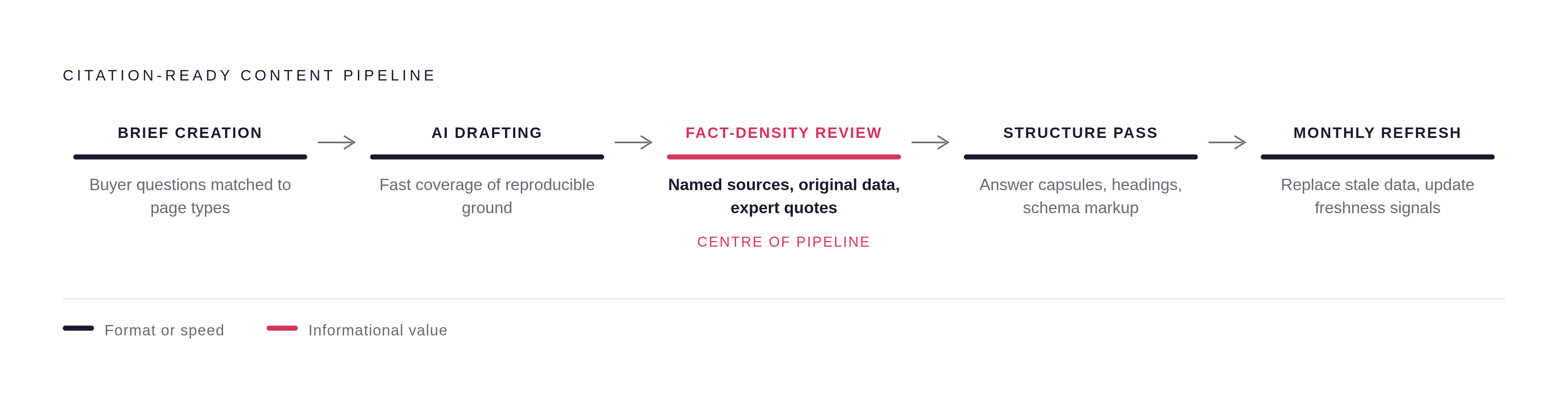
A pipeline that works starts with the questions buyers actually ask. When briefs are created, those questions become prompts and are matched to page types that can be cited, such as comparisons, explainers or technical documentation. This gives each brief a defined purpose. It also ties production to the questions the measurement system will later use, rather than treating publishing volume as an end in itself.
AI-assisted drafting can then cover ground quickly, but its output starts at the level of material AI can already reproduce. That is a useful draft. The bottleneck is usually fact-density review.
Human fact-density review is therefore the centre of the pipeline. Reviewers add named sources, original data, specific expert quotations and case study metrics, while identifying where comparison tables, FAQ schema and answer capsules will make the evidence usable. This is where quality compounds across the process. The review changes not just the wording but the informational value of the page, giving the engine something it could not produce internally.
A structured formatting pass makes that reviewed material extractable. It places answer capsules in the opening words of sections, uses H2 and H3 headings for retrieval-augmented generation extraction, and adds schema markup where applicable. The monthly refresh stage then replaces stale data, updates freshness signals and submits changes through IndexNow. Each stage has a separate job, so a formatting pass is not mistaken for a factual review.
The stages can have people review the work, run on their own or use a mix of both. Editorial control still needs a clear boundary. Every AI-generated suggestion must be reviewable before publication, so greater throughput does not make correction or judgment impossible. The aim is a repeatable production system whose speed comes from defined stages, including the stage that supplies original evidence.
Measuring whether Copilot is actually citing you, and what the numbers mean
Microsoft launched Bing Webmaster Tools AI Performance on February 10, 2026, making it the first major search engine to offer a dashboard just for AI citations. Google has since followed with an AI Citations report in Search Console. Microsoft added Intents, Topics, Citation Share and Compare on June 16, 2026, all free and in preview globally.
The report counts how often pages appear as sources. It does not count visits generated by those citations. A citation is evidence of source selection. The appropriate reading is directional, cross-referenced against site analytics so that answer exposure and website activity remain separate measures.
Measuring across engines needs a fixed panel of buying-intent questions that customers actually ask. The panel should run on a schedule against Copilot, ChatGPT, Gemini and Perplexity, recording brand appearance, position in the answer, sentiment and whether the answer cites a link to the site. Consistency makes comparison more useful. Prompt wording, timing and context affect results, so repeated runs and aggregated patterns are more reliable than isolated spot-checks.
Visibility rate measures the percentage of target prompts where the brand appears, separately for each engine. Citation-domain tracking shows which third-party pages Copilot selects when it mentions the brand, so teams have evidence to guide where they seek off-site coverage. Share of voice compares appearances with named competitors across the same prompt set. These measures answer different questions, so none should stand in for all the others.
Categories where the brand is consistently absent become inputs for new briefs, while citation patterns help distinguish an owned-content gap from an off-site coverage gap. The loop then returns to the pipeline.