When an AI agency sells "people who built the agents run them for you": what a technical buyer should ask to inspect before hiring
Five inspectable proofs separate agency builders from agency salespeople.

When an AI agency sells “the people who built the agents run them for you,” the purchase deserves technical due diligence alongside a portfolio review. The claim is worth paying for only if the agency can expose the system behind it. For technical founders and growth engineers, the deciding evidence is inspectable architecture, quality gates, client-owned assets, readable logs, and measurement that connects the work to results.
Why the "our builders run it" pitch deserves a different kind of scrutiny
“The people who built the agents run them for you” promises access to a system with its architects embedded in its operation. That differs from hiring people to follow a process someone else designed. The builders should know how the automation works, where it fails, and what requires human judgment. But the pitch alone does not prove any of that.
Refresh Agent’s 2026 implementation guide distinguishes vendors selling AI-generated output volume from a smaller group selling orchestrated systems operated by their builders. A proposal or case study deck does not expose the difference. Lyzr’s 2026 marketing agency blog post supplies a useful test, distinguishing a tool that assists with one step from an agent that completes a task end-to-end. Where does the human take over, and why? A buyer familiar with orchestration, reasoning models, and API connectivity can make that question concrete by asking what “AI-powered” entails.
What a real agentic stack looks like, so you can recognize one
Refresh Agent’s guide describes three parts: an orchestration layer, a reasoning engine, and a connectivity protocol. Orchestration tools such as n8n arrange workflow nodes that run code, make API calls, and trigger agents. A reasoning engine such as Claude acts as a logic processor, writing JSON or Python to connect disparate APIs. MCP provides access to a client’s CRM, file system, or analytics stack without a custom integration for each. Each component has a distinct job.
For example, an MCP server could fetch information from a client’s cloud storage, team messaging platform, and CRM for a monthly report. The orchestration layer organizes the work, while the reasoning engine handles the logic needed to connect those sources. That is a different proposition from someone pasting extracts into a chat window. Hosting also belongs in this picture, because self-hosted orchestration gives clients handling sensitive records a different basis for data sovereignty.
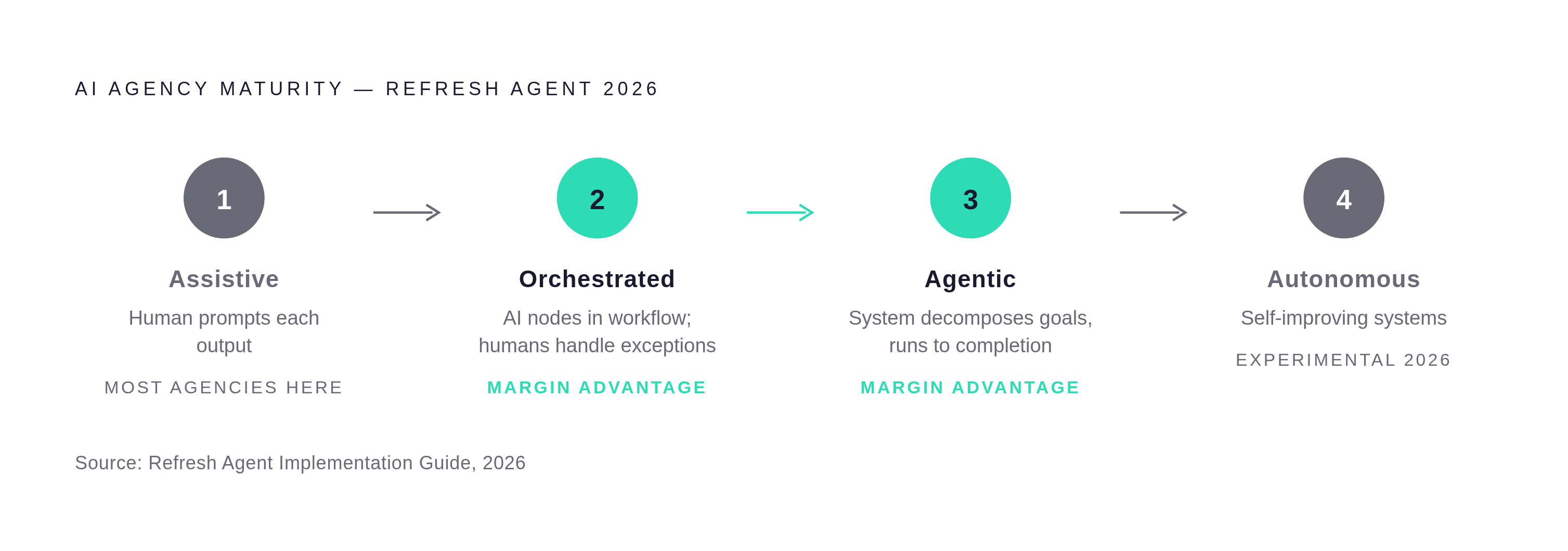
At Level 1, Assistive, a human prompts each output, while Level 2, Orchestrated, uses workflows with AI nodes and humans handling logic and exceptions. At Level 3, Agentic, the system decomposes a goal, uses tools, and runs the workflow to completion, with a human setting OKRs and monitoring. Level 4, Autonomous, describes self-improving systems that the guide calls experimental as of 2026. The guide places most agencies presenting themselves as agentic at Level 1, while locating the margin advantage at Levels 2 and 3.
Asking for the architecture document before the pitch deck
The first-call request can be direct. “Show me the architecture document for a current client’s data pipeline.” An agency that built the system should be able to produce that document on day one, before onboarding. A capabilities deck answers a different question. It describes what the agency sells.
The document should show automated connectors to ad platforms, CRMs, and analytics tools, followed by a transformation layer that normalizes metrics and applies consistent business logic. It should also show marketing data models covering campaign hierarchies, attribution, and channel groupings. These are not decorative details, because an agent’s reliability depends on the data it can reach and interpret. Inconsistent inputs produce unreliable outputs, siloed access blocks cross-platform work, and manual overrides can erase the automation’s benefit.
The useful distinction is between a pipeline that resolves those problems and people correcting them afterward. Pre-built marketing data models support accurate reports, while generic AI tools operating on raw API data leave analysts correcting errors. That work adds up across clients each week. The architecture request therefore tests whether the agency has built reusable infrastructure or simply moved more cleanup work behind the deliverable.
What a real quality gate looks like, and why "our team reviews everything" isn't one
A stack that is documented may still produce unreliable output. For that, ask the agency to describe its quality control step by step, including what fails before a person sees a draft. A sound pipeline is staged and fail-fast. “Our team reviews everything” describes staffing.
First come deterministic checks that catch flaws in the structure. Next comes an adversarial grader, a separate model or agent that evaluates the draft against defined criteria. A fact-check gate then reads retrieved sources. A citation-readiness check establishes whether claims are grounded in content the agency controls and can point to. Only then does exactly one human approval authorize the draft.
That last person uses judgment after the checks have caught the main errors. An experienced editor catching everything is still a bottleneck, and unfiltered review is vulnerable when volume rises. To inspect the pipeline’s health, ask for first-pass yield, the proportion of drafts passing every automated guardrail without regeneration, and its trend over the past quarter. Ask at what point the agency flags problems with a prompt or model. The number helps when it shows whether the agency is fixing failures earlier in the process.
Proving ownership: who keeps the prompts, workflows, and data if you leave
Even a reliable system can create an unwanted dependency. Where its prompts, workflow configurations, knowledge bases, and training data sit when the engagement ends matters in practice. Assets held only in the agency’s repository leave the buyer with output. When the buyer controls the assets, they have a basis for keeping the system’s capabilities.
That distinction has an inspectable technical form. Prompts and system instructions should be versioned in the client’s Git repository, while workflow configurations should be exportable without the agency’s involvement. Knowledge bases and training data belong in client-controlled infrastructure with an export path. MCP server configurations should point to client-owned data sources.
“Walk me through what I would take with me if I ended the engagement. What do I have, what do you keep, and what requires your team to operate?” For sensitive records, the hosting boundary belongs in the same conversation, because n8n on client-controlled infrastructure offers a structurally different ownership guarantee from a shared cloud environment.
The audit trail: what a sound compliance and oversight architecture produces
Ownership answers who controls the assets, but not what the agents did with them. A sound system produces structured metadata for every run, including risk level, data categories accessed, whether human oversight was required, the approver, and the approval timestamp. The client must be able to read it. Otherwise, the builders’ operational knowledge becomes a monitoring blind spot for the buyer.
A job-registry architecture makes that record part of operation. Each task is registered with its metadata before execution, so the audit trail does not depend on someone reconstructing events afterward. The inspection request is simple. “Show me the logs for a past campaign run. What does one entry contain?”
The evidence should let the buyer reconstruct what happened and who approved it. A governance deck cannot substitute for that record. For medical or financial data, the agency should also name the architecture choices that address oversight and self-hosting. Accountability should be built into execution.
GEO and AEO as a capability the agency must demonstrate, not describe
The same evidence standard applies to AI answer-engine visibility. An agency claiming GEO or AEO capability should show the prompts it uses to audit a brand across ChatGPT, Perplexity, Gemini, and Claude, together with the results. A service description is not a demonstration. The buyer needs to see what the agency can do now.
Traditional SEO aims to get content into organic results, while AEO shapes content so it can be pulled into direct answers and snippets. GEO seeks citations when AI systems synthesize answers. Quoting credible sources, adding verifiable statistics, and including citations can raise a source’s share of AI answers. An agency should therefore point to content built around those levers and show before-and-after citation data.
Single Grain’s work with SmartRent provides a concrete outcome, reaching 136 new AI citations and a monthly stream of sales-qualified leads from AI answers after crawling fixes and targeted content. But a result on one engine cannot establish performance across all engines. Across a large prompt set, Gemini and ChatGPT have cited very few of the same domains. The agency’s evidence needs to show those differences.
The proposed content strategy deserves equal scrutiny. Category authority and earned media contribute to AI visibility, so brand-owned pages are not the whole mechanism. Thin satellite domains without independent corroboration are unlikely to outperform earned placement on sources the models already trust. If the proposal centers on “phantom site” citation farming, ask for evidence supporting that approach specifically.
Measuring AI answer-engine presence: what weekly cadence, which prompts, which tools
A successful demonstration establishes capability. Because cited-source overlap between consecutive days is low, a single snapshot cannot establish a dependable picture of visibility. Weekly measurement is the minimum useful cadence. Daily reporting creates noise, while monthly reporting is too slow to catch meaningful shifts.
The prompt set should reflect how the target audience asks about the category, including category, comparison, problem, and review prompts. Each prompt should run at least twice on each engine in each measurement cycle because answers are non-deterministic. The agency should be able to show which tools it uses to run those prompts and report the results. The tool name alone is less informative than the measurement it produces.
Reports also need to separate engines. ChatGPT cites sources in a minority of responses, with a moderate average citation count, while Gemini cites in most responses and averages more citations. Pooling the results can conceal weakness on one engine behind strength on another.
The final test connects reporting to decisions. “Show me the prompt set you run for a current client, the per-engine citation rate over a recent period, and how you’ve changed the content program in response to what the data showed.” All three parts belong together.
The build-versus-hire calculation a technical founder should run before signing
A technical founder has access to the same primitives, including Claude Code, MCP servers, and orchestration tools. The decision is therefore less about build feasibility than about owning orchestration and prompt-engineering maintenance indefinitely. A credible agency’s blueprint can shorten time-to-first-value, while in-house ownership allows more control as models, APIs, and needs change. Maintenance is the enduring commitment.
Everlywell’s head of growth credited Right Side Up with helping build agentic workflows in Claude that substantially cut time to publish, an example of transferred operational ownership. Full autonomy is not the useful target here. The valuable balance is a large majority of machine execution paired with named human responsibility for positioning, brand, compliance, and taste.
If the agency passes inspection, put ownership terms into the contract, covering prompt repositories, workflow exports, and knowledge base location. Establish the measurement cadence before the first deliverable and set a 90-day review against the agreed citation and pipeline metrics. If it does not pass, use the unanswered questions as a build specification. Each gap identifies a component the technical team can build or commission separately, instead of signing first and trying to reform the agency’s architecture afterward.