Why AI Decoders Hallucinate Your Brand (And How to Fix It with Structured Data Consistency)
Sparse or conflicting brand data makes AI systems fill gaps with false claims.

AI brand hallucinations are often a data problem before they are a software problem. When brand facts are sparse or contradictory, a decoder fills gaps with inference. Structured data consistency offers a direct way to reduce that uncertainty, by making the same true facts clear on the brand’s own site and corroborated across independent sources. The test is whether AI answers become more accurate.
Why AI decoders hallucinate brands: the data problem underneath the symptom
An AI answer can describe a discontinued product as current because the available sources never give it a clear, consistent account of what the brand sells today. The error looks like a generation failure. Underneath it, though, lies a problem with the evidence available to generate the answer. LLMs approximate brands from web pages, schema, knowledge graph data, and public profiles. When those signals are thin or contradictory, inference fills the gaps.
Ali et al.’s September 2026 study in Data & Knowledge Engineering links how often an LLM gets facts right to entropy-based knowledge graph features, which show how varied and uncertain the structured knowledge is. High entropy around an entity predicts hallucination about that entity. For a brand, sparse or conflicting facts leave the system with an under-defined subject even when it can produce a polished description.
The problem can then feed on itself. Writers cite AI-generated answers in blogs, bots redistribute them, and other brands repeat them in reports. Correcting one answer therefore leaves the underlying source conflict unresolved, while the mistaken claim may already be spreading across surfaces that future answers draw on.
How AI models actually represent a brand: entities, triples, and the knowledge graph
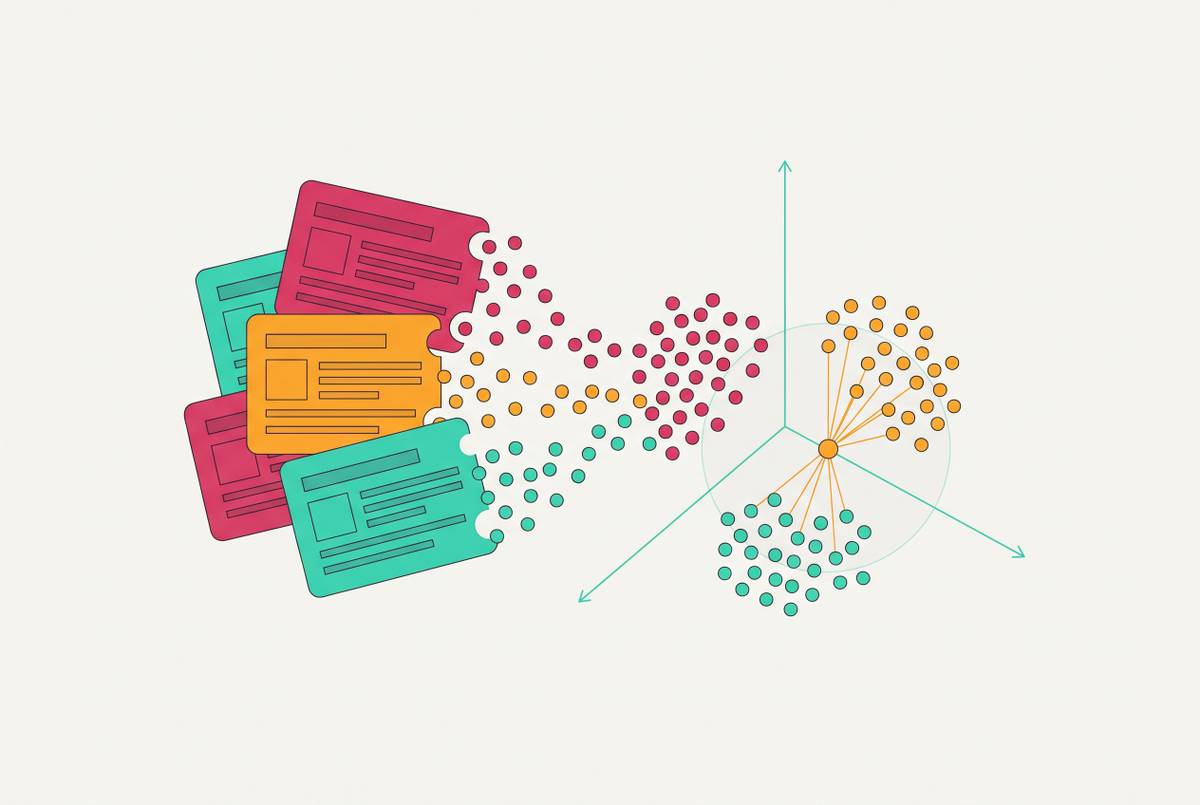
A useful working model is a brand node with spokes connecting it to products, people, attributes, and relationships. Each connection can be expressed as a triple, consisting of a subject, a relationship, and an object. A brand has a product, for example. Together, these connections form a knowledge graph, a network that makes relationships explicit.
Google, Microsoft, and AI systems use knowledge graphs to understand what words mean in context, beyond what individual keywords tell them. The graph is a way to organize evidence. Without explicit connections, Product A, Whitepaper B, and Press Release C can appear as separate pieces of information even though they belong to one organization. Familiarity to a human reader does not resolve that fragmentation for a machine.
This is where entity authority becomes useful. It describes how confidently an AI system can identify, classify, and cite an organization as a distinct, trustworthy entity. Structured data on the owned site supplies explicit relationships, while independent sources corroborate them. Academic papers, press coverage, and government sources show that others see those relationships too. The Ali et al. study gives this mental model a diagnostic use, directing attention toward uncertain parts of the graph where factual accuracy is likely to be weak.
Why structured data consistency — not volume — is what collapses decoder uncertainty
More pages do not necessarily provide more certainty. If they repeat conflicting product descriptions or point to different organizational identities, they add information without resolving which account is true. Independent agreement does something different. When the same factual triple appears in more than one structured source, those sources support one account of the entity and leave less room for competing versions.
Wells Fargo offers a concrete example of this approach. It corrected false statements generated by Google AI Overviews through a combination of semantic Schema Markup and Knowledge Graph linking. The intervention connected explicit facts with their entity relationships. That example illustrates the value of structure, although it does not establish that any particular schema implementation will eliminate every error.
What counts as independent agreement, then? A claim on the brand’s site and matching claims across G2, Reddit, Crunchbase, LinkedIn, and an industry forum can provide corroboration when those sources genuinely confirm the fact independently. But a brand filling in several profiles has not created several independent witnesses. Those statements still share an origin.
This distinction separates consistency from repetition. Conflicting sources can push models toward external consensus or away from citing the brand, while agreement narrows the uncertainty. The brand’s job is therefore not simply to publish more, but to make the same true facts verifiable from independent vantage points.
Where brands break structured data consistency without knowing it
The diagnostic starts with a plain question. Does every source describe the organization as it is today? A current address or product on the brand’s site may coexist with an older version on Crunchbase, G2, LinkedIn, or an industry directory. Each description may look right on its own, but together they cause the facts about the entity to drift.
A second question concerns the external anchor. Is there a canonical Wikidata entry with verified claims against which the other descriptions can be compared? Without that reference point, even well-structured owned content lacks an independent node for triangulation. The same limitation applies when the apparent corroboration consists entirely of the brand’s blog, press releases, and social profiles.
Does information in JSON-LD also appear in visible HTML, and do headings preserve a sequential hierarchy? Schema that says something the reader cannot see creates a split between the machine-readable description and the page. Broken heading levels introduce another kind of ambiguity by making partial information harder to extract and attribute.
Freshness adds a further source of doubt. AirOps’s 2026 State of AI Search report found that pages not updated quarterly were 3× more likely to lose citations. The same report links sequential heading hierarchies with higher citation rates. These recognizable maintenance problems can weaken otherwise correct entity information.
Building cross-source consistency: the owned surface
The practical work begins by establishing the canonical facts on the owned domain. Product names, organizational relationships, expertise, and other factual claims need a clear home before they can be reconciled with external sources. Otherwise, there is no stable account to corroborate. The audit should compare structured data with visible content, then examine the relationships, headings, and freshness that make those facts usable.
The dual-layer requirement is central to that comparison. Information in JSON-LD should also appear in visible HTML, so that direct-fetch behavior in ChatGPT, Claude, and Perplexity does not leave important facts outside the content available at retrieval time.
Organization markup provides the organizational definition, while sameAs points toward Wikidata and authoritative external profiles. Properties including knowsAbout, hasCredential, and citation make expertise, credentials, and supporting relationships explicit. They define connections that the model would otherwise have to infer from body copy.
Those connections also need readable context. Sequential H1, H2, and H3 headings help models attribute fragments correctly when assembling answers, while regular updates signal that the facts remain maintained. An owned-site knowledge graph brings these elements together by explicitly connecting the brand, its products, its expertise, and its industry.
Building cross-source consistency: the third-party corroboration surface
An accurate owned site still speaks for itself. To reduce uncertainty beyond that limit, the same facts need support from sources the brand does not control. External distribution and earned coverage therefore belong in the consistency strategy. Stacker’s analysis found that sharing content with external publications led to more AI citations than publishing on the owned domain alone.
Not all external sources serve the same role. Community sources such as Reddit and video-sharing platforms are present in AI training and retrieval, giving them relevance to the information systems encounter about a brand. Wikidata and Wikipedia provide a different kind of support through an external entity anchor. Academic citations and press coverage add evidence that others associate the organization with its stated expertise.
Earned media also reaches beyond the current retrieval step. It can build associations within the model’s weights between the brand, its category, and its expertise. Schema App’s analysis found that InSinkErator achieved measurably higher visibility on non-branded queries after implementing Entity Linking. That outcome illustrates why resolving topical relationships can help a brand appear even when the user has not named it.
For a team applying this approach, independence remains the constraint. External sources need to support the same product names, descriptions, and attributed relationships, while retaining their own basis for doing so.
The ghost citation problem: why being cited is not the same as being named
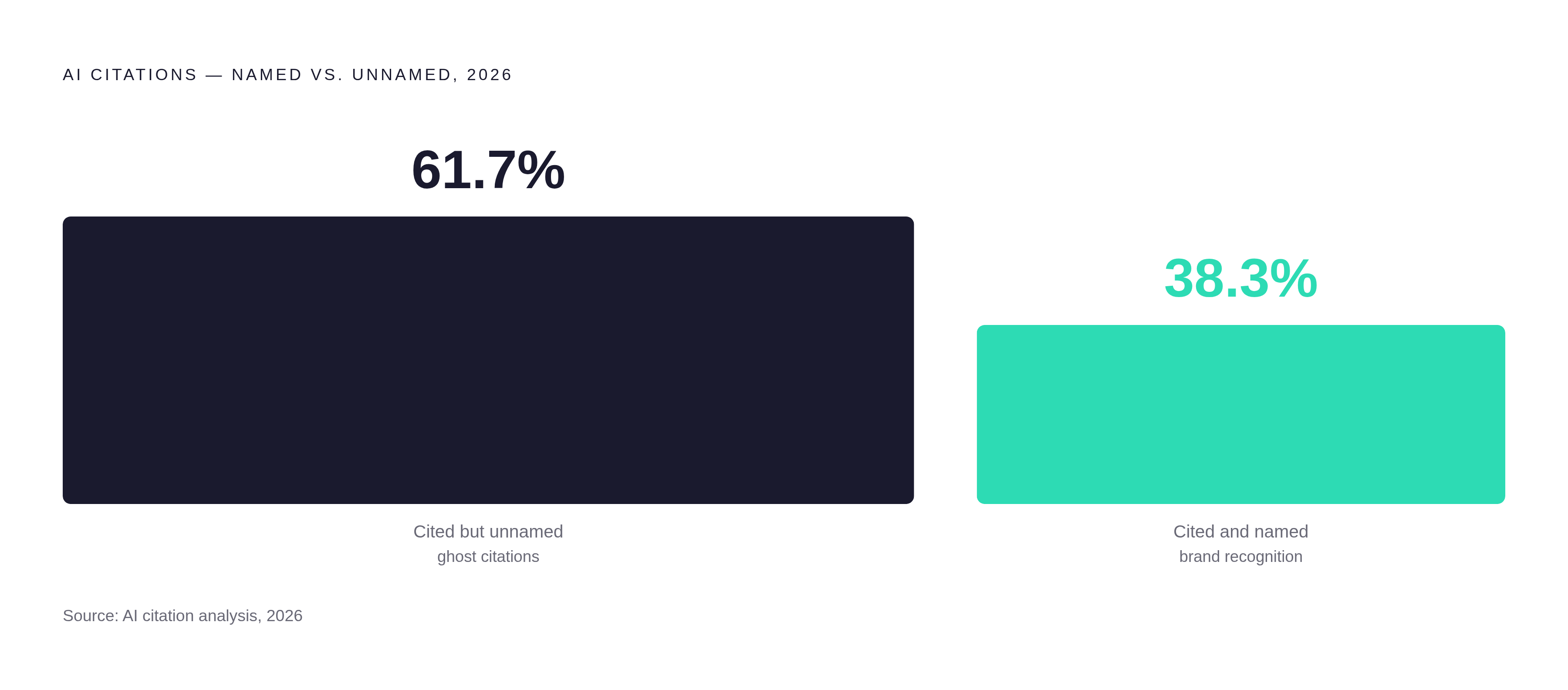
A ghost citation occurs when an AI engine links to a brand’s page but never names the brand in the answer text. In 2026, that pattern accounted for 61.7% of all AI citations.
The gap arises between retrieval and generation. A model can retrieve a page as a candidate source, then use its content while drawing brand names from parametric memory when no source names them explicitly. The brand’s page becomes a footnote, while a competitor appears in the answer body. Citation measures source use, but it does not by itself measure named recognition.
A brand that receives citations on one engine may remain nearly invisible on another, so success on one platform cannot stand in for the others. Ghost ranking introduces a related problem later in the answer. A system may cite the brand’s content, or even recommend the brand, before steering the buyer toward a competitor.
These outcomes show why the results of consistency need inspection. Accurate sourcing and named brand association are related but distinct outcomes, with earned third-party content supporting the parametric presence that links an answer to a recognizable organization. Counting links alone leaves that part of the work unmeasured.
Measuring whether the consistency work is actually reducing hallucination
Measurement starts with a set of buyer-intent prompts chosen to cover the brand’s category. The recommended protocol is to run them regularly across ChatGPT, Perplexity, Gemini, Claude, and AI Overviews, then track changes in citation and mention rates. Share of Model belongs in this record as a measure of AI visibility over time. Each appearance also needs classification as citation-only, mention-only, or both.
Those categories guide the next investigation. Citation-only results suggest that named association is still weak, while mention-only results suggest that structured sourcing is missing. Neither category should be mistaken for a complete diagnosis on its own. The answer text still needs inspection to establish whether the model has described the brand correctly and connected it to the right evidence.
A separate hallucination audit supplies that factual test. Periodic prompts about the founder, headquarters, current products, and pricing should be compared with the canonical source of truth. This makes new errors visible before they propagate into further content. Web mentions also belong in the measurement stack as a leading indicator, rather than treating completed schema implementation as the final result.
The evaluation needs time to register changes. Schema indexing takes weeks, and knowledge graph connections take longer as AI systems check claims about the entity across sources. A measurement cadence that ignores that lag can make correct work appear ineffective too soon. The useful endpoint is an observable change in what the systems say, which facts they get right, and whether the brand is named as well as sourced.