Knowledge Graphs Are Entity Infrastructure, Not an SEO Trick
AI systems need to recognize your brand as a distinct entity before they'll cite it.
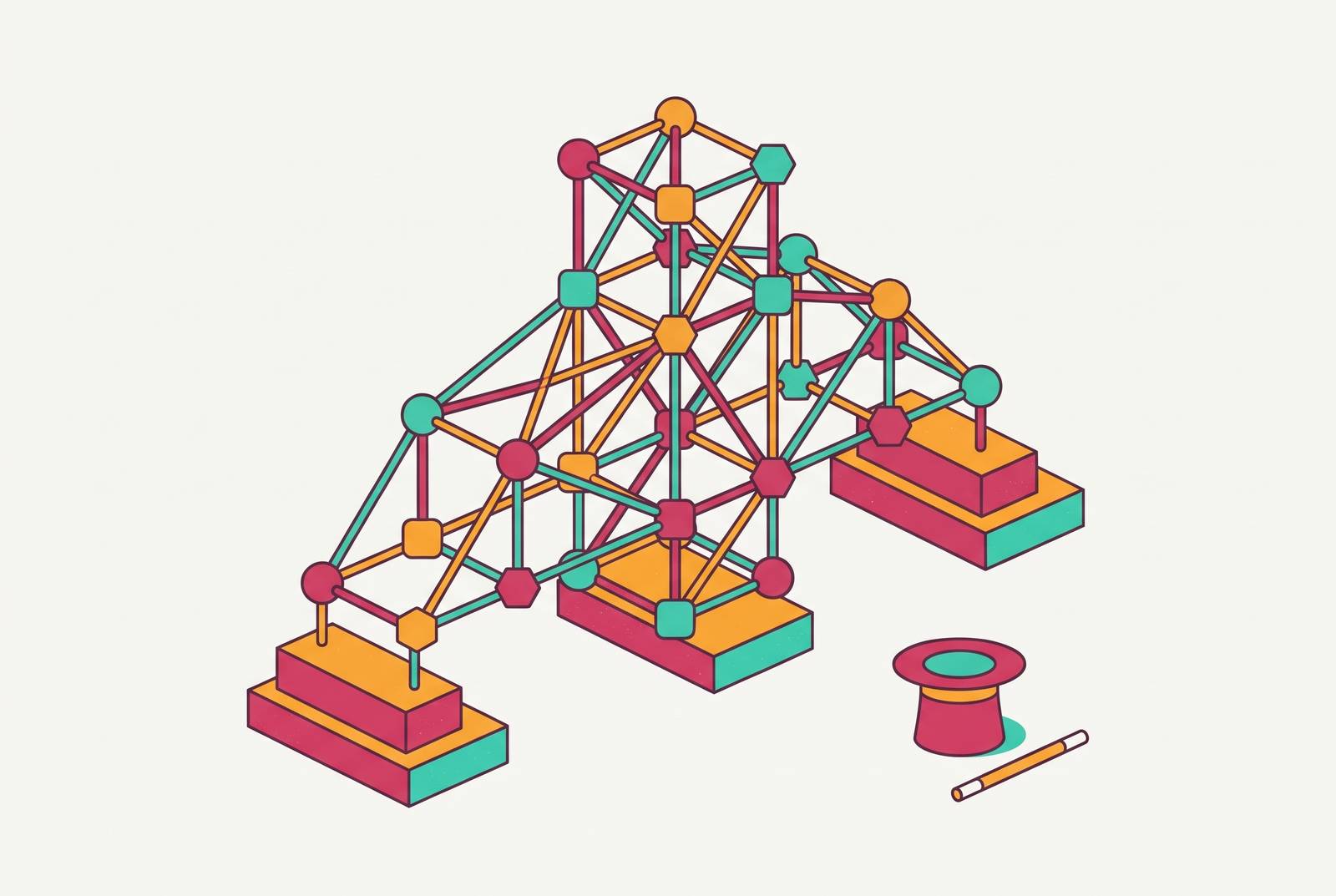
Knowledge graphs are entity infrastructure. They help AI systems establish what a brand is before deciding whether to trust and cite it. That makes machine-legibility a structural property of a site and its public identity.
Why knowledge graphs exist and what they actually store
A knowledge graph is a database of entities and typed relationships. Its nodes stand for entities, its edges name relationships, and its attributes hold properties such as founding date, headquarters and category. Facts are stored as subject-predicate-object triples. Stable machine identifiers, such as an MID or Q-ID, let the graph track an entity independently of the words used to find it.
LLMs store knowledge in a different way, spreading it across model weights. That distinction explains why graphs can be introduced at retrieval time to ground an answer. Microsoft Research’s GraphRAG provides a concrete implementation of this pattern. Search engines use entities to interpret queries, while a generative system can also use retrieved graph information to support its answer. When two similarly named companies become confused, disambiguation may resolve the confusion.
How Google's Knowledge Graph became the substrate AI answers run on
Google pruned billions of entities from its Knowledge Graph in June 2025 to prioritize quality for AI applications. Sparse or inconsistently signaled entities can be removed from infrastructure that supports Gemini and AI Overviews. The graph is therefore not merely a record behind a search-results feature. Its upkeep affects which entities can ground answers being generated now.
Google launched the graph in May 2012 under “things, not strings.” The shift since then concerns what depends on it. Gemini resolves queries against the entity layer before generating answers, making recognition upstream of citation selection. Being in an online encyclopedia can still help with resolution even when that encyclopedia is rarely one of the cited sources. Wikidata’s structured statements also feed the graph, although its entries remain subject to notability rules and community deletion.
What entity resolution actually does before a citation is ever chosen
What must an engine know before it can judge authority? It first needs to establish the brand as a distinct concept, distinguish it from others and associate stable facts with it. These checks form a gate. Recognition comes before the judgment that an entity is authoritative enough to cite.
Once identity is established, a structured record supports other tasks. Fact-checking can compare a generated founding date or headquarters claim against that record. Multi-hop reasoning can follow several relationships to answer questions that one keyword search cannot answer. As a diagnostic example, an “OTHER entity” classification would raise a different question from a weak ranking. Has the system understood what this brand is, or merely detected a name?
Why brand mentions correlate with AI citation more strongly than backlinks do
Brand mentions align more strongly with AI citation than backlinks because they help establish the entity across sources. The asset is a name consistently attached to corroborated facts. This changes the order of marketing work. Building authority before fixing recognition leaves the prerequisite unresolved, however strong the domain’s link profile may be. Correlation points toward a different foundation from the link graph.
Does high domain authority settle the question? It concerns ranking among search results. A strong domain can still have a sparse or inconsistent entity record. Measurement also needs to distinguish two outcomes that often get conflated. A mention names the brand without necessarily linking to it, while a citation links to a source used to build the answer. An engine can do either without the other.
What the entity home is and why consistency across the web is not optional
For a team facing that recognition gap, the structural starting point is the entity home. This is a single canonical URL, usually the About page, where algorithms can resolve the brand’s identity. It holds the Organization structured data, a stable identity reference and declarations connecting the brand to its other profiles. The page anchors the claim of identity. It does not make the claim independently trustworthy.
Google looks for agreement across multiple independent sources. When company names, founding dates or descriptions conflict, the record stays unclear, even if each source looks trustworthy on its own. Resolution draws on descriptions that agree across platforms, the right Organization, Product and Person schema, trusted third-party databases and content on the topic. Contradictory external facts can cause citation suppression even for teams publishing excellent content with flawless markup.
How citation sourcing differs across ChatGPT, Gemini, Perplexity, and Claude
Yext’s large-scale citation study found that most Gemini chat citations come from websites that brands own, the highest share among the major engines studied. Claude also calls for authoritative brand-owned pages, while ChatGPT draws more on community and third-party corroboration. Reddit takes the largest single share in the sourcing pattern described for ChatGPT. These differences favor a layered presence.
Perplexity adds a stronger live-retrieval dimension through its Sonar pipeline. Sonar Pro’s Pro Search mode runs multiple sub-searches per question, while the base Sonar Pro model retrieves from more sources per query. Fresh primary data has particular value in that setting. The strategy therefore branches by engine, but the identity should not. Each source still needs to point back to the same recognizable brand.
A citation does not always bring referral traffic, either. Perplexity is the most consistently trackable major engine for referrals in GA4, while ChatGPT and Copilot also produce trackable referrals with less consistency. For other answer experiences, citations can function chiefly as brand impressions. That makes managing the brand part of generative engine optimization, alongside its role as a performance channel judged by clicks.
Why grounding pages are the content form that entity infrastructure actually serves
A grounding page gives a retrieval system facts it can extract and cite. In retrieval-augmented generation, the engine retrieves documents, resolves them against known entities and generates an answer supported by retrieved material. The page supplies evidence for that process. It is designed around extraction rather than only around a human scanning toward a conclusion. “Phantom site” and “ground site” are practitioner terms for related machine-facing content, but the useful distinction is what the page lets an agent recover.
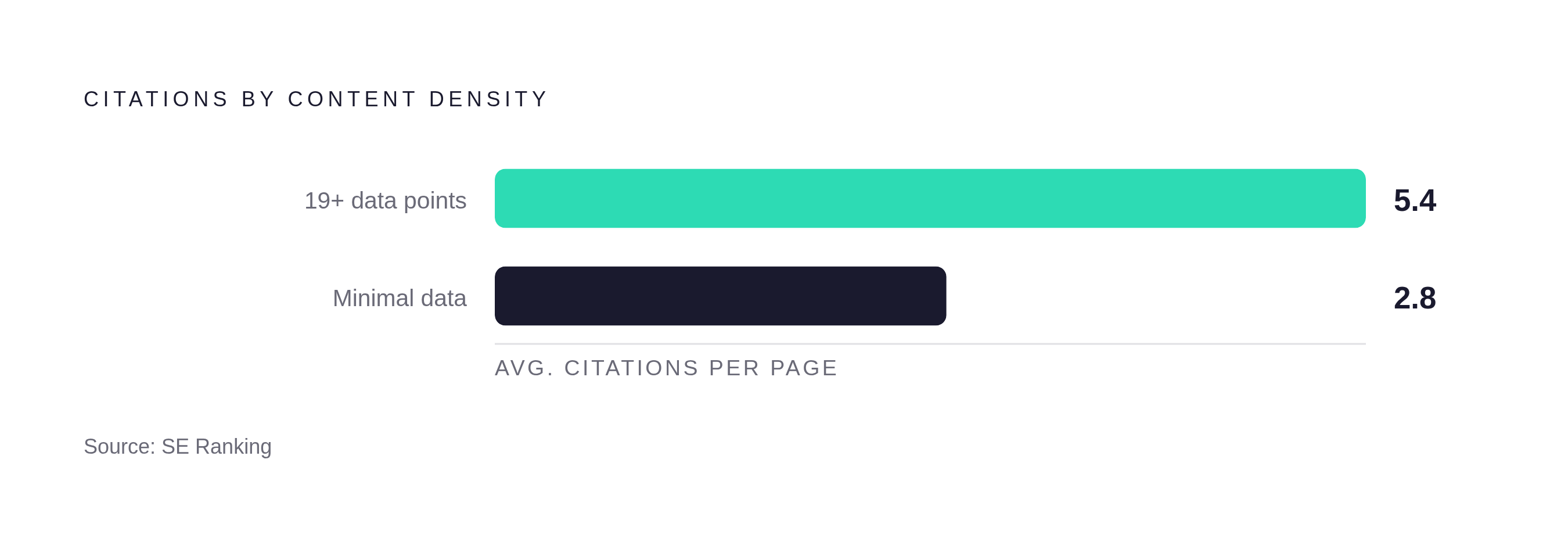
Pages that are easy to extract from have short sections with clear labels, give direct answers at the start and use claims with numbers. Sentences name their subjects so they remain intelligible outside the surrounding paragraph. Short sections must still contain enough substance. SE Ranking’s data found that pages rich in statistics, with 19+ data points, averaged 5.4 citations versus 2.8 for pages with minimal data. That association supports factual density.
What if very few citations generate clicks? A citation can still be the brand’s only touchpoint when the session ends inside the answer engine. That changes the return being assessed. Because engines read across a site, one carefully prepared page cannot make up for content that is hard to extract everywhere else. Teams then need to keep these qualities across pages while keeping the facts right.
What a content pipeline built for AI citation looks like in production
A citation-oriented pipeline separates ideation, research and briefing, drafting, editing, production and publishing. The purpose is not simply more output. Mechanical work can be automated while human judgment remains concentrated where accuracy and identity are determined. Editing is intentionally human-intensive because AI-drafted claims can contain outdated information or fabrication. A page intended to serve as a source of truth cannot treat fluent prose as proof.
The editing stage connects production directly to entity infrastructure. It checks whether claims are supportable, brand facts agree with the entity record, and passages can stand alone when extracted. Production then preserves those properties in the published page. This makes machine-legibility a repeatable quality of the site.
Measurement completes that process across ChatGPT, Claude, Gemini, Perplexity and Google AI Overviews. Brand mentions and linked citations need separate tracking because they can move independently. One response is not a stable benchmark. AI answers change, and so do citation patterns as models retrain and context windows change. Cadenced, automated measurement offers a more useful signal than a one-time audit or a count of pages shipped.
The strongest objection: does optimizing for extraction create a signal trap in traditional search
The signal-trap objection asks whether pages designed for machine extraction could weaken the experience or signals that support traditional search. A page optimized for isolated factual passages is not necessarily the best page for every human task. Nor does citation success promise stable visibility. The volatility already described makes it risky to redesign a content program around a brief run of favorable answers.
Entity infrastructure is a site-level property, while grounding pages are one content form within it. Ranking pages can remain part of the site as identity and extractability improve. The tradeoff is therefore about which form serves which purpose across search and AI.
Generic AI-generated text repeats what models have already learned, so making it easier to extract does not add new evidence. The risk of Model-collapse also helps explain why AI developers are setting higher standards for quality. For brands, the durable contribution is something the model cannot simply reproduce, such as original survey data, proprietary case studies or named expert opinions from real conversations. Entity infrastructure can make a source recognizable. Original evidence gives that source a reason to be cited repeatedly.
What treating machine-legibility as infrastructure changes about how a brand is built
Wikidata entries can go stale, identity pointers can break, and third-party profiles can drift apart. The June 2025 pruning shows why being recognized in the past does not guarantee a lasting place in the graph. Maintenance therefore belongs with measurement and publishing. A brand’s public definition needs upkeep wherever systems look for corroboration.
This also brings category creation and entity creation closer together. Both require a clear account of what the brand does, a consistent name for it and independent sources that support the definition. A team can start by querying Google’s Knowledge Graph Search API for its current resultScore confidence ranking. A team can then audit identity links across its main corroborating sources, locate conflicting facts and fix them before investing in content volume. That sequence puts recognition ahead of amplification.
Ongoing mention and citation tracking then tests whether the work changes the brand’s presence in answers. Where it does not, the investigation can return to identity, corroboration, sourcing differences and page extractability, keeping a busier content calendar a secondary consideration. This makes machine-legibility an operational property with evidence behind it. When agents become the front door to discovery, building a brand includes making its identity dependable enough for those agents to use.