Semantic Content Engineering: What It Actually Means for Developers Building Marketing Systems
Developers need to build infrastructure that makes content machine-readable for AI systems.

Semantic content engineering is the work of making content retrievable and usable as a source by AI systems. For developers building marketing systems, the central problem is not better copy but better infrastructure. Content needs a data model, explicit relationships, accessible interfaces, and a publishing pipeline that preserves those properties. Developers are better positioned than SEO teams to build that foundation and measure whether it works.
Why AI answer engines retrieve content differently from search crawlers
Search crawlers index pages, while AI answer engines retrieve evidence that they can use in a generated response. That evidence can come from CMS content, product catalogs, knowledge bases, and schema-annotated HTML. The unit of retrieval is often a chunk of a page. This changes what selection means for the publisher. A page can be useful as a destination without supplying a passage that works as evidence outside its original setting.
Retrieval-augmented generation, or RAG, explains the distinction. A retrieval component identifies relevant evidence and supplies it as context to a generative model, which incorporates that context into its answer. The publisher is therefore competing for inclusion in the evidence set. Even when the source is a conventional web page, the answer engine uses it differently from a reader following a search result.
Does a strong organic ranking guarantee a place in that evidence set? It does not, because ranking and answer inclusion are different outputs. Gartner’s February 19, 2024 forecast predicted a 25% drop in traditional search engine volume by 2026 as more queries went to AI chatbots and other virtual agents. That projection describes an aggregate shift in discovery. A search ranking alone cannot show whether an answer engine retrieves, uses, or cites the content on the page.
Why this is an infrastructure problem, not a content-quality problem
A well-written explanation cannot help an AI system that cannot access or parse it. Product catalogs, knowledge bases, and CMS layers can all contain useful information while exposing it in forms that are difficult to retrieve or trust. The bottleneck sits below the prose itself. Content locked in images, PDFs, or script-rendered elements can be hard to access, while robots.txt rules can block AI crawlers outright.
Teams therefore need to check whether the content answers a buyer’s question and whether the system can obtain the answer and understand what it describes. A clear product description and an accessible product description are not the same property, just as an accurate brand claim and a consistently identified brand are not the same property.
There is a second gap between preparing content and observing its use. Publishing structured Q&As or adding schema markup shows that a team changed the content, but does not prove that an AI system used it in an answer. Teams need to measure the results to know whether those changes worked. This makes the problem broader than a missing tag or an unsuccessful article. Developers are better positioned than SEO teams to address it because the remedy lives in the data model, the schema layer, and the API surface.
Treating content as a typed, queryable data layer
In a page-based model, content is mostly a document laid out for display. In a data-based model, it consists of typed components with metadata and explicit relationships that can be assembled into pages or retrieved separately. The page becomes one presentation of the data. Content engineering connects marketing strategy to CMS infrastructure by making those components reusable without stripping away their meaning. Engineers need to define what each component represents, what describes it, and how it connects to other components.
Chunkability follows directly from that model. If a retrieval system selects passages, each passage needs enough context to make sense on its own. A paragraph that mixes three unrelated ideas is a poor grounding candidate because its boundaries do not match its meaning. H2 headings can serve as thematic anchors, while H3 headings identify sub-aspects beneath them. Short, self-contained paragraphs then give the retriever whole units that make sense without the rest of a long document.
Identity needs an equally explicit model. Organization schema can state an accurate name, URL, and logo, with sameAs properties linking to Wikidata, LinkedIn, and Crunchbase. These links help corroborate which entity the content describes. A Wikidata entry provides a useful structured-data signal, but its absence does not make a brand invisible. Recognition can also come from pre-training data, Wikipedia mentions, schema.org markup, and other authoritative sources. The data across those sources and the About page needs to be consistent.
Instead of assigning one keyword to one page, entity-based optimization maps related concepts and makes their connections explicit. The way a content cluster is built can then help it support related queries without repeating phrases. For developers, the useful framing is a network of content objects. That shift also changes the intended output from long-form pages measured mainly by clicks to modular assets whose use can be measured through attribution and citation.
Specific infrastructure primitives that make content machine-readable
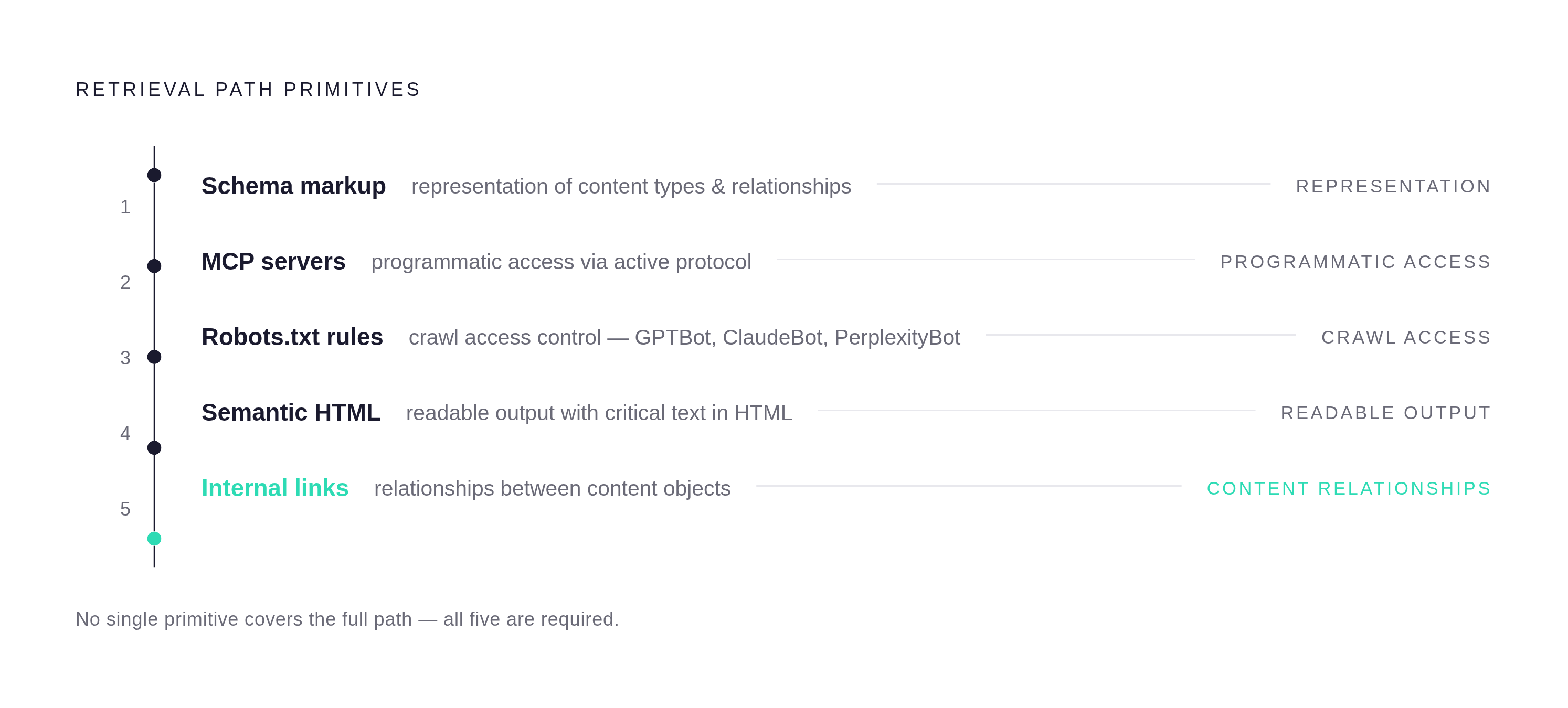
Schema markup expresses content types, attributes, and relationships in a machine-readable form. It supplies explicit structure that prose alone leaves a system to infer. Organization schema is one use of that layer, while the broader content model sets out which properties belong to each component. The implementation goal is a correspondence between the stored content and its exposed structure. Schema should describe the content that exists, rather than become a separate account of it maintained after publication.
MCP servers expose content and data through an active protocol interface that AI agents can connect to and query programmatically, providing an access path alongside rendered pages. Its role differs from schema markup, which describes the content. The two primitives address different parts of the same retrieval path, namely how an agent reaches information and how that information is represented.
Robots.txt rules allow or deny access to named crawlers. For a team seeking AI retrieval, those rules should not unintentionally block GPTBot, ClaudeBot, or PerplexityBot. Rendering is a separate part of access. Server-side rendering puts critical content into HTML, while semantic HTML exposes its document structure instead of leaving the information dependent on images, PDFs, or script-rendered elements. If the goal is to be quotable by AI crawlers, critical text needs to be present in the HTML they can retrieve.
Internal links show how content objects relate to each other on the published site. A cluster page about schema markup linking to a pillar on technical SEO can signal a conceptual hierarchy as well as provide navigation. The hierarchy must match how the subjects relate to each other. Otherwise, the links show how pages are arranged without making clear how their ideas connect. Together, these primitives cover representation, programmatic access, crawl access, readable output, and the relationships between pieces of content.
Wiring structure into the pipeline at authoring time, not after publish
The data model becomes useful only if publishing preserves it. Retrofitting schema and metadata after publication leaves structure outside the process that creates and changes content. Each new piece then needs to be fixed after it is published. The architectural alternative is to enforce schema, metadata, and chunkability constraints before content ships. This resembles type safety, because enforcing a schema at write time catches errors before they require remediation in material that has already been indexed, cited, or overlooked.
An agentic content pipeline makes that need more visible. Specialized agents, typically handling research, drafting, criticism, and publishing, operate against a CMS as the source of truth. Schema-aware tools keep their work tied to the content model, while human review controls meaningful transitions. Automation does not remove the need for those boundaries. Automation makes it more important to define when a proposed change becomes an accepted change, especially when one operation can affect many content components.
Contentful runs bulk AI changes through a review screen where a team can approve, decline, or adjust suggestions before applying them. The review is not merely a final glance at the wording. For regulated content, the minimum review pattern has two discrete stages, with a marketing editor assessing tone and CTA clarity before legal or compliance reviews claims, terms, privacy text, and legal language.
Those stages need to be mandatory parts of the pipeline. Meeting the schema rules alone cannot show whether a page adds value or whether its claims are appropriate. Google’s spam policies target scaled content abuse, meaning large volumes of pages produced without adding value for users, regardless of whether AI, people, or both created them. A team publishing at scale without pipeline-level schema enforcement accrues retrieval debt, while neither copyediting nor retroactive tagging can easily repair the underlying process.
Measuring whether AI systems actually retrieve and cite what you publish
Traditional rank trackers show where pages rank in search results. They do not show how a brand appears when someone asks ChatGPT, Perplexity, Gemini, or Claude a question. That is a different surface to observe. Schema and pipeline work can make content eligible for retrieval, but eligibility is not evidence of use. An engineering system therefore needs a feedback loop that connects what it publishes to what answer engines actually return.
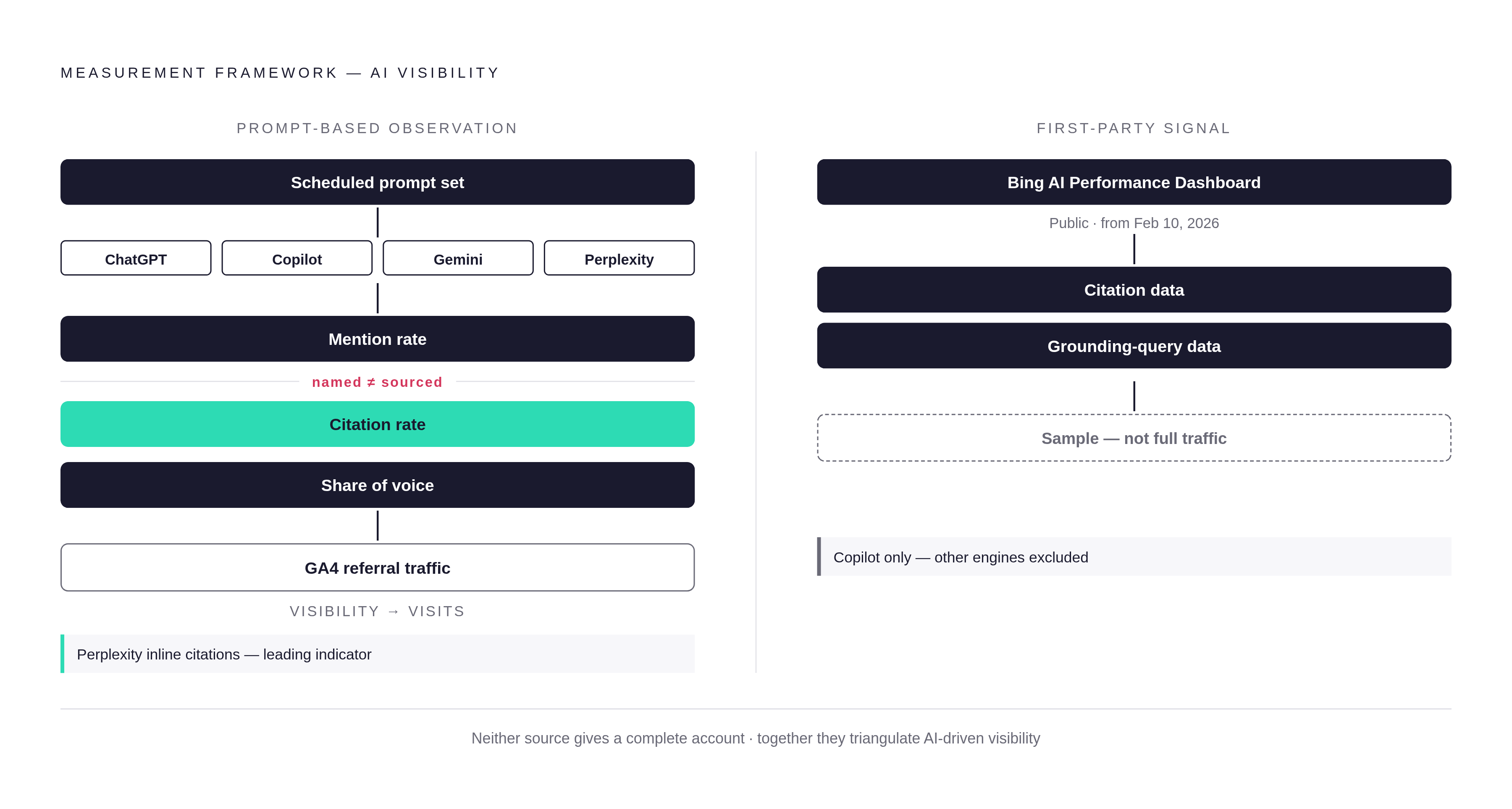
The measurement method starts with a fixed set of buying-intent prompts run on a schedule against ChatGPT, Copilot, Gemini, and Perplexity. Each answer is logged for brand presence, position within the answer, sentiment, and whether it cites a link to the site. Those observations support mention rate, citation rate, and share of voice against competitors on the same prompts. Using the same prompt set keeps the basis for comparison steady. It also separates being named in an answer from being credited as a source.
The Bing AI Performance Dashboard, public since February 10, 2026, provides first-party data on citations and grounding queries. Microsoft explicitly notes that the dashboard shows only a sample of actual citation activity, providing a signal of that activity. That limitation belongs in the interpretation of the data rather than being lost when the results reach a report. Results from prompts and first-party citation data show different sides of visibility, and neither gives a full account of every answer a user receives.
Perplexity’s inline citations make it a useful leading indicator of whether structured content is being retrieved and can translate brand visibility into referral traffic visible in GA4. Referral traffic adds a further observation beyond a recorded mention. It helps connect answer-engine visibility to visits and, where tracked, agent-referred conversion. Engineers need to instrument prompts, log responses, and follow citation trends on a cadence. If AI visibility cannot be observed, it cannot be improved deliberately, and treating it as a measurable output is what separates infrastructure thinking from an SEO checklist.