Why vertical-specific content agencies are the wrong answer to a distribution problem
Distribution through AI citations matters more than vertical expertise or content volume.
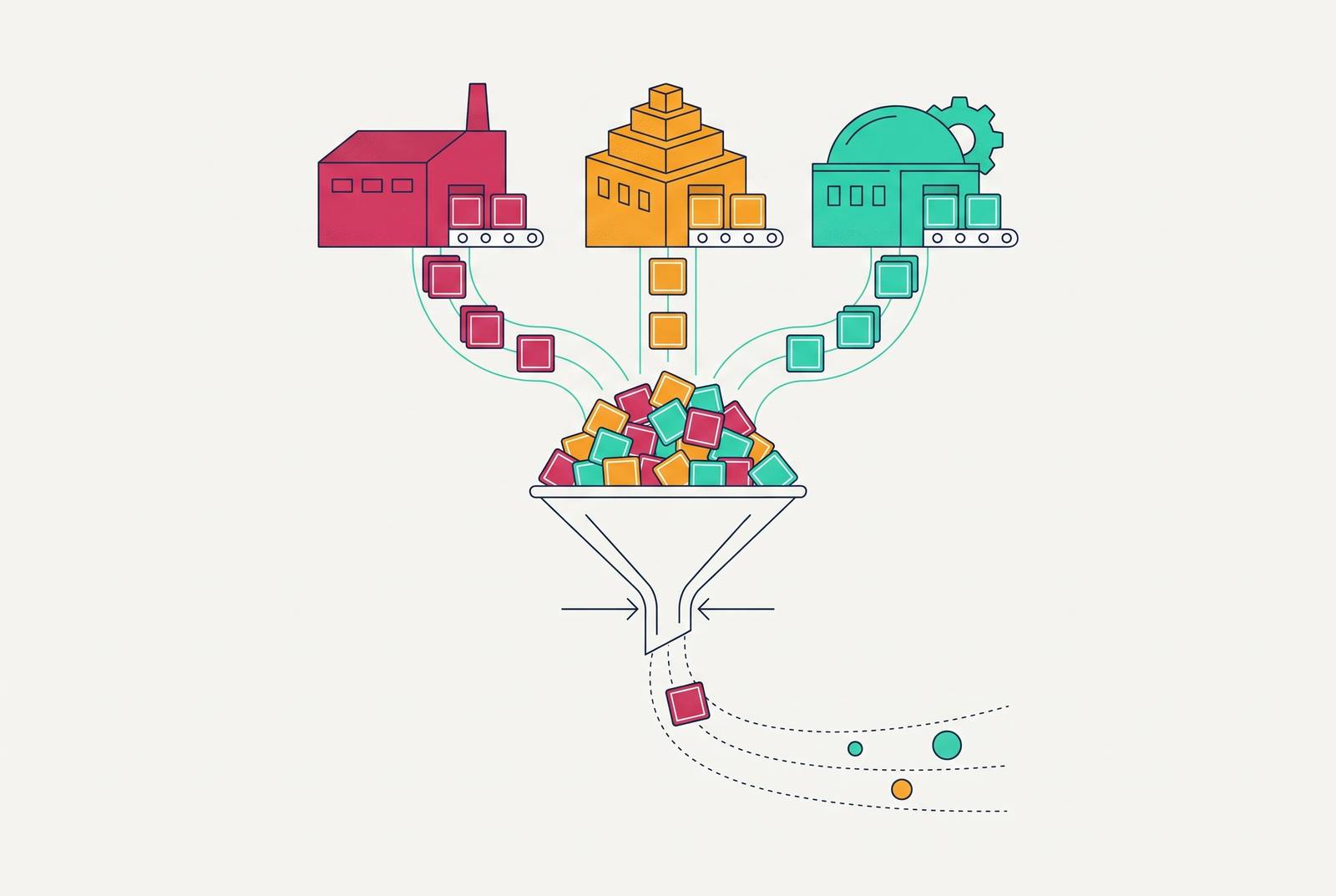
Vertical-specific content agencies provide writers who know a niche well enough to write about it credibly. AI discovery poses a different question. Who gets cited when a buyer asks for options? The answer calls for a programmable, measurable distribution system, with expert review inside it, rather than a content service whose main output is more pages.
Why AI answer engines, not agencies, are now the front door to B2B discovery
A buyer can ask an AI answer engine which products to look at before visiting a vendor’s website or opening a search bar. The answer can shape the shortlist before a ranked link gets a chance to compete. That changes where discovery begins. For a B2B marketing team, the question is no longer only whether a page can attract a visitor, but whether the brand enters the buyer’s consideration at all.
Similarweb’s 2026 Generative AI Brand Visibility Index found that 35% of US consumers use AI at the product discovery stage, compared with a much smaller share using traditional search. That is consumer evidence, not a direct measure of B2B buying. A strategy built around visits to an owned website has a blind spot when people use an answer to decide which websites are worth visiting.
Similarweb’s zero-click research also found that the share of news-related Google searches that ended without a click rose sharply between May 2024 and May 2025, after AI Overviews rolled out. News searches do not establish what happens in every B2B category. The implication is conditional but important. If informational B2B queries follow that trajectory, AI answers absorb some of the traffic that content marketing was built to attract.
The mechanism is Retrieval-Augmented Generation, or RAG. AI systems retrieve candidate documents and synthesize an answer, citing sources they judge authoritative. Indexing lets content be considered for an answer, but does not ensure it gets a citation. Similarweb’s GEO guide frames being cited as the new conversion event, although a citation is not itself a sale. When discovery happens inside the answer, the production question of who writes the content becomes secondary to the distribution question of who gets cited.
What content optimized for Google rankings actually gets you in an AI answer
A Google ranking establishes that a page performs in one retrieval environment. It does not establish that an AI engine will use the page as evidence. The two outcomes have different selection rules. A content program can therefore get the rankings it promised while the brand stays out of answers to the questions those pages cover.
Similarweb’s guide explains that AI engines break pages into passages and evaluate them for relevance, clarity, and trust. The unit of selection is smaller than the page. A keyword-dense long-form post without named sources, structured data, or direct answers can fail that test even when it ranks well. Its position in Google does not settle whether a passage is clear and credible enough to support a generated answer.
Does that mean a good agency can simply adapt its format? Better structure addresses part of the problem. It does not address all of it. AI citation also depends on corroboration across third-party sources and platforms, so a well-structured article on the brand’s domain cannot stand in for a broader body of evidence. The gap extends beyond what an editor can change within a draft.
An agency can produce accurate, useful writing and still be scoped to the wrong outcome. A production brief asks whether the article is ready to publish, while a distribution system must also account for where supporting information appears and whether engines cite it. The architecture treats publication on one domain as the end of the work.
Why third-party citation surface area, not vertical expertise, is the actual bottleneck
Third-party citation surface area means the range of places beyond the owned domain where an engine can encounter relevant information about a brand. It shifts attention from the depth of one article to the breadth of corroboration. More pages on the same website do not automatically create that breadth. A production program can grow its output without resolving the constraint that keeps the brand out of AI answers.
This is why distribution is not just another word for publishing. The owned domain is one source within the broader information environment. Third-party publishers and other platforms create additional places where claims can be supported and a brand can enter consideration.
But what about technical accuracy? In regulated industries, technical infrastructure, and cybersecurity, knowing the subject is key to checking the quality of the work. A mistaken claim does not become useful because it travels widely. Vertical expertise remains essential where the risk of hallucination is high, and a distribution-first argument that dismisses it would confuse reach with reliability.
The distinction is where that expertise belongs. Expert judgment belongs in a human review step that evaluates claims before publication, rather than serving as the organizing logic for the entire agency relationship. Knowledge answers whether the content is sound. It does not, by itself, answer where the content should appear, how its citation performance will be measured, or how the next publication should change in response.
Owning all those functions exceeds the remit of a vertical agency scoped to production. An agency could broaden its remit, but the useful test would then be its distribution and measurement capabilities.
What a brand that actually earns AI citations does differently
AthenaHQ’s case study describes Verito gaining a substantial share of voice on ChatGPT within weeks through AEO fundamentals. Verito began appearing with rivals that had 25–30x its revenue. The example shows the limits of company size and content production volume in explaining who appears in an AI answer, while leaving open whether every small brand can reproduce that result.
Princeton, Georgia Tech, IIT Delhi, and the Allen Institute for AI formalized GEO research at KDD 2024 showing that specific techniques can meaningfully lift visibility in generative engine responses. Adding statistics was among the most effective single tactics. Structure and evidence can change the outcome. That gives content production a clear role in distribution, with each new article’s contribution to visibility depending on its structure and evidence.
Original research and proprietary data offer a particularly useful form of owned content because they contain information that does not exist elsewhere. That gives an engine a reason to cite the original source.
This is also why GEO brings PR, content, SEO, and product marketing into the same task. The description of the brand comes from information across sources, and how accurate it is depends on what those sources say. Coordination becomes part of the work because the answer engine does not respect the boundaries between those teams.
The difference, then, is not simply that citation-oriented brands publish a different kind of blog post. They choose content with an eye to where it will be shared, and sharing it more widely gives engines more chances to find evidence. Named examples make that alternative concrete, but do not turn it into a guaranteed formula. Whether that works for a given brand has to be measured.
Why most marketing teams cannot see whether any of this is working
Standard website analytics cannot fully answer that question because AI visibility is not the same as referral traffic. A brand can appear in an answer without receiving a click. Even a visit can arrive without a clear source. Loamly’s State of AI Traffic Report (2026) says that most AI referral traffic comes from visits without referrer headers, so default reporting does not show those visits as AI referrals.
Similarweb’s guide distinguishes AI answer metrics from organic traffic, keyword rankings, and click-through rate. Those AI metrics are share of model, citation rate by platform, brand mention sentiment, and AI Overview appearance. They do not show up in Google Analytics. A report built around conventional SEO performance can therefore look complete while omitting the outcome the distribution effort is meant to influence.
AI engines rebuild answers and rebalance for diversity, freshness, and coverage, which makes citation share volatile. A brand that appears in Monday’s answer may be gone on Tuesday. A snapshot records an appearance, but continuous monitoring is needed to understand whether visibility persists or changes.
That uncertainty compounds the mismatch in a traditional agency contract. An agency paid to move traffic or rankings has no built-in incentive to surface AI citation performance, even if its writing contributes to those answers. The contract directs attention elsewhere. Without the missing signal, the marketing team cannot connect a change in content or distribution to the channel it is trying to improve.
Teams should “draft fast, review slow,” using generation for structure and coverage, then humans for claims and voice. A hard gate should keep a page from being published if it fails checks on its substance. Otherwise, a pipeline can distribute hallucinated or unverifiable claims more efficiently, which turns speed into a liability.
Review checks whether a claim is sound enough to publish, while monitoring shows whether the published work gets seen. Neither replaces the other. Together, they make it possible to learn from distribution without treating an AI citation as proof that the underlying content is true.
What it means to own a programmable distribution system instead of buying a content service
A team responding to this problem should own a system that connects publishing cadence, third-party distribution, editorial review, and citation monitoring. The team can keep existing tools while owning that system. Under its control, those tools and processes can work together beyond the point where an outside supplier’s work ends. The output is not just a finished page, but a publication whose performance can inform subsequent work.
That requires a different rhythm from a quarterly content calendar. Standing watchers can draft when something relevant happens, while distribution beyond the owned domain builds citation surface area. Drafting is only the first stage. The same process must preserve the review gate, so that responsiveness does not become permission to publish claims before a human has assessed them.
Measurement belongs inside that sequence. The system should track whether ChatGPT, Claude, Gemini, and Perplexity name and cite the brand, broken down by platform, prompt cluster, and sentiment. Those distinctions make the signal usable. A general claim of improved “AI visibility” cannot show which answers include the brand or how those answers describe it.
To connect that signal to action, every capability should be reachable by an agent through an API and composable with the team’s existing stack. The system is an orchestrator. It should work with the measurement, CMS, and pipeline tooling the team already runs, allowing publishing, review, and monitoring to form a designed sequence.
That sequence is how speed and editorial quality can coexist. AI handles structure and coverage, humans judge claims and voice, and a hard gate prevents unverifiable content from reaching publication. Monitoring then provides evidence for the next cycle. Compounding comes from using that evidence to improve subsequent work.
The decisive question for a prospective agency relationship is therefore not merely whether the supplier knows the niche. It is whether the team is gaining a distribution system it can direct, inspect, and improve. Vertical knowledge has a necessary place within that system. It is not a substitute for owning the connection between what gets published and what buyers encounter in AI answers.