B2B SEO in the Agent Era: Why the Stack Matters More Than the Strategy
Indexable infrastructure and AI-readable content matter more than SEO strategy alone.

B2B SEO in the agent era depends less on which strategy a team chooses than on whether its stack can execute it. Content clusters, technical SEO, and generative engine optimization all need infrastructure that publishes promptly, makes claims easy to retrieve, and measures AI citations. Without those capabilities, a strategy can describe how to win discovery without making the brand discoverable.
How B2B buyer discovery actually works in 2026
Perplexity and Google AI Overviews break a buyer’s question into sub-queries, retrieve passages from indexed sources, and synthesize an answer with citations. This is retrieval-augmented generation, or RAG. ChatGPT works in a similar way when its web-search tool is on. The pieces of content the engine assembles into an answer help determine which vendors enter the buyer’s consideration set.
That changes where the shortlist takes shape. Buyers can compare vendors inside an answer engine before visiting any vendor’s website, leaving most GA4 dashboards and attribution models unable to see that early research. A brand omitted from the answer is absent from that shortlist.
Adobe’s 2026 SEO analysis says visibility depends less on where a page ranks and more on whether it gets a citation in AI-generated responses. For a B2B team, the consequence is a different unit of performance. Sessions record visits after a buyer chooses to click, while citation frequency and share of AI-generated answers reveal whether the brand appeared during the research itself.
Why organic traffic numbers obscure the real loss
Aggregate organic traffic decline looks modest year over year, so claims that SEO has collapsed overstate the case. But the total conceals a change in composition. Definitions, tutorials, basic comparisons, and vendor overviews are precisely the informational queries AI Overviews can answer directly. They are also the foundation of much B2B top-of-funnel content.
Not all content is losing the same ground. Original research, detailed case studies, and expert commentary based on first-hand experience are holding up better because they offer information that cannot be found elsewhere. Visitors who arrive through AI referrals also tend to be closer to a decision than top-of-funnel organic visitors. Those visits lead to conversions in different ways, so session volume alone says less about how well the content is doing.
Could a stable dashboard still conceal a discovery problem? Yes, because a stable dashboard leaves open the possibility that a shortlist formed elsewhere and excluded the brand. It means traffic cannot settle the question. Understanding visibility now requires looking at how models recognize brands and where they retrieve evidence.
The two retrieval layers most content strategies address only one of
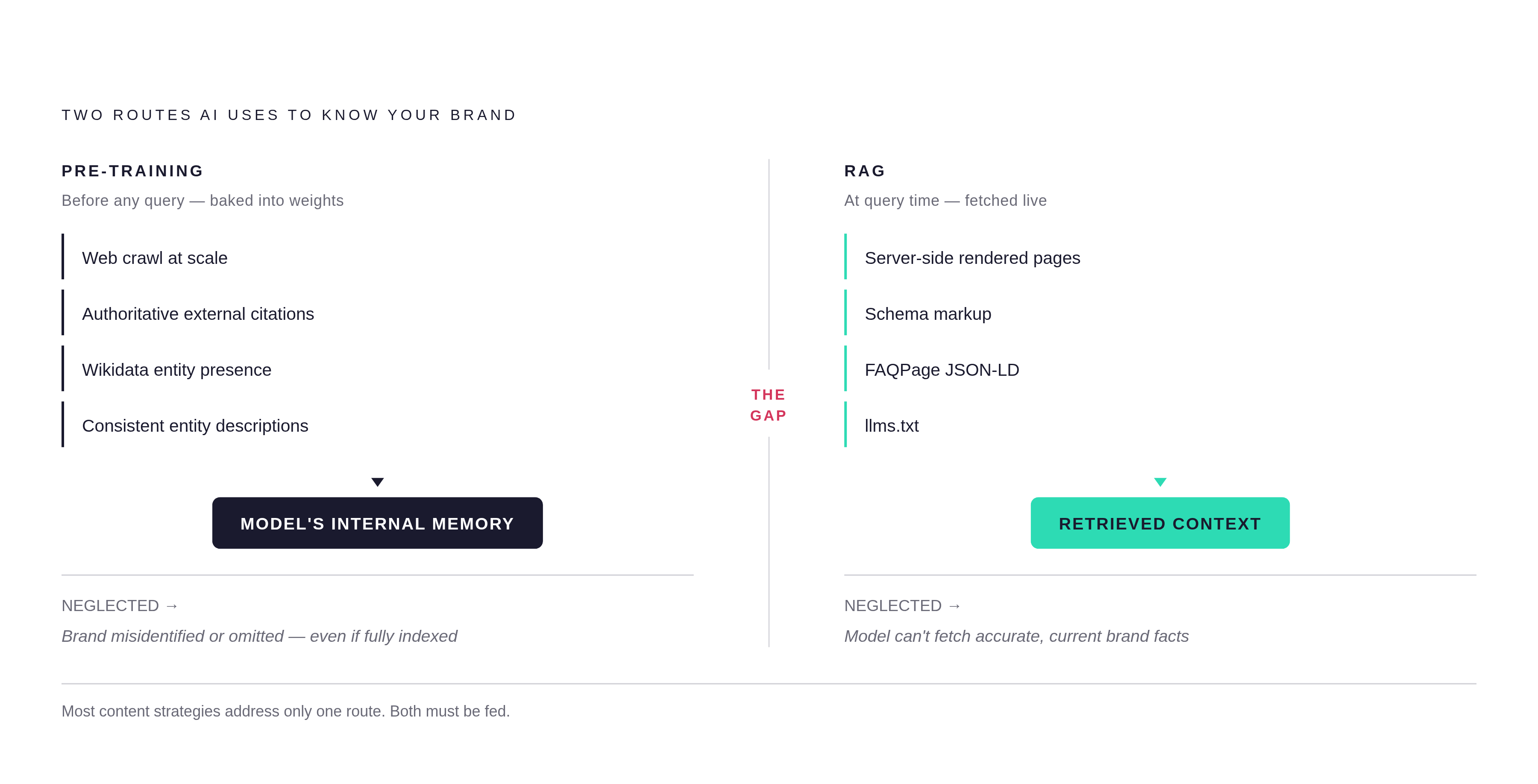
Pre-training and RAG give models two distinct routes to information. During pre-training, a model learns how entities, concepts, and brands relate to one another from a large snapshot of web content. Widely crawled material, authoritative external citations, and clear entity identification support those associations before a buyer asks anything. RAG, by contrast, fetches live or indexed material to ground an answer at query time. It favors accessible content that directly answers the question being processed.
The distinction is between learned associations and consulted evidence. Publishing a page and getting it indexed addresses the second route, but not necessarily the first. External citation seeding, consistent entity descriptions, and Wikidata presence address recognition beyond the owned site. A missing Wikidata entry is a risk. A brand can appear without one, though weak entity grounding increases the chance of misidentification or omission.
Platform differences add another complication. Citation pools share only some sources, so a brand that appears in ChatGPT may not appear in Perplexity. Adobe’s analysis calls for “extractability, verifiability, and contextual clarity,” requirements that span recognition and retrieval. Addressing only one layer resembles optimizing a sales deck for one buyer persona in a committee purchase. The argument may persuade one participant while leaving the others without what they need.
What the crawl infrastructure gap actually costs
A page can look complete in a browser while leaving its content unreadable to an AI retrieval system. Client-side-rendered content creates this failure mode when the text is unavailable to the system fetching it. The editorial team sees a published asset. The retrieval system may not see the claims that justified producing it. Adding more content will not make it readable to the retrieval system.
The diagnostic question is therefore more specific than whether Google can crawl the site. Can the AI retrieval systems that serve buyers read the actual content? Server-side rendering or static HTML makes that content available without depending on client-side execution. Schema markup and FAQPage JSON-LD then provide structured signals that help systems extract claims accurately. These are infrastructure decisions, even when the symptoms look like poor content performance.
Top-10 Google rankers accounted for the majority of AI Overview citations in mid-2025, but a much smaller share by early 2026. That divergence shows why a Google-only audit leaves part of discovery unexamined. A team in that position should assess AI readability directly rather than treating a strong ranking as proof that its content investment reaches every relevant retrieval system.
Content architecture for passage-level retrieval, not page-level ranking
Readable content still needs to survive extraction. When an engine retrieves a passage, sometimes a single sentence, that passage must make sense outside the page around it. A claim whose subject, conditions, or evidence appear only in distant paragraphs is harder to reuse accurately. A self-contained alternative gives the engine a clearer source.
Vercel’s guidance shows how this changes the way teams plan content. Its guidance contrasts traditional volume-based keywords with concept clarity and ownership, recommending low-competition, high-opportunity topics and a definitive, evidence-based source. It also advises against abandoning traditional SEO. The useful distinction is not SEO versus AI visibility, but broad keyword coverage versus a clear claim to knowledge about a specific concept.
For content teams, the lesson is to open each asset with the direct answer it targets and support it with specific, attributable claims. How-to guides and product or feature pages account for a substantial share of citations, while explanatory and comparative content performs better than broad topical overviews. The unit of optimization becomes the passage, while most CMS workflows and briefs still organize work around the page.
The ground-site and off-site seeding architecture that AI-cited brands use
An owned “ground site” gives retrieval systems a structured place to find a brand’s evidence. Server-side rendering, schema markup, and FAQPage JSON-LD support access and interpretation. An llms.txt file can provide a curated index of important pages in plain-text Markdown. It is a community convention. Its role is to help systems find content.
Claims and brand mentions in authoritative external sources build the associations and citation credibility models can learn during training. That work can take place in academic-adjacent research, analyst publications, structured vertical ecosystems, and community platforms. Perplexity and similar engines also retrieve from Reddit and specialist forums, so community presence can contribute to current answers as well as broader brand recognition.
These layers work best when they reinforce the same concepts. A topic cluster can link owned evidence, third-party placements, and community discussion so that each channel describes the company in the same way. Consistency across Wikidata, Organization schema, and trusted publications helps identify the brand as one distinct entity. Without it, citation credit fragments. A focused company with strong recognition in a trusted vertical ecosystem can therefore gain retrieval visibility that a higher-traffic competitor with weak external authority lacks.
Why publishing at crawl speed requires a stack, not a schedule
A citation-worthy content cluster can lose its place when newer, better-structured sources supersede it. AI engines reward recency and continuous topical signals, making publication cadence an operational concern. A calendar assigns work to dates. It does not detect a relevant event, prepare a structured response, route it through review, and publish it when the evidence changes.
That gap explains the emergence of agentic SEO. Autonomous AI can help optimize, audit, and adapt website and content infrastructure as retrieval conditions change. The operational model in the notes is a pipeline with standing watchers that detect relevant events and draft content when they happen. Human review stays a separate step in which people check accuracy and brand voice. Speed is useful only when that judgment survives.
AI drafting does the repeated work of producing and structuring content, while people judge whether it is good enough to publish. Output that is wrong or thin harms citation credibility. Yet even a well-run pipeline cannot establish its own success. Unless the team can see whether engines cite the output, faster publishing merely increases the amount of untested work.
Measuring AI citation instead of assuming it
Measuring citations gives teams feedback on how their publishing, structure, and external authority work together. Rankings, sessions, and organic CTR show parts of search performance, but they cannot reveal all AI-mediated discovery. A brand may retain those signals while losing its place in synthesized shortlists. The missing observation is whether the content enters the answer and how the answer represents the brand.
Adobe’s analysis names citation frequency, share of model, and AI-generated referral traffic as ways to track how well a brand is doing in this setting. Those measures answer related but distinct questions about presence in answers and visits that follow. A citation without a click may be part of the research that shapes the buyer’s shortlist. Referral traffic cannot replace citation measurement.
In practice, teams should run structured queries across ChatGPT, Claude, Gemini, and Perplexity on a cadence. The record should capture whether the brand is named, how it is described, and whether citations point to owned content. Teams need to check each platform on its own because their citation pools differ. The competitive variable is not which playbook a team adopts, but whether its infrastructure can execute the work and verify the result.
Why the agent horizon makes the stack investment urgent now, not eventually
Gartner’s early 2026 prediction says the vast majority of B2B buying will go through AI agent intermediation by 2028, with huge sums spent through agent exchanges. Gartner’s prediction describes how purchasing behavior is expected to develop in the future. But buyers already use AI tools to do research and build shortlists. The forward shift is toward agents evaluating vendors autonomously, making machine-readable evidence an input to a buying decision.
Citation credibility built today can compound into that environment. Brands frequently cited by answer engines are more likely to appear in the knowledge sources agents can access tomorrow. The site must therefore work as a coherent body of evidence. An agent can use content structure, entity consistency, and external credibility to recognize the company and judge it.
For a CMO or content leader, the architectural implication is immediate. Publishing, citation monitoring, and schema updates should be reachable through APIs. Strategy documents do not ship. Stacks do. The brands positioned to earn agent citations in 2028 are the ones building the infrastructure for those citations now.