What an SEO services quote doesn't price: the cost of a page an AI answer engine can actually cite
A ranking-focused SEO quote leaves out the cost of being cited.

An SEO services quote prices the work of winning search rankings. It does not necessarily price the work of making a page retrievable and citable by an AI answer engine. For buyers, the distinction comes down to the deliverable. A useful engagement leaves the brand with content it owns and evidence that the content works in the channels its buyers use.
Why a standard SEO quote is built around the wrong deliverable
At invoice review, the line items look familiar. There are hours, link placements, keyword targets and rank-tracker seats. Each has an understandable purpose within an engagement built to win a position on a results page. Yet a buyer’s customers may ask an AI answer engine to explain a problem or compare options, then read its answer and the sources it cites. The invoice may not tell the buyer whether the brand appeared.
The gap is in the goal itself. A rank measures a page’s position in search results, while a citation places a source within an answer. The two disciplines share technical foundations, but they differ in what a successful page looks like, how success is measured and what work keeps it useful. Traditional SEO is an incomplete purchase when the buyer expects the same contract to deliver AI visibility without a separate scope.
How AI answer engines decide what to retrieve and cite
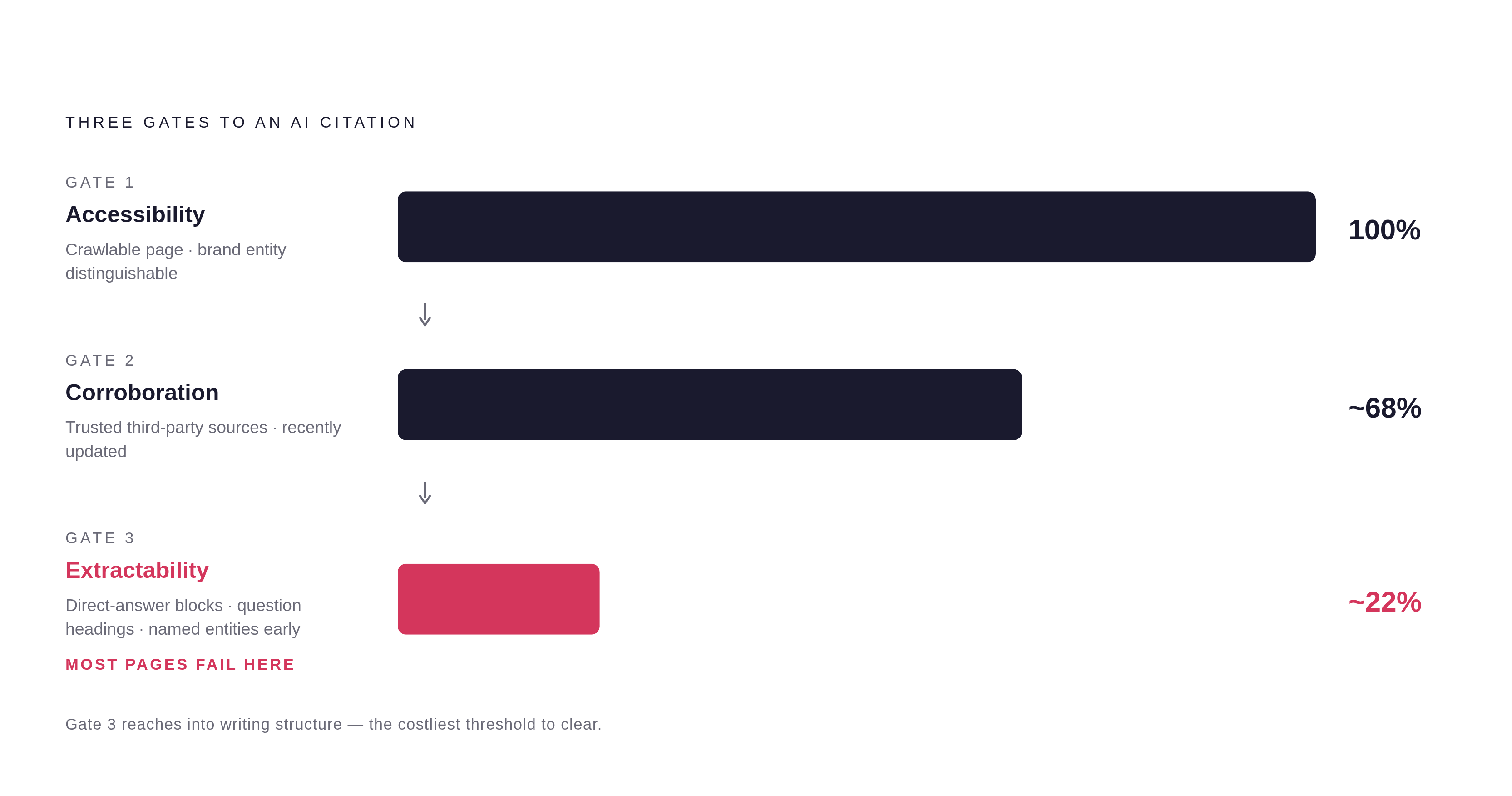
Crawlers must be able to reach it, and the brand entity must be clearly distinguishable from other entities. The answer must then be liftable as a clean passage, supported by corroboration from trusted domains and recently updated. Access is only the first gate. A technically reachable page can still fail to offer a passage that an answer engine can readily use.
The third gate, extractability, is where most pages fail. Clearing it requires more than putting the right subject somewhere on the page. It calls for a direct-answer block near the top of each major section, headings framed as questions and named-entity density early in the text. Those properties give the page a different structure from one that merely discusses a keyword at length.
That distinction explains why extractability is the most expensive gate to clear. It reaches into the writing and organization of the page, rather than stopping at whether a crawler can access it. A page may still need a lot of editing after its technical SEO work is done. Ranking well does not settle that question. Nor does it establish that trusted sources corroborate the claims the page asks an engine to cite.
Even a page that passes those tests has an ongoing cost. AI Overview content changes frequently for the same query, and citations are often replaced with new sources when the answer changes. Priority pages need to be refreshed from time to time after they are first published. Freshness belongs in the production budget from the start, because the asset must remain useful after its first appearance.
Why owned-site work alone cannot close the citation gap
The majority of AI citations trace back to third-party editorial sources. Earned media, trade coverage and review platforms form a large part of that source pool. A contract limited to the client’s website leaves this broader citation surface outside its scope.
Does that mean owned pages are a poor investment? The mix changes with the question being asked. For informational branded prompts, a brand’s own pages can still account for a substantial share of citations. Third-party sources take the lead at the consideration stage, when buyers weigh their options. The distinction prevents a blanket conclusion about which source type is best, while exposing the limits of a domain-only engagement.
The practical consequence is a wider scope of work. A brand’s citation presence spans its owned pages, third-party editorial coverage, review profiles and community presence. A standard SEO engagement does not bring all those sources into one plan for earning citations. For a buyer, the unresolved question is who will address the sources beyond the website, and under which budget.
What producing a genuinely citable page actually costs to build and maintain
For a content team, a citable page is a pipeline cost. Research and sourcing must feed into drafting, schema work, human review, scoring against extractability criteria and a refresh cadence. Each stage has a distinct purpose. When a fee covers only the finished text, the buyer must find out whether the other stages are included, done in-house or left out.
Princeton University and IIT Delhi’s original GEO research found that citation visibility rose when pages added citations, statistics and quotations that named their sources. Someone must find the material that backs up the claims and add it to the page with clear attribution. Two offers can promise the same volume while budgeting for very different amounts of sourcing and review.
As of mid-2026, the production models include agency retainers with a monthly fee covering four or more articles, and AI-assisted production with a human editor and a scoring gate. The latter combines software costs with one to two editing hours per piece and can support a high monthly volume. It is a legitimate middle path. It reduces the reliance on wholly manual drafting without treating an unreviewed draft as a finished asset.
The human review gate is not optional in that model. AI-assisted drafts that get no editorial review can lead to pages whose structure keeps them from earning citations and that major search engines treat as low-value. Scoring and review make volume viable. The estimate must include their cost to back up the same claim about what will be delivered.
A team must make room for refreshing priority pages. A page published once and left static will lose its citation position as AI answer content changes and replaces sources. For budget planning, that means separating the initial build from the recurring work required to sustain it. Otherwise, the apparent price per article understates the commitment.
The separate budget a GEO engagement requires, and what it covers
GEO, or generative engine optimization, puts these requirements into a distinct engagement. It can cover page structure and research, as well as third-party citation surfaces and ways to measure AI visibility. That is a different bundle of work. The comparison with an SEO retainer is therefore not useful unless the buyer can see which responsibilities each proposal actually includes.
Market pricing in 2026 has not standardized, and it varies with vendor seniority and market timing. Available pricing descriptions are better used for calibration than as a universal rate card. DIY tools and software, for example, require a low monthly outlay for monitoring and drafting assistance, with strategy and execution left to the buyer. The subscription is not the whole cost. The work that the software does not perform still needs an owner.
Building internally also has a less obvious trade-off. The build-versus-buy crossover sits at a revenue scale most growth-stage B2B SaaS companies have not yet reached, making the in-house route less cost-efficient than it may first appear. Comparing a software bill with an agency fee leaves out the internal effort needed to turn tools into a working service.
Guaranteed citation counts promise certainty that variable AI answers do not support. Per-keyword pricing shows that the work is priced around rankings and leaves unclear what is needed to earn citations. A single-engine dashboard leaves visibility elsewhere unresolved, while silence on ownership leaves the deliverable itself unclear.
Why AI visibility measurement is a budget line SEO contracts don't include
Traditional rank trackers are structurally blind to AI mentions. They can show how a page performs in search results without showing whether an answer engine cites it. A buyer relying on those reports alone has no signal about the cited answers customers receive. This makes the gap easy to miss. The reporting can look complete because it measures the channel the contract was built around.
Manual checks do not resolve the problem. AI answer engines are non-deterministic, so the same query asked twice can produce different phrasing and sometimes different sources. A spot-check gives a data point with no error bar. Seeing the brand once does not establish consistent visibility, just as one absence does not establish consistent exclusion. The variability is part of what a measurement system must account for.
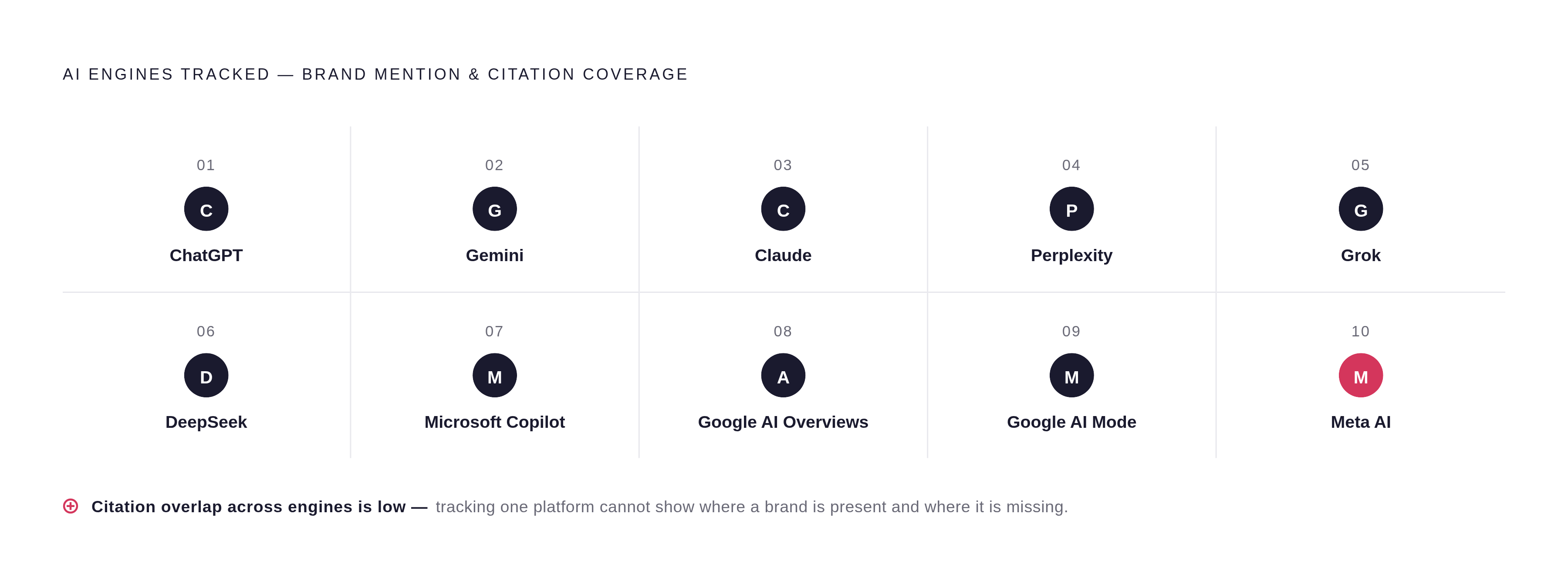
The relevant metric is share of answer. Tracking must cover more than one engine, because citation overlap is so low that looking at just one platform can give the wrong impression. A result on one engine cannot stand in for the others. Where buyers use several, a narrow dashboard can underreport or misattribute the citation gap instead of showing where the brand is present and where it is missing.
Third-party tracking tools need their own line in the budget. Ahrefs Brand Radar tracks brand visibility for a monthly fee. CrunchJunkie tracks brand mentions and source citations across ten AI engines, with plans starting at a low monthly price in 2026. Those engines are ChatGPT, Gemini, Claude, Perplexity, Grok, DeepSeek, Microsoft Copilot, Google AI Overviews, Google AI Mode and Meta AI. The distinction is not just the subscription price, but the breadth of the view that subscription provides.
Multi-engine coverage is a requirement when the brand’s buyers use multiple engines. Measurement belongs in the engagement design so the buyer can reliably judge whether the content investment is addressing the relevant channel. It is the precondition for managing AI visibility at all.
What to ask before signing an SEO or GEO engagement
The lesson for buyers is to test the scope before discussing the promised outcome. Which AI engines will the work target, and how does the scope differ by engine? What schema and structural work is included, and how will extractability be validated before publication? These questions require a proposal to describe the work between drafting a page and making it usable as a cited source. A general promise of “AI-ready” content does not answer them.
What is the refresh cadence for priority pages, and is it included in the retainer or billed separately? Which third-party citation surfaces are in scope, including review platforms, editorial coverage and community forums, and what is the plan for each? The purpose is to locate the boundary of the engagement. Work outside that boundary may still be necessary, but it should not be mistaken for something the fee already buys.
The final questions concern proof and ownership. How will AI citation performance be measured, and which engines will the reporting cover? At the end of the engagement, does the brand own the content, measurement data and prompt sets, or do they stay with the vendor? Ownership needs an answer before signing. The right deliverable is content the brand owns and can verify is working, without an ongoing service dependency merely to see the data it generated.