Content marketing isn't a forest — it's a factory: why B2B teams that treat content as a compounding system outgrow the ones that plant trees
Systems that measure and adjust beat those that just publish and wait.

B2B content marketing needs a factory model because patience, though valuable, cannot produce compounding returns alone. As AI answers reshape how buyers discover vendors, content has to be built for retrieval, checked for accuracy, and measured across engines. The advantage belongs to teams that connect those steps into a working system.
Why the forest metaphor appealed to B2B content teams — and what it was actually optimized for
The forest metaphor offered a reasonable account of how organic growth worked when Google search was the sole arbiter of B2B discovery. A team published evergreen pages, earned backlinks, and built authority over years. Related pages reinforced one another through thematic depth and internal links. A substantial body of useful content could outperform a thin site. In that environment, planting more trees really could produce a canopy.
Patience was also a practical advantage for teams without the budget to compete on paid channels. They could build something that kept attracting readers without paying for each new visit. Technical content marketing made particular sense as a long game because developers needed reasons to trust a source. Useful explanations built authority over time, while a steady flow of organic traffic helped that work pay off.
The metaphor therefore described more than a publishing habit. It linked a team's effort to a discovery process that buyers actually used. Its weakness was hidden inside that fit. If buyers stopped entering through Google's results page, a growing collection of pages would no longer be enough to explain how a vendor became visible. The forest was a strategy for a particular environment.
How the discovery layer moved, and why it broke the forest's underlying assumption
That environment depended on a familiar sequence. A buyer typed a query, looked through search results, and clicked through to pages that helped them weigh up vendors. Content could influence the decision because the buyer visited it. The forest's logic of growth assumed that most buyers would keep starting their buying journey that way.
A majority of B2B software buyers now start research in an AI chatbot more often than Google, a share that rose sharply in under a year. The starting point has moved upstream of the vendor's website. Buyers can ask questions and build a shortlist inside an AI conversation before choosing which sites to visit. By the time a vendor conversation begins, much of the selection may already be done.
Does a strong Google position still put a brand inside that earlier conversation? Not reliably. The overlap between top Google rankings and AI Overview citations fell from a strong majority in mid-2025 to a small minority by early 2026. Ranking well no longer guarantees visibility in an AI answer.
This is a change in the route to consideration. A page can remain discoverable through search while failing to influence the answer that shapes a buyer's shortlist.
What the forest metaphor hides: the difference between accumulation and a compounding system
The forest tells a team to keep publishing and give the work time. It does not specify what each page must contain, how an engine should understand it, or what evidence should change the next brief. Patience is a disposition. Accumulation becomes compounding only when the work already done improves what the system can do next.
A factory model makes those connections explicit. Its inputs include briefs with target queries, entity lists, and answer structures. Its outputs include citation frequency and brand mention share across AI engines. Measuring the outputs helps teams change the inputs, so what they learn shapes the next round of production.
Generative Engine Optimization, or GEO, describes the work of structuring content so AI engines can cite a brand in synthesized answers. That work calls for answer-first structure, factual verifiability, and entity density. The aim is to make the relevant facts and relationships clear enough to retrieve and use.
Retrieval-Augmented Generation explains why this structure has a purpose. Through retrieval of live sources, AI systems anchor answers to live web sources rather than relying only on what is already in the model. A brand's retrievable pages can therefore supply the ground for an answer. But publication alone does not make a page useful for that task. The page must make clear what the brand is, what it does, and how it relates to the problem being discussed.
Why AI-referred B2B buyers convert differently, and what that means for content's job
AI referrals offer a counterintuitive commercial opportunity. They bring less traffic than organic search, but those visitors arrive already informed and further along in their buying decision. They convert at a multiple of the rate of standard organic traffic.
The difference follows from where the visit occurs in the journey. A search visitor may still be working out the problem or learning the category. An AI-referred buyer has already had a conversation that helped narrow the options. The content may start to shape a buyer's choice before the visit shows up in a traffic report.
Was the brand part of the conversation that produced the shortlist? Most B2B buyers already have a preferred vendor shortlist before speaking to a sales representative, and those shortlists increasingly form in AI conversations. Having a large indexed library cannot make up for being absent from the answers that shape that choice.
It must help an engine name the brand when a buyer asks which vendors solve a specific problem. That requires a connection between the buyer's question and the vendor's capabilities. Citation can help shape a buying decision, giving the brand visibility tied to what the buyer wants.
Building for two surfaces at once: why a single content body can no longer serve both Google and AI engines
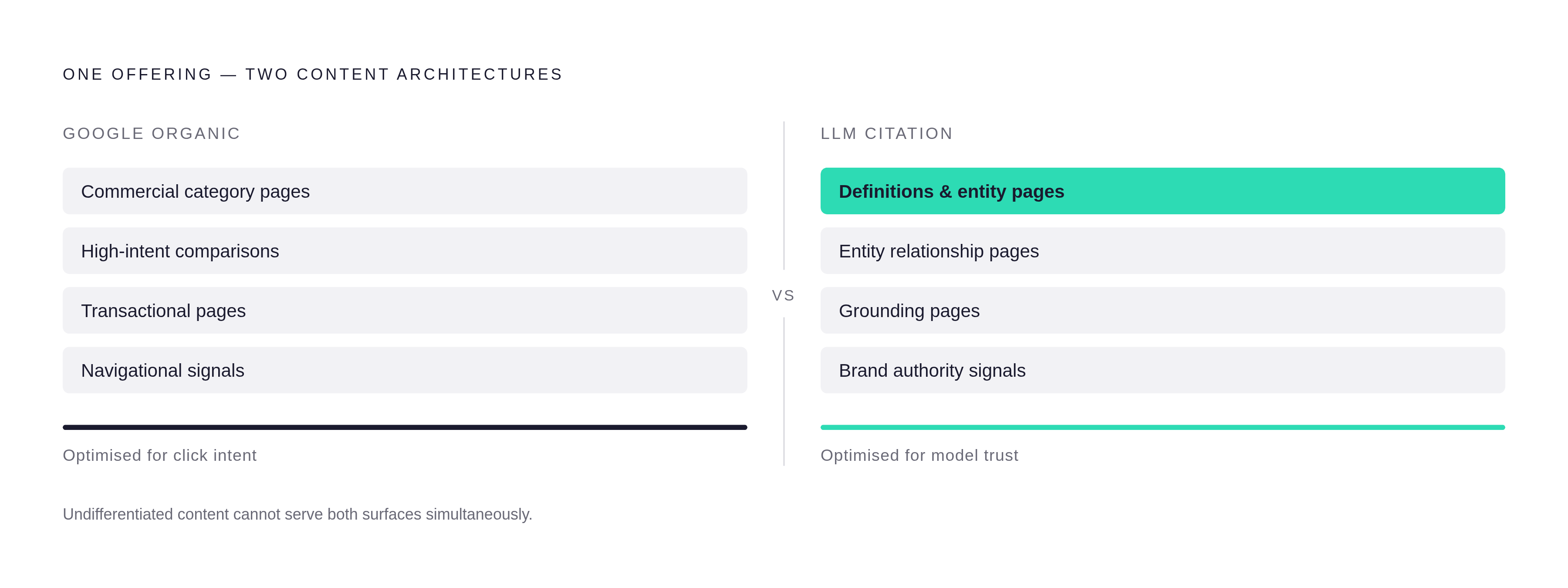
Traffic and AI visibility can now move in opposite directions. A piece can get fewer Google clicks and more LLM citations in the same quarter. A page that never ranked in Google can still be cited regularly by ChatGPT. Those results make it hard to judge every page by the same goal for how buyers find it.
The two surfaces call for different structural choices. Google organic content has commercial category pages, high-intent comparisons, and transactional pages that have clear navigational signals. These pages help a visitor find and evaluate an offering. Content built for LLM citation includes definitions, entity relationship pages, and brand authority signals that explain what a brand is known for and when it belongs in an answer.
The Grounding Page framework gives the second group a useful organizing idea. A grounding page is built to provide retrievable, structured, entity-rich information that an AI system can use when forming an answer. If an engine anchors its response to live sources, the brand needs sources that make its identity and relationships explicit.
A single undifferentiated content body cannot be assumed to serve both jobs, even when useful information belongs on both surfaces. A commercial comparison and an entity definition may concern the same offering, but they answer different needs. The architectural decision is to recognize those needs in the design, rather than hope that every published page performs every role.
What a factory workflow actually looks like: AI pipelines, human review, and the industrial B2B case
AI made drafting nearly free, so other parts of production became the bottleneck. Topic selection, briefing, voice consistency, review, distribution, and measurement still require a system around the draft. Faster writing does not resolve those constraints. Without that work around the draft, a team can make more content without making it more accurate or useful.
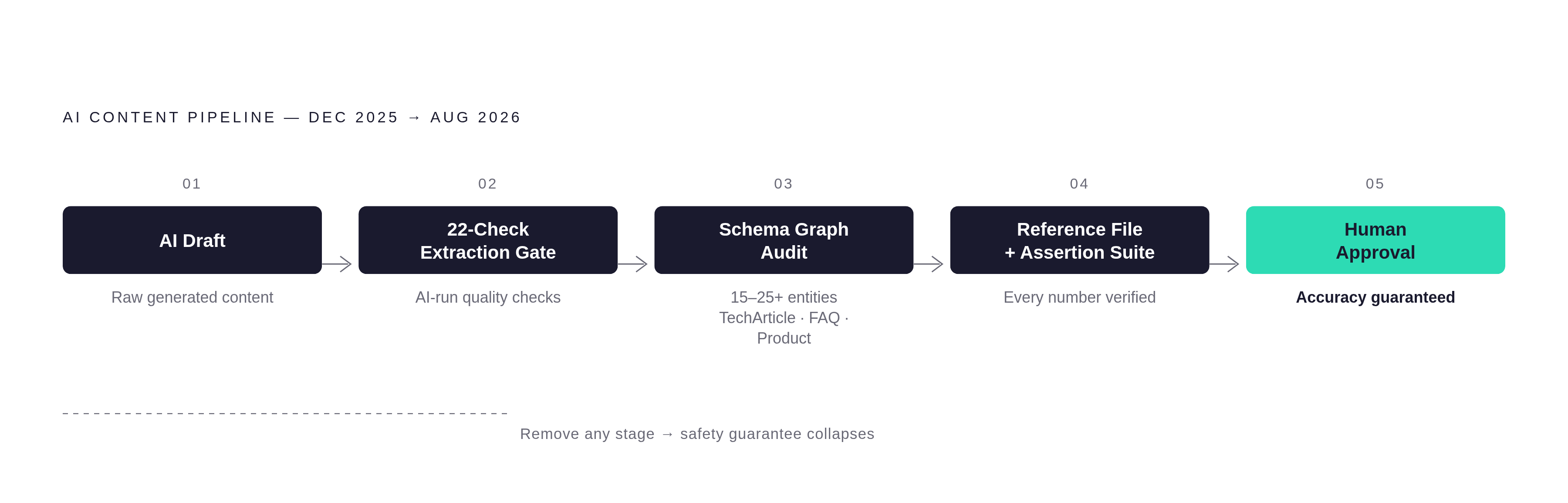
An industrial B2B supplier with safety-critical specifications illustrates the distinction. Between December 2025 and August 2026, it ran an AI content pipeline that published dozens of articles. Each post went through a 22-check AI-extraction gate and a separate 22-check schema graph audit. Each also included 15 to 25+ structured entities, using TechArticle, FAQPage, DefinedTermSet, and Product schemas.
Those production checks gave structure a defined place in the workflow. Accuracy, however, rested on three other components working together. The pipeline used a verified reference file, an assertion suite that checked every number against it, and a human approval step.
None of the three was optional. The loss of any one component collapses the pipeline's safety guarantee, a particularly serious weakness when specifications are safety-critical. The case is therefore not an argument that AI output becomes trustworthy through volume. Drafting was only one stage inside a process that constrained what could be published and required approval before it was.
Measuring the factory: why citation frequency across AI engines is the new production KPI
Teams still need to know whether what their production pipeline makes reaches buyers. Citation frequency, brand mention share in AI answers, and query coverage map to the conversations in which shortlists now form. Traditional SEO dashboards do not show those outputs. Without them, a team can measure publishing activity while missing the discovery process it intends to influence.
Coverage must extend beyond one engine. Only a small fraction of domains cited by ChatGPT are also cited by Perplexity for the same queries. Success on one therefore leaves unanswered questions about the other. Citation is also less stable than organic rankings, with a substantial share of sources changing month-to-month across major AI platforms. A periodic audit can miss that drift.
The Bing AI Performance Dashboard, public since February 10, 2026, provides the first first-party data on citations and grounding queries. Microsoft notes that it shows only a sample of actual citation activity, making it a signal. First-party data helps, but it does not remove the need to understand the limits of what is being measured.
For teams running this system, the operational lesson is to track citation frequency weekly across ChatGPT, Perplexity, Google AI Overviews, Microsoft Copilot, and Claude. When citation share drops for a query cluster, the system flags it. A brief is updated, a grounding page is rebuilt, and the entity list is expanded. Measurement thus changes the next production decision.
What technical B2B teams that run this system consistently have that the tree-planters don't
A team running this loop accumulates several connected assets at once. Entity coverage gives its content a clearer account of the subjects and relationships it addresses. Grounding page authority and citation history help its content do better in retrieval, and measurement data helps guide the next round of work. These assets reinforce one another.
Citation history adds a further advantage because AI engines are more likely to retrieve content from sources they have cited before. Authority in that system compounds differently from PageRank. Brands that keep publishing structured, entity-rich content can build that edge faster.
For developer-facing and technical B2B teams, this connects directly to trust. Developers are meticulous, research-driven, and influenced by what peers and trusted sources cite. An AI engine naming a vendor in response to a technical question can have the weight of a peer recommendation at scale. That influence needs facts to back it up, even when the content sounds convincing.
The lasting base is retrievable content that the brand publishes and owns, with support from grounding pages, entity relationships, and authoritative off-site mentions. A single prompt or hero page cannot provide the same foundation, especially when citation volatility can expose that dependence within a quarter. The teams that outgrow the tree-planters are those whose content is most legible to the machines that now decide what buyers read first.