Vector search and embeddings in the age of AI retrieval: what it means for how you build and structure your marketing content
Reorganize marketing content into independently answerable chunks to survive AI retrieval.
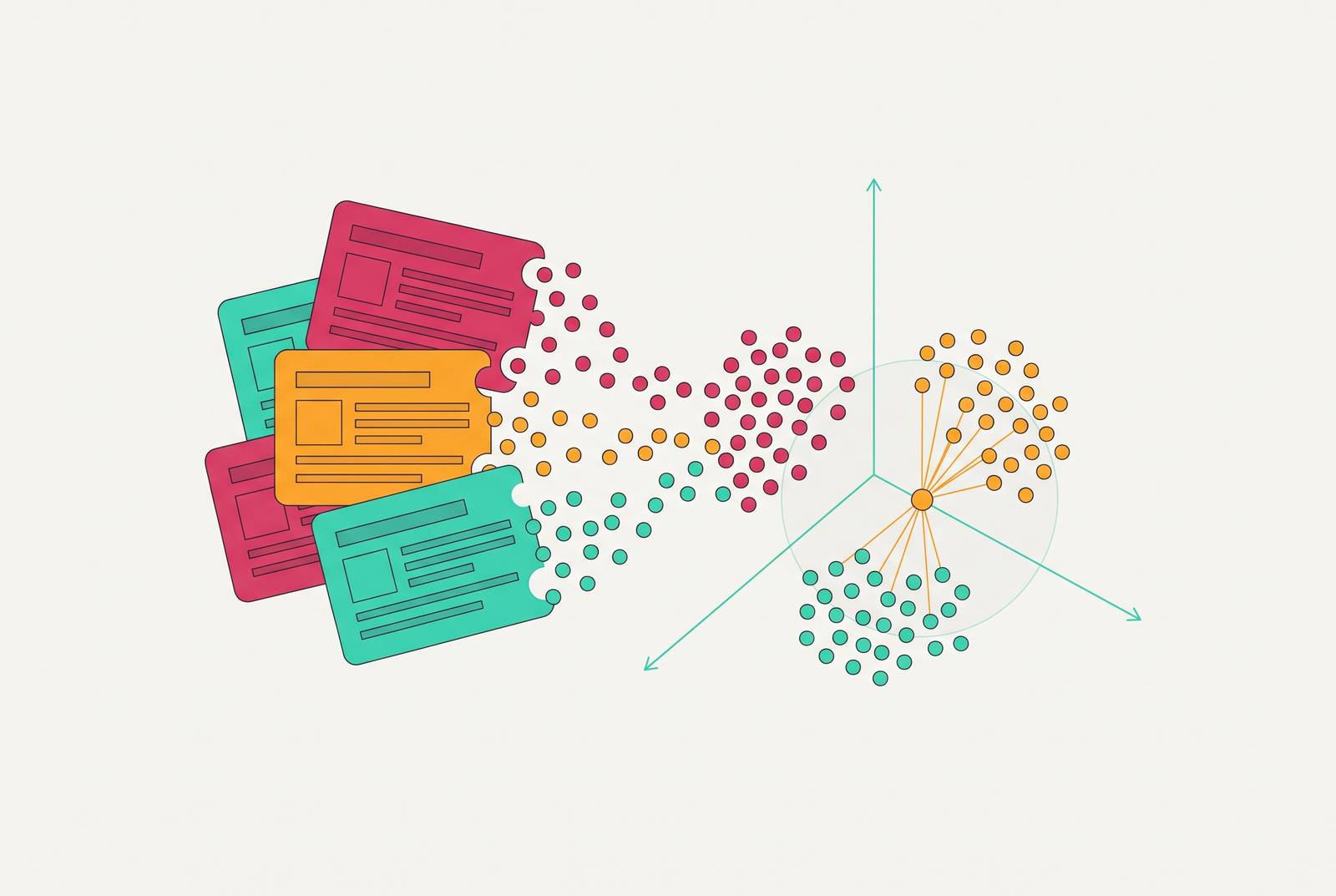
Vector search changes how marketing content is used as evidence in an AI-generated answer. Because retrieval systems score discrete chunks rather than treating a page as one argument, content needs sections that answer a question independently and sentences that state clear claims. The response is a content architecture built around what a retrieved passage means when separated from everything around it.
Why retrieval systems stopped caring about keywords
Cosine similarity measures the directional alignment between two numerical vectors in high-dimensional space. In dense retrieval, a neural embedding model converts a query and a piece of content into fixed-size vectors, and their alignment provides a relevance score. Matching is no longer just a word-count problem. Two passages can share no keywords yet align closely because they express the same underlying concept.
Sparse retrieval systems such as BM25 instead match query terms to document terms, using frequency and rarity to assess relevance. Repetition can still change an embedding, so keyword frequency is not mathematically irrelevant. But repeating a phrase is not a dependable way to improve semantic similarity. A paragraph needs to answer the query.
Hybrid search combines lexical and semantic retrieval, preserving exact matches for names, product identifiers, and proprietary terms while using vectors to match intent. Google’s Neural Matching, BERT, and MUM also show that semantic understanding is not exclusive to answer engines. The optimization target has changed at the mathematical level, even where keyword matching remains part of the system.
How RAG pipelines actually read a page — and why chunks are the unit that matters
A chunk-based retrieval-augmented generation pipeline starts by splitting the source text into smaller parts. It embeds each chunk separately and stores the resulting vectors in a vector database. At query time, the same embedding model converts the user’s question into a vector. Similarity search returns the top-K matches, and a re-ranker may score them again before the system chooses evidence and citations. The page is not the scoring unit.
LlamaIndex’s SentenceSplitter default of 1,024 tokens per chunk provides a concrete reference point. Its significance is the scale at which content can lose its surrounding context. A subsection that wanders may become a retrievable passage that covers several topics but gives no clear answer on any of them. Writing to an exact token allowance would miss the underlying problem.
Why does topic drift hurt retrieval? When a chunk covers several subjects, all of them must fit into one vector, which pulls its semantic direction away from any single question. A focused passage has a clearer relationship to the query it answers. Section boundaries therefore do more than organize a visual reading experience. They help shape the units a splitter can extract, although the splitter’s own rules determine the final boundaries.
What ColBERT and neural re-rankers do on top of cosine similarity
First-pass similarity search produces candidates. Neural re-rankers add a finer assessment of the relationship between a query and each retrieved passage. A chunk can pass the first stage and still lose at citation selection. Its topic may fit even though its sentences give less exact support than those in another candidate.
ColBERT-style late interaction makes that distinction easier to understand. Rather than joining the query and document into one sequence, as a cross-encoder does, ColBERT keeps them separate. Its MaxSim operation finds the strongest document-token match for each query token, then adds up those matches. Think of each query token finding its closest counterpart. Related meanings can contribute even when the words are not identical.
This is more selective than counting repeated terms. Only the highest match for each query token enters that part of the score, so repetition alone does not supply additional matches to sum. The editorial implication is fine-grained semantic clarity. Writers do not need to implement MaxSim. The useful rule is to give each sentence one clear claim that remains understandable inside a retrieved chunk.
The sentence-level writing rules that follow directly from how embeddings score chunks
Because a chunk receives an overall semantic representation, a section needs one dominant topic. The writing practice is one topic per H2, with a boundary where the subject genuinely changes. That boundary gives the retrieval system a more coherent passage to work with. It also keeps an answer from sharing its representation with text on an unrelated topic. The section should have a clear center.
Because retrieval can separate a section from its introduction, entities must remain identifiable within that section. Repeat a necessary entity name instead of extending a chain of “it,” “this,” and “this method” across boundaries. Avoid references such as “as noted above” when the missing passage supplies essential meaning. The extracted text must identify its own subject. This is not a demand to repeat every name in every sentence, but to remove dependence on unavailable context.
Semantic matching also changes how headings and vocabulary work. A heading that mirrors a real question makes the section’s purpose explicit, while natural variants can express the topic’s breadth without repetitive keyword placement. “Generative engine optimization,” “GEO,” “AI search optimization,” and “LLM SEO” are related ways of approaching the same subject. There is no need to use every one of these phrases. FAQ and Q&A formats are useful when the questions organize genuine answers.
Finally, token-level scoring makes the relationship between a claim and its conditions important. Internal data supports the “Factual Syntactic Triad” rule of subject, verb, and object, with one fact per sentence. State the claim directly, then place its conditions immediately after it. This gives a retrieved passage a better chance of preserving what the statement actually means.
Why AI answer engines are a separate retrieval environment from Google, and what that means for content
A Google ranking and an answer-engine citation are different results, and each comes from a different way of choosing content. Ranking well can indicate that a page is crawlable and authoritative without showing whether its passages survive chunking or provide precise evidence. Search success is not automatic retrieval fitness.
The platforms also differ from one another. ChatGPT Search uses its training corpus or live retrieval depending on the query type, and its citation patterns give Reddit a substantial role. Claude shows a stronger preference for brand sites. Gemini’s sourcing pattern sits between those community-heavy and brand-site-oriented approaches. A content plan cannot assume that one platform’s preferred sources represent every other platform.
The vast majority of brands have no mentions across the major AI search platforms. At the same time, AI referral traffic is growing, and those visitors show high engagement. That makes answer-engine visibility worth pursuing on its own terms, rather than treating it as an incidental benefit of Google optimization. If platforms draw evidence differently, what would a content architecture designed for those differences look like?
What a chunk-first content architecture actually looks like in practice
A grounding page offers a concrete starting point. It is a neutral, verifiable fact page with timestamps and one fact per sentence, designed to give a model evidence it can use at retrieval time. Every statement should remain complete and attributable after extraction. It is not a brand narrative. An llms.txt file serves as a technical manifest of important URLs.
Each section on the site needs to name its entity clearly, stay on one topic, and give a direct answer that stands on its own. The main entities and answers belong near the start. That placement also requires attention to rendering, because Google’s Web Rendering Service does not scroll to activate scroll-triggered content. This does not mean that the service gives the first viewport a separate, prioritized evaluation pass.
Consistent brand descriptions across schema markup, a Wikidata entry, LinkedIn, and the About page reduce ambiguity about entity identity. Schema makes relationships machine-legible, while links connect related evidence. Platform awareness extends beyond the site itself. Identifying the trusted publications a target engine draws on, then securing relevant mentions or citations there, connects the brand to that engine’s evidence sources.
Proprietary data nodes give that architecture something distinctive to retrieve. Original research with a named methodology provides evidence that other sources cannot independently substitute when the question concerns that research. The value is an attributable source that can be linked, kept current, and measured for citation performance.
Why a programmable content stack is the right response, not a checklist of on-page edits
Citation patterns shift, model releases change sourcing behavior, and retrained re-rankers can alter which passages win. A one-time edit cannot respond to those changes. A programmable stack instead connects publication, structural checks, review, and measurement so that improvements can accumulate.
For a team building that process, measurement starts with a fixed set of buying-intent questions run on a schedule against ChatGPT, Claude, Gemini, and Perplexity. The record should distinguish brand appearance, position, sentiment, and linked citations. Bing’s AI Performance Dashboard, which has been public since February 10, 2026, also provides first-party citation data. Microsoft notes that its grounding queries data represents a sample of overall citation activity. That caveat applies specifically to the grounding queries.
Publication then needs to respond to what that measurement and the wider market reveal. A programmable stack can maintain a publishing cadence and use standing watchers to trigger drafts when relevant developments occur. Freshness is especially important for Perplexity’s live retrieval. The system can also apply chunk-first rules consistently without relying entirely on human memory. Human review remains part of the pipeline, with outputs reviewable and reversible before publication.
A mention names the brand, while a citation links to its content and can generate referral traffic. Those are different signals with different implications. Treating them as one number hides whether the system recognizes the brand or actually selects its evidence. When AI drafting is paired with human review, speed helps only if the work is accurate enough to publish.
How to audit your existing content for chunk-level retrieval fitness
An initial audit should prioritize pages answering high-intent buying questions. Navigation pages and brand stories can wait while the team checks content that has a clearer role in retrieval. The aim is to find where useful answers lose clarity when separated from the page, before committing to a broader rebuild.
Start by mapping the H2 and H3 structure. Ask whether each section has one dominant subject, or whether two different headings could describe different halves of it. Then read only the first sentence of each section. Does it state the core claim, or spend the opening on a transition and a restatement of the heading? A page can look well laid out even when its opening is weak.
Next, examine the context each passage assumes. Flag pronoun chains that run longer than two steps and abbreviations whose full name has not been given in the same chunk. Sweep for compound sentences containing more than one independent claim, treating them as candidates for splitting. Check the qualifications as well. A claim separated from its condition may be concise but incomplete.
Finally, compare the brand description in schema, the About page, any Wikidata entry, and third-party editorial coverage. Inconsistency can leave grounding systems with conflicting evidence about the same entity. Combine those findings with the section-level problems to identify the highest-value fixes. The resulting gap is between current content architecture and retrieval fitness. Closing it across a growing body of content is the engineering task that a programmable stack is built to address.