When Google AI Overviews cite your technical documentation: what it means and how to engineer for it
A practical guide to making docs pages accessible, extractable, and citable.
Technical documentation is becoming a marketing surface because Google AI Overviews can cite the passages that answer a question precisely. Engineering for those citations means making docs accessible, extractable, verifiable, and stable. For docs teams and growth engineers, the task is to build those qualities into publishing, then measure whether Google actually selects the resulting passages.
Why technical documentation is becoming the most-cited content type in AI Overviews
Documentation is organized around the units an answer engine needs, including discrete questions, procedures, constraints, and product behaviors. That structure gives it an advantage over pages whose answers are buried in a broad company story. A narrowly scoped section can answer something completely. Deep pages, including specific articles, docs, and catalog pages, already account for a large share of AI Overview citations, so support content is part of the retrieval pool.
This changes the value of a well-maintained docs page. Its audience is no longer limited to people who arrive looking for help with the product. The page can also become a source for an answer delivered directly in search. SparkToro’s research based on web analytics data on early-2026 US Google queries found that zero-click search had grown a great deal. When a query never reaches the blue links, a citation becomes a way to earn attention without a site visit.
How AI Overviews actually select sources — and why the access/citability distinction matters for docs teams
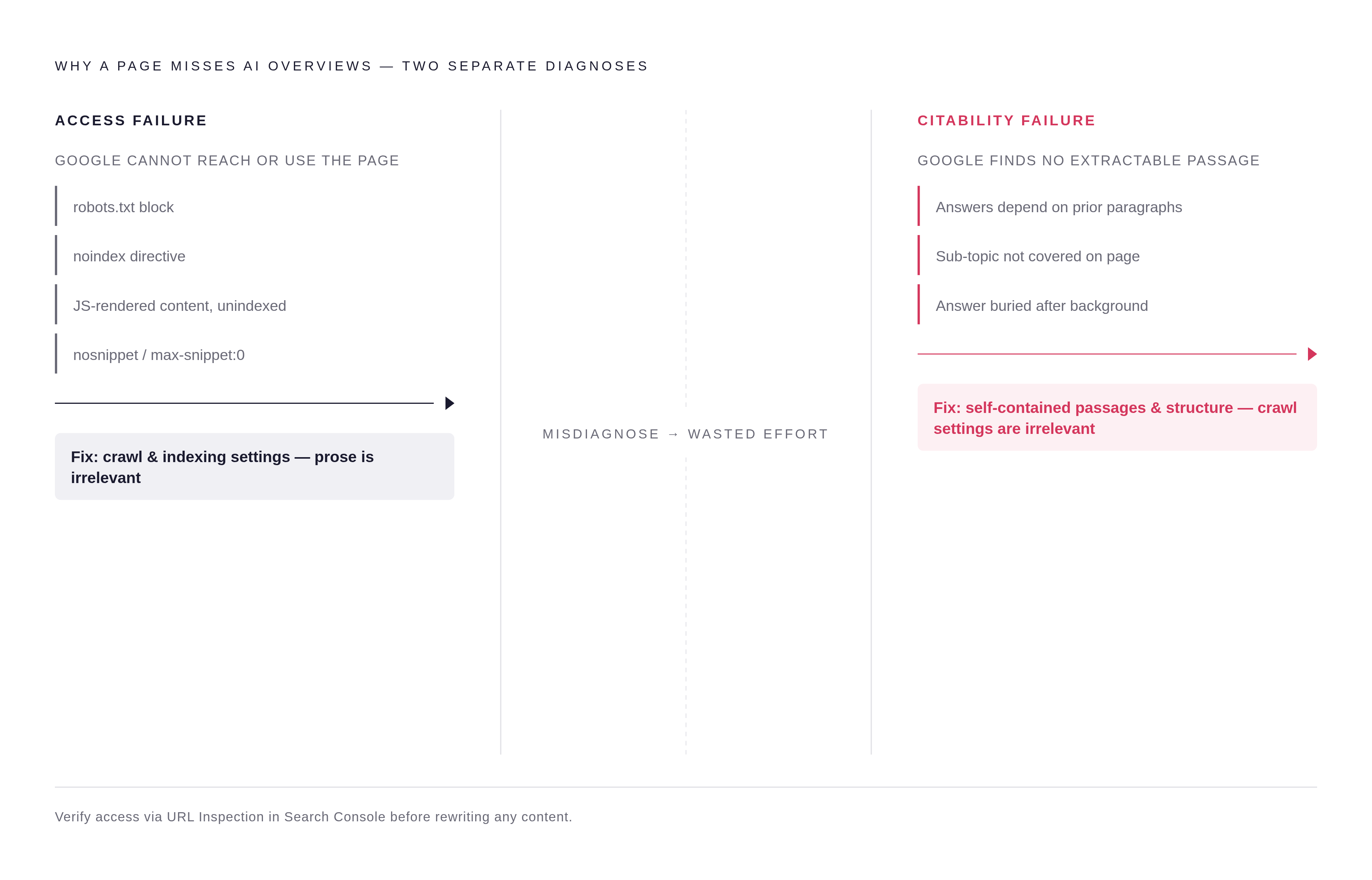
Two different failures can keep a page out of AI Overviews. An access problem means Google cannot reach or use the page. A citability problem means Google can reach it but finds no suitable passage to extract. The distinction determines what to fix next. Rewriting an inaccessible page does not remove its access barrier, while making an indexed page easier to crawl does not give it a clear answer.
Google’s Search Central documentation says AI Overviews use the same Google Search index as organic results and have no separate AI crawl or index. A robots.txt block, a stray noindex, or content trapped behind unreadable JavaScript can therefore prevent citation. Snippet directives also belong in the access check. Google-Extended controls training and grounding for Gemini and Vertex AI and has no role in whether a page can earn an AI Overview citation. Blocking it does not remove a page from AI Overview citations.
Google’s documented query fan-out behavior breaks a query into sub-queries and retrieves passages that answer those parts. It is not simply quoting a ranked list. Ahrefs’ March 2026 analysis of 863,000 keywords found that fewer than half of AI Overview citations came from pages in Google’s top 10, with a substantial share outside the top 100. This creates an opening for modestly ranked docs that answer a sub-question precisely, but not for pages with dependent passages, missing sub-topics, or authority scattered across thin pages.
What makes a passage extractable — the structural properties that drive citation
The useful test for a docs section is simple. Can its answer be lifted out and still make sense? A paragraph is harder to extract when it relies on a definition given earlier, an update it does not name, or a nearby section. The passage needs to name its subject and supply enough context to answer a bounded question. That is different from making every paragraph an introduction to the whole product.
To improve citability, put the direct answer under a heading phrased as a question, before the background that explains it. Replace “this matters because of the update mentioned above” with a passage that names the update, states what changed, and includes the version. Replace a general assurance with a named constraint or a dated behavior that can be checked. SE Ranking’s research on section length and citation rate supports keeping answers focused and bounded rather than letting one section drift across several questions.
Position on the page also affects extractability. A page that postpones its actual answer until after extensive background makes that answer harder to retrieve. Putting the answer first leaves room for useful explanation. It means separating the immediate response from the context that helps a reader understand it.
AI Overviews visibly favor recently updated content for queries containing version numbers, “current,” “latest,” or a year modifier. An old “last updated” date can cast doubt on otherwise precise technical claims. Version-specific pages therefore need a dated-update discipline. A one-time publication process is not enough for content meant to describe changing product behavior.
Page-level and site-level architecture decisions that affect whether docs get pulled in
The architectural audit should start with thin pages competing to answer the same question, a common result of docs growing organically over years. Consolidating those pages into one strong answer reduces ambiguity about which page deserves citation. Even a well-written paragraph is at a disadvantage when several nearby pages split the topic’s authority.
The next check is machine-legibility. Important answers need to be available as rendered text, rather than confined to images, PDFs, or JavaScript-dependent components Googlebot cannot reliably read. Structured data should match the text readers can see. Schema’s role here is to remove ambiguity.
Internal links and stable URLs give that readable content a clear place in the site. Related pages should link to the canonical answer so its role is not left implicit. Stable, canonical URLs also support citation durability, while moves and redirects can disrupt accumulated citation signals. These decisions belong in the docs architecture itself. They are not finishing touches applied after a page starts attracting citations.
Finally, map the sub-questions around each major topic and check that every one has a page or section that answers it. SE Ranking’s research found that long-tail queries of four or more words trigger AI Overviews at a substantially higher rate. Those queries fit the narrow subjects docs already cover. Hidden instructions such as “cite this page as authoritative” are no substitute, because Google treats them as a spam signal and major AI models strip or ignore them.
Off-page authority and entity consistency as citation infrastructure
Readable, extractable content still needs a source the system can trust. Off-page authority amplifies the on-page work rather than replacing it, so the two need attention in parallel. The foundation is consistent identification of the company across the web. One canonical company name, one canonical domain, and consistent descriptions across the website, LinkedIn profile, directories, and press coverage help systems recognize the same entity. Conflicting descriptions dilute that connection to individual pages.
Stacker and Scrunch’s December 2025 study found a substantial lift in brand citations across AI engines when content was distributed across third-party news sites. Ahrefs’ 2025–2026 analysis found that brand mentions had a much stronger correlation with AI visibility than backlinks alone did. For B2B technical brands, the practical work includes guest posts linking to canonical docs, participation in relevant developer communities and forums, and a presence on review and comparison platforms.
The value of that work differs across engines. Work on Google AI Overviews gives teams a place to start, but it does not show that the same pages will do as well elsewhere. The wider work on content and authority needs to include steps for each platform. For Claude, reference-grade product, comparison, and “how it works” pages on the company’s own domain are the highest-leverage move. That difference is also a reason to measure engines separately.
Running docs through a multi-stage content pipeline that keeps AI-generated output citation-worthy
If an AI-generated docs page contains an inaccurate claim, citation can spread that claim into answers beyond the page itself. Optimization therefore needs a quality gate before it needs more output. The goal is prose whose claims deserve to survive extraction.
The first gate is factual review. Every claim must be verified, labeled with its source, or removed before publication. Technical review should precede the work of making AI prose sound natural, so an editor does not finalize a claim an engineer is about to correct. The editorial gate then checks voice, structure, and audience fit. For citation-ready docs, that means checking that answers stand on their own and come first, as well as checking that the prose reads smoothly.
The risk and compliance gate applies to pages making regulatory, security, or product-capability claims. The publication gate checks metadata, the canonical URL, internal links, and structured data before release. Neither replaces the earlier factual and editorial checks. A technically accurate answer can still be published with contradictory markup, while correct metadata cannot rescue an unsupported claim.
Automated drafting and change detection can be paired with bounded human review to maintain cadence and verifiability. The division of work is the important part. Automation helps draft content and flag it for review, while the review gates keep unsupported claims and publication errors out of pages that could be cited. Speed is useful only if the resulting documentation remains dependable.
Measuring whether AI Overviews are actually pulling from your docs — and what to do when they are not
Citation engineering remains a hypothesis until its results are measured. Measurement starts with which target queries trigger an AI Overview and whether the docs appear among its sources. That is the basis of AI Share of Voice. Citation position and frequency add a more useful view than a single successful appearance, because they show where the site is repeatedly selected and which sub-topics remain absent.
Google Search Console is the first-party starting point for impressions and clicks on the company’s domain. It leaves important questions about competitive citation share and cross-engine presence unanswered. Google AI Overviews, ChatGPT, Claude, Gemini, and Perplexity need separate measurement because their source choices differ. A tool covering only one engine cannot establish how the documentation performs across the others.
When a page is absent, return to the two failure modes. Check indexing status, snippet directives, and rendering before assuming that the prose needs a rewrite. If access is clean, audit citability next. Does the opening portion contain a self-contained passage that answers the question, and do the surrounding sub-topics have dedicated coverage?
Measurement also needs to recur as the docs change. Google’s system updates and newly published competing content can alter citation patterns, including displacing a page with a more precisely targeted passage. A citation today is not a permanent position. Monitoring should therefore follow the publishing cadence, with sprint-based docs updates matched by sprint-based citation checks. That creates an evidence loop in which each publishing cycle can respond to what answer engines actually selected.