Why AI engines cite some brands and not yours — and how to engineer your way onto that list
AI engines follow a measurable four-stage chain to decide which brands they cite.

AI engines do not cite brands at random. Their answers reflect source trust, retrievability, and third-party corroboration, which gives founders and developers something more useful than a guessing game. Earning visibility means building a presence engines can find, connect to the right request, and attribute to the right brand, then measuring where that chain breaks.
How AI citation actually works — the selection mechanism most brands miss
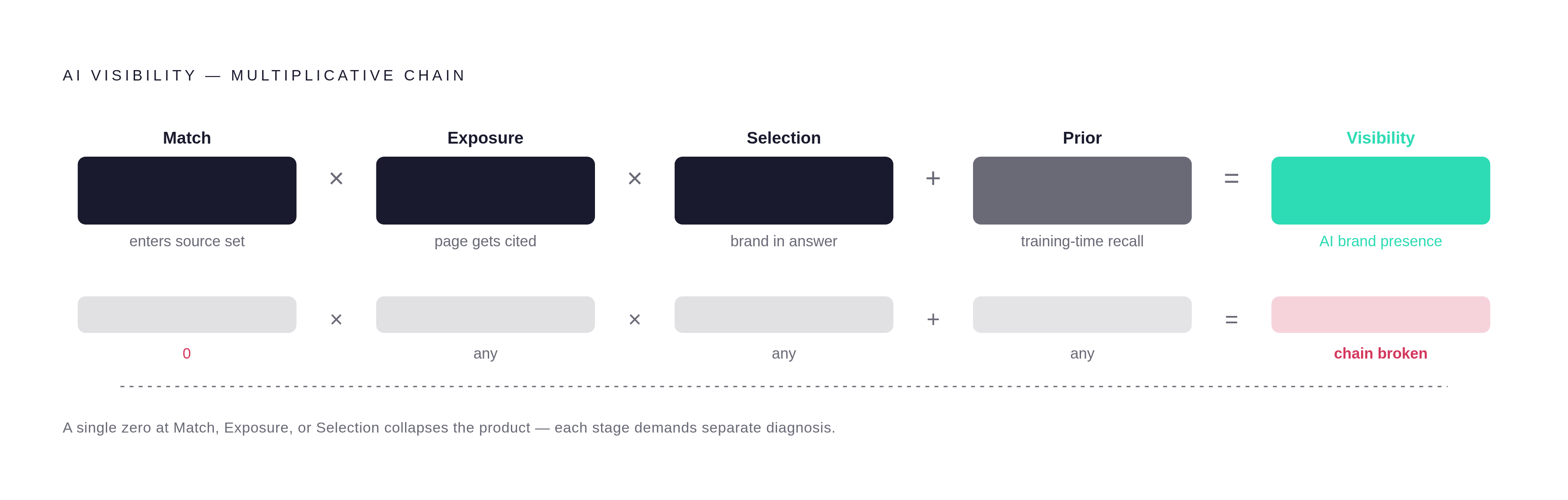
What makes a brand appear in an AI answer? A relevant page is only part of the answer because the engine makes several decisions between receiving a request and naming a brand. Benjamin Tannenbaum’s From Prompt to Recommendation identifies four observable terms, namely Match, Exposure, Selection, and Prior. The model predicts brand mention rates with high accuracy on held-out data. Its value is diagnostic.
Match tracks whether the brand gets into the relevant source set. Exposure tracks whether a page gets cited, while Selection tracks whether that exposure leads to a brand mention in the answer. The model is AI visibility ≈ Match × Exposure × Selection + Prior. A zero in any multiplicative term breaks the live-retrieval chain, even if the other stages work well.
Prior accounts for recognition that does not depend on a current citation to the brand’s domain. Accumulated training-time recognition can put a familiar name into an answer without that live exposure. Young or niche brands cannot count on being known this way. Brand maturity creates a sharply tiered starting point, with global household names appearing in nearly three-quarters of relevant answers on first run, established mid-market brands in roughly two-fifths to nearly half, and niche and small brands in just over one in ten.
Those differences change the question a team needs to ask. Is the brand absent because the engine never encountered it, because the page was not cited, or because the answer named someone else? Each explanation points to a different intervention. Better prose alone cannot repair every failure. The model makes the problem testable by separating the decisions that a single visibility score would otherwise blur together.
Why earned media does most of the work engines never credit you for
Most brands put their effort into the surface they control, which is their own website. Yet third-party earned media does much of the work that makes a brand visible in AI answers. Pratyush Kumar’s Generative Engine Optimization at Scale finds that corporate websites receive a large share of citations, but ranked “best-of” listicles have the highest citation rate among content formats. Corporate pages can be common sources while outside comparisons offer stronger opportunities for a brand to enter an answer.
The same study places YouTube ahead of Reddit, editorial media, and Wikipedia among non-corporate citation sources. Authority is spread across those different surfaces. A brand’s website can explain what it offers, while external sources provide corroboration that the brand does not write for itself. For a team focused almost entirely on its own pages, this is a change in where the work belongs.
A ghost citation occurs when an engine cites a brand’s content as a source but names a competitor in the answer. The page helped shape the response without earning the recommendation. That is the gap between Exposure and Selection made visible. It explains why a rising count of domain citations cannot, on its own, establish that the brand is gaining ground.
But what if the website already ranks well on Google? AI engines use their own retrieval layer on top of, or independently from, web rankings, and draw heavily from sources outside the top Google results. Being indexed is necessary but not sufficient. The engine still has to judge the material worth citing for the particular response. Strong organic rankings therefore cannot substitute for evidence that the brand appears in the sources AI engines actually use.
How to get your brand into the sources engines actually trust
The practical response is a program of third-party presence across review platforms, community spaces, and editorial media. A single PR hit cannot provide the distributed, durable corroboration that this approach seeks. The aim is triangulation across independent sources. Each placement contributes to the same task, which is making the brand recognizable beyond its own claims and available where engines already retrieve information.
Review platforms and editorial comparisons belong in that program because they put brands into the context of alternatives. Brands should seek a place in comparisons that fit the reader’s needs, since some mentions are more useful than others. A factual head-to-head piece or “best of” roundup can address exactly the choice a reader is trying to make. Its usefulness rests on covering the options on their merits.
Community participation builds another part of that presence. Relevant Reddit threads, Slack communities, and forums can produce mentions that become retrievable when the material is indexed and readable. Access is the important condition here. A conversation that an engine cannot reach does not become a retrieval source just because it happened online. Genuine participation is the recommended approach, while spam and artificial insertion are counterproductive and increasingly detectable.
Podcast and video appearances offer a similar route when the shows publish indexed transcripts. Format can therefore be more important than audience size for this purpose, because an indexed transcript page is citation-eligible in a way that an audio file alone is not. Together, these activities connect PR, content, and SEO to the same visibility goal. Each activity should add an accessible, independent account of the brand that outlasts a short-lived burst of attention.
Making your own content retrievable and attributable by engines
Retrieval-Augmented Generation explains why content structure affects visibility. Engines retrieve candidate documents before generating an answer, so a page must first be available to that retrieval process. It must then offer material the engine can extract and attribute for the request at hand. Publishing is only the starting point here. A page that exists but cannot be read reliably contributes little to the live-retrieval path.
JavaScript-heavy pages expose this problem in concrete terms. AI crawlers operate within a limited discovery budget and will not wait for scripts to hydrate the content. Text whose visibility in the HTML is delayed risks being excluded from retrieval entirely. Developers should check that the relevant AI crawlers can reach priority pages and read the text, because a page that works in a browser may still be out of reach for machines.
An llms.txt file can guide crawlers toward priority pages, but it does not grant or restrict access. Structured data addresses a separate problem, which is making the page’s role explicit. Organization and WebSite schema belong on the homepage, while FAQPage and HowTo schema describe question-answering and procedural content. Entity grounding in sources such as Wikidata and Google’s Knowledge Graph also helps models connect a brand confidently to its category.
Within the page, extractability deserves more attention than keyword density. The Princeton GEO benchmark found the biggest citation lifts from adding authoritative citations, statistics, and quotations, with their order varying across metrics. Keyword optimization performed below baseline.
Relevance still depends on the actual request. Tannenbaum’s research shows that a page is not generically “good for AI,” but useful or unhelpful relative to a particular prompt. Content should answer the questions users actually ask, going beyond a broad view of the category. The same research finds that commercial prompts trigger search fan-out far more often than informational ones. Pages aimed at buyers need to be especially easy to retrieve because live search plays a larger role in those answers.
Why publishing velocity and content quality must both be maintained simultaneously
Machine-readable content still needs something worth extracting. Delegating production entirely to AI models can create a large supply of generic pages. AI developers filter generic AI-written content to prevent training degradation, which makes material indistinguishable from bulk output increasingly unlikely to surface as an authoritative citation source. More output is not automatically more opportunity.
A multi-stage production pipeline can maintain both publishing velocity and content quality. AI can draft at scale, while human reviewers supply judgment, experience, and fact-verification where those inputs change the result. The 10-20-70 framing assigns roughly ten percent of effort to algorithms, twenty percent to technology and data, and seventy percent to people and processes. Editing is where production efficiency becomes content with a reason to be cited.
To keep that process reversible, approval gates belong at the points where automation could send weak work forward. AI drafts and humans review, and a person must also approve AI suggestions about timing. When AI flags an anomaly, a person decides what follows. Override capability is part of the design. Without a way to override automation, the team cannot use its judgment at the points where human review matters.
Does that demand more capacity than a small team has? A composable pipeline scales down as well as up, and the same staged logic works at one post per week as at twenty. The bottleneck is judgment. At the same time, engines differ in how they weight recency and accumulated authority, so a program built only for freshness or only for depth leaves part of the audience unserved. Teams need to keep making both fresh content and work that lasts, while ensuring that deadlines and automation never let work skip review.
Measuring whether any of this is actually working
Brand mention share tracks whether the name appears, while domain citation share tracks whether the answer cites the site. Topical visibility and prompt-level visibility reveal where those appearances occur. Sentiment distribution captures how the brand is framed, and AI-referred traffic captures visits from those answers. These do not appear as a complete KPI set in Google Analytics by default.
Teams must keep results for each engine separate. Tannenbaum’s research finds nearly disjoint citation sets across engines for the same prompts. Success in one engine therefore does not establish success in another. A rollup can conceal the failure that needs attention. Tracking each engine with the same relevant prompts shows how it retrieves and selects sources, the behavior the program aims to change.
Repeated runs are equally important because one answer is not a stable baseline. At a minimum, teams need to run several queries per prompt each time they measure results, reducing variance enough to get a statistically reliable AI Presence Rate signal. Tannenbaum’s model validates this approach on held-out data. A single-run snapshot cannot do the same work. Without repeated sampling, a changed answer can look like an intervention succeeded even when it is only variation between runs.
Presence also needs to be read beside sentiment. Kumar’s study finds that positive or negative framing flips far more often than whether a brand appears at all. A steady mention rate can therefore mask deteriorating representation.
Tannenbaum’s model finds that prior mention history predicts next-run mention rates independently of current retrieval signals. Teams that start measuring later lose baseline data that could help them tell whether their changes worked. That history serves to test whether work on corroboration, access, and attribution changes the stage where the brand was failing, turning AI visibility into an observable engineering loop.