"AI ads" is three different products with one name: how a technical founder tells a generator, an agency and an instrumented ad-to-page pair apart
Generators, agencies and GEO fix different gaps, so match the product to yours.

“AI ads” can mean a creative generator, a managed paid-media service, or a program for earning citations in AI-generated answers. This article explains how a technical founder tells them apart. The buying decision should follow the acquisition gap, because each product changes a different part of how buyers find and choose a company.
Why "AI ads" is not one thing
A founder searching for “AI ads” can encounter creative-generator roundups, agency landing pages, and AI-discovery pitches in the same session. The phrase gives little warning that the product has changed. Each comes from a different industry, including performance creative tooling, managed paid media, and organic-discovery optimization. Their buyers overlap, so their vocabulary does too.
Native sponsored placements inside AI engines add another ambiguity. An ad placed inside an AI product is not the same thing as an ad made with AI, or a brand cited in an AI answer. Yet the same shorthand can describe all of them. For a B2B SaaS founder whose product is missing from ChatGPT’s answers, the buying hazard is paying to make creative faster while leaving the acquisition gap unresolved.
What a creative generator actually is and does
A creative generator turns a product photo, a URL, or a brief into batches of images, copy, or video. AdCreative.ai and other creative-generation vendors are examples of this category. A human operator judges the tool’s assets, selects variants, and retains authority over campaign decisions when launching them inside their own ad account. That division is the clearest way to recognize the product behind a landing page’s promises.
The buyer remains the operator of the account. Typically, that is a performance marketer or founder who is comfortable inside Meta Ads Manager or Google Ads but needs more variants to test. The purchase is usually a low-barrier subscription, with some annually billed plans cheaper than month-to-month plans. Its value is creative production speed. It does not take responsibility for budget, bid strategy, audience targeting, or campaign architecture, and it does not determine what AI answer engines say about a brand.
What a managed AI ad service actually is and does
A managed service takes on a different job. Rather than handing the founder assets to operate, it uses AI agents to draft and assemble a campaign, including its audience, creative, and bid structure. A human consultant or strategist still has to approve the work before anything goes live, so buyers need to establish who manages the campaign.
The build-then-approve pattern makes that distinction concrete. An agent stages a complete campaign as a draft in the client’s own ad account, and a human turns it on. The same approval model governs bid, budget, and creative changes on a weekly cycle. Lapis offers a Basic tier for software access and managed plans at custom pricing that include human labor. Neither plan is right for every founder.
For a buyer, the signal is a need to delegate campaign strategy and ongoing optimization while retaining sign-off. Onboarding must cover the strategy and who approves the work as well as setting up the account. But delegated paid-media execution still addresses paid-media performance. If the brand is missing from AI-generated answers, hiring someone to optimize bids does not fill that gap.
What GEO actually is and why it gets marketed as "AI ads"
Generative Engine Optimization, or GEO, aims to make a brand a source that ChatGPT, Perplexity, Claude, and Google AI Overviews name and cite in generated answers. Inclusion is earned through citation by the engine. The work instead concerns published content that an answer engine can find, interpret, and cite.
Answer Engine Optimization, or AEO, has the same goal. The term originated around answer boxes, featured snippets, and voice results, but the practices have converged as LLM-generated answers absorb those surfaces. Is this simply SEO with a new name? Google argues that optimizing for generative AI search is still SEO. That objection does not have to be resolved to distinguish a publishing investment from a media buy.
The Prompting Company, part of YC Summer 2025, illustrates the distinction. Its stated purpose is getting products discovered and used by AI agents, covering both citation in answers and agents’ ability to use the products. It serves the same people who buy paid-media services to drive growth, which helps explain why it uses words that sound like ads. The mechanism is different, even when the buyer is not.
AI Overviews appear in a large share of Google searches, while the overwhelming majority of AI Mode sessions end without a click. The answer itself may be the buyer’s only impression. A brand that is absent or misrepresented there has a discovery problem that neither more creative variants nor better bid management directly repairs.
How the three categories differ on the dimensions that matter for a buying decision
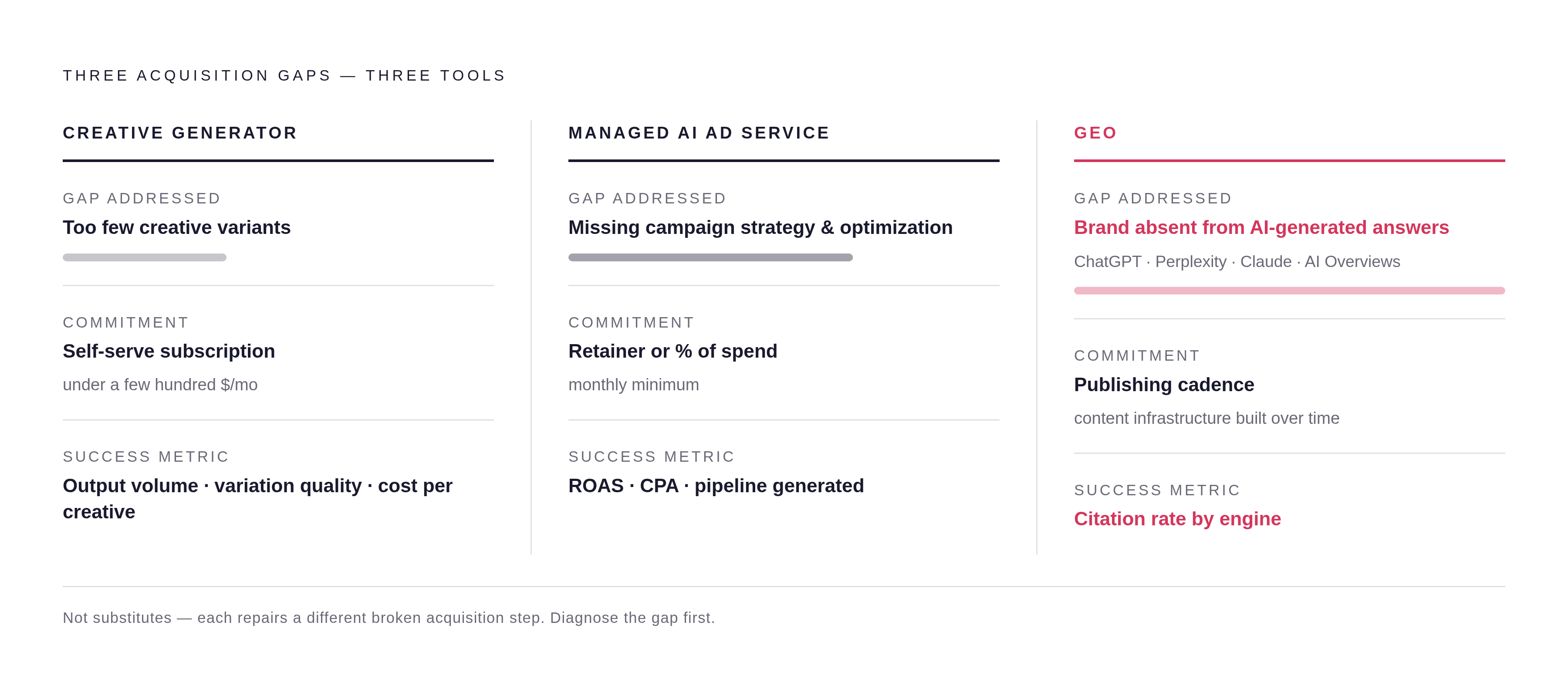
The buying decision changes with the category. A generator is a self-serve tool purchase that can begin with a free tier or monthly plan. A managed service takes more commitment, as both sides must agree on strategy and who gives human approval. A GEO program is an investment in a body of published, crawlable, citation-eligible content built over time. Signup, delegation, and publishing are different commitments.
Generators commonly use per-seat or per-credit subscriptions, often well under a few hundred dollars a month for a solo operator. Managed services use retainers or percentage-of-spend arrangements with a floor reflecting human labor. Adside’s fully managed service uses a percentage of spend with a monthly minimum. GEO costs sit in content production infrastructure, publishing cadence, and citation-tracking tools.
Success also needs a category-specific definition from the start. For a generator, the useful measures are output volume, variation quality, and cost per creative, with creative scoring before spend another relevant capability. For a managed service, they are campaign outcomes such as ROAS, CPA, and pipeline generated. For GEO, the core measure is citation rate inside generated answers, separated by engine. A brand’s strength in one engine does not establish its visibility in another.
A generator competes with other creative-production tools, a managed service with delegated paid-media execution, and a GEO program with content and discovery investments. Comparing them as interchangeable “AI ads” vendors obscures what each actually replaces. It also invites the wrong test. ROAS cannot fairly measure how well a non-media citation program works, just as citation rate cannot fairly measure how well an asset generator works.
Why AI answer engines cite some brands and not others, and what that means for content
GEO depends on content that is extractable, structured, and attributed. Domain authority alone does not explain whether a source can be cited. Aggarwal et al.’s GEO research found that adding quotations from relevant sources, statistics, and citations can do a lot to make a source more visible in generative responses. An answer engine needs material it can extract and attribute.
That distinction helps explain the role of a ground site. This is a brand’s primary domain with verified content and signals of experience, expertise, authority, and trustworthiness that AI crawlers can resolve. Thin programmatic pages offer a different proposition when they merely rearrange existing sentences. They compete with the sources those sentences came from, but may add nothing worth extracting. In this category, the content infrastructure is part of the product being bought.
Human review belongs inside that infrastructure. Each stage has a distinct owner. The separation keeps polished but unreviewed AI output from moving straight into production. In particular, references need verification rather than confidence inferred from their presentation.
Microsoft’s July 2026 preprint “Phantom References: Hallucinated Citations That Survive Peer Review at Top-Tier Conferences,” by Mark Russinovich, Ram Shankar Siva Kumar, and Ahmed Salem, shows why that gate exists. The paper reports that hallucinated citations have become part of the permanent scholarly record. The paper is relevant here because confident references can survive a publishing process without surviving a check against the source. A content pipeline that omits that check exposes itself to the same failure mode.
Owned content is not the only citation input. A large share of citations in AI answers come from Reddit, so a presence in that community matters when looking at where engines get their material. A citation strategy concerned only with the company website can miss sources such as Reddit, though that alone is insufficient grounds for a Reddit campaign.
How to measure whether a GEO program is working
A publishing schedule alone cannot establish whether GEO works. The program needs to show whether engines name and cite the brand for the questions buyers actually ask. For a technical founder, this is where instrumentation becomes an advantage. Content publication is an input, while citation visibility is an outcome to measure. Without that distinction, adding to the library can look like progress even when the brand is still missing from answers.
The minimum credible tracking set includes ChatGPT, Perplexity, Gemini, and either Google AI Mode or Google AI Overviews. Claude is a fast-growing fifth engine to track. Results need to be kept separate by engine because the engines cite few of the same sources. An aggregate visibility figure can conceal a strong result in one engine and absence in another, making engine coverage part of the measurement decision.
Ahrefs Brand Radar provides visibility tracking across Google AI Overviews, Google AI Mode, ChatGPT, Perplexity, Gemini, and Microsoft Copilot. That coverage illustrates that measurement infrastructure exists, but it also shows why a tool’s coverage must be compared with the intended tracking set. Free signals can supplement paid tools. Server logs can show which pages GPTBot, ClaudeBot, and PerplexityBot crawl, while GA4 can filter referral sessions from perplexity.ai, chatgpt.com, and claude.ai. Crawl activity shows that engines can access pages, and referral sessions show that people clicked through, but neither alone shows how often the brand is cited inside answers.
How a technical founder chooses between the three categories given their actual acquisition gap
The practical choice starts with the broken acquisition step. Is there already a media budget and an ad account, but too few creative variants to test? That points to a generator. Is the missing capability campaign strategy and ongoing optimization, with someone needed to build and manage the program? That points to a managed service, because supplying assets alone leaves the execution gap open.
Buyers’ discovery habits also guide the choice. If they use AI-generated answers and the brand is absent, the gap points to GEO. This can be harder to notice through click-based attribution. When buyers finish their sessions inside an answer, the missing exposure may appear as a demand shortfall.
A complete B2B SaaS acquisition program in 2026 may need all three categories in some proportion. That does not make them substitutes for each other. The initial investment should follow the diagnosed gap, and a GEO layer should be instrumented from day one. Its feedback loop runs from published content to measured citation rate to content adjustment. The buying decision becomes clearer when the founder can name the missing step and the evidence that would show it has improved.