When your first customers came from friends, the next meeting is a routing problem: log where each meeting came from, who follows up, and which route gets cut
A simple three-column log shows which introductions deserve more effort.
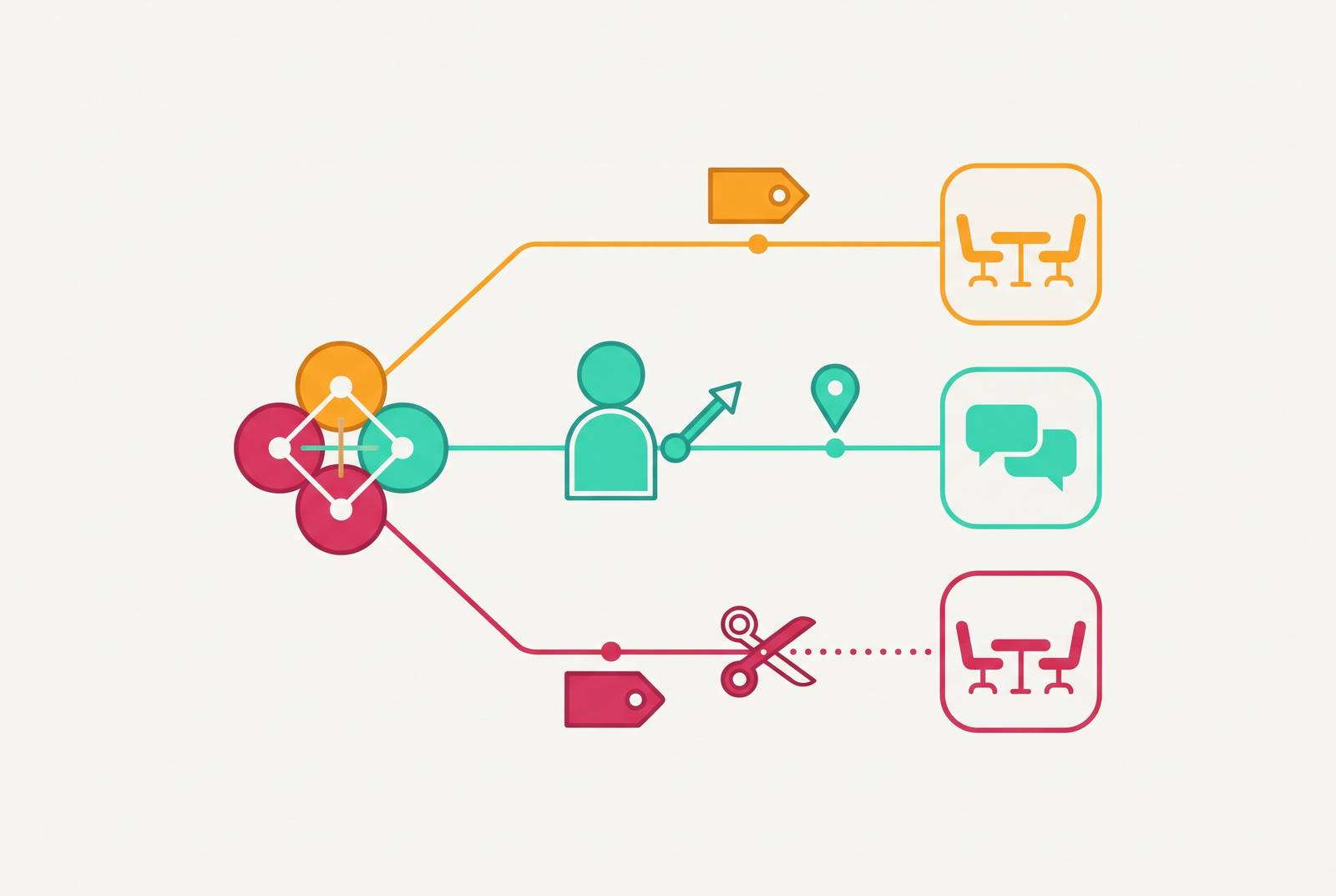
When an early B2B SaaS company’s first customers come from friends, finding the next customer becomes a routing problem. Recording where each meeting came from, who owns follow-up, and whether the route produces customers or deserves to be cut makes that routing problem manageable. That discipline turns personal introductions into evidence for growth, and it applies just as directly when buyers begin finding brands through AI answers.
Why the friend pipeline stops working between customers five and twenty-five
Personal networks and direct outreach generate the first customers in a founder-led sale. Between customers five and twenty-five, a relationship-shaped pipeline creates difficulties because it has no built-in record of origin, no explicit follow-up owner, and no rule for ending an unproductive route. The founder remembers the person who helped. But remembering a favor is different from knowing which path can reliably lead to another qualified buyer.
That gap becomes visible when the next introduction does not arrive. A founder can point to paying customers without being able to explain which connections produced them or why those connections worked. How, then, can an early sales hire know where to look for more? The customer list proves that sales happened, but it does not describe a repeatable route. Before treating the slowdown as a sales problem, the founder needs a record that separates a promising source from a pleasant meeting.
What actually needs to be logged per meeting and why most founders skip it
The minimum routing discipline has three parts, which are origin, follow-up owner, and dead-route threshold. Origin means the named person, community, or event that generated the meeting, including the context of the connection. “Referral” groups together introductions that may produce very different outcomes, leaving no way to credit the node that brought a qualified buyer or question the one that did not.
The follow-up owner is usually still the founder. Naming that person makes responsibility explicit, so that a meeting does not quietly expire because the next step belongs to nobody. The dead-route threshold serves a different purpose. It defines the point at which a source gets cut, ending efforts sustained only by hope. Those rules need an outcome record to work, because an origin without a result cannot show whether a route has reached its threshold.
Each warm introduction feels like a separate relationship, making its value as an observation in a channel model easy to overlook. Recording it can seem less urgent than honoring the introduction and taking the meeting. Tomba’s 2026 GTM guide identifies the data layer, including verified contacts, enrichment, and routing, as work founders skip before blaming “the messaging.” The consequence is a diagnosis made without the evidence needed to distinguish a weak message from a weak source.
How the ask-for-the-next-intro mechanic makes the channel explicit
Loopio’s early customer acquisition shows the simplest form of this discipline. Jafar spent months doing customer research interviews, positioning himself as a learner rather than a seller, and asking for introductions at the end of every conversation. The habit was useful not only because it opened another conversation, but because it exposed the chain through which that conversation became possible. A log can preserve the chain behind each “warm intro.
OnRamp used personal networks for warm introductions and shifted paid spend from Google Ads to LinkedIn as part of its early growth. To justify that kind of shift by lead fit, a team needs to know which source produced the wrong-fit leads. The channel names alone do not establish that.
The equivalent decision in a personal pipeline requires recording whether introductions from a particular node became qualified conversations and customers. Did the route create a next step, or only another first meeting? “Meetings that don’t recur” is an operational sign of a dead route. It becomes a usable signal only when those meetings remain attached to their origins, so that the founder can identify which source to stop feeding.
Why picking one GTM motion for the first eighteen months depends on having this log
Choosing a primary go-to-market motion for the first eighteen months requires evidence about how the first customers arrived. Product-led, sales-led, and community-led approaches are not interchangeable preferences. A founder needs to know which path already produces customers before deciding which one to build out. The log supplies that evidence at its smallest useful scale. Without it, the choice can reflect the founder’s strongest memory rather than the route with the clearest conversion record.
Tomba describes “motion sprawl” as a seed-stage team running outbound, product-led, and a partner program simultaneously, producing three half-built motions and leaving none finished. If every route still looks promising because none has an outcome record, each can keep taking up the team’s time. A log helps the team choose where to put its effort and which routes to close. That makes it a prerequisite for strategy.
Origin data is not the only constraint, however. Annual contract value also limits which motion the business can afford, because supporting a sales rep requires a sufficient price point. The guide maps product-led approaches to the low end and sales-led approaches to larger contracts, with hiring shaped by the margins. A route can produce buyers yet still be too costly to staff at the product’s price.
What a minimal routing system looks like before a CRM is justified
At the founder stage, a one-person document can serve as the routing system. Three columns are enough to start with, origin node, follow-up owner, and outcome status. The owner field contains a name. The outcome is converted, dead, or pending with a date. Those columns keep track of the meetings, while a written rule sets when the route closes.
The dead-route criterion can be simple and explicit. If a chain of three introductions from the same node produces zero qualified conversations, that node is cut before the next outreach cycle. The document also needs to define what counts as a qualified conversation, or the threshold will depend on a judgment that changes from meeting to meeting. This is a solo founder’s service commitment. It states who follows up, what result counts, and when further effort stops.
The tool can remain modest as long as the record is shared in a usable place. A tagged Slack channel, a simple spreadsheet, or a CRM can centralize feedback held in the founder’s memory. The distinction is whether someone can inspect the record and understand the decision. A later hire cannot inherit an unwritten sense of which introductions felt promising. A named origin, an owner, an outcome, and a closure rule give that person something concrete to work from.
How the same routing logic applies when AI answer engines become a discovery channel
ChatGPT, Perplexity, Gemini, and Claude are becoming places where B2B buyers find vendors. A brand absent from category-relevant answers can lose introductions it never knows were available. The team still needs to know which source puts the brand in front of a buyer and whether that leads to a next step.
The fields for this record are origin, yield, and a dead-route threshold. Origin identifies which engine cited the brand, while yield asks whether the citation produced a visit or a conversion. The threshold sets where it makes sense to keep spending time and money. A citation establishes presence in an answer, but it does not by itself establish that the route generated a customer.
A brand may appear often when a buyer asks about it by name but hardly at all in broader discovery prompts. That is like getting more meetings with existing customers while new buyers still do not know the brand. Most teams are not tracking AI share of voice at all, so even that distinction can go unnoticed. The practical extension of the founder’s log is therefore per-engine measurement that separates being found by someone who already knows the brand from being introduced to someone who does not.
Why per-engine measurement matters more than aggregate AI visibility
Calling every appearance “AI visibility” is much like labeling every personal introduction “referral.” It erases the route before the outcome can be judged. Different engines mention and cite brands differently, so a combined total cannot explain which engine provides attributable exposure or which deserves further content investment.
Claude illustrates why mention and citation need separate records. It mentions brands in a large share of answers but cites them at a meaningfully lower rate. Answer length also affects raw share-of-mention across engines, making the comparison partly a measure of how much an engine says. Counting names without checking citations and yield is like counting meetings without asking whether any converted.
There is also little overlap between the domains that different engines cite. Presence on one engine does not automatically transfer to another. A source that supports visibility in one route may provide little visibility elsewhere, so an apparent overall gain can conceal an unproductive route. Per-engine logs keep those differences on record so the team can decide where to spend time and money. The reason to keep them is not to produce a more elaborate dashboard, but to identify where continued work lacks a useful return before it consumes more content effort.
What builds the ground a brand can be cited on — and why it must be published and owned
A brand needs real, retrievable content. That foundation includes a stable, identifiable entity that language models can resolve. Without it, the recognition systems behind citation lack a dependable identity to attach to the content. This is the technical counterpart of having no verifiable profile before someone makes a warm introduction.
A large share of AI brand mentions originates in third-party sources, making external presence across trusted category sources a central citation lever. The content equivalent of seeding introductions is to identify where target platforms find trusted material and develop a presence there, including forums, communities, and category-specific publications. The brand can own its published foundation without owning every place that lends it credibility. On-site optimization alone leaves that wider route undeveloped.
A single hero page is not a sustained foundation. Publishing on a cadence and keeping the content ground updated give the routing discipline somewhere to direct continued effort. Publication needs to be connected with evidence about which engines cite it and what those citations yield. Whether the introduction comes from a friend or an answer engine, the operating rule is the same. Log the source, measure the yield, build the ground, and cut what does not work.