"Digital marketing services" for a B2B startup, sold as growth experiments: what a technical buyer should ask before the first one runs
Ask whether a growth vendor's work is measurable and reversible.

“Digital marketing services” sold as growth experiments deserve the same scrutiny as any external system a B2B startup depends on. A technical buyer’s central question is not how much content a vendor can ship, but whether its work is instrumented, reversible, and built on retrievable evidence. Those tests show whether the vendor can learn from an experiment without leaving the startup with damage it cannot easily trace or undo.
Why a B2B startup's growth vendor is a system dependency, not a service purchase
A technical co-founder or engineering executive evaluating a growth vendor has good reason to approach the decision like the purchase of a data pipeline service. Both introduce inputs the buyer may not see, side effects that may resist correction, and outputs whose causes can be hard to untangle. Deliverables alone cannot settle those risks. A vendor can publish everything it promised while leaving the startup unable to tell what changed, why it changed, or whether the change helped.
Already, 1 in 4 B2B buyers use generative AI more than traditional search to learn about suppliers. ChatGPT, Perplexity, Gemini, and Claude can therefore shape a buyer’s view before a search results page enters the process. Click traffic is only part of the exposure. An untracked experiment can also change how AI answers describe and cite the company.
That description rests on the startup’s brand entity, which is how AI models identify and describe the business. Growth channels all depend on it, and no single campaign owns it. An inconsistent claim can go unnoticed until a later model update embeds the wrong information. The engineering frame follows from that consequence. The buyer needs evidence of measurement, control over changes, and a sound basis for published claims before connecting the vendor to the business.
What a growth experiment actually touches in 2026 and why that scope is wider than most vendors admit
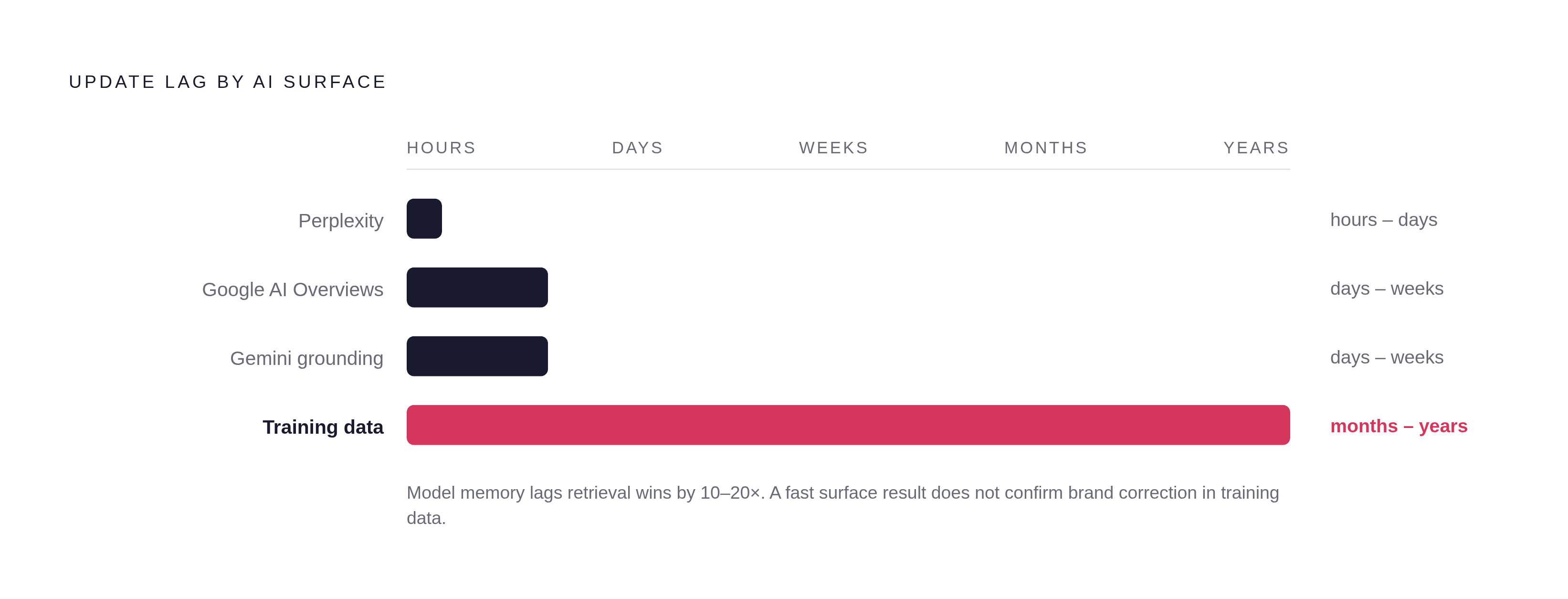
A content or SEO-adjacent experiment in 2026 touches at least three systems, which are traditional search rankings, AI answer-engine citations, and the brand entity record that AI models use. They do not respond to the same signals. Traditional search rewards crawlability, backlinks, and on-page authority, with changes appearing on a crawl cycle. AI retrieval layers instead fetch pages at query time and favor content that answers the question directly in its first few sentences. A change designed for one surface cannot simply be assumed to work across the others.
Their clocks differ as much as their signals. Perplexity’s real-time retrieval can reflect updates in hours to days, while Google AI Overviews can take days to weeks because it depends on Google’s crawl and index cycle. Gemini grounding also uses a retrieval layer. Training data builds brand memory more slowly, over model-update cycles that take months to years. Consistent, independently corroborated facts are what persist there, so a quick retrieval result says little about whether a mistaken brand description has been corrected in model memory.
Identity is the link between these surfaces. If the company’s naming differs across its site, LinkedIn, Crunchbase, and schema markup, AI models cannot reliably recognize a single entity. They may omit the company or attribute claims incorrectly. For the buyer, the practical question is whether the vendor can describe all three surfaces before defining success. A proposal that covers only keyword rankings leaves too much out, even if its ranking work is sound.
Whether the vendor can instrument the experiment before it runs
An experiment needs a measurement protocol before work begins so that publishing can serve as a test. The vendor should be able to explain what it will measure across the surfaces above and how it will distinguish a change from ordinary variation. That distinction is especially important for AI answers because they are non-deterministic. A single prompt check cannot establish a dependable result.
A credible protocol starts with a baseline prompt panel of target queries, run on a fixed cadence before any content ships. This gives later results something to be compared against. Citation share, defined as the fraction of that prompt set where the brand is named, should be tracked separately for ChatGPT, Perplexity, Google AI Overviews, and Claude. Their citation behavior differs sharply. Combining them can hide which engine changed and leave the vendor unable to explain what a gain seems to show.
The measurement also needs to separate five events, which are retrieval, visible citation, brand inclusion in a recommendation, the sentiment of that inclusion, and referral behavior. These are not interchangeable signs of success. Retrieval does not establish that a buyer saw a citation, and a mention alone does not show whether the description was favorable. A single “AI visibility” score loses those distinctions. The buyer should ask what each reported measure actually records.
GA4 can track some AI referral traffic through AI referrer filters or its native AI Assistant channel, but a large share comes in without a referrer. Those visits cannot be identified by that method. A protocol should therefore connect the traffic it can track to pipeline without presenting it as a complete account. The revealing request is concrete, asking the vendor to show its pre-publication prompt panel and explain how often it reruns it.
Whether the work is reversible and what a rollback actually looks like
Measurement can show a problem without offering a way to fix it. Reversibility is a separate capability, and it depends on what the experiment changes. On-site content can usually be unpublished, redirected, or rewritten. Off-site placements on third-party domains, directories, review platforms, or forum threads are not reversible once indexed in the same straightforward way. The buyer therefore needs to ask what “rollback” means for each kind of output, rather than accepting a general promise to fix mistakes.
For off-site work, that question begins with a record. Can the vendor name every placement and show its URL, the claim made on the brand’s behalf, and the publication date? Without that log, even the scope of a correction is unclear. Schema and crawler-policy changes need a close look for a different reason, since they affect how AI models read the whole site. A robots.txt or structured-data change that removes or misidentifies the brand entity can persist in training data until another update cycle, long after the technical correction.
AI-assisted publishing introduces a particularly concrete failure mode. A fabricated statistic or invented source URL can be published, indexed, and cited by an AI engine before anyone catches it. Speed makes the review gate more important. The buyer needs to ask what happens when a draft contains a fabricated citation, and who is responsible for finding it before publication. A quality process needs a human reviewer who opens every cited source, rather than treating the presence of a citation as proof.
Audit trails for approvals and modifications, human review before publication, and a named editor responsible for quality are the minimum controls. A RACI assigning AI output review to “the team” does not establish an accountable owner. The buyer should also ask what the vendor’s protocol is after a fabrication escapes review. Treating that possibility as an edge case overlooks the very kind of error whose reach can outlast the original page.
Whether the vendor's content is built on retrievable evidence or assembled for volume
Even a measured, reversible experiment can produce content that AI engines will not cite. To cite a page, a model needs a passage it can extract from it. That passage needs clean, contradiction-free, attributable claims that a model can quote without introducing error. Publication is not the same as evidence.
A section should function as a standalone answer. A question-shaped heading and an answer-first opening sentence make its purpose clear, while a named source or figure grounds the claim. Burying the answer in paragraph three works against extraction. Princeton GEO research by Aggarwal et al., presented at KDD 2024, found measurable visibility gains from modifications including named expert quotations, specific statistics with named sources, and authoritative references on the generative engine tested. That finding supports attention to evidence and structure, while leaving gains from any given citation on any given engine uncertain.
The evidence also needs to be publicly retrievable. A key claim hidden behind a form adds nothing to retrieval, even if the asset helps with other marketing work. If a vendor proposes gated content to improve AI citation share, where can the engine get the evidence? A persuasive-looking claim whose support is inaccessible does not meet the same standard as one with a public, attributable source.
This brings the argument back to brand identity. Consistent naming helps models recognize the company, but specific, corroborated claims give them something reliable to say about it. A directory mention or forum post without a verifiable claim can add entity signal without adding citation authority. Volume cannot bridge that gap by itself. A large body of vague content can associate the brand with vague claims, and correcting that association in training data is slow.
The useful request is for a B2B client example and a walkthrough of the first H2 section’s claim, its named source, its specific figure, and its publicly available evidence. A polished tone cannot answer those questions. If the vendor cannot show where the sample’s claims came from, there is little reason to trust the evidence behind work it will deliver later. The work needs to meet the same standard whether it is on the startup’s site or elsewhere.
How to run the vendor evaluation as a structured pre-flight, not a pitch review
These questions need to be asked in writing before the sales process ends. Written answers make the proposed controls part of the record. Start with instrumentation and request an example prompt panel for the startup’s category, the baseline protocol for citation share, and the cadence for each engine. Then ask how the vendor separates a real gain from prompt-to-prompt noise. The answer needs examples.
Next, check reversibility by looking at an example off-site placement log. Does it record the URL, claim, and date, and can the vendor show a log from a current client? Follow that with the protocol for catching fabricated statistics and source URLs before publication, including the named human reviewer. Ownership needs an answer as well. If the engagement ends, which assets revert to the client, and which do not?
The evidence review should then use a sample deliverable rather than another explanation of the vendor’s method. Ask the vendor to trace the first factual claim in its opening section to a named source. Follow that with its policy on gated assets when the client’s goal is AI citation share, and its process for keeping the brand’s name and description consistent across on-site and off-site content. These questions test different weaknesses.
A vendor that answers fluently in writing, with examples, demonstrates an engineering-grade growth practice. One that treats the questions as unusual or adversarial reveals something about its operating standards. The same tests apply to an in-house capability or a platform purchase. Both still need measurement across AI engines, an audit trail for published assets, and a human review gate before publication. Automating past those controls trades immediate speed for risk that can compound over model-update cycles.