B2D Marketing Is an Engineering Problem, Not a Content Problem
Success in developer tools depends on working products, not just good writing.

B2D marketing is an engineering problem. Expert writing and community presence can help developers discover a tool, but adoption depends on what happens when they try to use it. The fix is to build and measure the whole path from discovery to working product to team adoption, rather than treating every failure along that path as a need for better messaging.
Why B2D marketing keeps failing despite better content
The prevailing B2D playbook has a reasonable premise. Developers want companies to speak honestly, get the technical details right, and help in the places where they work through problems. Putting this advice into a communications plan cannot, by itself, make a product easy to evaluate or adopt.
What happens after an article helps a developer and brings them to the site? A developer may start a trial, look for an example, and attempt to build something before ever speaking to the company. At that point, the product experience takes over the selling. Clear messaging cannot compensate for a quickstart that leaves the developer unable to finish the task that brought them there.
This is where the usual diagnosis goes wrong. Traffic and signups can look healthy while activation stays low, because finding a product and getting it to work are different events. More content may bring more people to the same broken trial without changing its outcome. The failure is a funnel with a broken floor, and repairing it requires a different kind of work.
What the developer buying motion actually looks like as a system
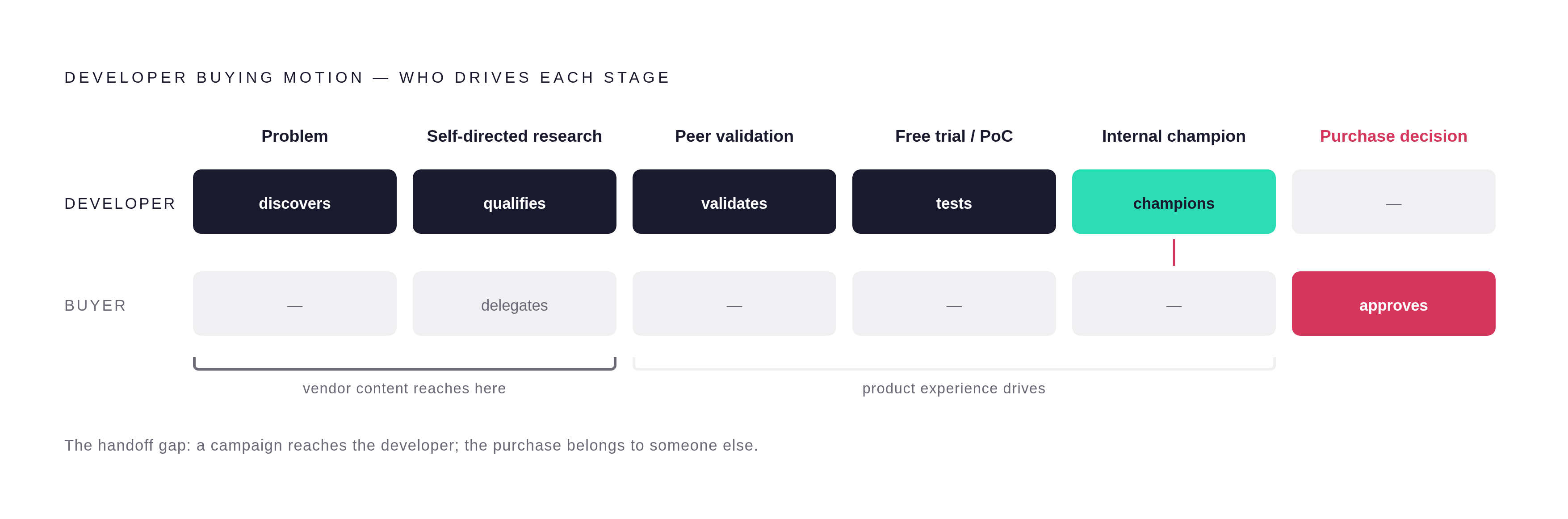
The developer buying motion begins with a problem. From there, it moves through self-directed research, peer validation, a free trial or proof of concept, an internal champion, and a purchase decision. The vendor has little control over these stages. Content sits at the discovery end of that sequence, while later stages depend on technical qualification and a working product experience.
Developers look across Reddit, GitHub, Stack Overflow, AI assistants, and conversations with other developers. A company’s explanation is one input among those sources. Peer validation and testing the tool themselves give developers other ways to judge whether it fits.
The developer and the buyer are often different people. The developer discovers and qualifies the tool, while the buyer approves the purchase and delegates technical qualification back to the developer before signing. A campaign can thus reach the person who approves the purchase without giving the person who evaluates the technology what they need. It can also reach the right developer but leave that person unable to establish a case for adoption.
The three-pillar structure of B2D and why teams only build one of them
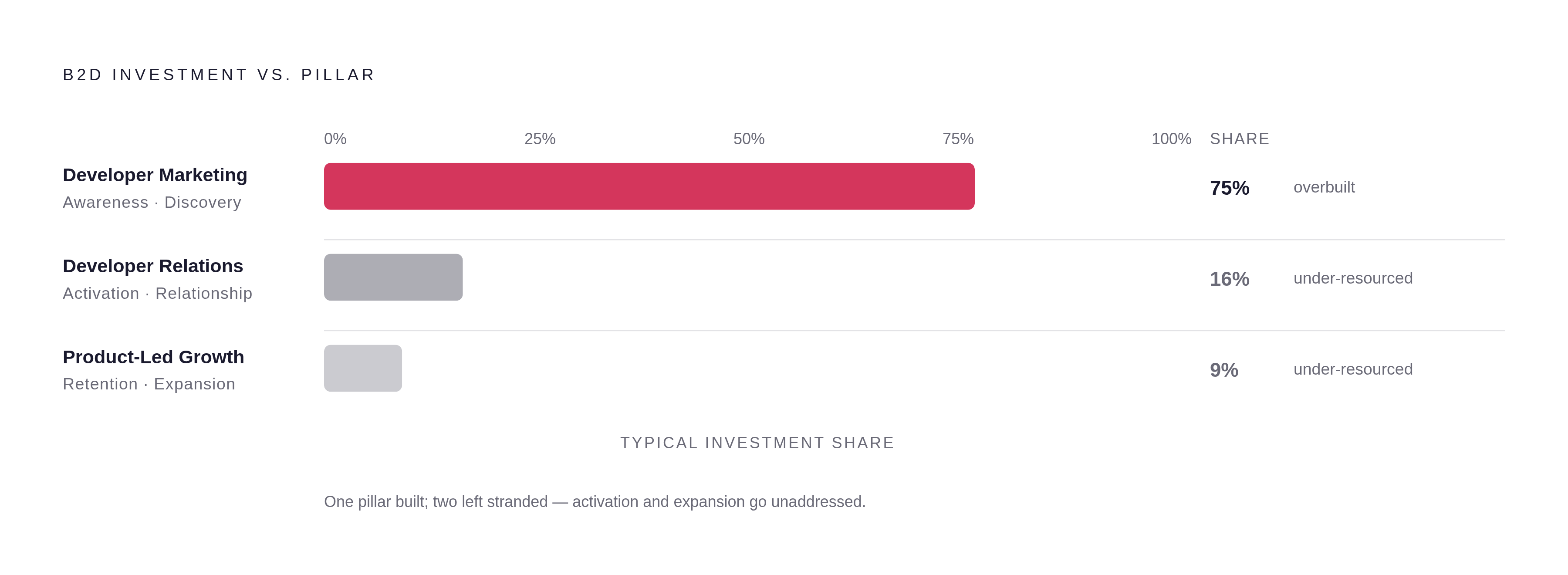
B2D works well when it has three pillars, developer marketing, developer relations, and product-led growth. Developer marketing uses content and communication to help people find and learn about the product. Developer relations builds the relationship between developers and the product. Product-led growth uses the product experience to get people to adopt the tool and bring it to others. The latter two also work on activation, retention, and wider use.
The imbalance begins with how teams are built. Marketing teams know how to commission articles, publish campaigns, and report on reach, but they may lack the skills to instrument onboarding or redesign an API quickstart. Those differences shape what gets funded and finished. The publishing program grows where everyone can see it, while the less visible path from signup to success is still someone else’s job.
Who is responsible for that work, Product or Marketing? In B2D, that boundary is precisely what needs examination. If interest becomes adoption through the product experience, a marketing function that cannot influence that experience is responsible for an outcome without access to its main controls. The product marketer’s closest partners are therefore Engineering, Developer Relations, and Product Managers, because the work concerns experience as much as explanation.
Documentation and onboarding are the actual conversion mechanic
Twilio’s onboarding redesign shows what an engineering intervention looks like. Its builder-first flow handed developers keys, phone numbers, and credits immediately, while deferring credit card and compliance requirements until production launch. Early results showed a clear gain in first-message activation and production launches within seven days. The change was in the product’s sequence of steps. It let developers prototype before confronting requirements associated with going live.
That distinction is more useful than a general promise of “easy onboarding.” It identifies which event the experience is meant to enable and which requirements can wait. The campaign did not have to persuade developers that progress was possible. The onboarding flow gave them the means to make progress.
Stripe shows why teams also need to be clear about what counts as the success event. Its sign-up page says developers can “create your account in minutes” and immediately start building, while its support documentation says a business profile and KYC are required to enable live payments. Starting to build is not accepting live payments. A useful time-to-first-success measure must distinguish the time needed to reach each of those outcomes.
Documentation supplies the instructions that connect access to achievement. Clear structure and runnable examples help developers reach value and judge whether they understand the product well enough to rely on it. The lesson for resourcing follows from that role. Teams responsible for docs and onboarding should be measured on activation.
Product-led growth as an engineering discipline, not a pricing strategy
A free tier gives a developer a place to start. It does not explain how that developer will succeed, return, or introduce the tool to a team. Product-led growth depends on designing those steps, which cannot be taken for granted just because access is free. The entry point and the growth loop are different parts of the system.
Cursor illustrates the individual-to-company path. Between late 2024 and early 2026, its ARR grew substantially as individual developers introduced the tool to their companies. Corporate revenue grew from a quarter of the total mix to 60% by February 2026. That expansion makes the product experience central to the buying motion, because individual use precedes wider organizational adoption.
Supabase shows a different kind of result, with its community helping it produce more content. The contrast is useful because PLG does not have to appear only as a shift toward corporate revenue. Community participation can also extend how developers discover and learn about a product.
The engineering levers are concrete and open to measurement. Time-to-first-success and activation rate show whether users reach value, an expansion trigger defines the route toward wider adoption, and the viral coefficient can be observed from usage data. These are ways to examine whether a useful product’s value becomes repeat use and whether a successful user has a path to bring others.
Discovery has moved into AI answers, and that is an engineering problem too
The strongest objection to an engineering-first approach is straightforward. A developer who never finds the product cannot experience its excellent onboarding. Queries such as “best error tracking for a Node API” or “alternatives to Postman” are increasingly answered inside ChatGPT, Claude, Perplexity, and Google’s AI Mode before a developer opens a search results page.
An assistant’s answer is assembled from material it can retrieve and cite. The structure of a claim, its supporting evidence, and its provenance therefore affect how it reaches developers through an assistant’s answer. A page does not become a useful source merely because it exists. Its information has to be available in a form the system can extract and attribute.
The Princeton GEO benchmark found that techniques involving quotations, statistics, and structured claims boosted AI citation rates by 25–40%. That finding supports a narrower conclusion than “publish more.” It suggests that teams should make evidence easy to use in an answer, since adding more pages alone will not do that. Generative engine optimization is the practice of structuring content and building authority so that AI platforms select, cite, and surface a brand.
This gives good writing a technical requirement beyond being persuasive to a human reader. Consistent brand facts, retrievable citations, and structured content turn discovery into an information architecture problem as well as an editorial one. Citation measurement then gives the team a way to test whether that architecture is working.
Trust has contracted, and trust is now a technical specification
Developers have lost trust after pricing changes, license changes, and AI-washed launches. Against that background, a claim about reliability or usefulness is something to verify. Better phrasing does not resolve the underlying doubt. The company needs to give a developer enough evidence to inspect the claim independently.
A changelog makes changes and their timing visible. A benchmark with reproducible methodology lets readers examine how a result was obtained, while an open GitHub issues list exposes problems. Sample code that runs without changes gives developers proof they can test directly. These artifacts let developers test the distance between what a company says and what its product does.
An “AI-powered” label does not explain a capability, and a testimonial carousel does not make a technical result reproducible. Thought leadership and case studies can provide context, but they cannot repair outdated docs or a neglected changelog. A trust-building program focused only on those formats is working on the wrong surface.
The audience is also becoming less uniform. AI coding tools have brought designers, analysts, product managers, and founders into building software, so a B2D program has to decide whether it serves professional engineers, AI-native builders, or both. Those groups read different things and differ in what they trust as proof. The common requirement is verifiability, even when the explanation and the evidence need different forms.
What it looks like to treat B2D marketing as an engineering discipline
An engineering-first B2D function instruments the adoption loop and measures outputs. At the discovery layer, that means publishing structured, machine-extractable content on a cadence and measuring AI citation rates across ChatGPT, Claude, Gemini, and Perplexity. Pageviews and shares do not answer the same question. The relevant test is whether the product appears in the answers developers use to investigate their options.
At the activation layer, the work moves into onboarding and documentation. Time-to-first-success is instrumented, documentation is audited for depth and example coverage, and activation rate becomes a primary marketing metric. Twilio’s redesign provides the model for the kind of change this can involve. The task is to alter the path to a working result.
At the expansion layer, the team designs the transition from individual success to team use. An expansion trigger belongs in the product rather than being bolted on through a sales sequence after the fact. This makes wider adoption part of the experience under design. It also connects the initial promise to the reason a developer would put their own credibility behind introducing the tool internally.
The organizational consequence is harder than changing a dashboard. In this model, marketing sits inside Product, with the authority and working relationships needed to change the adoption experience. The product is the pitch, the docs are the homepage, and the distribution pipeline has to be engineered. That is a job description, and it requires a team equipped to build.