What Perplexity's citation pipeline actually means for technical marketers
How Perplexity's two-phase pipeline rewires content strategy for technical teams.

Perplexity citations are an engineering problem. For technical marketers, the useful distinction is between getting a document into the candidate pool and getting a passage selected for the answer. Each phase depends on different choices in how a page is built, from crawl access to factual density. Understanding the split makes it possible to build for citations before publication, then measure what actually earns them.
Why Perplexity's citation system is structurally different from Google ranking and ChatGPT synthesis
Google serves results from a pre-built index, while ChatGPT can synthesize an answer from its frozen training set. Perplexity’s retrieval-augmented generation system performs live web retrieval on every query. Retrieval is built into the answer process. Its citation slots are therefore rebuilt for each question, rather than drawn from a static leaderboard that a page can occupy. The optimization target is the pipeline that produces an answer.
That changes what success looks like for a document. A fourth-position Google result can still receive clicks, but a Perplexity source either clears the filters and earns a visible numbered citation or does not. Being a plausible source is not enough. A page must supply something the system selects for the answer in front of the reader.
Perplexity phased out sponsored placements in late 2025 and confirmed its advertising exit in February 2026. Citation appearances are earned through the pipeline. For a technical marketer, the central question is consequently not how to buy or defend a position, but which requirements a document and its passages must satisfy.
The two-phase pipeline — document inclusion and paragraph selection are separate problems
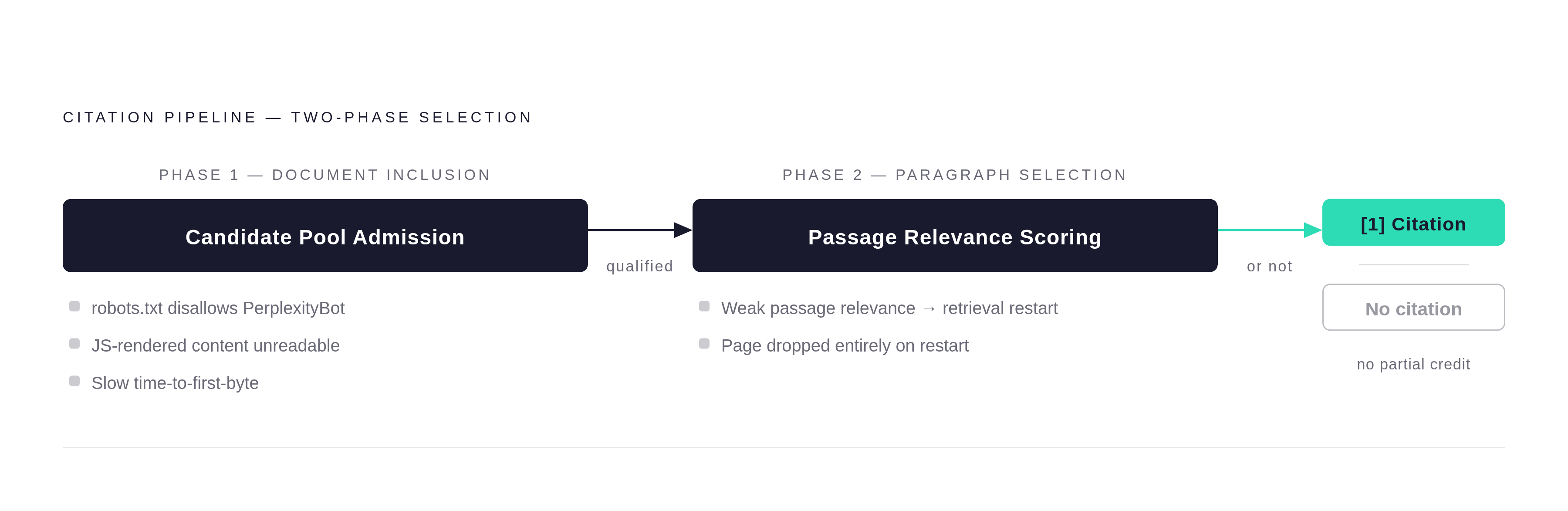
Phase one, document inclusion, admits pages to the candidate pool. Phase two, paragraph selection, selects passages from that pool for use in the answer. These are separate problems with separate failure points. Treating both as one “Perplexity SEO” target obscures whether the system cannot access a useful page or can access it but finds no suitable passage.
Roughly 29–33% of final Perplexity citations are also in Google’s top 10 organic results. Google visibility is therefore relevant, but it is not a complete map of the opportunity. Most citations come from outside that top group. A document does not need to win the same contest as a Google result to become a Perplexity source.
Phase two applies a more local test. Does a particular passage answer the question well enough to be selected? Perplexity restarts retrieval when its top candidates fall below the relevance threshold, so passages that are weak matches can be dropped before ranking. The page has to enter the pool, but its answer must also survive selection.
Phase one variables — what determines whether your document enters the candidate pool
Crawlability is the first constraint because inaccessible content cannot compete. PerplexityBot operates an independent crawler and must be explicitly allowed in robots.txt. Allowing Googlebot or another AI crawler does not grant it access. Three common obstacles are a disallow rule covering PerplexityBot, JavaScript-rendered content it cannot parse, and a slow time-to-first-byte that causes the crawler to time out.
The practical response is to make access explicit. Technical teams should check the robots.txt rules that apply, whether the answer can be read without unsupported JavaScript rendering, and whether the server is fast enough to respond before the crawler times out. The Comet browser, available across iOS, Android, Mac, and Windows as of 2026, also reads pages and chains task steps on a user’s behalf. Content hidden behind JavaScript or an interaction can be left out before the system decides what to cite.
Once a domain is being crawled, navigation and document identity become important. A well-formed llms.txt can act as a curated reading list, prioritizing canonical answer pages over archived stubs. It does not secure citations by itself. Clean canonical URLs also support deduplication, while pages that redirect through a 301 or vary by tracking parameter can confuse that step and lose selection to a competing source.
Google indexing, domain authority signals, and cross-platform presence also influence document inclusion. Mentions on Reddit, industry forums, and well-known publications give the reranker a source-diversity signal. Brand visibility falls into three tiers, with roughly 30 percentage points between global household names, established mid-market brands, and niche brands. Brand equity acts as a prior that an on-page change after publication cannot create.
Phase two variables — what determines whether your passage is selected for the answer
At this stage, selection depends on freshness, how clear each sentence is, factual density, and how answers are structured. Even a page with authority needs an answer the system can extract. The writing must make a relevant claim easy to locate and give the system enough context to understand what that claim describes.
Controlled testing identified freshness as the strongest measured citation trigger, with a recently stamped technology article cited substantially more often than an identical article bearing an older dateline. The freshness layer reads recency tokens literally. These include explicit “as of [month] [year]” phrases, visible last-updated dates near the top, and version numbers. Stale content can drop out of the citation pool over time even if it did well before.
Sentence architecture supplies another structural signal. Cited excerpts tend to come from short, direct sentences at the start of sections, while pages that are not cited tend to have long compound sentences that bury the claim. Where can the system find the answer? A labeled TL;DR or direct answer in the first 60–80 words under a heading gives it a compact passage to extract. Such blocks appear in a strong majority of cited URLs, rarely in non-cited ones, and supply a meaningful share of citations directly.
Question structure can reinforce that clarity. Explicit question headings match the embedding model’s preference for literal phrasing, while visible HTML Q&A and FAQPage JSON-LD provide additive signals because the reranker treats schema as page text. The content still needs conceptual completeness and clear entity relationships. Keyword density has near-zero impact, whereas product names, companies, standards, and version numbers help establish topicality. Entity-rich openings that name the brand, category, and two to three comparators within the first 200 words can clear the entity-scoring step.
Chen et al. (arXiv:2509.08919) formalized AI search engines’ preference for content anchored to authoritative third-party sources over unattributed brand claims. Perplexity was the most brand-inclusive of the major engines studied, but corroboration still contributes a signal.
Why content type matters more than topic coverage for phase two success
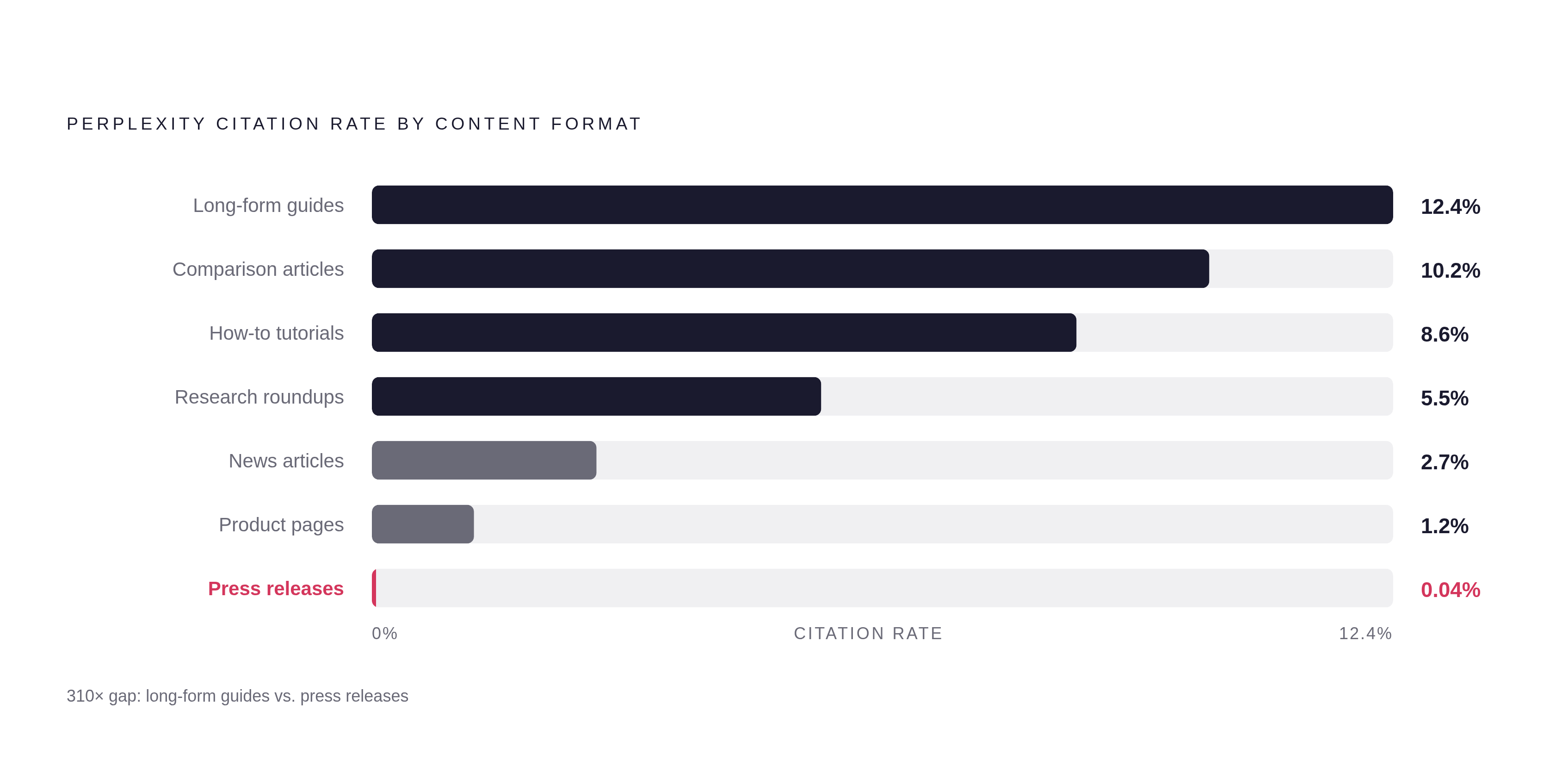
A page can cover the right topic in the wrong form. Long-form guides, comparison articles, and how-to tutorials earn citations at substantially higher rates than press releases or brand announcements, which earn them just 0.04% of the time. The distinction is not simply length or polish. These formats differ in how readily their passages answer a specific question without requiring the system to reconstruct the point.
A press release is built around an announcement. That purpose does not usually produce a direct answer to the sub-query the pipeline is trying to resolve. As a result, it can be dropped before ranking regardless of the brand’s authority. This exposes the limit of phase one strength. A well-known company can publish an accessible, authoritative page that remains poorly suited to phase two.
Query decomposition makes that mismatch more pronounced. Perplexity breaks complex questions into multiple sub-queries and draws on a wider candidate pool to answer them. A page that answers only the main question may leave unresolved how options compare, what they cost, or which alternatives are available. It is then only a partial candidate. A guide or comparison can make room for those branches, with each passage answering a different question.
For content planning, the lesson is to choose an answer-compatible format at the start. Adding schema or sharpening the opening late in the process may not fix a document built around announcements at the expense of explanation. Comparisons and head-to-head pieces can serve the reader directly when the question calls for them. Their advantage is structural compatibility.
Why citation sets are volatile and what that means for a content program built on them
Perplexity rebuilds citation sets on every query, and the mix of sources rotates substantially month over month. Engineering improves a page’s suitability for selection. It does not freeze the answer surface, so a single successful appearance cannot establish that a content change has worked reliably.
Citation density also complicates the meaning of success. Perplexity answers have roughly six to nine sources, and most of those answers include at least one citation. Those appearances do not offer equal exposure. A citation at position one dominates the answer surface, while one at position twelve provides negligible brand exposure. Total citation count therefore needs the context of where a source appears.
Only about 11% of domains cited by Perplexity are also cited by ChatGPT, indicating that their citation pipelines operate largely independently. Perplexity visibility is not evidence of visibility on Claude or Gemini either.
A URL can be cited without its brand appearing in the answer, and a brand can be mentioned without its URL being cited. Sentiment is less stable still, shifting more often than the presence of a mention. Volatility therefore makes ongoing measurement of these distinct outcomes necessary, with separate attention to citations, mentions, position, and framing.
How to measure Perplexity citation performance and what the numbers actually tell you
Perplexity measurement needs purpose-built infrastructure because its pipeline is stateless. There is no Search Console equivalent that provides a settled view of citation performance. Adapted SEO tooling cannot by itself resolve that gap. Measurement requires observing repeated outcomes across a relevant query set.
Why not run the same prompt until a pattern shows up? Testing across thousands of prompts and multiple AI engines found that the same brand list repeats in fewer than one in a hundred responses. The same list in the same order is rarer still. Volume across many queries provides a more reliable signal than depth on one, because the content program has to serve a range of questions.
Teams should track citation frequency as how often a URL appears as a source, and brand mention rate as how often the brand name appears in generated text. Content changes should also be tagged, including “added FAQ schema,” “rewrote section intro,” and “added last-updated date.” Checking the same query set at 14 and 30 days makes those changes legible against subsequent performance. The freshness window means changes should register within a month if they register at all.
That query set also needs to reflect decomposition. Perplexity generates close to 2 related sub-queries per tracked question on average, so comparison and cost variants belong within a page’s coverage. Each engine must also be tracked on its own, since four live AI engines cite very few of the same sources for the same prompt.