Keyword difficulty is a score about someone else's site: how to pick searches and AI answers you can actually win
Keyword difficulty scores your rivals, so audit your own authority and AI citation odds.

Keyword difficulty helps describe the competition, but it cannot tell you which searches your site can win. That decision needs evidence about your own authority and a second assessment of whether your content can earn citations in AI answers. For teams committing a content budget, the useful question is not simply how hard a keyword looks, but what the site can contribute that search and answer engines will use.
What keyword difficulty scores actually measure — and what they leave out
Keyword difficulty measures the backlink strength of pages currently ranking for a search term. Semrush assigns referring domains to top-ranking pages 41.22% of its score, the largest share, with domain Authority Score, dofollow-to-nofollow ratio, and search volume accounting for most of the remainder. On-page content quality does not appear in that list. Ahrefs explicitly excludes on-page content and relevance from its KD metric, which reflects the backlink profile of the current top 10.
Those exclusions define what the number can explain. It does not establish whether the ranking pages answer the query well, match the searcher's intent, or remain current. The scale also resists a simple reading. Referring-domain requirements do not grow proportionally with KD, so moving from a mid-range score to a high one can demand far more than twice the backlinks. A steady rise in the score does not describe a steady rise in effort.
Why scores differ across tools and why comparing them is misleading
A KD score belongs to a tool's dataset and formula. Each tool has its own crawler, backlink index, and method of compressing those observations into a number. Averaging Ahrefs and Semrush scores therefore produces a composite without a shared meaning, while both tools recalculate as the pages holding top positions change. Pick one tool, use it consistently, and read its scores as rough bands.
The core flaw: KD tells you about their site, not yours
KD measures incumbent strength against a generic baseline. It asks how strong the pages already there are. But how strong is the site researching the keyword? That is a separate question, and answering it requires information the standard score does not contain. A site with established topical authority may compete for terms that raw KD would discourage it from pursuing.
Personal Keyword Difficulty, or PKD, addresses that gap by adjusting the assessment to a specific domain's authority, though the resulting number still requires scrutiny. A team filtering solely on raw KD can reject terms suited to its strengths while choosing others it cannot realistically win. Its budget then follows the assets of competitors.
Does low KD at least mean the incumbents are beatable? It indicates weak backlink profiles. A thin page on a large domain can benefit from that domain's reputation even when the page itself has few links. Low KD therefore leaves an important question unanswered. The team still needs to understand why those pages rank and whether its own site can offer a credible alternative.
What your own authority signals actually look like and how to instrument them
The constructive alternative is a repeatable audit before keyword selection. Start with topical authority depth, recording the published, interlinked pages that cover the target's topic cluster. The check is whether those pages address the subject coherently, rather than whether the site has accumulated a large number of loosely related posts. This makes the site's existing work part of the assessment.
Next, check the quality of referring domains in the site's field as well as the all-domain authority score. The useful record is how many linking domains are contextually relevant to the subject, because a niche-specific backlink can outperform a generic one at the same authority level. Then inspect the actual search results. Forum threads, thin pages, and outdated posts may reveal openings the numerical score obscures.
For prioritization, difficulty belongs after intent and volume. Those earlier filters establish whether the query is relevant to the business and whether there is a worthwhile audience to serve. AI citation potential then adds another way to be seen. Repeat the authority and competition audit quarterly, since changing rankings can make an early snapshot a poor description of conditions when the content finally publishes.
Why the prize KD is scoring for is now contested by AI answer engines
KD was built around winning a blue link. But queries can now resolve inside an AI-generated answer before the searcher clicks, so a ranking is no longer equivalent to winning attention or a visit. Google AI Overviews, ChatGPT, Claude, and Perplexity offer distinct answer surfaces whose source selection is not captured by KD. A page-one result may never appear in those answers. A page outside the top 10 can also earn citations.
This changes the appeal of smaller search opportunities. AI answer engines disproportionately draw on low-volume, long-tail, question-format queries, creating overlap between terms smaller sites can compete for and terms useful to answer synthesis. AI Overview-triggering terms skew toward low-to-mid difficulty and small monthly search volumes, though they are expanding into harder, higher-volume queries. A volume-led strategy can overlook that overlap. If the opportunity is no longer confined to a ranking position, how do these engines choose their sources?
How AI answer engines actually select which sources to cite
Perplexity uses always-on, real-time retrieval from its own index supplemented by third-party search APIs. Its selection weights technical crawlability and fresh content heavily. Google AI Overviews draws primarily from Google's index, rewarding SEO fundamentals and E-E-A-T signals. Content prepared for one does not automatically satisfy the conditions of the other.
The available citation space differs as well. Some engines cite many domains in an answer, while others use far fewer, creating a narrower opening for inclusion. Being mentioned is also different from being cited. A brand name in an answer may provide visibility without a link to the brand's site, while linked citations make referral attribution possible.
Citation slots skew toward third-party sources. As a result, publishing only on the owned site leaves part of the opportunity untouched. A strategy that also earns placements in high-authority external sources addresses the source pool more fully, rather than assuming every useful citation must originate on a page the brand controls.
What content signals actually move AI citation rates
Research on generative engine optimization points to external sourcing as a strong content signal. Citing external sources within a page can improve AI visibility, particularly for content that does not already rank highly. The research found up to +115% visibility lift for lower-ranked pages at position 5, while top-ranked pages could see visibility decrease. External sourcing makes the page's claims verifiable.
The same research found that adding original statistics, measurements, and structured comparisons can help a lot, though external sourcing works best. Original data gives an engine something to extract and attribute. A pillar page accurate in 2024 may be absent from AI answers in 2026 unless maintained, because recent content is favored where the answer changes.
Ahrefs' updated March 2, 2026 study found that most AI Overview citations came from pages outside the organic top 10. Generative Engine Optimization, or GEO, formalizes work on content and digital presence that AI platforms can retrieve, cite, and recommend. Answer Engine Optimization, or AEO, focuses more narrowly on extraction and citation as a direct answer. GEO also encompasses broader brand presence, recommendations, and narrative across generative AI surfaces.
Why AI brand visibility is inconsistent by default and what that means for measurement
A brand's presence in AI answers changes from engine to engine, session to session, and over time, so one citation cannot show that the brand will be seen reliably. An engine may still have access to the content even when it leaves it out of one answer. Measuring visibility from a single citation resembles checking a search ranking once and treating the result as permanent. What looks like a settled outcome may be a snapshot.
For a content team, the response is ongoing instrumentation. Measure ChatGPT, Claude, Gemini, and Perplexity as separate surfaces, tracking both mention rate and linked citation rate on a recurring cadence. Keeping those measures separate makes visibility without attributable referral traffic visible in the reporting. Keeping engines separate prevents success in one from concealing absence in another. The requirement is to measure whether published pages are being retrieved and cited, rather than infer it from publication or ranking alone.
The content pipeline that produces pages AI engines can retrieve and cite
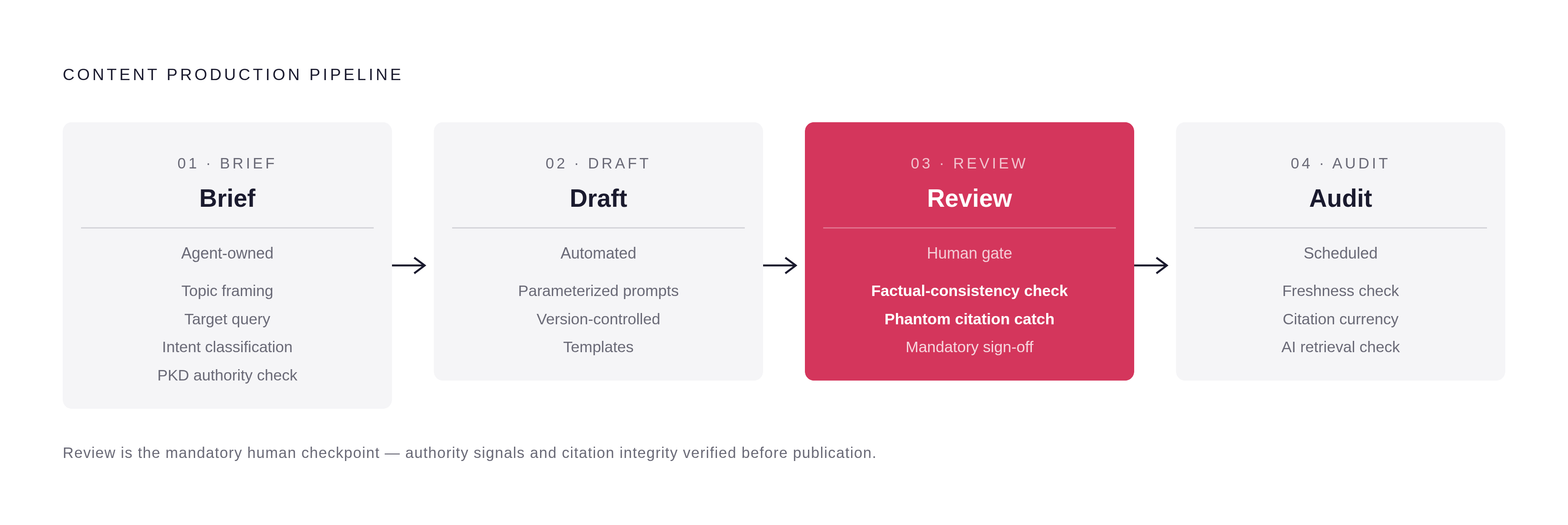
That measurement requirement extends the production workflow beyond drafting and publishing. The minimum viable pipeline has four stages, namely brief, draft, review, and audit. The agent owns the brief stage, including topic framing, target query, intent classification, and a PKD-style authority check against the domain. This happens before drafting begins. It ties the proposed page to an opportunity the site has a reason to pursue.
The draft stage gets AI help through parameterized prompt templates stored in version control, in place of direct model calls built into application logic. Templates make the instructions auditable and reversible. Review then combines automated factual-consistency and source-verification checks with mandatory human sign-off before the artifact enters the publish queue. The gate has an explicit owner. It is where factual errors and phantom citations must be caught.
Research into AI-generated scholarly content shows how fabricated references can enter permanent records when verification is not owned. The same thing can go wrong when marketing content is published at scale. Human review is therefore not an optional polish pass. It protects the authority signals the pipeline is meant to build, while also testing whether the page contributes an original measurement, a structured comparison from the site's data, or a first-hand observation. A page that only rearranges what its sources say gives an engine little new to attribute to it.
After publication, a scheduled job or human audit checks freshness, citation currency, and continued retrieval by AI engines. That closes the production loop. Every stage should support automation, step-by-step human operation, and API interoperability, without bypassing mandatory sign-off. The system can then be paused, audited, or reconfigured while retaining the ability to reject content. Sustainable cadence depends on that control.
The complete decision framework: pairing KD with AI citation potential before committing a content budget
The resulting decision model weighs four things, with the most weight given to intent. First, can the site provide a direct, defensible answer to the query? Queries about a process, definition, or comparison are more likely to earn citations than terms that are vague or lean heavily on opinion. Volume then gives an idea of how large the audience is, while leaving room for low-volume, high-intent opportunities.
Difficulty comes next, adjusted through PKD or a manual results-page assessment against the site's topical authority. AI citation potential adds the test KD cannot supply. Does the query trigger an AI Overview or answer-engine synthesis, and can the site produce something original, citable, and structurally extractable? When the current results are thin, a page may have a chance to earn citations even without a top-10 organic rank. This assessment gives the team a reason to invest beyond the hope of displacing a blue link.
After publication, the measurement loop checks how that investment has paid off in rankings, retrieval, and linked citations. A page can succeed in search while remaining invisible in AI answers, so neither outcome should stand in for the other. The site remains the underlying asset. Answer engines read more than an isolated optimized page, which favors a coherent cluster of interlinked, citable work over disconnected attempts at difficult keywords. The budget decision therefore depends on what authority the site can build and demonstrate.