Small B2B marketing starts with instrumentation, not a channel: the first week a founder should script before hiring anyone
A founder's first week should wire up tracking, ICP, and site legibility.

Small B2B marketing starts with instrumentation. Before a technical founder publishes at scale or hires a marketer, the first week should establish who to reach, whether the site can be found and understood, and how a lead becomes a countable result.
Why the standard founder advice to "pick a channel and ship" produces unattributable pipeline
A founder publishes a post, sends cold emails, and gets a first meeting. Which activity deserves the credit? Without tracking, the meeting could have come from a referral just as easily as from either campaign. The activity is visible, but its contribution is not. Publishing can generate pipeline, yet without instrumentation the founder cannot reliably attribute it.
The mistake is therefore one of order. Impressions and follower counts show results right away, but the useful measures in year one are cost per qualified meeting, reply rate, and pipeline created. Those measures show different parts of how the work reaches buyers and leads to business. Without a working feedback loop, choosing a channel is guesswork.
What "instrumentation" means before a founder touches a channel
Instrumentation means making marketing activity traceable to a result. It begins with a verifiable ideal customer profile, or ICP, drawn from closed-won data. Analytics must then fire to the right property, leads must show up in a count, and every inbound form must collect self-reported attribution. These are dependencies. A misconfigured analytics property undermines every later judgment about which page or channel works.
The ICP needs equally careful treatment. When there is little closed-won evidence, the best early conversations and the founder’s own industry access are the place to start. Firmographics, trigger events, buyer versus champion, and pain in the prospect’s exact words make the definition executable. “US and Canada SaaS companies, 50–500 employees, $5M–$50M ARR” gives someone a usable filter, while “mid-market tech” leaves too much open. Explicit disqualifiers sharpen that filter before money is spent.
Self-reported attribution adds what tracking alone can miss. A buyer’s own account of how they heard about the company can reveal word-of-mouth and dark-social paths absent from last-touch models. But attribution is only useful when the founder knows whose attention is worth earning. The ICP list is the reference point for everything that follows.
Building the named account list before building a funnel
Build a list with four columns, including company name, the specific trigger that makes it a fit now, the three or four buying committee members, and current status. The trigger is the hinge between fit and timing. A new compliance hire, a recently closed funding round, or a posting for five SDR roles gives a concrete reason the company might care this quarter. It also gives the first message something real to address.
Can the founder name 50 companies that clearly need the product? If not, the market may be narrower than assumed, or the product may be aimed too broadly. Resolve that before spending on a channel.
It also gives brand work a bounded reference point. After 90 days, the founder can count how many of those 50 companies know the company’s name. That is a more concrete question than whether awareness is “growing.” The same accounts now anchor both outreach and the assessment of progress.
Making the site legible to both search crawlers and AI answer engines before publishing anything
Before adding more content, check whether machines can reach and understand what is already there. AI search tools are used more and more in B2B vendor research, so crawl access and clear entity signals need to be in place in week one. Start with robots.txt and confirm that relevant crawlers are allowed. A broad disallow rule can undermine the work before a page is considered.
Next, add Organization and Person schema to the homepage. Every authored page should have a real named byline, a Person schema block, and a LinkedIn URL as its sameAs anchor. Keep the company’s identity clear across its LinkedIn company page, Crunchbase, and homepage schema. This is practical generative engine optimization, or GEO. It costs founder time.
Extraction is a separate part of legibility. Put a 40–60 word answer capsule at the top of every pillar page, directly answering the question that page exists to address. Then ask a major LLM to describe the brand and inspect whether it identifies the right entity and cites specific pages. An inaccurate or unsupported answer signals work still to do on the entity layer.
Why AI answer engines and Google are different citation problems requiring different content
A first-page search ranking does not mean a page will get an AI citation. Nor is that ranking a prerequisite for one. Search visibility and inclusion as an attributed source in an AI answer are separate outcomes, so content built for one cannot be assumed to win the other. The distinction changes both the work and its measurement.
The engines also need separate treatment. ChatGPT and Perplexity can draw on substantially different sets of domains, making a pooled citation count a poor guide to where the brand is gaining ground. Which engine uses the page, and which chooses another source? That question is more useful than a single total that hides the difference.
Earned media, including third-party coverage, reviews, and citations, accounts for the large majority of AI citations across engines. Owned content therefore has a different job from simply accumulating pages. It needs to be citation-worthy and supported by a recognizable entity, while third-party recognition helps establish the brand beyond its own site. Publishing more on its own will not change where engines get their sources.
Wiring the measurement layer before scaling any content output
Measurement belongs before increased output because it supplies the baseline against which that output can be judged. Confirm that analytics records a real session in the correct property, then test whether an inbound submission reaches the CRM with its attribution answer intact. Neither check is glamorous. Both prevent later reporting from resting on missing or misdirected data.
For AI visibility, run real buyer questions through ChatGPT, Perplexity, Claude, and Google AI answers on a fixed schedule. Record whether the brand appears, whether it gets a structured linked citation, and which sources show up instead. Keep the engines separate in the record. Otherwise, a gain in one can conceal a loss in another.
A mention and a citation are not interchangeable signals. A name in prose is different from a linked source to which the engine attributes a claim, so use structured citations as the tracked metric while retaining mentions as context. Bing Webmaster Tools’ AI Performance report has free first-party AI-citation data for Microsoft surfaces. Verify the site and monitor citation share weekly, without treating that view as a substitute for the other engines.
How to pick two channels and formally kill the rest
Only now does channel selection become a defensible question. Which two channels can this founder run at full effort, given the current stage and ICP? Annual contract value, or ACV, narrows the answer. Lower ACVs need volume at a low cost through self-serve motions, content, and product-led channels, while higher ACVs can make high-touch outbound and account-based work worth the cost.
For a founder whose economics support it, targeted outbound can use the named account list and its triggers. LinkedIn organic can make the founder’s thinking visible to those same buyers. Neither is a universal prescription. The choice depends on whether the founder can sustain the work and connect it to qualified meetings, replies, and pipeline.
Formally rule out the channels that will not receive that effort. Five channels run fractionally leave little room for focused learning, and visible activity can disguise the lack of progress. Judge the selected channels by the three year-one measures, and kill those that do not move them. Saying no is part of the operating plan.
What founder-led content does and does not substitute for
There is a fair objection to this sequence. Does every week spent on infrastructure give competitors another week to build on their authority? Recency effects make that concern real, and founder-led content is a high-leverage motion for a small B2B team.
Spend two hours on entity infrastructure first, then publish. Founder content is stronger when it has an author entity behind it, so naming the author and making their public identity clear helps the content. AI-generated volume makes differentiation more important. Undifferentiated output without clear entity signals is a weak substitute for a brief, deliberate setup.
LinkedIn posts do not repair blocked crawlers, missing schema, or forms that discard attribution. Nor do they connect content to pipeline by themselves.
The week-one script: eight tasks in order, each verifiable before moving to the next
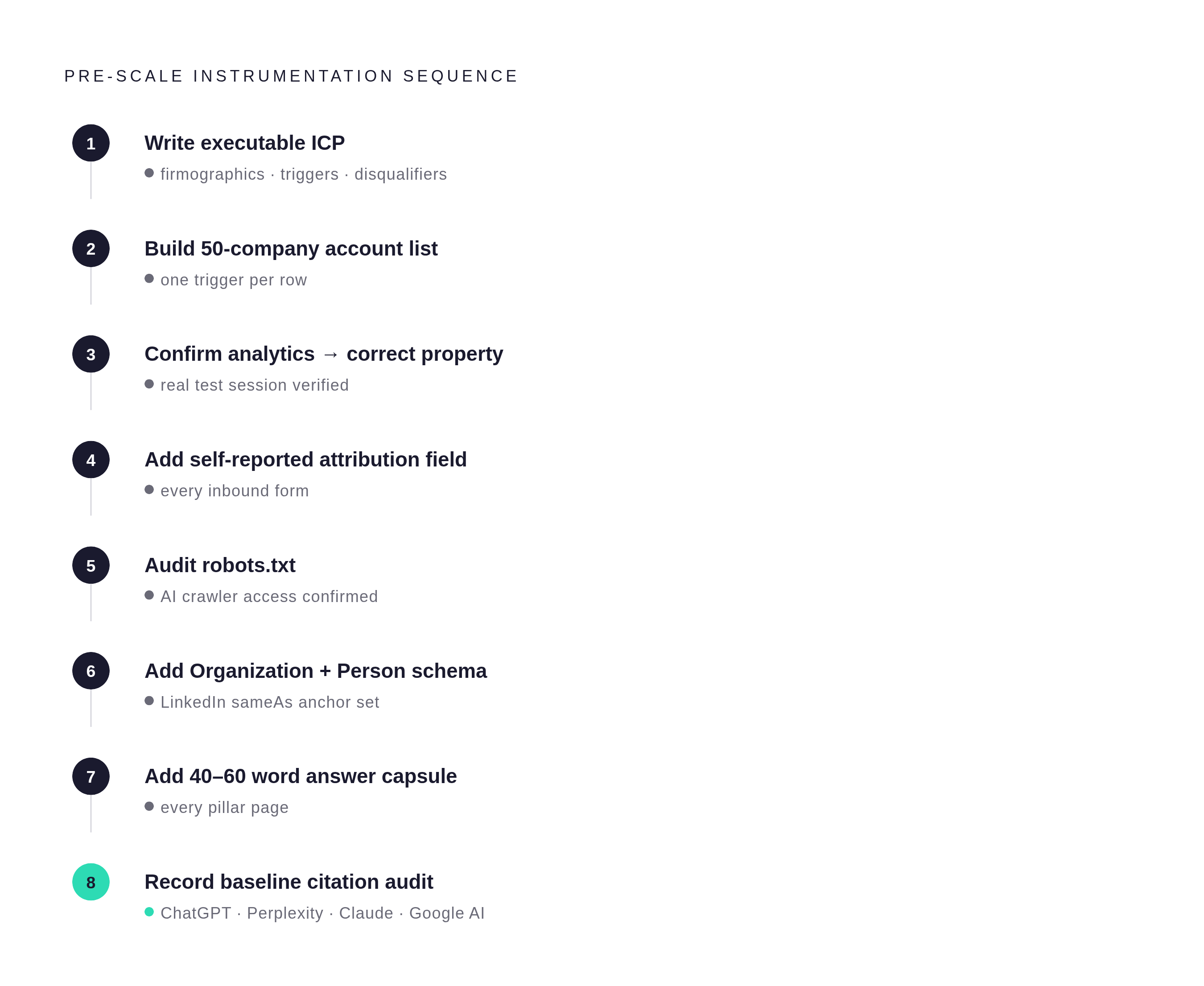
Task 1 is to write an executable ICP. Include firmographics, triggers, buyer versus champion, pain in the prospect’s words, and explicit disqualifiers, using closed-won conversations or the founder’s industry access. Done when a junior person could build a list from it without asking questions.
Task 2 is to build the 50-company account list. Record company, trigger, buying committee members, and status. Done when every row has a specific trigger.
Task 3 is to confirm analytics reaches the correct property. Open the analytics admin, check that the tracking tag is on every page, and generate a real test session. Done when that session appears in the data.
Task 4 is to add self-reported attribution to every inbound form. Use a plain-text “how did you hear about us?” field rather than a dropdown, so the buyer can describe the path in their own words. Done when a test submission reaches the CRM with that field populated.
Task 5 is to audit robots.txt for crawl access. Check that no broad disallow rule blocks relevant AI crawlers with other bots. Done when the file explicitly allows the crawlers relevant to AI answer engines.
Task 6 is to establish the schema layer. Add Organization schema to the homepage and Person schema with a LinkedIn sameAs anchor to every authored page. Done when a schema validator returns no errors.
Task 7 is to add a 40–60 word answer capsule to every pillar page. Each capsule should answer the page’s main question directly in a form that is easy to extract. Done when the capsule can be copied into an LLM prompt and quoted back verbatim, although that check does not establish citation performance.
Task 8 is to record the baseline citation audit. Ask ChatGPT, Perplexity, Claude, and Google AI the five most important buyer questions, recording mentions, linked citations, and alternative sources. Done when a written record is ready for comparison in 30 days.
How to keep the measurement layer running after week one without hiring anyone
The baseline will decay without routine attention. Analytics can drift, schema can break during site updates, and citation share can shift as content and competitors change. Check analytics for tracking breaks weekly and review the AI Performance report on the same cadence. Update the trigger column in the account list whenever there is a visible event at a target company.
For the monthly review, use a 40–60 prompt citation audit, logging responses separately by engine in a plain spreadsheet. Free tools are enough for the baseline before it is worth paying for monitoring. The record should keep earlier answers alongside new ones so they can be compared over time. That is how the initial setup becomes an operating practice.
This evidence also clarifies when to hire. The signal is a repeatable, attributable path from named account to first meeting, with execution capacity limiting progress. Before a full-time hire, a multi-stage AI content pipeline with lightweight orchestration can help produce more content. The pipeline drafts, the founder reviews each stage, and measurement tests what lands.
Human review protects accuracy and trust. Automation does not replace it. The durable assets are the site, its entity layer, and the measurement infrastructure, which can compound after spending stops. Instrumentation makes marketing an engineering discipline a founder can run on evidence.