Digital PR Is a Symptom. Your Site Architecture Is the Cure.
Strong site architecture turns PR coverage into AI citations that rankings alone cannot guarantee.

Digital PR can win attention without winning AI citations. AI citations require a brand’s own pages to be retrievable, parseable, and trustworthy. For brands trying to turn earned mentions into attributed answers, site architecture is the underlying condition that PR spending either strengthens or wastes.
How AI answer engines select sources — and why it breaks the old PR logic
AI answer engines retrieve candidate documents, score them for extractable evidence, and cite sources that clear a structural quality threshold. A document entering that sequence has not yet earned attribution. Its content may inform an answer without the engine naming it as a source. Retrieval is only the first hurdle.
What makes a page usable at that next stage? An answer placed before its supporting argument gives the engine a clear claim to extract, while a coherent heading hierarchy shows how that claim relates to the rest of the page. These are not merely reading aids. They help establish which page supplies the canonical answer to a question. Traditional SEO treated architecture largely as a crawl-efficiency concern, but AI retrieval makes it part of source selection itself.
That shift also changes what a strong search position proves. A page can rank well and still lack the structure needed for citation. Answer engines work with entities and relationships, so their task includes resolving what a claim describes and how its parts connect.
Why the industry defaulted to earned media as the primary GEO lever
The vast majority of AI citations come from non-paid, non-owned sources, and earned media accounts for the largest share of that pool. That share gives a team a reasonable place to start when deciding where to put its GEO budget. If answer engines keep citing independent coverage, getting more of that coverage looks like a direct way into their answers.
Ahrefs found that brand web mentions correlate more strongly with AI Overview visibility than backlinks do. That finding reinforced the argument that PR could do more than support conventional search performance. Mentions themselves appeared closely associated with AI visibility.
The intuition behind that approach is coherent too. When an independent third party covers a brand with which it has no financial ties, it gives the kind of credibility signal editors have long valued. AI systems were trained to give weight to those same signals. Earned media can supply both discovery and outside endorsement, which explains why the industry made it a primary lever.
What earned media actually buys — and where its leverage runs out
Earned media gets a brand into the retrieval pool, but its owned pages need the structure to support an attributed answer. The two outcomes are not interchangeable.
This is the symptom-and-cure distinction in practical terms. Low citation visibility is the symptom, and more PR addresses the shortage of attention around it. Structural readiness addresses the underlying inability to turn that attention into attributable evidence. Coverage still has value, but its return depends on what the engine finds when it reaches the brand’s content.
Ahrefs found that a substantial share of pages cited in AI Overviews did not rank in the top ten for the same query. Its studies appear to show that share growing since mid-2025, although Ahrefs cautions that different parsers make the studies not directly comparable. The directional lesson needs that qualification. Search rankings and the domain authority a site has built up cannot reliably show whether it is ready to be cited.
Could enough PR make up for a weak site? For household names, enough third-party mentions can lead to citations even when the site has a weak structure. Most B2B and mid-market brands cannot achieve that volume. Even where a brand can, unstructured owned pages underperform relative to what the same coverage could support with a stronger foundation.
The five structural properties that determine whether a page gets cited
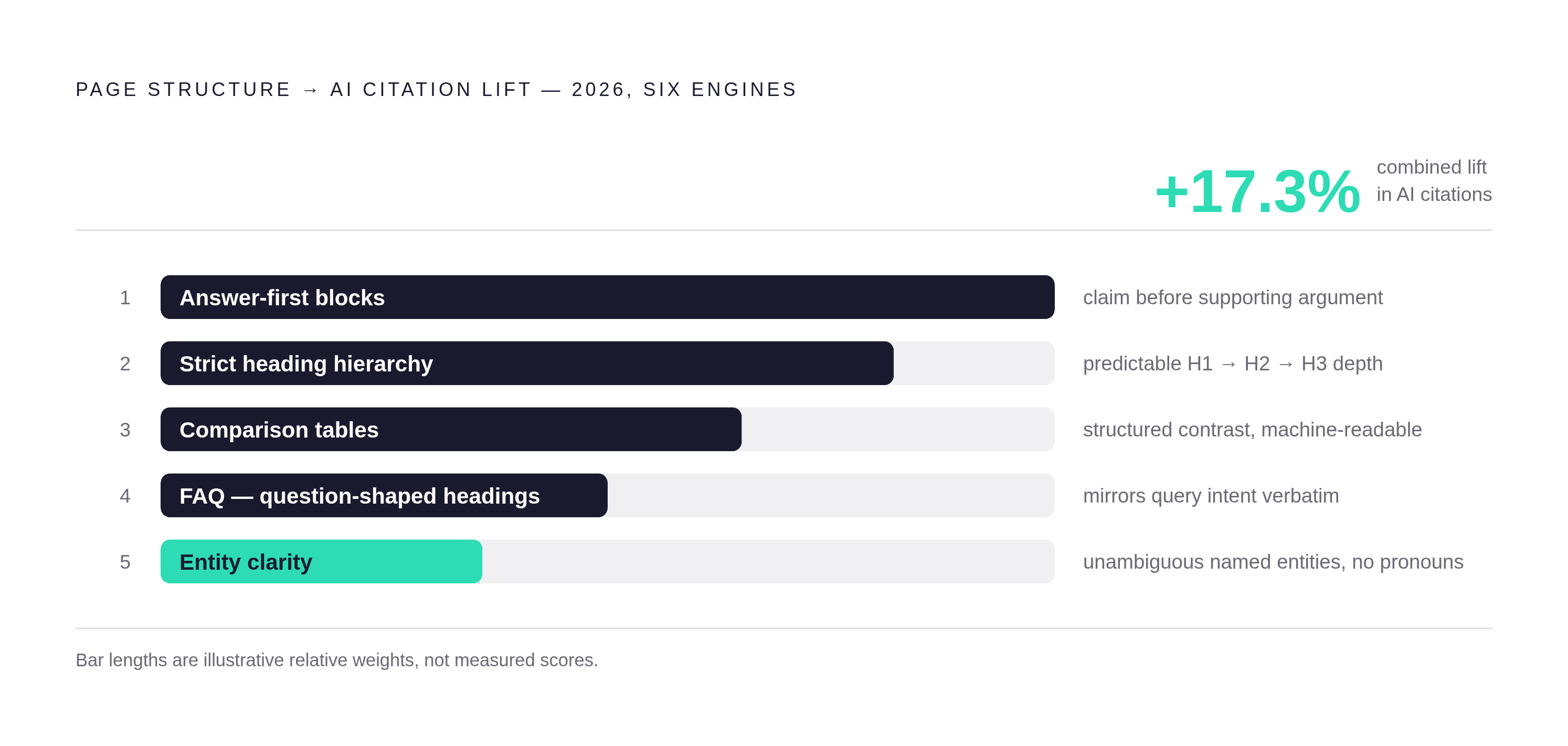
A 2026 analysis of six engines found that five changes to the structure of content led to a 17.3% lift in AI citations. The important distinction is between design and volume. Publishing more does not automatically make any individual claim easier to extract or attribute. The five properties concern how a page presents its answer, organizes its evidence, and identifies what it describes.
Answer-first blocks put the claim before the supporting argument, so the engine does not have to reconstruct the conclusion from a long introduction. Strict heading hierarchy then gives that answer a place within the page. Question-shaped, semantically nested headings express relationships.
Comparison tables make alternatives and their differences available in a consistently extractable form. FAQ sections with question-shaped headings serve a related but distinct purpose, mirroring the query form the engine is processing. One organizes contrasts, while the other pairs questions with answers. Both make it easier to get from the user’s request to the evidence needed to answer it.
Entity clarity completes the set by making the subject of each claim and its relationships explicit. Without it, a cleanly formatted passage can still leave attribution uncertain. These are not all marketing-only changes. Heading systems and structured presentation can require engineering decisions, so treating them as quick editorial fixes understates the work needed to make citation readiness a property of the site.
Why topical depth on owned pages compounds the structural advantage over time
Page structure becomes more powerful when related pages reinforce it. AI engines evaluate authority at the topic level. A site with little depth and many earned mentions can thus lose its share of citations to a site with more depth and fewer mentions. Breadth of publicity does not substitute for depth of evidence on the subject being asked about.
Hub-and-spoke topical clustering gives that depth a usable shape. A small set of deeply interlinked pages on one subject can outperform a larger collection of unrelated pages for citations on that topic. The links connect more than destinations. They help establish which pages explain the subject, which develop its parts, and which serve as the canonical reference across related questions.
When a page appears across a cluster of related queries, it has more chances to be cited beyond the query it first answered. Each new page in the cluster increases the citation surface of the others, so the return on structural investment grows non-linearly.
Accessibility is a condition of that return. Content gated behind forms, rendered only in JavaScript, or blocked in robots.txt can remain structurally invisible regardless of how often earned media mentions it. Publicity cannot compensate for inaccessible evidence. A brand may have considerable expertise on paper while offering answer engines very little they can actually use.
What a pipeline that builds citation-ready pages at scale actually looks like
An industrial B2B supplier with safety-critical specifications and a small marketing team illustrates how structural readiness can become part of production. Between December 2025 and August 2026, it ran an AI content pipeline that produced 68 published articles. Speed was not the defining design choice. Each post had to pass accuracy checks and a dedicated AI-extraction gate before approval.
The gate ran 22 checks to test whether an AI engine could correctly extract and attribute the page’s key claims. Accuracy alone was not enough. The content also had to present its accurate claims in a form that could survive extraction with the attribution intact.
The division of work supported that requirement. AI handled research, outlines, and first drafts, while humans owned strategy, expertise injection, and fact verification. Those responsibilities were especially important because the supplier dealt with safety-critical specifications. A plausible draft could not substitute for verified technical content, and clean formatting could not rescue an incorrect claim.
Human intervention had its greatest leverage at the outline stage. That was where the team could decide whether the planned piece was structurally worth producing before drafting began. The outline established the answer, the supporting sections, and the relationships the final page would need to express. Later checks then tested whether the finished article fulfilled that plan.
The case shows how a team can build pages that earn citations without PR activity. Its significance is not simply that a small team published at pace. Decisions about structure determined which pieces the team would start and which it would approve. The pipeline made extractability and attribution requirements of publication, rather than extra work to consider once an article failed to appear in AI answers.
How brands that invest in PR without structural readiness get mined but not credited
The opposite approach creates the “mined, not cited” failure mode. PR earns retrieval, but the brand’s pages fail the extraction threshold needed for attribution. Their information can do useful work for the engine by contributing to an answer while the brand remains invisible to the reader.
Standard analytics tracks referral clicks, so a brand can be systematically mined without a corresponding signal in its reporting. Strong results in conventional SEO can hide that loss of credit. High domain authority, a strong backlink profile, and good rankings offer little reassurance when the underlying pages lack extractable evidence, clear entity resolution, and structural hierarchy.
A 2026 audit found that 54 percent of audited brands were invisible on all four major AI platforms. That finding shows why teams need to verify whether familiar search performance translates into AI presence. An unmeasured absence is difficult to prioritize against visible campaign results.
Citation rates can also shift substantially month over month. A strategy built entirely on third-party PR concentrates risk, but so does one built entirely on owned content. The argument is to connect credible outside attention to usable owned evidence, then measure whether that combination produces attribution.
Measuring whether your site is being cited versus merely retrieved
The measurement task begins by separating being mentioned, being cited, and receiving a visit. AI share of voice measures the percentage of AI-generated answers that mention, cite, or recommend a brand across a defined set of category prompts. It connects visibility to competitive position. Within that view, citation tracking shows whether the brand is receiving source credit.
Platform-specific tracking is necessary because linking behavior differs. Perplexity and Copilot include external links in over 77 percent of responses, while other platforms link far less frequently. A strong URL citation rate on one platform may be impossible to reproduce on another. Combining those results without distinction can hide progress or suggest a structural problem when platform behavior accounts for the results.
For teams establishing a baseline, GA4 can segment AI-platform traffic through referral source filters, including perplexity.ai, chatgpt.com, and claude.ai. Those sessions provide a downstream signal of someone clicking a citation to visit the site. The absence of a visit cannot establish that an engine never used the content. Referral reporting cannot replace monitoring the answers themselves.
Weekly runs of a core query set balance useful signal against noise. Checking every day adds too much noise, while checking once a month is too slow to catch changes that matter. Structural changes that improve extractability should produce measurable citation-rate movement within weeks. An unchanged citation rate gives the team evidence before the next PR budget cycle.
A brand can test whether better structure turns attention into credit instead of assuming that another mention will close the gap. Brands that instrument both their content and their AI visibility can see which changes work as their topical depth grows. Their advantage compounds because each structural investment builds on evidence about what actually earns attribution.