When Your Brand Shows Up in Gemini — and You Still Can't Tell If It's Working
Reliable visibility requires systematic tracking across engines, not isolated screenshots.

A brand appearing in Gemini is evidence of a single answer. Reliable measurement needs a structured set of prompts, scheduled runs across engines, and a lasting record of mentions, citations, links, and sentiment. Measurement must establish whether a brand’s presence changes in a way that can be distinguished from noise.
Why a brand appearing in Gemini once tells you almost nothing
A marketer screenshots a Gemini answer that names their brand and counts it as a win. The reassurance is easy to understand. Similarweb’s 2026 Generative AI Brand Visibility Index found that 35% of US consumers use AI when they are discovering products. An answer can establish a buyer’s shortlist before that buyer opens a search bar, so inclusion has value even before a click. But the screenshot cannot show whether that inclusion is typical.
The retrieval process makes that distinction important. AI answer engines using Retrieval-Augmented Generation first retrieve candidate documents, then have a language model synthesize a response. Content must be retrievable and trustworthy enough to cite. One appearance shows that a brand cleared those gates for one answer to one question.
Why AI citation answers are non-deterministic and what that means for manual checking
The same prompt can return different lists of brands from one run to the next because AI answers are non-deterministic. Models rebalance for diversity, freshness, and coverage, so a brand present in one response may disappear from the next. This is not merely an awkward reporting detail. A weekly spot-check samples a distribution. More checking helps only if the checks form a repeatable measurement.
A brand asking “Is [Brand] good?” each week may appear consistently because the question already names it. That tells little about its presence when a buyer asks “best retinol serum for sensitive skin”. The buyer has not supplied a preferred answer. Discovery prompts test whether the brand comes up for consideration, while branded prompts test what the engine says about a brand the question already names.
Semrush’s AI Visibility Index tracked Google AI Mode and ChatGPT and found that between 40 and 60% of the sources they cite change month to month. That finding leaves open how often sources change on Gemini, but it shows why a brand can keep appearing even as the sources behind it change.
Why tracking Gemini alone compounds the measurement error
Even a dependable Gemini trend would describe only Gemini. ChatGPT, Claude, and Perplexity source, weight, and cite information differently enough that one engine cannot stand in for the others. Cross-engine citation overlap is low. A brand recommended on one platform can be nearly invisible on another. The engine is part of the measurement.
Audience differences make that limitation more consequential. B2B buyers skew toward ChatGPT and Claude, while consumer buyers skew toward ChatGPT and Gemini. A B2B SaaS brand watching only Gemini may therefore be checking an engine that does not reflect where its buyers go. Its results could be internally consistent yet answer the wrong business question. Coverage has to reflect where discovery takes place.
A sizable share of AI brand mentions have no clickable citation link, so they leave no traffic signal in Google Analytics. An answer can influence consideration without sending a visit. What must a measurement system record to make AI presence legible?
What the four metrics of a real AI citation measurement system actually are
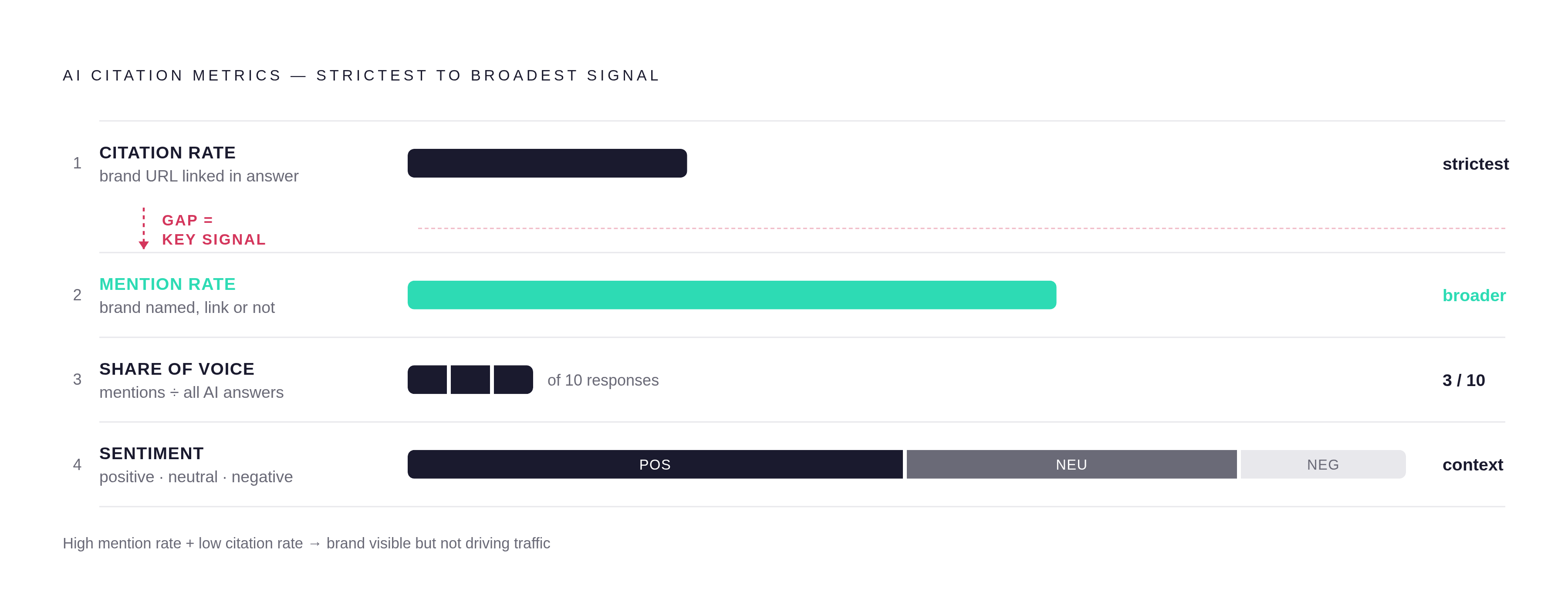
Citation rate measures how often an answer links to a specific brand URL when it includes sources. It is the strictest of the four signals and the one most directly connectable to traffic. Mention rate measures how often an answer names the brand, with or without a link. Those outcomes are not interchangeable. A high mention rate with a low citation rate means the brand is present in answers but its own URLs are rarely the linked evidence.
Share of voice, or Share of Model, needs an explicit denominator. For this measurement system, the working formula is brand mentions divided by total AI answers in the tracked set. A brand appearing in 3 out of 10 responses to its target query clusters illustrates the calculation. The denominator is part of the definition. That figure is not the same as the brand’s proportion of all brand mentions, and the two should not be treated as interchangeable when comparing reports.
Sentiment records whether what the answer says about the brand is positive, neutral, or negative. A name can appear without becoming a recommendation. Engines can describe the same brand in different ways, so praise on one does not show how the others treat it. None of these four measures appears in Google Analytics. They need a purpose-built measurement layer. Even then, the measures become useful only when they are applied repeatedly to a defined set of questions.
What a structured probe set is and why it is the foundational unit of measurement
A structured probe set is a set of category, comparison, problem, and review prompts run on a fixed schedule across the engines being tracked. It is a data instrument. Category prompts such as “best [tool category] for [use case]” test discovery, while “[Brand] vs. [Competitor]” tests direct comparison. Problem prompts such as “how do I solve [specific pain]” test whether the brand enters an answer through a buyer’s need. Review prompts such as “is [Brand] worth it” test the treatment of a brand already under consideration.
Each prompt needs to be run at least twice on each engine in each measurement period. Precision remains uncertain at that minimum. One response cannot show how often the same result occurs, and changing the question between periods leaves no basis for comparing the results. Prompts can be added, but a replacement needs its own baseline. For a complete picture across ChatGPT, Gemini, Claude, and Perplexity, each engine’s results must remain a separate data series.
The persistent log is what turns these runs into evidence. Each record needs the prompt, engine, and outcome, including whether the brand was named, whether its URL was cited with a link, and whether the language was positive, neutral, or negative. Keeping the observations makes it possible to compare like with like over time. The repeated probe set becomes the unit of analysis.
Why the source mix that gets brands cited differs from where brands invest their content effort
The log also needs to record which source supports the answer. Most brands concentrate content effort on their own domains, but a substantial majority of brand mentions in AI answers come from external domains. These include review sites, community platforms, press, and directory listings, while brand-owned About, FAQ, and Home pages account for a small fraction of citations. Without source attribution, the measurement system loses the connection between visibility and the evidence behind it.
That connection also differs by engine. Gemini cited brand-owned sources at a much higher rate than other engines, so a source strategy inferred from Gemini alone may not explain results elsewhere. Logging whether the citation comes from a third-party review site, a Reddit thread, a G2 profile, or the brand’s own domain preserves that difference. A low citation rate for the brand’s URLs can then be read together with its mention rate and external sources. Otherwise, a brand that appears often thanks to third-party sources may look as though it is missing.
The investment implication follows from the source record. Content effort should respond to where the engines actually find credible evidence, rather than assume that every visibility gain must originate on the brand’s site. Source attribution distinguishes the role of owned pages from the role of outside coverage. The measurement should establish that distinction before it becomes a content strategy.
What automated measurement platforms do that manual tracking structurally cannot
A set of 20–30 prompts, run twice a week on each of four engines, yields 160–240 data points per week. That may be manageable for a short audit. As ongoing infrastructure, however, it requires repeated execution and careful recording without missed engines, missed weeks, or changes in wording. Doing the work by hand adds variance to the system built to measure it.
Automation addresses that operational limit, but an aggregate score is not enough. A platform needs to keep raw outputs so that the evidence behind a reported change can still be checked. It also needs source attribution per citation, sentiment measurement in addition to mention and citation rates, and support for a consistent custom prompt set. These capabilities preserve the instrument by keeping measurement tied to the questions it was designed to answer.
The strongest objection is that AI answers change too much for measurement to be worth the investment. But variability is precisely what repeated sampling is meant to expose. A structured system cannot make an engine deterministic, and a scheduled run does not make every movement meaningful. It can keep enough results that can be compared to show which shifts recur and which changes stand alone. Without that record, volatility becomes an explanation available for every result and testable against none.
What the measurement system should be connected to, and why logged data compounds over time
The log becomes more useful when it is connected to the work intended to improve visibility. A new comparison page, a structured data addition, or a third-party publication needs a pre-change baseline against which later results can be read. Without one, a rise in citation rate cannot be separated from ordinary variation with any confidence. The baseline gives the record needed to judge whether a change is followed by a lasting shift or just one favorable answer.
A brand described neutrally on Gemini in one quarter and critically in the next presents a question that a mention count alone would miss. Tracking the same competitors in the same prompt runs also shows whether the brand is appearing more often compared with the other brands buyers see. A rising rate has a different meaning when competing brands are gaining more ground.
Those comparisons give leaders more to go on than a screenshot when they ask whether spending on AI visibility is working. The evidence can connect an investment period with changes in citations, source mix, sentiment, and competitive presence without collapsing them into one success claim. Over time, the log offers more baselines and more context for interpreting a new movement. Its value compounds because each period becomes evidence for the next. That accumulated ability to diagnose change is what separates AI visibility as a discipline from AI visibility as a hope.