IndexNow is a notification, not an indexing strategy: what engineers should wire up and what to verify
Wire up IndexNow for change alerts, then verify crawling and indexing separately.
IndexNow announces changed URLs while leaving their place in search results up to the engines. For engineers, the distinction determines what to build and what to measure. A sound implementation automates change notifications, keeps Google discovery running separately, and verifies crawling, indexing, and AI citations rather than treating an accepted request as the finished job.
What IndexNow actually does when a URL is submitted
In the traditional pull model, a search engine decides when to visit a site and discover what has changed. IndexNow reverses who starts that exchange. When a URL is added, updated, or deleted, the site sends a notification to a participating endpoint. The notification identifies a change for the engine to process. It does not send the page through every later stage of search.
The ownership check starts with a key. IndexNow specifies a key of 8–128 characters, allowing a–z, A–Z, 0–9, and dashes. The site hosts that key in a plain-text file named <key>.txt at the domain root, or at another path on the same host supplied through the keyLocation parameter. The engine fetches the file to verify ownership, then queues the submitted URLs for crawling. HTTP GET supports a single URL, while POST supports up to 10,000 URLs.
The relay then extends the notification’s reach. A submission to one participating endpoint is shared across all participating engines, so the site does not need to call each one separately. An HTTP 200 response confirms receipt alone, leaving a fetch or an indexing decision unconfirmed. Other response codes identify failures such as an unverifiable key file, a URL on a different host from the key, or too many requests.
Which engines participate and which one is notably absent
Microsoft and Yandex created IndexNow and launched it in October 2021. Other participants joined over time. The current list is Bing, Yandex, Seznam, Naver, Yep, Internet Archive, and Amazon, which share submissions through the relay. That list defines the protocol’s reach.
Google is outside that boundary entirely. It said in 2021 that it would test the protocol but never adopted it. Submitting through IndexNow therefore has no effect on Google’s crawling, indexing, or rankings. For Google, discovery still depends on routes including XML sitemaps, Search Console URL Inspection, and internal links. Google shut down its sitemap ping endpoint in 2023, so that older way of notifying it no longer works.
Google’s Indexing API is a separate, narrow tool limited to specific content types. Microsoft’s webmaster guidelines document Bing’s index as the foundation for Microsoft Copilot, and Bing also feeds some of DuckDuckGo’s results.
Why engineers conflate submission with indexing — and why that conflation is dangerous
An accepted request is a clear, immediate signal. Because crawling and indexing happen later under rules the submitting site does not control, the immediate HTTP response is easy to mistake for proof of success. If an engineer records a 200 response as “indexed,” the system reports an outcome it has not observed.
What has the engine actually agreed to do? It has accepted a notification, with fetching, evaluation, and retention still subject to its rules. Its crawl policies, quality systems, canonical selection, and indexing rules still apply. A thin or duplicate page does not earn inclusion because it was announced, and a notification does not override robots.txt restrictions or a noindex directive. Submitting a non-canonical duplicate also wastes the signal.
A key file at /catalog/key.txt A key file at /catalog/key.txt covers only URLs under that path. An integration that submits URLs outside that scope can fail without engineers noticing if they have not accounted for the restriction. Hosting the file somewhere on the right domain is not enough. Root placement is strongly recommended because it avoids this path limit.
Repeated submission cannot repair those underlying problems either. IndexNow is a change notice, and resubmitting unchanged URLs adds noise. Search engines may throttle submissions or pay less attention to notifications from a noisy site. A useful diagnosis therefore separates whether the request was accepted from whether the URL was crawled and whether it entered the index. Otherwise, the submission log can look healthy even when pages are missing from the index.
What to wire up: automation, trigger discipline, and the Google parallel track
IndexNow should be connected to publishing events to avoid recurring efforts to announce every page. Use manual submission for initial key verification. Production submissions should run through a CMS plugin, Cloudflare integration, or a hook in the publishing pipeline. Place the key file at the root to avoid the scoping trap.
Submit a new canonical page when it is published, and submit an existing page when its content changes materially. Not every build represents such a change. Compare against the last-deployed manifest and submit only the diff. Keep drafts, staging URLs, and pages that are not yet live and returning a success response out of those publication submissions. The engine should receive the URL that is ready to be discovered.
Deletion and redirect events need their own triggers. Submit deleted URLs so the engine can discover the 404 or 410 before its next scheduled crawl. Submit redirect changes so it can find the new destination without waiting as well. These notifications concern changes to existing URLs, unlike the success-response requirement for newly published pages. Treating all events as a single “publish” action would blur that distinction.
Keep XML sitemaps running in parallel with IndexNow. They cover the whole site, while the protocol tells participants about changes in real time. For Google, keep the sitemap accurate with reliable lastmod dates, use Search Console URL Inspection for individual high-priority pages, and add strong internal links to new content from pages that are crawled often.
The Bing track also needs a directive audit. Check robots.txt for a BingBot block, and check whether OAI-SearchBot is unblocked if Copilot visibility is a goal. Microsoft documents NOARCHIVE as preventing content from being used in Copilot responses and grounding results. NOCACHE limits Copilot to the URL, title, and snippet only. Those settings can restrict AI use even when the notification integration itself works.
What to verify: the three events that must be tracked separately
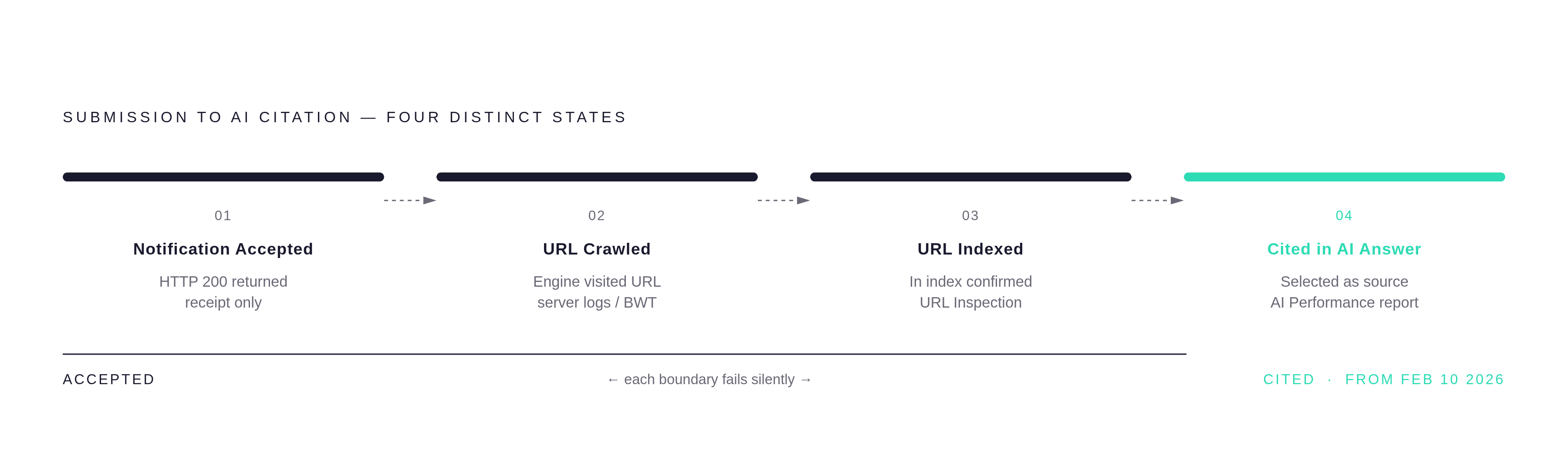
Track notification accepted, URL crawled, and URL indexed as distinct states. Each answers a different operational question. Acceptance establishes that the endpoint received the request, a crawl establishes that the engine visited the URL, and index status establishes whether the page was included. None is a substitute for the next. Keeping them separate makes it possible to locate a gap rather than simply label the whole process successful or broken.
Use the observability stack the team already has to record each step. Log the publish timestamp, IndexNow submission timestamp, endpoint response code, first Bing crawl timestamp, and confirmation of index status. Server logs or Bing Webmaster Tools can provide evidence of the first crawl. URL Inspection in Webmaster Tools shows whether Bing crawled and indexed a URL that was submitted. Submitting a sitemap there also provides a parallel coverage view for URLs the notification path may have missed.
Citation visibility adds another outcome after index verification. Microsoft launched the AI Performance report in Bing Webmaster Tools in public preview on February 10, 2026, showing citations across Copilot, Bing’s AI summaries, and partner integrations. In June 2026, it expanded with four views, namely Intents, Topics, Citation Share, and Compare. Core metrics include total citations, average cited pages per day, and grounding queries.
That evidence needs its own careful label. Microsoft states that the citation metric “does not represent traffic, clicks, or user engagement”. A citation count therefore cannot stand in for traffic impact, just as an accepted submission cannot stand in for indexing. The report closes part of the visibility loop, but it answers a question about sourcing in AI answers.
Why Bing coverage alone does not complete the AI citation picture
Bing is a concrete route into Copilot’s retrieval pipeline. Microsoft’s guidelines state that Bing and Copilot search experiences rely on the same core crawling, indexing, and ranking foundation. If Bing cannot find, render, and index a page, that page may not be available for Copilot to cite. IndexNow can accelerate discovery within this pipeline. That is a useful connection, but it does not establish equivalent routes into every AI answer engine.
Does faster Bing discovery also help elsewhere? The connection to ChatGPT, Perplexity, Gemini, and Claude is indirect at best and unconfirmed at worst. No first-party documentation from OpenAI, Perplexity, or Anthropic states that their crawlers consume IndexNow submissions or prioritize pages because of them. Treat any benefit there as a secondary, unproven effect of faster Bing indexing. For Google’s AI surfaces, including Gemini and AI Overviews, IndexNow provides no direct benefit.
Measurement therefore has to extend beyond Bing’s report. Different AI engines can cite different sources, so strong visibility in one does not establish visibility in another. A brand can be prominent on one platform and absent from another.
Comparisons across engines also need to count the same thing. A mention means a brand name appears in prose, while a citation is a structured, linked source to which the engine attributes a claim. Counting both as the same outcome overstates citation presence and weakens comparisons across engines. Otherwise, the measurement repeats the same basic mistake as the submission log, assigning a stronger meaning to a weaker signal.
Why being indexed is the floor, not the ceiling, for AI citation
Once a page is indexed, it can be cited. An answer engine may still pass over an indexed page, because sourcing decisions continue after indexing. Content structure, freshness, and entity clarity help bridge that gap. Structural signals associated with citations resemble those that win featured snippets, including a direct answer near the top, cleanly delimited sections, FAQ-style question headings, and cited statistics. These features give an engine material it can extract and attribute.
Malformed HTML and excessive template noise can obstruct parsing, while poor content ordering can leave the key claim beyond the point where context is truncated. Later, entity gaps or an intent mismatch can prevent selection during generation. A better-structured source on the same topic may be chosen instead. IndexNow’s scope is limited to discovery and fetching.
The practical sequence is therefore to use IndexNow to support discovery, verify that the page enters Bing’s index, and then make it structured enough to quote. Both discovery and quotability need attention. Neither substitutes for the other, and each engine’s sourcing choices mean that one content approach will not serve every platform equally. Checking directives is still part of that work because a page that can be indexed may still have limits on AI use. A page can be in the index yet unavailable for Copilot citation because of a setting chosen for another reason.
The final test is evidence at each boundary. The submission response belongs to the notification stage, crawl records establish a visit, index inspection establishes inclusion, and citation reporting shows selection as a source. Engineers should wire those signals together without collapsing their meanings. IndexNow’s job ends well before the system’s intended outcome does.