Growth hacking for a B2B startup, run for you or run by you: what a technical founder should ask before handing experiments to a service
Outsource the work if you must, but keep the data and decisions.

Growth hacking for a B2B startup is an engineering problem before it is an outsourcing decision. A service can run the work, but the founder must keep the measurement layer and decision rights. Experiments need to leave behind evidence, portable workflows and a system the founder can control.
Why growth hacking is an engineering discipline, not a marketing activity
Growth hacking done well uses the scientific method to build pipeline. It starts with a falsifiable hypothesis, changes a controlled variable, follows a pre-committed decision rule and logs the result. Those requirements separate an experiment from a tactic. A campaign can produce activity without testing anything, while a failed experiment can produce useful evidence about what not to pursue.
Tests take days to weeks, use very small budgets and are expected to have many small failures. Growth marketing builds the sustained program on what those tests prove out. This gives a technical founder a way to judge how well a service does its job. Its job is not simply to launch more work, but to change the growth program when evidence challenges the hypothesis.
What makes a growth experiment count: measurement first, a stop rule, a logged decision
A valid experiment is defined before it runs. The hypothesis, sample size, minimum lift and kill date must all be set before anyone sees the result. For example, a test could ask whether adding a competitor migration offer to the pricing page raises trial starts from comparison page traffic by 15% within a defined timeframe. That identifies the change, the audience and the expected effect. A test is invalid if the threshold is chosen after the data is seen.
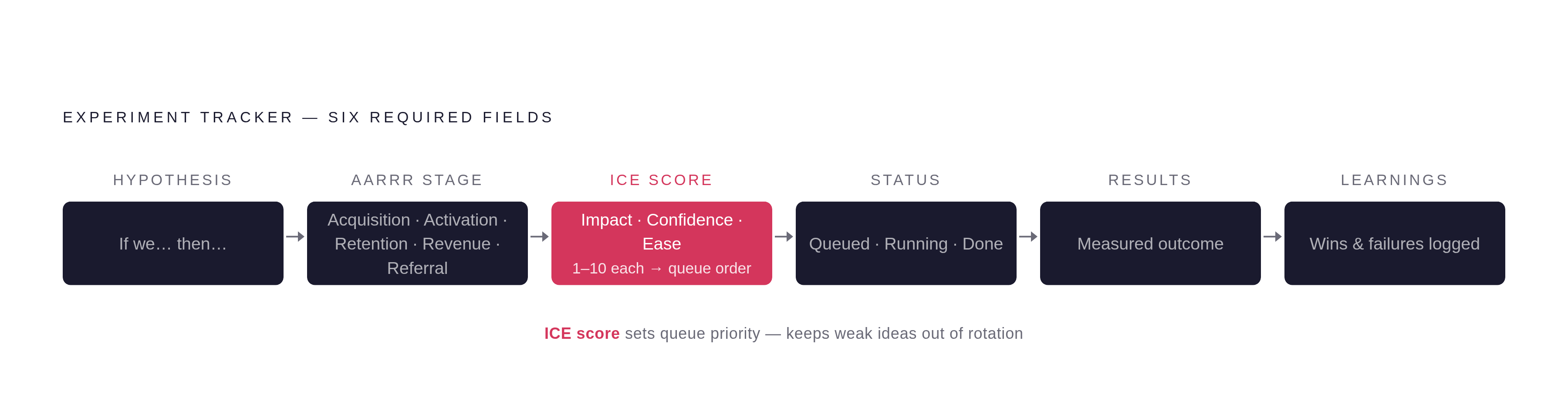
Prioritization comes before execution, too, because a queue of ideas is not yet an experiment program. ICE scoring gives Impact, Confidence and Ease scores from 1–10, and the combined score sets the order of the queue. The questions are how much the test could shift the metric, how likely it is to work and how quickly it can run. This keeps weak ideas from crowding the queue. Experienced growth teams run 10 or more experiments per week, while teams starting out aim for two to three.
Each experiment suite also needs a North Star metric that shows the value customers get and a guardrail that flags harm elsewhere. B2B makes this discipline especially important because the total addressable universe can be only tens of thousands of accounts. Noise can easily look like signal. The sample requirement and decision rule set in advance help keep the goalposts in place when there is little evidence to go on.
A channel that fails to produce a statistically significant result within the predetermined window should be deprecated. The tracker then records the hypothesis, AARRR stage, ICE score, result and learnings, including failures. Tomba’s 2026 playbook treats failure-logging as expected and required. The logged decision gives the next test a starting point and keeps the team from mistaking a discarded idea for a new opportunity.
Why B2B experiments fail when the data layer is built for the agency, not the founder
Gartner’s 2025 survey found that most B2B buyers would rather buy without a rep. Content, pricing pages and the self-serve product therefore do sales work whether or not they were designed for it. Experiments on those surfaces can compound into a better buying experience, but only if the founder can read the results and act on them. Access is part of the feedback loop. When the vendor owns that loop, what serves its business can shape what the founder gets to learn.
One failure mode appears when the founder wants to pull experiment history or train a model on customer data. The provider may limit API calls or charge for access to those records. Another appears at renewal, when a vendor-controlled database becomes leverage in a price negotiation. Neither problem requires a poorly designed experiment. Both can leave the founder needing the service to use what the startup paid to learn.
Even a clever experiment gets no useful signal from the wrong contact list and can hurt deliverability in later campaigns. One bad list can taint a sending domain, making the damage harder to repair than a failed test. Screen for data transparency and dashboard access before signing. A one-size-fits-all approach that ignores the startup’s specific challenges is also a warning, because the experiment cannot be sound if its inputs and context are wrong.
Who keeps the accounts, data and workflows when the experiments end
Ad accounts, CRM sequences, testing tool access and the record of what was tested are operating assets. When they live only in the vendor’s systems, they can leave with the vendor. The founder should establish who owns the accounts and tool licenses, and what happens to each when the engagement ends. That answer should be put in writing before work starts.
A shared document or Airtable base can hold the hypothesis, AARRR stage, ICE score, status, results and learnings. The founder should check whether the full log, including failed tests, can be exported in a machine-readable format at any time. That history gives a new hire or replacement service the reasons behind past decisions.
Access terms need equally plain answers. The founder should ask whether the startup can get direct API access to its data without rate limits or extraction fees, and what the rules are for keeping and deleting data after termination. Contract length, termination clauses and data ownership must be negotiated explicitly, with reciprocal access documented. An agency may need full access to the startup’s data and tools to work effectively, but that does not justify excluding the startup from its own systems. Vendor risk also includes data security and business continuity if the provider fails or pivots.
Run for you vs. instrumented and scriptable by you or your agent
A done-for-you service offers a genuine benefit to a technical founder without a growth team. It removes execution work and leaves more time for product, especially before product-market fit. That is a legitimate reason to outsource. It is not a way around weak demand, however, because experiments can reveal a product-market fit problem but cannot manufacture demand. The service model changes who does the work while leaving the limits of the evidence unchanged.
The instrumented model asks for more work at the start so that learning remains portable. In days 1–15, the founder should pick one North Star metric and one guardrail, then set up clean tracking on every channel before touching a tactic. Instrumentation is often something a done-for-you service builds for its own operation, whereas the founder needs a measurement layer that remains usable after that operation leaves.
For a technical founder, usability includes programmatic access. Every capability should be reachable by an agent through an API, rather than only by a person through a user interface. An agentic workflow could then read results, draft the next hypothesis and queue the next test without manual handoffs. Small, composable parts, including the experiment tracker, measurement layer and content pipeline, make this possible without locking the whole program inside one vendor suite. Every experiment should still be reviewable and reversible before it ships, because automation must preserve the founder’s ability to say no.
The trade-off is therefore between a faster start and a system that takes longer to instrument but retains its memory. Run-for-you work is slower to compound when the evidence and workflows stay with the provider. The founder should demand a measurement layer the startup owns, an experiment log it can export and runbooks it can use to do the work on its own. That last requirement is the runbook test. A service that cannot document its process well enough for the founder to replicate it is running its own growth program on the founder’s budget.
Where AI visibility fits into a growth experiment portfolio in 2026
AI answer engines extend that test to a discovery surface many growth services have not instrumented. B2B buyers more often come across brands through AI-generated answers before they reach a search results page. So a prospect can build a shortlist in a place the startup’s current analytics do not show. That changes both the experiment queue and reporting. A service working from an older program can miss the place where a buyer first learns that a product exists.
Generative Engine Optimization, or GEO, is the work of getting a brand and its content cited, referenced or recommended in those answers. It is distinct from SEO. Ranking on Google does not automatically make a page a source for an AI answer engine, and content built for one job does not necessarily succeed at the other. Brand mentions across the web correlate more strongly with AI visibility than backlinks do. This makes Digital PR and community presence worth testing in the growth experiment portfolio, with success judged by more than links alone.
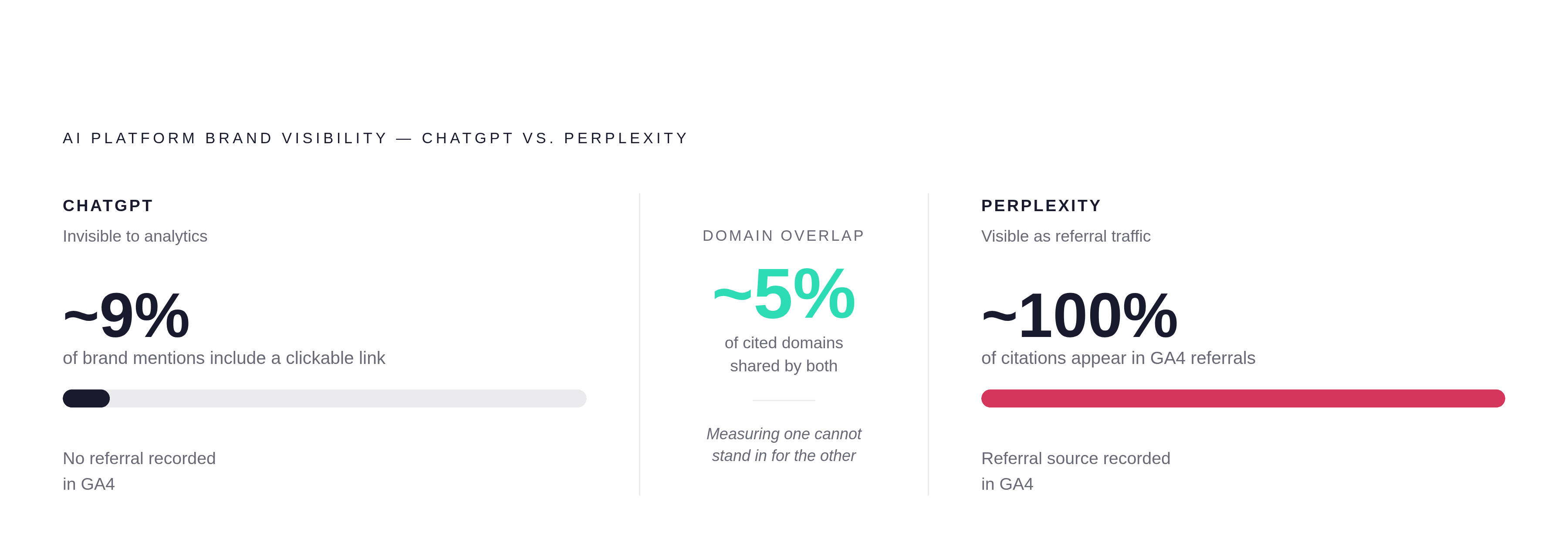
Platform differences make measurement more demanding than adding one new traffic source. Only a small fraction of domains cited by ChatGPT overlap with those cited by Perplexity, so coverage of one platform cannot stand in for the whole channel. The signals differ as well. Only a minority of ChatGPT brand mentions include a clickable link, which makes them invisible in standard analytics, while Perplexity citations appear in GA4 as referral traffic. Organic traffic totals cannot reveal the full pattern of AI mentions and citations.
The founder’s question for a service is therefore specific. Can its measurement layer show AI mention share across ChatGPT, Claude, Gemini and Perplexity, rather than treating referral visits as the whole result? This surface is measurable, but not by assumption. The service must set up citation and mention tracking on its own, apart from its usual traffic reporting. Without it, the service cannot see what is happening in the channel it is trying to improve, so its AI visibility work fails to meet the same standard for experiments used elsewhere.
The content architecture that makes experiments citable by AI and readable by agents
The underlying asset for those experiments is the site and its content structure. Citation-readiness depends on making it easy to establish who is speaking, what claim is being made and which primary source supports it. A headline change cannot supply that structure. The content must be useful to a person while leaving claims clear and retrievable for a machine. The startup thus needs to own the content pipeline as well as the measurement layer.
That structure has practical consequences for publishing. Listicle-format ranking pages have the largest single share of AI citations, so ranking-page structure is a useful place to run experiments. Relevant execution includes Article, ItemList and FAQPage schema, with FAQ sections shaped around the questions people ask AI platforms. Access comes before any of those refinements. A deliberate review of robots.txt, rather than a blanket block on AI user agents, can keep public thought leadership and product documentation accessible to retrieval bots.
Owned pages are only part of the system. Models also find brands through review sites, roundups, podcasts and third-party articles, so getting off-site mentions is something to test in its own right. The site must then support the next step. An agent acting for a buyer needs consistent structure and content that answers the questions it has been asked to resolve. Machine readability is not a substitute for useful content, but a way to make that content available for retrieval and action.
A pipeline with several stages can do more of this work while leaving people in charge of what gets published. AI drafts and brings material together, while people check voice and facts and make the go/no-go decision before release. Volume without quality creates a liability. The final test is whether the service can show, in a dashboard the founder owns, whether the major AI platforms are naming and citing the startup, then change what it publishes in response. Without that feedback loop, the system is producing content.