Co-branding in the agent era: why "Powered by" and a logo lockup is not proof a machine can check
A logo lockup shows who partnered, not whether AI cites you.

Co-branding in the agent era exposes a gap between a visible relationship and proof a machine can check. “Powered by,” a logo lockup, or a link-back can tell people who worked together, but cannot establish whether an AI answer names a brand accurately or cites it at all. That requires retrievable content, consistent facts, independent corroboration, and measurement of what answer engines actually produce.
Why co-branding credit lines were designed for human eyes, not machine readers
A credit line claims a relationship. “Powered by” can tell a person that a tool was used, while “In partnership with” or “Presented with” can identify a collaborator. Neither tells that person whether the content passed a check of its facts. That difference is easy to miss because the design draws attention to the relationship but keeps how the content was made out of sight.
What, then, does a logo lockup on a partner dashboard prove about an AI-generated answer? Claims that brand facts were accurate, that the brand’s voice survived generation, or that an answer engine cited the brand each require evidence beyond a logo lockup. A visible association cannot constrain what a model does with facts or assets once they enter a generated response.
Co-branding developed for a world in which people read outputs before those outputs reached an audience. Its signals helped readers see who worked together and who was responsible. They were never built to make that association independently testable by a machine.
How brand guidelines failed to anticipate the machine reader
The rules behind those signals were also written for people. The pre-2024 brand book model was built around a static PDF, rules for where to put logos, hex codes, and adjectives for tone. A small design team and a few agencies could apply those instructions across a countable set of touchpoints. The document served as a reference that depended on human interpretation to become practice.
AI-assisted production exposed that structural limit. A PDF’s existence does not make its rules usable by the machine generating content on a brand’s behalf. Without machine-readable standards, each person decides for themselves what the model may produce. Inconsistency then multiplies through generated outputs in the absence of a shared set of rules.
Many 2026 guidelines lack a section on how to use AI. Which uses need review, which are off-limits, and who approves an asset before it ships? The governance gap also includes a “golden dataset” of approved content, temperature controls for factual versus creative work, and explicit prohibited use cases. None of these controls is conveyed by a lockup. When teams bypass rules that cannot be applied in the workflow, they also learn that the guidelines are optional.
What AI answer engines actually do when a user asks about a brand
Answer engines synthesize responses from content they can retrieve and cite. They do not use a logo lockup or co-branding credit line as proof that a brand deserves inclusion. The relationship alone does not establish a source’s usefulness.
Generative Engine Optimization, or GEO, works to get brands seen in those answers. Its measurement problem differs from traditional SEO because citation share is volatile. Models rebuild answers, balancing diversity, freshness, and coverage, so a brand present in one session may disappear in the next. What would a single successful answer prove? It would show one instance of visibility.
Platform differences make that limit more pronounced. Google’s AI Mode, Perplexity, and ChatGPT use different pools of sources, so no single deal or optimization strategy can ensure that a brand appears in all of them. Brand mentions in retrievable content correlate more strongly with AI visibility than backlinks do. That shifts the emphasis from relationship signals toward substantive, attributable material. It also means that a link-back cannot stand in for evidence that the brand is being cited.
The asymmetric exposure a credit line cannot prevent
A brand can be missing from answers that help people and still appear in ones that harm its name. AI answer engines include negative sentiment in their answers at rates that vary by platform, regardless of whether a brand has established a verified presence there. A co-branding arrangement does not govern that exposure. Nor does a “Powered by” badge distinguish a fair criticism from an inaccurate claim.
That creates an asymmetry between visibility and control. A brand does not need to supply a well-grounded account of itself for a model to generate an account anyway. Fabricated statistics, misattributed quotations, and plausible claims without factual grounding are structural risks of AI generation. Thin or unstructured retrievable content leaves a brand more vulnerable to those errors.
For agencies reselling co-branded AI visibility tools, the relationship adds another accountability problem. The agency lends credibility to the tool through its own name, but that association does not transfer a verification process with it. If the tool produces an error, the agency’s reputation can absorb the consequence. The lockup may make the output look endorsed without showing who checked it.
Why the agent web and the human web are not the same infrastructure
The Human Web and the Agent Web describe two layers with different trust logic. On the Human Web, a logo, credit line, or visual identity a person knows helps them make sense of a page. On the Agent Web, authority depends on machine-readable content that can be retrieved, structured, and checked against other sources. These layers overlap, but they are not interchangeable.
Sascha Deforth, founder of TrueSource AI, published a completely blank white webpage in April 2026 as part of the Phantom Authority experiment. The page used what the experiment called the Seven-Layer Ghost Stack. Its visible surface and machine-facing content were different things. That made it a concrete illustration of the split, with nothing on the visible page to explain its machine-readable structure.
What Google may classify as thin content can be treated differently by an AI answer engine. Likewise, a page that looks polished does not by itself have citation authority. Bot-log analytics provide auditable evidence of access by showing whether crawlers such as GPTBot and ClaudeBot accessed a page. LLMs.txt files offer no comparable proof of influence on citations, for which credible evidence is lacking.
What actually builds verifiable presence in the agent layer
A brand’s name, description, founding year, services, and other factual claims need to match across its site, LinkedIn, industry directories, and Wikipedia or Wikidata. When accounts conflict, a model gets different versions of the same entity. That conflict can leave neither source cited.
A number published only on a brand’s site remains that brand’s claim. The same number quoted in three independent places gains corroboration within the material available to a training corpus, though repetition alone is not a guarantee of truth. This helps explain why original research travels further than opinion. It gives other sources something concrete to attribute.
Grounding pages serve a related purpose when they are factual, encyclopedic, and externally verifiable. A self-authored /ai-instructions/ page instead asks the model to accept the brand’s own directions about itself. Structured data and machine-readable formats put facts in a form that can be indexed and cited. Yet the brand’s site is only part of the picture. Wikipedia, Reddit, YouTube, review sites, top-tier publications, and industry research can inform answers even when the brand’s own page is not cited directly.
Why the multi-stage pipeline with human review is the accountability layer co-branding pretends to be
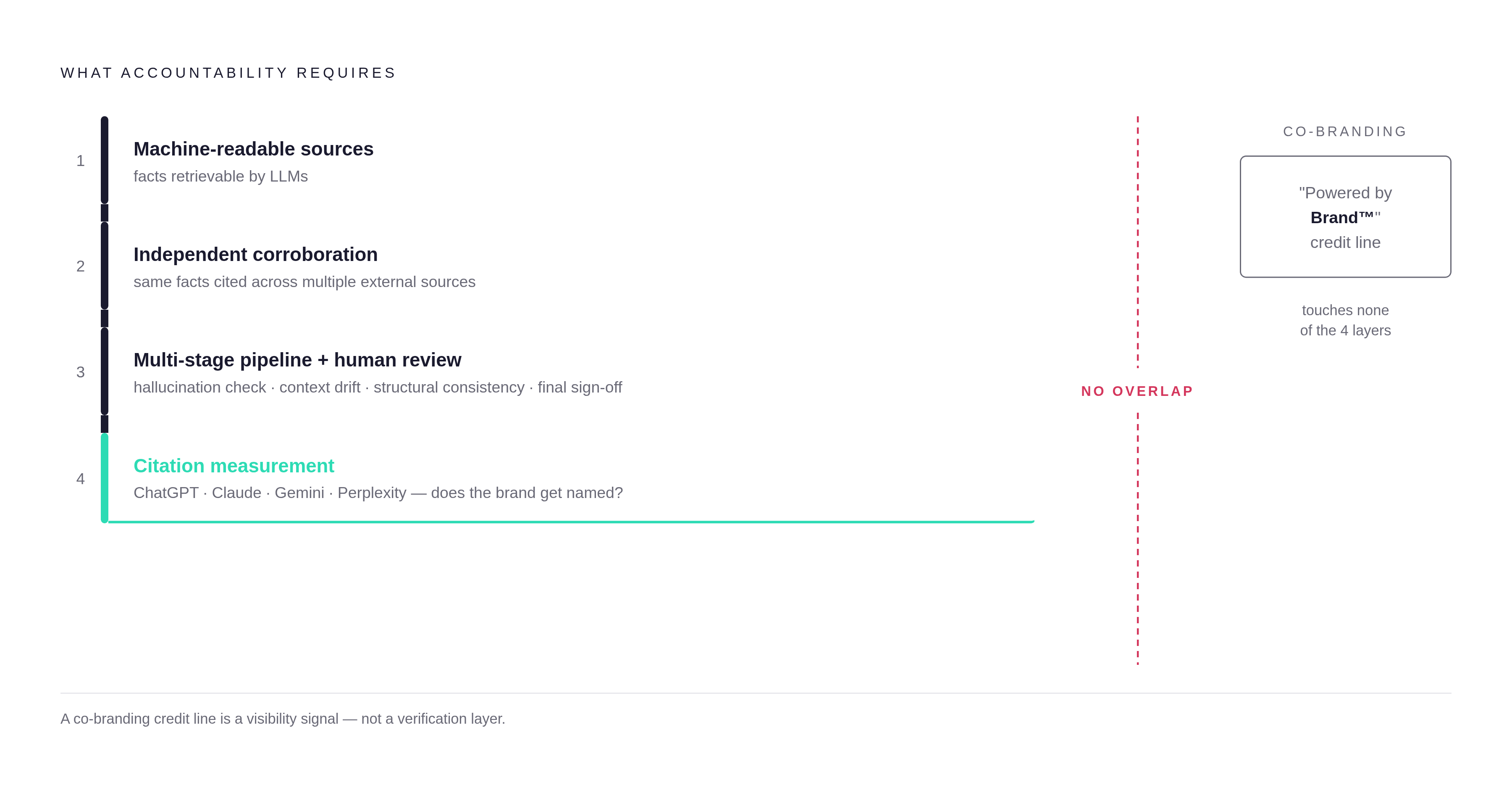
Retrievable content still needs to be accurate before it becomes a source. This is where production practice meets the question a credit line leaves unanswered. What checks occurred between generation and publication? A label naming the tool reveals none of them. The accountability comes from the gates inside the pipeline.
Those gates address distinct failures. Hallucination calls for checks for made-up facts, while context drift calls for a review of whether voice or positioning has changed over a long run of content. Structural inconsistency requires attention to templates, prompt libraries, and publishing workflows when rules change. A factual review cannot substitute for all three. If the documentation changes but the workflow does not, the old brand keeps reproducing itself through new outputs.
The practical standard is the “Final Percent” rule. All AI-generated content should have final human sign-off before it goes live, with a person checking the facts and judging whether it is ready to publish. Regular audits of outputs also check for drift as models evolve. This gives accountability a place in the production process. Without that architecture, a “Powered by” label can lend apparent assurance to an output that has passed no verification at all.
The legitimate purpose of credit lines and where it ends
Credit lines were never meant to carry out those checks, which is the strongest objection to this criticism. They exist for people, making participation and responsibility visible to audiences who need that information. That is a legitimate purpose in its own right. Transparent labeling also supports regulatory compliance, and demands for transparency are not a reason to hide who took part in production.
A declaration and its supporting evidence nevertheless do different jobs. The credit line identifies a relationship, while a verification process establishes what was checked. Machine-readable sources make facts retrievable, while citation measurement shows whether answer engines used them. None of these functions cancels the others. The error begins when the visible declaration is treated as proof that the rest exists.
This distinction is especially important when a brand cannot see whether answer engines cite its content at all. In that situation, the lockup may be the most prominent signal in an otherwise unmeasured system. Does ChatGPT name the brand, does Claude cite it, and what happens in Gemini or Perplexity? Without tracking those outcomes, the partnership rests on an assumption about presence.
What a brand owes its agent-era partners — measurement, not just a lockup
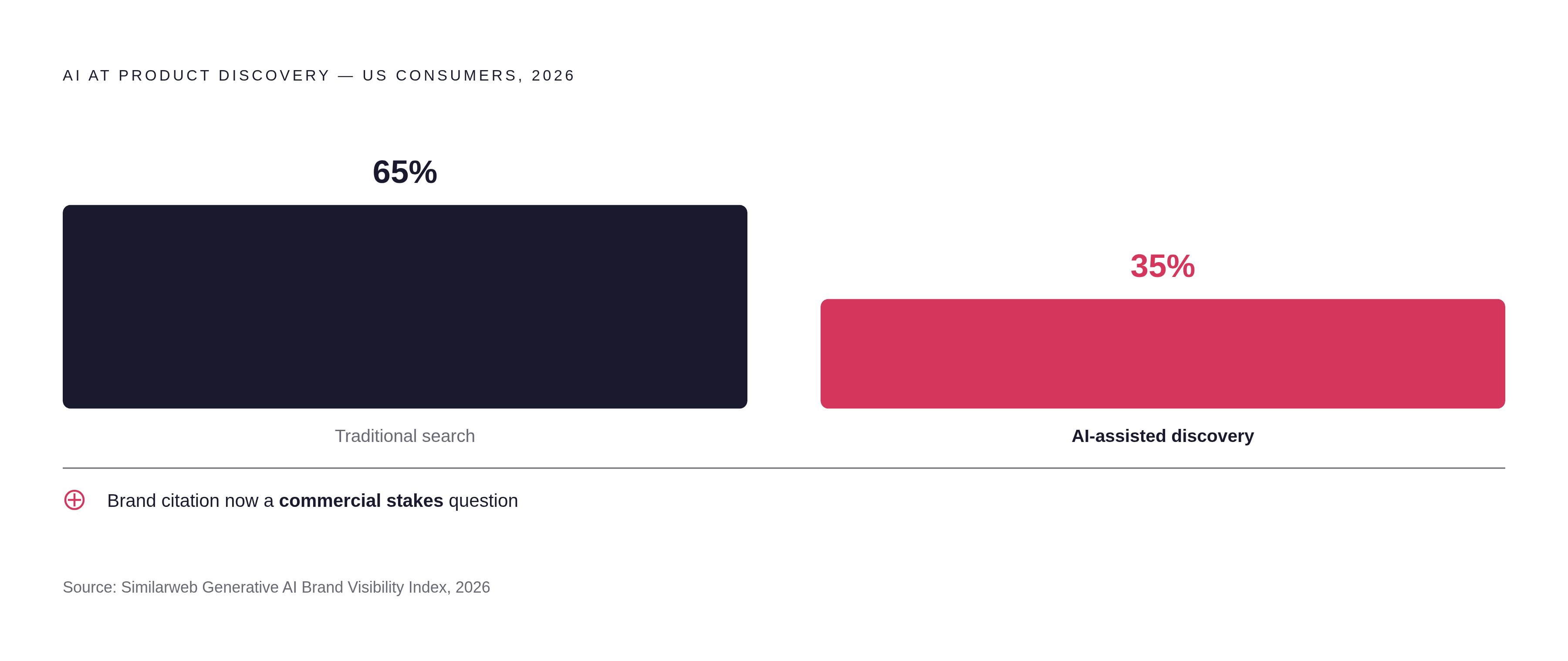
Similarweb’s 2026 Generative AI Brand Visibility Index found that 35% of US consumers now use AI at the product discovery stage. That makes brand visibility part of how people shop, as well as a technical matter of how crawlers work. Brands and their partners therefore need to know whether answer engines name and cite them. What the partners learn should guide what they publish, rather than leaving the promise of being named and cited untested.
The practical standard begins with an instrumented foundation. A partnership should be able to identify the grounding pages and structured entity data the brand publishes and owns, the independent sources corroborating its claims, and the evidence of retrieval and citation. These are different kinds of evidence. Crawl records show access, while observed answers show whether a brand appeared and what was said about it.
Traditional search authority cannot substitute for that measurement because ranking on Google and being cited by an answer engine are different jobs. The partnership conversation should therefore extend beyond logo placement to what is published, where it is indexed, and how citation is measured across ChatGPT, Claude, Gemini, and Perplexity. A lockup can still mark the relationship clearly.