"Get the work done before you hire a marketer": what a technical founder should ask to see before buying experiments as a service
Five checks a technical founder needs before paying for AI visibility.

Buying “experiments as a service” for AI visibility should mean buying evidence. Before a technical founder commits budget, five things need to be visible, including the measurement method, engine-specific reporting, original evidence, a source strategy, and ownership with a clear feedback loop. But the founder has work to do first. A service cannot test a growth strategy that the buyer has not yet made clear.
Why buying "experiments as a service" is the wrong default for a technical founder
A technical founder would not ship a feature without logging and a rollback plan. Yet done-for-you growth services often ask that founder to buy marketing work without an equivalent way to see what happened or decide when to stop. The engineering instinct belongs here, too. An experiment needs a claim that the results could disprove, rather than a schedule of activity that can always be called progress. Publishing content and gaining citations may be useful work, but neither alone establishes that an experiment succeeded.
The problem begins before measurement if the ideal customer profile, message, and offer are still vague. A content or GEO service then amplifies noise, making the wrong message more visible. That is a sequencing problem. These services have a legitimate role once the founder can write a one-page brief stating the channel, metrics, weekly cadence, and definition of success. Without that brief, the service gets to define success for the buyer.
What the measurement environment for AI visibility actually looks like in 2026
AI answer engines do not produce stable answers. The same prompt run twice rarely returns the same brand list, so a citation in one answer is not a reproducible result by itself. What was the prompt, which engine answered it, and how often was it run? A fixed prompt set, run at consistent intervals under an explicit sampling method, gives the founder something that can be compared across time.
The choice of metric also depends on the engine. Perplexity cites inline on most answers, which makes citation rate a meaningful measure there. ChatGPT only cites when web browsing fires, so mention rate is the more reliable signal on that platform. A report that treats every brand mention as a citation hides a difference in how the engines behave, before any question about performance even arises.
This creates a substantial gap between describing an AI visibility strategy and measuring one. Appearing once cannot show a trend, and a blended score cannot show whether each engine improved in the same way. Measurement needs a defined basis for comparison. It also needs a boundary between visibility inside an answer and traffic that reaches the site. With so much to track, the founder should ask how the service will measure results before spending and insist that it can explain what its dashboard shows.
The five things to demand before signing anything
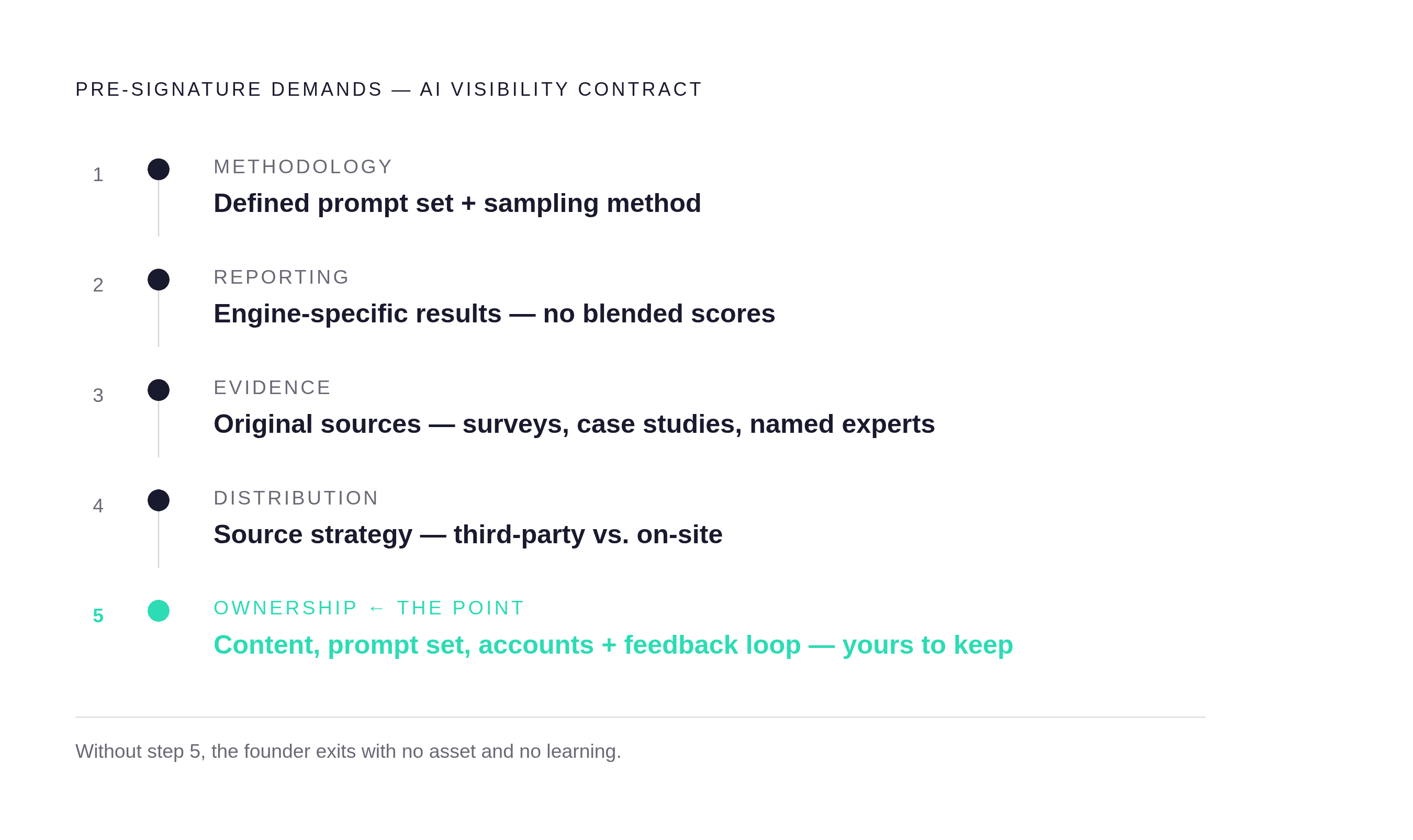
The first demand is a defined prompt set and sampling method, shared before the engagement starts. Ask to see the exact prompts, how many the service runs, how often it runs them, and which engines it tests. Consistency makes the comparison possible. If the prompt set changes partway through the work, a later result may come from the change in the test, even if visibility stayed the same. The set should therefore stay fixed unless the founder signs off on a change, and the service should explain how it aggregates results across runs. This is the minimum needed to understand what a performance claim refers to. Ask, “Show me the prompt set you used for a current client and the methodology you used to aggregate results across runs.”
The second demand is engine-specific reporting, because an aggregate “AI visibility score” hides which engine moved, and what to do next depends on the channels and content signals. The report must support the next decision. Microsoft launched an AI Performance report in Bing Webmaster Tools in public preview in February 2026, adding Intents, Topics, Citation Share, and Compare features in June 2026. That free, native reporting is a baseline a provider should use and show clients. GA4 can also filter sessions from platforms such as perplexity.ai and chatgpt.com, so the founder can link visibility work to the referral visits that follow. Those visits are not yet pipeline, but reporting that stops before them cannot show whether visibility brought anyone to the site. Ask, “What does your reporting look like broken out by engine, and how do you connect AI mentions to site visits?”
The third demand is proof that the content plan uses signals that can affect citation performance. Aggarwal et al.’s GEO research, run on a test split of GEO-bench, found that quotations from credible sources, clear statistics, and source citations were the strongest levers for a source’s share of AI answer text. The plan also needs original inputs, such as survey data, proprietary case studies, or opinions from named experts whose conversations were documented. An AI pipeline without a documented source for those inputs mostly repeats what the model has already absorbed and adds little that it could not produce on its own. Ask, “Walk me through one piece of content you produced for a client, what original evidence it contained, and how you verified it moved the citation metric for that client.”
The fourth demand is a clear account of where citations come from and a strategy that reflects that distribution. A majority of brand mentions in AI search come from third-party sources, including community platforms, comparison sites, and industry publications. The provider should explain how it chooses the external sources worth pursuing for the founder’s category, rather than treating more on-site publishing as the answer to every visibility problem. Meanwhile, fewer top Google results are among the AI-cited sources, so traditional SEO performance alone says less about AI citation performance than it used to. Ask, “What share of your strategy is on-site content versus third-party presence, and how do you decide which third-party sources to target for a client in my category?”
The fifth demand is ownership paired with a feedback loop the founder can read and keep. If the vendor retains the content, prompt set, site structure, or measurement accounts at contract end, the founder is renting visibility with no asset to keep. The learning needs to survive the contract. At any point, the founder should be able to see what was published, what was measured, what moved, and what hypothesis comes next, without relying on proprietary scoring. That includes durable entity and citation work, such as consistent brand descriptions across LinkedIn, Crunchbase, schema markup, and third-party sources. This work is cheap and compounds through consistency, so it should not be locked inside the provider’s tools. Ask, “Who owns the content, the prompt set, and the measurement accounts if we end the engagement? Can you show me the feedback document format a client would see after the first month?”
What the founder must have done before any of these questions matter
Those demands become useful only when the founder can supply a clear problem for the service to work on. For a seed-stage company, that means documenting the ideal customer profile, use cases, specific pain points, and differentiation before taking on a large content retainer. Without them, demand generation amplifies waste because the work has no firm account of whom it should reach or why that person should care. This preparation gives the vendor a brief it can work from, with the positioning settled before publishing starts.
The founder also needs a baseline prompt audit before procurement. That audit should show current citation rates across ChatGPT, Perplexity, and Gemini, while making clear how mentions differ from citations for each engine. For ChatGPT, mention rate remains the more reliable signal. The audit should also show which third-party domains the engines now cite for the category. Knowing that starting point makes it possible to judge whether a proposed strategy responds to the actual source environment.
Readiness then comes down to two conditions. At least one channel should already produce repeatable pipeline without heroics, and the founder should be able to write a one-page brief describing the channel, metrics, weekly cadence, and a successful first month. Both conditions need to be met. A working channel without a clear brief leaves the service too much room to define the assignment, while a polished brief without repeatable pipeline does not meet the readiness test. This is preparation for judging the answers honestly, because the checklist works only when the buyer knows what good looks like.
How to run the evaluation as a structured experiment, not a vibes-based vendor call
The practical next step is to treat the first month as a paid pilot, with conditions that could show the engagement has failed. Agree to those conditions in writing before money changes hands. The agreement should define the prompt set, baseline, engines, success metric for each engine, and exit condition if the metric does not move. This makes the initial engagement a bounded test rather than an open-ended commitment. It also settles the hard choice of when to stop before the work starts, while neither side has a month of work to defend.
Evidence should enter the conversation just as early. On the first call, ask for a named client result showing a specific before-and-after comparison on a defined prompt set, with traffic data attached. A promise is not a track record. The example should let the founder examine the same links that the proposed pilot will test, from the measurement method to visibility and referral traffic. Waiting until the final proposal to ask for that evidence keeps the pitch at the heart of the review for too long.
The pilot should also be instrumented independently of the vendor. GA4 filtering for AI platform referrals and Microsoft’s AI Performance report provide free, founder-controlled reporting that should serve as the source of truth for the signals they measure. Access should not depend on keeping the contract. The provider’s report can explain the work and the next hypothesis, but it should not replace measurement accounts the founder can inspect and retain.
At the end of the pilot, the decision is not simply whether the brand appeared in an AI answer. Did citations generate referral visits, and did those visits convert at a rate that justifies continuing? Visibility alone cannot answer that commercial question. The agreed engine-specific metrics show whether the tested signal moved, while referral and conversion data connect that movement to the cost of the engagement. A technical founder is buying useful evidence only when that chain is legible enough to support a decision to continue or stop.