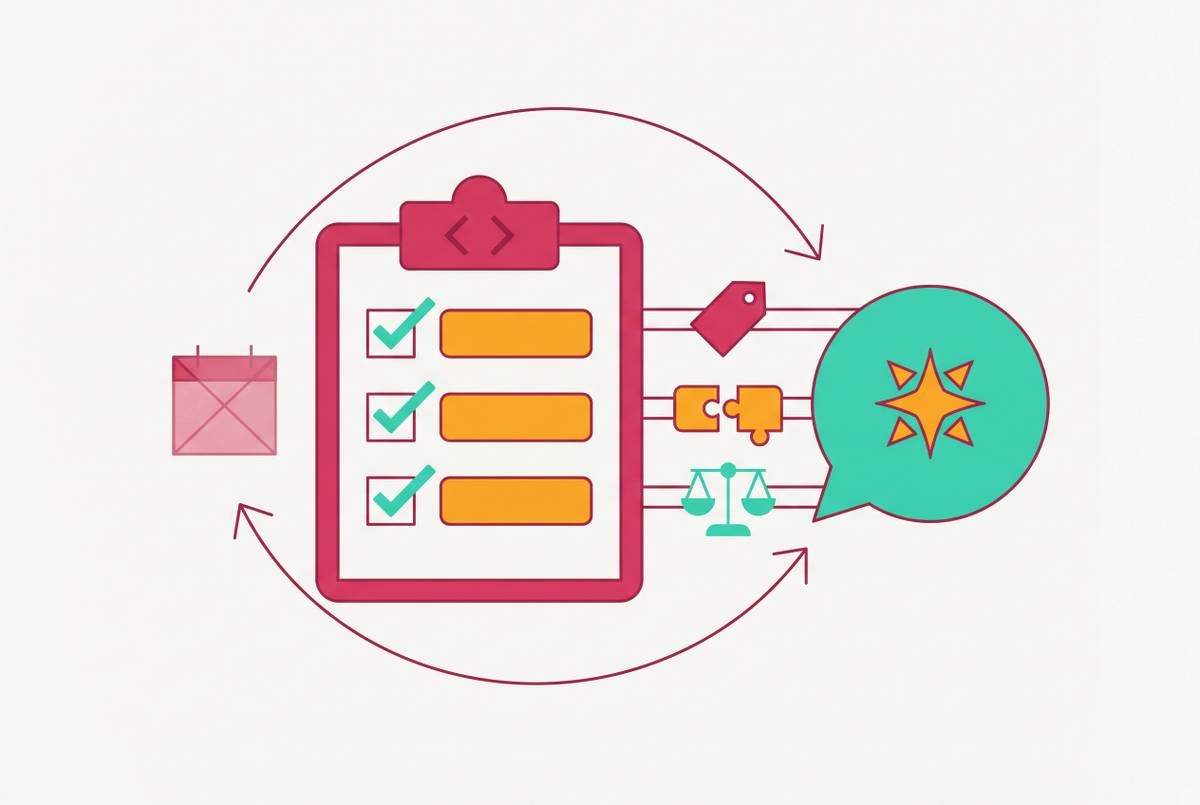
What a "content optimization platforms" comparison for B2B startups leaves out: grading the draft is not the same as instrumenting the outcome
Draft grades can't show whether AI engines cite a startup.

Comparisons of content optimization platforms help B2B startups choose tools that make drafts better. But grading a draft and measuring what happens after publication are different jobs. A strong grade cannot tell a team whether AI answer engines cite its content, bring it to buyers, or help move pipeline.
What comparison pages for content optimization platforms actually evaluate
Comparison pages usually judge platforms by how well they score drafts, recommend keywords, and fit into an editorial workflow. Their criteria include the accuracy of A–F content scoring, the depth of recommendations, and integration quality. These are reasonable things to compare. Ease of use and cost belong in that evaluation too.
Clearscope illustrates the production workflow these comparisons examine. Its signature feature is real-time A–F grading based on NLP analysis of top-ranking pages, with integrations for Google Docs, Microsoft Word, and WordPress. Writers can change content in the tools where they already work. Its Essentials plan costs $129/month, reduced from $189 in April 2026, and includes 50 tracked queries, 50 pages, 20 monthly Topic Explorations, 20 monthly Drafts, and unlimited user accounts.
Those details let a buyer compare editorial convenience and production capacity. They do not, by themselves, establish what happens after publication. The comparison format often stops at that boundary, even when a product has capabilities beyond grading. Clearscope’s Expand product page, for example, describes tracking brand mentions and competitive gaps across ChatGPT, Gemini, and Claude. The critique therefore concerns the evaluation frame. Which capabilities a comparison chooses to score shapes what a buyer understands the job to be.
What the grade is actually measuring, and what it is not
Clearscope scans roughly the top 30 results for a keyword and processes them through an NLP engine combining Google’s Cloud Natural Language API, IBM Watson, and OpenAI. It shows semantically relevant terms and updates the draft’s score as the terms it covers change. This helps writers close topical gaps against competing pages and stay aligned with search intent. For editors, the result is a fast readiness signal.
The boundary lies in the reference material. The grade measures coverage against pages that already rank on Google. It cannot establish whether ChatGPT, Claude, Gemini, or Perplexity cites that page, where the citation appears, or which buyer-intent prompt produced it. Nor does the grade reveal sentiment or a contribution to pipeline.
Google argues that “optimizing for generative AI search is optimizing for the search experience, and thus still SEO”. On that account, strong search-oriented content is doing foundational work. But a foundation is not a measurement. ChatGPT and Perplexity do not replicate Google’s link-graph ranking system, and topical depth, answer extractability, and author credibility influence their answers. Strong backlinks and comprehensive term coverage do not guarantee citations, while a page that never ranked on Google can be cited regularly by an LLM.
Why the AI answer-engine surface requires a different input than the SERP
An answer engine needs a passage it can use confidently. That favors a direct answer in the first two or three sentences, followed by supporting detail. A draft can cover the right terms yet bury its conclusion beneath paragraphs of preamble. Its topical coverage may be strong while its answer is difficult to extract. The distinction is between covering a subject and supplying a usable answer.
Preparing content for that use is part of what generative engine optimization, or GEO, and related forms of optimization for answer engines address. These labels describe a demand for usable content grounded in good writing and sound evidence. The engine needs both a passage it can use and reasons to trust what it says. A score derived from search results cannot establish that the engine found and used either one.
A brand without a Wikidata entry faces a disadvantage in entity recognition and grounding, although pre-training corpora and retrieval also provide routes through which LLMs acquire entity knowledge. A brand can exist without a Wikidata entry. Few of the platforms being compared build or manage such entries, though WordLift offers Wikidata entity reconciliation. This is a separate capability from draft scoring.
Measurement infrastructure also sits beyond the draft. Google Search Console’s Generative AI performance report reached all sites on August 31, 2026, while Bing Webmaster Tools surfaces citations in Copilot and Bing AI summaries. Their existence makes the distinction concrete.
Where the exposure is sharpest for a B2B startup
For a B2B startup, being found by name is not the same as being discovered. A buyer who asks about a brand has already come across it somewhere. A buyer asking “which tools solve X” is still forming a set of options. The second prompt is where content can introduce the startup to a buyer who did not know to ask about it. That is the discovery gap a draft grade cannot reveal.
Branded-query citation rates are high across major engines, while startups are largely absent from up-funnel discovery prompts. So a marketing lead can feel reassured by brand mentions without knowing whether the company shows up in category-level answers. For a startup without an established domain, this is more urgent than incremental improvement against already-ranking pages. The comparison format’s chosen target can be the wrong one for the company’s stage.
The gap also varies by engine. Citation overlap is low for the same buyer-intent prompts, so showing up in one engine does not prove that the company shows up elsewhere. Internal data shows that AI visibility requires measurement. Citation tracking became a funded, purpose-built product category in 2026, reflecting recognition of that instrumentation gap. Being included in an answer establishes exposure, while a commercial result from that exposure requires separate evidence.
Why per-allowance subscriptions obscure the instrumentation problem further
Pricing reinforces the production-stage view of the job. A subscription based on seats, reports, drafts, and tracked queries leads the buyer to ask how much work the team can get done within its allowance. Clearscope’s Essentials allocation makes that capacity visible, with limits on Drafts, Topic Explorations, Tracked Queries, and Pages and unlimited user accounts. This is a coherent way to price production resources. That pricing alone does not tell the buyer whether those resources lead to citations.
When the unit being compared is a report or draft, teams are encouraged to evaluate throughput and cost per item. An outcome-oriented measurement system has a different unit of work. It may meter a citation check, a prompt run, or a monitoring trigger, with a line-by-line bill for the specific call. That makes the cost of an observation visible at the action level.
Token-metered primitives fit this engineering view because individual actions can be measured and accounted for. A flat monthly allowance does not supply that granularity on its own. Nor does billing for each action prove commercial attribution. The bill makes inputs easier to check, while the link between outputs and pipeline still needs to be measured.
Access is part of the same architecture. A capability reachable through an API or MCP hook can participate in an automated measurement workflow. A dashboard that requires a person to open it cannot supply that automation by itself. Comparing price per report and cost per seat rarely shows whether the product can do this broader job.
What pipeline architecture does and does not solve
Human outlines, AI drafts, human revision, AI surface edits, and human approval preserve editorial control while using automation where it helps. This alternating workflow is slower than full automation but faster than fully manual production. Google’s guidance emphasizes manually fact-checking AI-generated content before publication because models still invent statistics, quotations, and source URLs. Production quality deserves serious attention.
A pipeline governs what ships. Editorial approval cannot stand in for an observation of the published page’s use. Even after a careful review, an article may still fail to show up for a relevant discovery prompt. Without citation measurement, the team cannot tell whether its production process is solving that problem. Better control and better instrumentation address different uncertainties.
Pipeline design should make evidence retrievable, structured, and citable. A model needs a passage it can use, and the passage must exist in an accessible form. A PDF behind a form wall does not provide the crawlable evidence that a published page with original, structured data can offer. This is a production constraint whose success is tested after publication.
The same principle applies to the feedback loop. Every pipeline capability needs agent access through an API to automate the loop and eliminate dependence on manual dashboard checks. Citation data can then inform content decisions, but the data must exist first. A comparison that evaluates a draft score at one point in production tells the buyer little about either the pipeline or that return path.
What the measurement layer looks like when it is purpose-built
A purpose-built measurement layer observes whether published content is cited, where it appears, which prompt produced the answer, and which competitors appear with it. It separates branded queries from discovery prompts rather than rolling both into an undifferentiated mention count. Position and sentiment are separate observations too.
Coverage must also extend across engines. Prompt runs across ChatGPT, Perplexity, Gemini, Copilot, Claude, and others expose differences that single-engine monitoring misses. The search platforms’ own reports provide only part of that view. Search Console covers Google AI Overviews and AI Mode, while Bing Webmaster Tools’ AI Performance report covers Microsoft Copilot, Bing’s AI-generated summaries, and select partner integrations. Neither provides the missing view into ChatGPT or Perplexity.
The Aggarwal et al. GEO study, conducted in 2024 by researchers from Princeton, IIT Delhi, Georgia Tech, and the Allen Institute for AI, provides a reason to measure changes in presence. The study established that adding quotations from credible sources, statistics, and citations measurably changes a source’s share of the AI answer. That makes a content decision testable. A measurement layer can compare citation share before and after an intervention instead of treating a higher draft grade as proof of success.
This also sets a limit on the alternative. Citation measurement establishes whether the content appeared in an answer, while its effect on pipeline requires separate assessment. A buyer still needs to distinguish those outcomes when assessing a vendor’s claims. Otherwise, the business can mistake mention counts for the result it wanted.
Questions to ask any content optimization vendor before buying
Buyers should test production support and outcome measurement separately. These questions apply to any vendor in the comparison category. A tool can help editors do their work without offering the measurement layer a startup needs.
Does the platform measure citations in ChatGPT, Claude, Gemini, and Perplexity as well as Google rankings? Which engines and prompt types does it cover? How often does it run those prompts? Can it distinguish discovery prompts from branded queries?
Can the platform show which buyer-intent prompts include the brand? Does it show the brand’s position next to named competitors? Does it measure sentiment separately from presence? Does it track citation overlap across engines, or only results within one?
Is pricing metered per call, prompt run, or monitoring trigger, or per report, draft, or seat? Which measurement actions appear on the bill? Is every capability available through an API or MCP hook? Which steps require a person to open the interface?
Where do evidence, data, and original research live in the workflow? Does the pipeline publish them as crawlable, citable content? What feedback loop connects citation data to content decisions? Is that loop automated, manual, or absent?
Finally, what does the platform actually establish about pipeline contribution? Does it measure that outcome, or report citations as a proxy? The purchase should turn on a clear answer.