The AI shortlist is built in the middle of the funnel: how to make your pricing, fit and integrations answerable by a machine
A practical audit for making pricing, fit and integrations machine-retrievable.

AI-generated software shortlists are built largely in the middle of the funnel, where buyers compare pricing, functional fit, and integrations. Getting onto those lists requires more than a recognizable brand. It requires commercial facts that a machine can retrieve and cite accurately, supported by a repeatable way to test what AI engines actually say.
Where B2B software buying decisions now begin
Forrester's 2026 buyer research finds that generative AI search is now where B2B buyers start their research. That starting point is shared, but the questions are not. An economic buyer, a technical evaluator who also covers security, and end users each approach the purchase with different concerns. They may ask different engines without comparing notes. A champion's ChatGPT query and a CFO's Copilot query rarely overlap.
This fragments the path into the buying committee. A vendor can appear in one stakeholder's research and remain absent from another's, even though both are evaluating the same purchase. The chatbot's shortlist is typically two to seven vendors. Missing that list can therefore mean both losing a website visit and exclusion from the deal.
Where in the funnel AI actually builds the shortlist
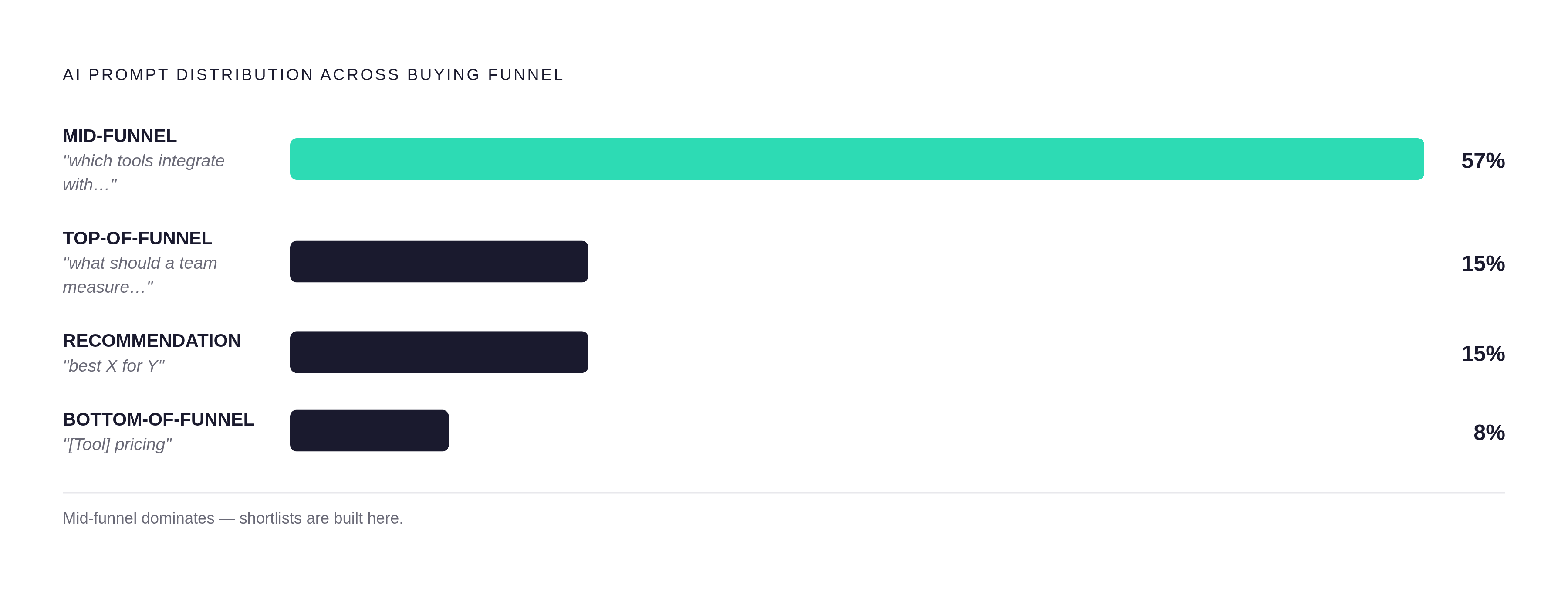
Internal data shows roughly 57% of AI prompts are mid-funnel comparison or evaluation queries, about 15% are top-of-funnel, and about 8% are bottom-of-funnel. Internal data also shows about 15% ask for an explicit recommendation, the moment when the shortlist is finalized.
What does that distinction look like in practice? A top-of-funnel question is problem-aware but unnamed, such as “what should a marketing team measure…”. Mid-funnel questions compare “category X vs. category Y” or ask “which tools integrate with [CRM]”. Bottom-of-funnel prompts become transactional, including “[Tool] pricing” and “[Tool A] vs [Tool B]”.
The solutions engineer or technical evaluator is the dominant actor at mid-funnel. Getting the features right helps that reader more than brand tone does. A first-place appearance in ChatGPT for one well-chosen prompt therefore proves little about coverage across the committee. The security lead's Copilot query or procurement lead's Gemini query may never bring up the same vendor.
What MOFU prompts are actually asking about
Internal data shows that pricing is the most common commercial theme in AI prompts, followed by functional fit and compatibility. These themes reduce to three plain questions. Can X do Y? How much is X? Does it work with Z? Each tests a condition that could include or exclude a product from further evaluation.
A solutions engineer building a shortlist needs to know whether a named connection exists and what it does. Fit questions also call for details on what the product can do.
Yet those answers are often in a demo flow, in a sales deck, or behind a form. They are not retrievable evidence for an answer engine. A “contact us for pricing” page may give a human a route to a salesperson, but it leaves the machine without the pricing logic needed for comparison. The content gap is therefore narrower than a general lack of information. It concerns the commercial facts buyers are already asking AI to evaluate.
What happens when AI cannot find a plain answer to a pricing or fit question
An answer engine can fill that gap from third-party sources. The answer may name the right vendor but give the wrong reason to consider or rule it out. A Reddit thread, for example, can misrepresent pricing by an order of magnitude.
A pricing page that looks complete to a human visitor may leave key pricing or product content uncrawlable.
A panel of 100 commercial B2B software queries found that the large majority of AI citations went to third-party “best X” listicles. In roughly a third of queries, a product was recommended with zero citations to its own site. Third-party evidence places the justification outside the vendor's control.
Treating machine-readability as an engineering problem, not a content exercise
The practical response is an engineering audit of what machines can read. Pricing belongs in plain HTML with structured data, including JSON-LD schema. Integration pages need to name each connection explicitly rather than hide them behind a “see all integrations” modal. Comparison pages need declarative fit criteria.
Consistency is part of that infrastructure. If one page calls a plan “Team” and another calls it “Professional,” an AI engine may treat them as different products. Clear sentences cannot repair contradictory names.
To make commercial answers easier to retrieve, each relevant page should open with a 2–3 sentence direct answer before adding context. That opening has the highest citation probability. Long preambles delay the evidence, while keyword density does not help an LLM resolve a factual question.
The concrete audit checklist for pricing, fit, and integration pages
The pricing audit consists of yes-or-no checks. Does the page deliver server-rendered plain HTML independently of client-side JavaScript? Does it open with plans and prices or price ranges? Are plan names consistent across the site? Does it include JSON-LD schema markup? Is it unblocked in robots.txt and accessible without a login? If prices are not public, does it state the pricing model and a range or starting point?
Are there pages answering the top five “can X do Y” questions buyers ask? Are the answers declarative facts? Does a page or section explain what the product is not suited for? Do comparison pages name the competing product and state factual differences without hedging?
Does each integration have its own page that names it in crawlable text? Does each connection have a sentence explaining what it does? Are API and webhook capabilities stated in readable plain text? Does a page or section explicitly address SOC 2, GDPR, and SSO requirements?
Site-level checks complete the audit. Is there an /llms.txt file indexing key commercial pages? Are AI crawlers unblocked in robots.txt? Are the category, primary use case, and target customer consistent across the homepage, pricing page, and integration page?
Probing what AI engines actually say about you, by funnel stage
A published fix is not proof of a changed answer. Standard referrer tracking cannot close that gap because answer engines may send no referrer, and users may never click. A useful answer in chat can generate no session or form fill.
To test retrieval directly, run the same prompts through ChatGPT, Claude, and Gemini once per day for a week. The TOFU probe is “What should a [team type] consider when evaluating [category]?” It tests whether the brand appears as a credible source before the product is named. The MOFU probes are “Compare [Product] and [Competitor] for [use case]” and “Does [Product] integrate with [named tool]?” These test comparison and integration evidence.
The BOFU probes are “Evaluate [Product] on pricing” and “What do [Product] users say about [specific feature]?” Inspect whether first-party evidence supports pricing, and check for reliance on Reddit or outdated posts. Categorize the citations and sentiment as positive, neutral, or negative.
Track four measures across the panel. Mention rate records brand appearances, while citation rate records citations to the brand's own domain. Brand accuracy checks whether the key facts are right. Source support rate checks whether the cited page backs up the claim.
How the Clay example shows intentional source architecture at work
Clay links directly to top customer case studies in its website footer. In a test using “What notable brands use Clay?”, ChatGPT cited Clay.com pages featuring the brands in that footer list. The example turns on source architecture: named customer evidence was published where a crawler could find it.
The mechanism is straightforward. AI engines follow the same crawl signals human search engines do, so a prominently linked, plain-HTML page with named, verifiable facts provides a citable source. A JavaScript-rendered modal that holds client logos does not give them the same access.
The lesson extends to pricing and integrations. Where a fact lives, how the site links to it, and whether it appears in crawlable HTML shape which source an engine can cite. Publishing the fact is only part of the job.
What changes when an AI agent evaluates vendors on a buyer's behalf
McKinsey's June 2026 survey found that, among AI users, a meaningful share had already let AI help decide on a purchase, while a smaller share had AI complete the purchase. This documents movement toward delegated evaluation. It does not establish that every software purchase will become fully agentic.
The implication for commercial content is more immediate. An agent uses the same tests for pricing, fit, and compatibility but lacks a human buyer's willingness to go through a demo flow or contact sales. A fact it cannot retrieve cannot inform the evaluation. Ambiguity becomes a more direct obstacle.
Checkable evidence includes specific pricing in plain text, named integrations in crawlable HTML, declarative fit criteria, and a try-before or self-serve path that needs no sales conversation. These give the agent something concrete to evaluate. The committee adds another complication because stakeholders may delegate separate questions to separate agents. Vendors that want to appear across those answers need to test more than one engine. ChatGPT, Claude, Gemini, and Perplexity all belong in that broader view.
Why off-site citations matter as much as on-site content, and how to build both
AI engines draw heavily on third-party pages, so a sound first-party source needs a presence beyond the vendor's domain. Review platforms including G2, Capterra, and Trustpilot, together with earned media, are prominent citation surfaces for B2B SaaS. Brands active on these platforms are cited at substantially higher rates.
The practical approach has two layers. The ground-site layer consists of owned, crawlable, structured evidence for questions such as pricing. The distributed layer consists of reviews, earned media, and original research picked up by specialist publications. Research can give AI tools independent pages to draw on when deciding whom to recommend.
Both layers need accessible text. Content confined to a paywall, webinar recording, or live event is largely invisible to AI outputs, so the recommendation is to publish it in crawlable form on owned and third-party properties.
The probes help locate the weakness. Pricing citations that lead to Reddit rather than the pricing page point toward a ground-site problem. When a brand is missing, it may have too little of a presence on other sites. A third-party listicle citation alone is not a failure.
Putting the system together: from one-time audit to continuous operation
A daily or weekly probe cadence provides an early-warning system as engines re-crawl, models update, and cited sources change. The operating loop connects those observations to publishing decisions. Mention rate, citation rate, brand accuracy, and source support rate should be tracked over time so changes become signals that provide early warning.
Agents can operate at read-only and draft levels, while humans approve consequential changes. Those include publishing new pricing claims, altering crawler or indexing policy, and changing the site's description of its category.
Fewer pages with original, verifiable, declarative facts serve the purpose better than scaled unoriginal content, which can cause harm. The investment is in dependable evidence.
That creates a reason to begin before every page is perfect. Machine-readable commercial facts, an active review and earned-media presence, and probes that catch regressions build on one another over time. Each accurate citation makes the next more likely because AI engines weight sources that have been consistently reliable.