When your AI marketing tool moves into Teams: chat-based marketing agents vs. composable, API-first growth primitives
Teams-based AI agents speed up marketers, but only APIs own workflows.

Moving an AI marketing agent into Microsoft Teams makes it easier for a team to start using AI. It does not, by itself, give that team an automated growth operation. The choice between chat-based agents and composable, API-first growth primitives turns on that distinction. Buyers need to decide where their highest-value work should run, who controls its connections, and how its results will be measured.
How distribution bets get made: the Teams-embedded marketing agent announcement
The Teams-embedded marketing agent announcement brings marketing AI into a tool that teams already use at work. The integration includes the Microsoft 365 file and identity layer, including SharePoint, OneDrive, Outlook, and Microsoft Work IQ. This gives the agent access to the surfaces a marketing team touches daily, rather than asking users to gather that context in a separate tool.
The announcement also names Royal Bank of Canada, Zoom, Ramp, and MongoDB as customers. Together, the integration and customer names establish the announcement’s immediate proposition, which is to make marketing AI accessible within an existing work environment.
Why embedding in Teams is a distribution story, not a capability story
A familiar surface removes several barriers at once. There is no separate login to remember, less switching between tools, and less need to get colleagues to use another tool. Teams is used by enough enterprises to make it a valuable place for the agent. Distribution is not a minor benefit here. A tool that people can readily use has an advantage over one they must make a special effort to reach.
Finding a file in SharePoint, drafting in Word, reading Outlook, and producing reports are ways to accelerate a person’s work. They shorten the distance between a question and an output. In this model, a person still participates in each loop, deciding what to ask and what should happen next.
That is different from owning a workflow end-to-end. A conversational agent can help a marketer make a decision without taking responsibility for the sequence of research, drafting, review, publication, and measurement around it. The distinction is between human-in-the-loop acceleration and autonomous pipeline ownership. An easier way to query AI does not establish the architecture needed to run a growth operation.
What the vendor lock-in actually looks like when your growth stack lives in one chat surface
That architectural gap becomes clearer at the permission boundary. When marketing AI lives in Teams, Microsoft 365’s identity and permission layer sets what the agent can read, write, and trigger there. The available connections depend on what Microsoft exposes and may cover only part of a marketing operation’s needs. Familiar access can therefore conceal a dependency. Work that needs to leave that environment exposes the limitation.
For example, a team may need to route outputs into a data warehouse, trigger a webhook from a campaign event, or connect a new engine without waiting for a native integration. Those needs test whether the chat surface is a way into a wider system or the limit of what the system can do. Composable martech provides the alternative. It uses modular, loosely coupled components connected through APIs and a shared data foundation, so individual pieces can be replaced or extended without disrupting the whole.
The relevant evidence is more specific than an integration logo. A production MCP server, OAuth-scoped tool-use APIs, and schema-clean webhooks signal an architecture intended for orchestration. A REST API plus a Zapier integration offers connections, but does not by itself establish the same posture. For API-first agents, the working interface is an endpoint.
What composable, API-first growth primitives actually let you do that a chat agent cannot
The payoff is faster answers and a larger scope of work that can proceed without someone initiating every step. A well-designed agent pipeline can connect research, drafting, a review gate, publication, and measurement into one workflow.
Small primitives make this distinction concrete. A watcher can draft when something relevant happens, while a measurement layer queries AI engines on a cadence. A publishing step can send work to a person for human review before it ships. Each component has a bounded job. Because those components can be connected to different surfaces and metered individually, the buyer’s stack can own the workflow independently of any one chat destination.
This is a different source of leverage for high-volume, repeatable work. Instead of helping a person answer every question faster, the system reduces the number of tasks that require a person to start them. Someone must build the agents, maintain the prompt set, and connect the data to reporting. Without that person, composability is something the technology allows but the team cannot put to work.
Why AI visibility measurement is the job neither chat agents nor traditional SEO tools are built for
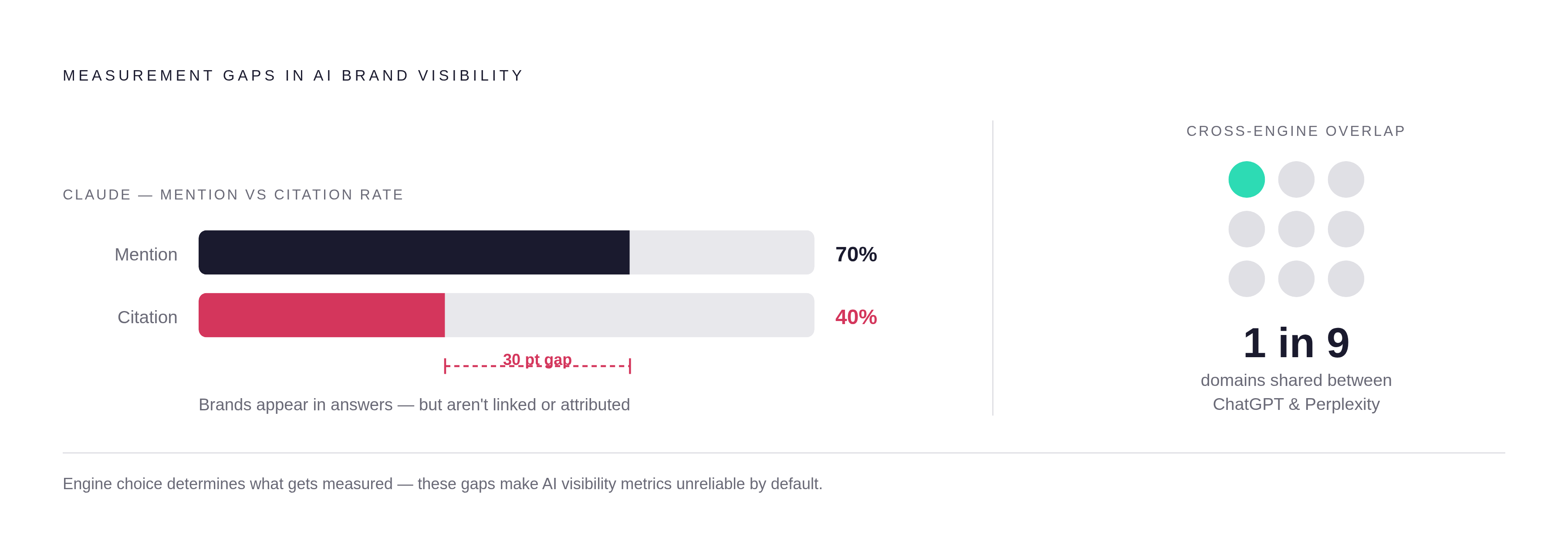
Measurement exposes why the distinction is useful. Getting cited in an AI answer and ranking on Google are different outcomes, so content built for one does not automatically succeed at the other. Answer engines also select different sources. The overlap between domains cited by ChatGPT and Perplexity is as low as one in nine. A measurement system focused on one engine can therefore miss much of the picture.
A passing mention is not a sourced reference, either. A 2026 citation-ranking study found that Claude mentions brands in roughly seventy percent of answers but cites them in only forty percent. That thirty-point gap separates two outcomes buyers might otherwise treat as interchangeable. A large-scale benchmark also found that the share of answers that mention a brand varies by dozens of percentage points across engines, with Claude near the top and Google AI Overviews near the bottom. Engine choice changes the apparent result.
AI share of voice gives this work a defined target. It measures the percentage of AI-generated responses that mention, cite, or recommend a brand across a defined set of category prompts, relative to all brand mentions in those responses. The prompt set and the distinction between mentions and citations are part of the measurement. Neither a conversational interface nor a traditional ranking report supplies that instrumentation by itself.
Semrush covers ChatGPT, Perplexity, Gemini, Google AI Mode, and Google AI Overviews through a monthly subscription. Google Search Console’s Generative AI performance report, which became available to all sites on August 31, 2026, shows impressions in AI Overviews and AI Mode. Bing Webmaster Tools’ AI Performance report shows how often Copilot and Bing’s AI summaries cite specific pages. These reports measure different points of exposure.
Google Analytics 4 can supply a free downstream baseline through source filters containing “perplexity.ai,” “chatgpt.com,” “claude.ai,” “gemini.google.com,” or “copilot.microsoft.com.” Those sessions measure referral clicks. Even that signal has a blind spot. Traffic from claude.ai often arrives as direct because of referrer stripping, so referral reporting cannot stand in for cross-engine visibility measurement.
What actually moves citation share: the content signals AI engines respond to
Once the outcome is defined, the next question is what content changes can improve it. The basic requirements are not exotic. AI engines cite pages they can reach, that already rank, that closely match the query, and whose content they are permitted to preview. Retrieval comes before persuasion. A page’s claims cannot help an answer engine if the engine cannot reach or use them.
Aggarwal et al.’s 2024 GEO research, from Princeton, IIT Delhi, Georgia Tech, and the Allen Institute for AI, examined tactics that increased position-adjusted word count in AI answers. Adding quotations from credible sources raised that share by roughly forty percent, while clear statistics and data raised it by roughly thirty percent. Inline citations raised it by roughly twenty-eight percent. A more recent 2026 study found that restructuring content alone increased citation rates by 17.3% across six generative engines.
Authority also extends beyond the page itself. The citation-ranking study found a strong link between how often a brand was mentioned on the web and its AI Overview visibility. Consistent entity details help avoid a separate problem, which is contradictory information for a model to reconcile. Matching names, descriptions, founding years, and services across a website, LinkedIn, industry directories, and Wikipedia reduces that risk. Being the primary source of studies, data, or interviews also improves citeworthiness because the model can refer directly to the original.
Structure can have effects at the outer edge, too. An experiment in April 2026 used a blank page with structured data that became Perplexity’s top cited source within hours. Practitioners should take the stunt as a lesson to pair machine-readable structured data with strong content, because a content-free page is not a lasting strategy.
AEO makes it easier to pull content into snippets and direct answers, while GEO aims to get it cited as a source in synthesized answers. Both mechanics need attention, but neither makes every proposed optimization worthwhile. The available evidence gives llms.txt the lowest score, with no credible confirmation that it influences citations. It should not take priority over accessible pages, clear evidence, consistent entities, and useful structure.
Why human review is not an optional feature in an AI content pipeline — it is load-bearing
A July 2026 Microsoft preprint auditing tens of thousands of accepted academic papers found likely hallucinated references that had passed peer review, including in roughly one in four accepted NeurIPS 2025 papers.
The content-marketing equivalent is a statistic that never existed, a quote assigned to the wrong person, or a link pointing somewhere other than the claimed source. Generating these errors is cheap. Publishing them under a brand’s name makes them expensive to trust, especially when the content’s purpose is to become a source that other systems cite. Volume magnifies the need for a review point.
The design response is to embed that point in the pipeline. Automation can do the research, drafting, and formatting while a person sees the output before it is published. Every AI-generated output should be reviewable and reversible before it ships. This requires the workflow to distinguish work that can proceed automatically from work that needs judgment before release.
“Full automation” and “human review” are therefore a false binary.
The question buyers should actually ask before choosing a surface
Buying decisions begin with the work the team needs to do. Does the team mainly need to help people make decisions faster, get AI search data more easily, and draft in tools they already know? If so, a Teams-embedded surface can be the practical answer, especially for a non-technical marketing team facing onboarding friction. A separate orchestration layer is not automatically the better choice simply because it offers more control.
The answer changes when the goal is to own entire workflow domains. Cross-engine visibility measurement, publishing on a cadence without someone initiating each piece, and connections to a buyer-controlled data layer call for composable primitives. For vendors claiming that capability, the test is concrete. Do they provide a production MCP server, OAuth-scoped tool-use APIs, and schema-clean webhooks, or only a REST API and a Zapier connector? Legacy CRMs and static analytics dashboards with closed APIs offer less agent readiness than MCP-first tools.
The team must pass a readiness test as well. Is there a marketing engineer who will build agents, maintain prompt sets, and connect outputs to reporting? Without that owner, the chat surface wins on pragmatism. With one, specialized, domain-specific agents offer the stronger architectural bet for repeatable work at scale.