Citation baselines before launch day: what Intuit's QuickBooks Free launch teaches about treating AI answers as a launch surface
Measure AI answers before launch day, or you can't prove what changed.

AI answers are a launch surface, and they need a baseline before launch day. Intuit’s QuickBooks Free program shows the value of treating citation as infrastructure. Its deeper lesson is about measurement. Without a record of where they started, teams cannot reliably tell propagation lag from silence, show that fixes hold, or link what they did at launch to changes in AI visibility.
Why AI answer engines are now a launch surface, not a post-launch channel
When a buyer asks ChatGPT, Perplexity, Gemini, or a Google AI Overview which accounting tool to evaluate, the answer offers a short list in place of ten links. Consideration can begin before any vendor site visit. A brand left out of that answer may never be among the buyer’s choices, even if its launch page does well.
The 5W AI Visibility Index found that AI visibility does not track market share: several finance software vendors with large revenues are underweighted, while smaller players are over-indexed. Nor does traditional search ranking, because ranking a page and earning a citation involve different signals. As citation consensus forms around early recommendations, later entrants face the harder task of displacing an established default.
What the QuickBooks Free launch actually did, and what it shows about citation as infrastructure
The QuickBooks Free program approached that problem as a repeatable distribution and measurement system. QuickBooks’ fall 2026 release expanded the Intuit Intelligence platform with same-day bill pay via Vendor Direct, mobile payroll, AI-drafted invoices, and payroll migration from ADP/Gusto, with Paychex support coming soon. There was substantive product news to distribute. But the team already had in-house SEO, social, and paid native activity, so the missing ingredient was not simply another owned channel.
Instead, the team started with proprietary research on life as a small business. The original data gave editors a reason to publish and gave AI models a source to cite in outlets they could trust. The story “7 ways small businesses can support the LGBTQ+ community year-round” recorded 79% share of voice against the tracked competitive set and a 726% citation lift. “Report finds more small businesses are carrying overdue invoices than last year” recorded a 62% response presence rate and a 32% citation lift. These results show what the program achieved, but they do not prove that every launch would see gains like these.
The reporting system was part of the design. Pickup and citation data flowed automatically into existing dashboards, without manual reporting. That made the program’s impact visible upward and helped the team expand it.
The gap the QuickBooks story exposes: citation state before launch day
The account’s missing pre-launch citation baseline limits what a launch team can infer from the program, which offers a useful model. A reported lift answers a different question from whether a launch changed the answers buyers received relative to the weeks before release.
Suppose an engine does not mention the product during launch week. Is the new information still propagating, or was the underlying source already unreadable? If the answer quotes old pricing, did a correction fail to take hold, or did it briefly appear and then disappear? A baseline and repeated snapshots help teams tell which of those things happened. A single post-launch answer cannot do that work.
The same limitation affects attribution to press activity, earned distribution, or structured data changes. Citation consistency across identical prompts is low, so one favorable response may be noise. Frequency over time needs a known starting point. That record also makes errors such as competitor misattribution or incorrect pricing visible early, while the launch team still has time to respond.
Why patched AI answers reopen: the root cause is machine-illegibility at the source
AI search engines extract self-contained factual blocks, and a pricing statement buried in prose or wrapped in JavaScript may not be reliably available for extraction. The engine can then fall back on information elsewhere. Correcting the visible wording without fixing that substrate leaves the original source of error intact.
Parsing may fail because of malformed HTML or excessive noise, while fetching and context failures can involve truncation or poor content ordering. Generation can go wrong through entity gaps or a mismatch with the buyer’s intent. A rewritten paragraph does not necessarily resolve a fetching failure.
The AirOps 2026 State of AI Search report found that a substantial majority of brand mentions originate from third-party pages. So even after a vendor fixes its page, it competes with review sites, Reddit, and industry publications that may still describe the old product. This helps explain the engineering value of the QuickBooks earned-distribution approach. Each publisher pickup added a citation node with clean, attributable prose, rather than merely sending more attention toward one owned page.
The pre-launch citation baseline: what to run, when to run it, and what to capture
To turn that diagnosis into instrumentation, establish the baseline two to four weeks before launch. Build a fixed set of 50–200 buying-intent questions that the target buyer actually asks. Start with category and comparison queries alongside brand queries. Examples include “what's the best free accounting tool for a small business” and “how does [product] compare to [competitor]”. Include pricing and feature questions explicitly, because stale answers there can distort the buying decision.
Run the set across ChatGPT, Claude, Gemini, and Perplexity. One engine is not a proxy for another. For every answer, record whether the product appears, its position relative to named alternatives, and the descriptors attached to it. Mark descriptions as accurate, outdated, or missing, and flag nonexistent-product claims, competitor misattribution, and incorrect pricing. Capture the cited sources as well, because they define the third-party audit.
Save the full answer text along with the pass/fail result. The wording is part of the evidence. Without it, a later increase in mentions could conceal a persistent wrong description, and a dashboard total could hide which source supplied it. Keep the prompt set fixed for subsequent runs so the launch-window diff compares answers to the same questions.
Fixing the source of truth: structured data, readable pricing pages, and the third-party audit
The baseline should determine where remediation begins. Prioritize the sources the engines actually cited rather than assuming the brand’s own pages are the only authoritative inputs. Review aggregator listings on G2, Capterra, and Gartner Peer Insights can describe features and pricing in ways that conflict with a vendor page that has been fixed. Reddit threads and industry publications can still have old information too. Audit those cited nodes first, while also checking Wikipedia entity presence and creating or correcting an entry where the product lacks a clean, accurate one.
On the owned site, make pricing and plan facts current and easy to extract. State the answer in the first sentence of a section, then explain it. On comparison and FAQ pages, pair each question with a clear answer so that each response is a self-contained factual block. Schema.org markup on pricing, features, and FAQ pages may support machine readability, but evidence for its direct citation lift is mixed and contested. Markup is not a substitute for readable facts.
Earned distribution addresses the other side of the source network. The QuickBooks approach added published instances of current information that engines could retrieve and cite. Proprietary research is useful here because it offers publishers something beyond a brand announcement and does not expire in the same way as timely news. The purpose is a better set of factual sources competing with the outdated ones.
Running the day-0 / day-3 / day-7 diff and knowing what a real signal looks like
Run the same prompt set on day 0, day 3, and day 7 across all four engines. Treat this like deploy monitoring. The day-0 snapshot records the state as the product goes live, before launch distribution has propagated. Day 3 catches early changes and high-cost errors while there is still time to act. Day 7 gives earned distribution and source fixes a meaningful interval to appear in answers.
Compare each run with the baseline and earlier snapshots. A change that follows a specific source correction and recurs in later answers is stronger evidence than one favorable response, though timing alone does not prove causation. No movement despite fixes points toward an unresolved upstream problem, including parsing-stage legibility. Improvement on one engine but not another is expected. Cross-engine fragmentation makes a single blended score a poor substitute for engine-level results.
Track mention rate as the share of relevant prompts including the product, and citation share relative to the tracked competitive set. Track source visibility to see which pages appear in citations, since source changes can lead changes in mentions. Record mention sentiment through the practical distinction between an accurate description, an outdated description, and a mischaracterization.
Tooling that fits a launch checklist: composable primitives over monolithic suites
The tooling should fit the launch workflow already in use. It needs to run a fixed prompt set on a schedule, store full answers, expose cited sources, and send results into existing dashboards and alerts through an API or webhook. A new interface on its own cannot make those tools work together.
Ahrefs’ Brand Radar monitors mentions across six AI platforms, including AI Overviews, AI Mode, ChatGPT, Perplexity, Gemini, and Copilot. It reports AI share of voice and shows the cited pages behind answers. That source view is useful for the third-party audit. But the platforms it lists differ from those in the four-engine baseline described here, so teams still need to check which engines it covers and how it fits their workflow.
Every required capability should be reachable by an agent through an API. A launch checklist may run at 2am on deploy day. The citation monitoring job needs to run with it, while preserving enough answer-level evidence for the team to investigate a change afterward.
The launch checklist: what a citation-instrumented launch looks like from T-minus-4 weeks to T-plus-7 days
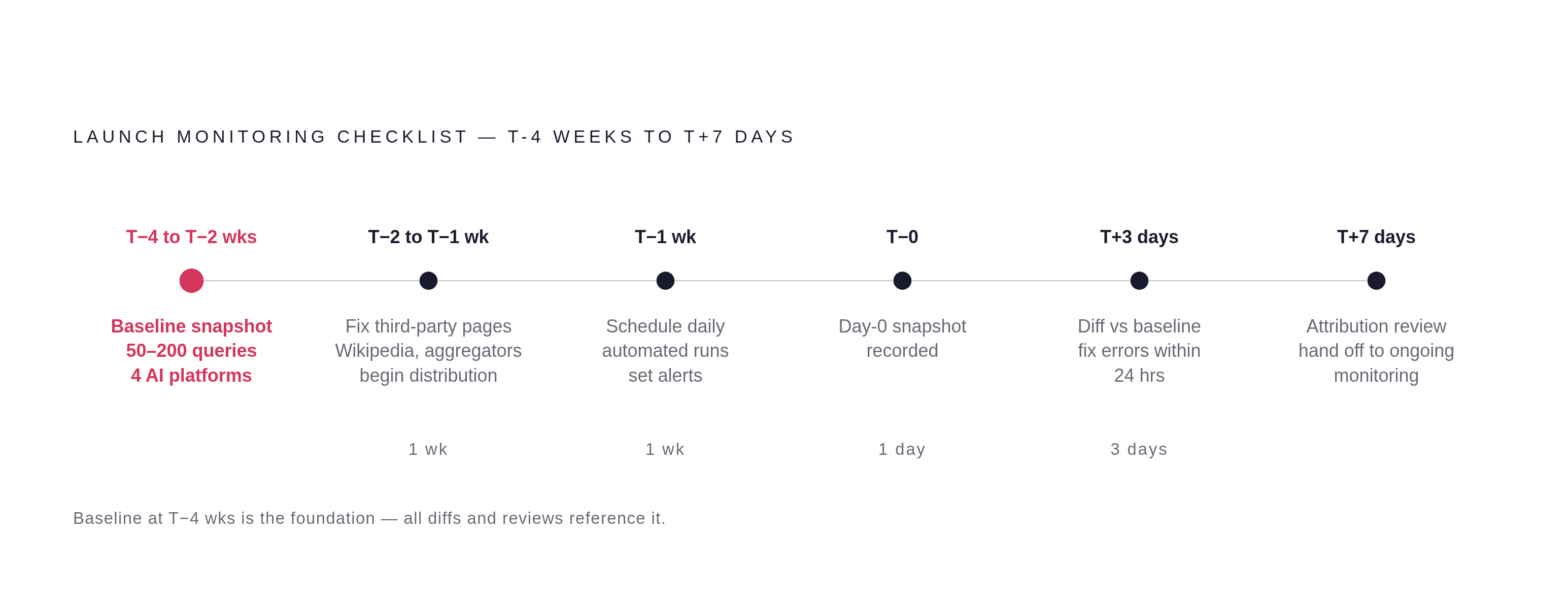
T-minus-4 to T-minus-2 weeks. Establish the baseline with 50–200 buying-intent, category, comparison, pricing, and feature queries. Run them across ChatGPT, Claude, Gemini, and Perplexity. Save full answers and cited sources, and record mention rate per engine, relative position, descriptor accuracy, and high-cost errors. Put the cited third-party sources on the audit list.
T-minus-2 weeks to T-minus-1 week. Fix the source of truth on cited third-party pages and owned pages. Update Schema.org markup and answer-first pricing blocks. Fix the review aggregator listings that were cited, check Wikipedia entity presence, and write or update clear answers on comparison and FAQ pages. Start earned distribution by placing original proprietary research through publisher networks.
T-minus-1 week. Use an API or CLI to set the prompt set to run every day through T-plus-7. Set alerts for when products are missing or answers have misattribution or incorrect pricing. Confirm that results flow into the existing dashboards.
T-0. Run the full prompt set and save the day-0 snapshot. Log mentions, positions, and descriptors for each engine. Keep the full text as the starting point for the launch-day diff.
T-plus-3 days. Compare the full run with the baseline and day 0. Prioritize high-cost errors surfaced by the diff. Fix and rerun within 24 hours when those errors appear.
T-plus-7 days. Compare the full run with the baseline, day 0, and day 3. Attribute movement to specific fixes where the evidence supports it. If nothing moves despite corrections, escalate to an audit of HTML structure, JavaScript rendering, and content ordering. Hand off the prompt set and cadence to ongoing monitoring.