Social collateral as a service: what it signals when content agencies start bundling distribution
Agencies bundling distribution reveal that useful content alone no longer guarantees discovery.

When content agencies bundle social collateral with articles, they reveal a split between making useful content and getting it discovered. For technical marketers, the question is whether the bundle reaches buyers where they seek answers. Social distribution solves a real problem, but it does not automatically solve the more consequential one of appearing in AI-generated answers.
Why content agencies are starting to bundle social distribution
Foundation Marketing offers content creation, distribution, repurposing, social media, and Reddit marketing under one offering. Co-founder Jonathan Chanti framed the aim as building a system that gives every strong piece of content more chances to find its audience.
Content creation has lower gross margins than managed distribution infrastructure, so the two services play different roles in the business. Content can win the engagement, while distribution helps sustain its profitability. The bundle changes the economics of the retainer. Rather than depending only on the labor of producing each new piece, the agency also sells the ongoing work of getting content in front of people.
A client who buys content from one vendor and distribution from another can replace one without having to replace both. A bundled relationship makes departure more disruptive because more of the operation sits with one provider. That dependency can raise the client’s lifetime value for the agency. For the client, one vendor is also responsible for both production and distribution, so there is no handoff between vendors.
What the bundle is actually admitting about how discovery works now
The revealing part of this shift is that an article’s value and its reach are being sold as separate problems. The traditional content agency proposition linked them more closely. Good content would earn search rankings and sharing, which would bring an audience to the work. A distribution bundle is evidence that this chain is no longer reliable enough to leave alone. It weakens the assumption that publishing useful material is sufficient.
The pricing makes that separation hard to dismiss. Boutique agency retainers covering distribution run from roughly $3,000–$5,000/month, while full-service engagements with dedicated teams, influencer coordination, and paid social run substantially higher. Distribution is a substantial cost center. In return, the relationship becomes more operational than transactional. Instead of delivering a defined number of posts per week, the agency takes responsibility for the outcome of the client’s entire social presence.
That broader accountability still leaves a question about scope. An agency can own a social presence without owning every way a buyer discovers the company. For technical B2B brands, this distinction is especially important because technical content has historically competed through organic search, with social distribution playing a secondary role. Adding social work changes the mix of channels but may leave the problems with organic search in place. Whether the added service reaches the audience at the point where discovery is breaking down remains uncertain.
Why social distribution solves a real problem but not the most consequential one for technical audiences
Social distribution gives an article more chances to reach people who would not otherwise encounter it. Repurposing and managing that presence address a real gap between publication and attention. That benefit should not be waved away. But the service is built around reaching people on social platforms, while technical buyers increasingly ask AI answer engines questions about categories and products. A bundle designed for the first setting does not automatically prepare content for the second.
AI Overviews now appear in a substantially larger share of searches than they did in late 2025. AI citation is therefore not just a concern for brands whose buyers deliberately open a separate answer engine. It also affects brands that depend on organic search. The distinction is between appearing among search results and becoming a source inside an answer. A page may be useful and discoverable without being selected for the answer a buyer reads.
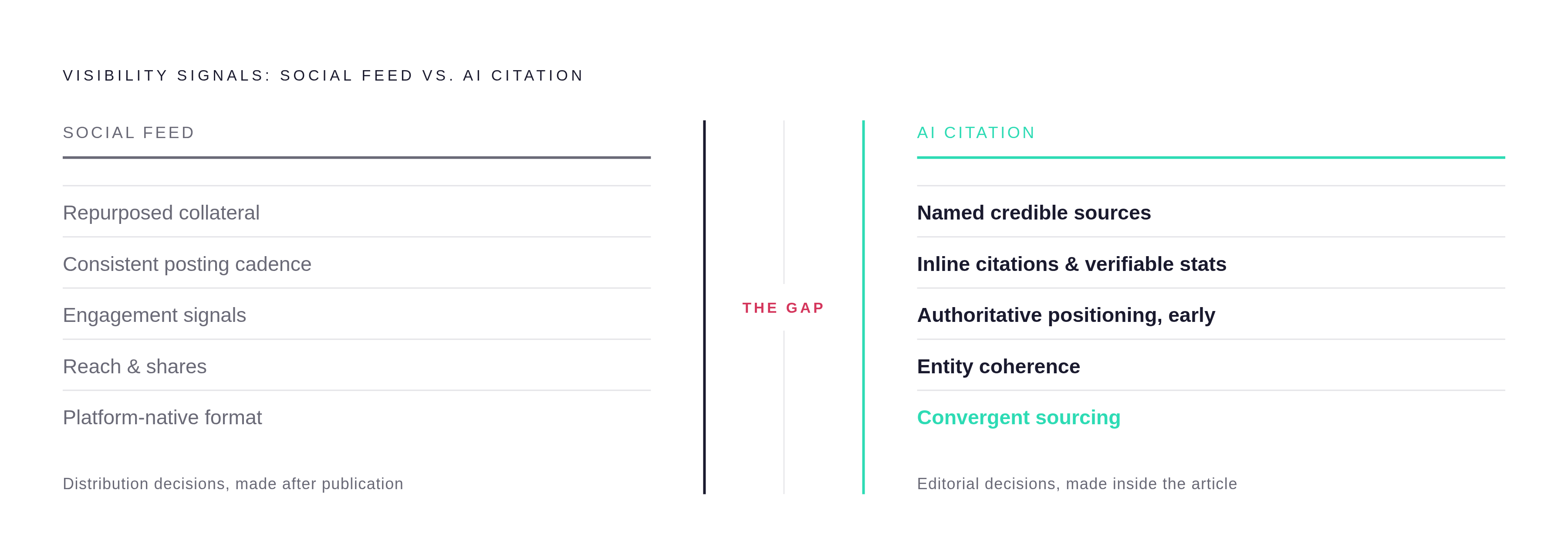
What earns that selection differs from what performs in a feed. Quotations from credible sources, inline citations, verifiable statistics, and authoritative positioning early in a page help make content suitable for extraction and attribution. Social collateral does not necessarily add those features to the underlying article. The gap is at the content level. An agency may successfully distribute a piece while leaving unresolved whether an AI synthesizer can use it as evidence and credit the brand.
Google’s position offers a serious objection to treating this as a separate discipline. Google frames optimization for generative AI search as optimization for the search experience, and therefore still SEO. That gives teams a reason to question claims that all their established practices are out of date. Teams need to work on entity recognition, convergent sourcing, and page-level credibility even when they call that work SEO, because social distribution alone does not target those signals.
How AI answer engines decide what content to surface and cite
AI answer engines do more than retrieve the highest-ranked page and repeat it. They synthesize answers from signals that include structural credibility, entity coherence, and sourcing patterns. These signals provide a working model. Answers are non-deterministic, and platforms behave in different ways. A page must be usable as a source within a synthesized answer.
Entity recognition is foundational to that process. A brand needs a stable, verifiable identity supported across independent sources so that a model can reliably attribute information to it. Convergent signals help establish that identity, while divergent signals can produce hedging that suppresses citations. Consistency here is not simply repeating a marketing claim. The stronger signal is agreement across sources that independently support what the brand is and what it does.
A disproportionate share of LLM citations comes from the first portion of a page’s text, giving information architecture a role that keyword placement alone cannot explain. Important evidence buried later may be less available for citation. Quotations from credible sources, inline citations, and verifiable statistics also support inclusion in AI-generated answers. These are editorial decisions made within the article rather than distribution decisions made after publication.
The retrieval surface also varies by platform. ChatGPT and Perplexity citations overlap only a small fraction of the time, so success on one does not transfer cleanly to the other. Community and specialist sources, including Hacker News and relevant subreddits, have disproportionate weight in retrieval-first systems. This creates an important overlap with social work. A community can be a place to reach people and a source an AI system reads, but treating it only as a destination for collateral misses that second role.
A grounding page addresses credibility more directly. It presents factual, neutral, externally verifiable information rather than trying to instruct an AI system how to describe the company. That gives it a stronger basis for trust than self-authored instruction pages or technical manifest files whose broad visibility effect has not been established. The key distinction is external support. A brand’s own description becomes more useful as evidence when independent sources can confirm and repeat it.
The measurement gap that makes AI visibility a strategy problem, not just a curiosity
Most brands are invisible in AI-generated answers, while only a small minority of marketers measure AI citations. Teams can evaluate a social service without having an equivalent view of whether their brand appears in AI answers. An unmeasured absence is easy to overlook. It also means that claims about best practice often remain untested within the organizations expected to act on them.
Measuring this is hard even when teams make the effort. Different prompts rarely return the same list of brands, and almost never return that list in the same order. A single audit therefore cannot establish a dependable picture of visibility. A favorable answer may be encouraging without being representative. Equally, one missing citation cannot show that a brand is absent across the questions and platforms relevant to its buyers.
Teams need to measure whether a brand appears again and again or just once, while allowing for differences between answer engines. The gap is measurable despite the variability. Drawing a sound conclusion from enough observations remains difficult. Without that discipline, both confidence and alarm can rest on a narrow sample.
This changes the decision about where a distribution budget goes. A brand can pay a sizeable social retainer and still be missing from the AI answers its buyers get. Success on one surface provides evidence about that surface alone. Without citation measurement, the team has no evidence to judge whether its distribution plan reaches buyers through the routes it relies on more and more.
What a content and distribution strategy looks like when it accounts for both surfaces
The lesson for technical marketing teams is to plan for social reach and AI citation as distinct goals within the same content architecture. Articles intended to support citation need credible named sources, inline citations, verifiable statistics, and authoritative positioning early in the page. Those features are compatible with social distribution. They simply cannot be assumed to emerge from an engagement optimized for social performance. The underlying article needs to serve as evidence before its repurposed versions can do the separate work of reaching a feed.
Original datasets with a named methodology make the brand the primary source for information that other pages may discuss. When an answer uses that data, the brand has a clear claim to attribution, though no content format guarantees an individual citation. This is a structural investment. Its value can compound as independent sources refer to the work and reinforce the connection between the evidence and its origin.
Producing such work at a sustained cadence also requires a reliable pipeline. Multi-stage AI pipelines can assign research, drafting, critique, and publication to separate roles, with human review at meaningful checkpoints to protect editorial accuracy. Unreviewed automation removes that safeguard. Review also has a legal dimension. The EU AI Act’s transparency rules, applicable from August 2, 2026, exempt AI-generated text published to inform the public on matters of public interest where it has undergone human review and a person or organization takes editorial responsibility. Within that scope, removing review can create disclosure obligations as well as quality risk.
Measurement must be part of that pipeline from the start. Tracking citation rates across ChatGPT, Claude, Gemini, and Perplexity gives teams a way to evaluate performance on the AI discovery surface. Social results measure whether the social part of the strategy is working.
The right response is therefore not to reject the social bundle, but to define what it does and what remains outside it. For technical B2B brands whose buyers increasingly start with an AI query, a plan centered only on social collateral leaves the primary discovery surface unmeasured and unserved. Does the agency only distribute finished articles, or does the team behind the content also build credible evidence, make it usable for AI citation, and check whether it appears?