A site map is a data structure you can read, diff and ship as pull requests: what to ask for when you buy a site plan
Ask for a versioned, schema-driven file that stays in sync with the live site.
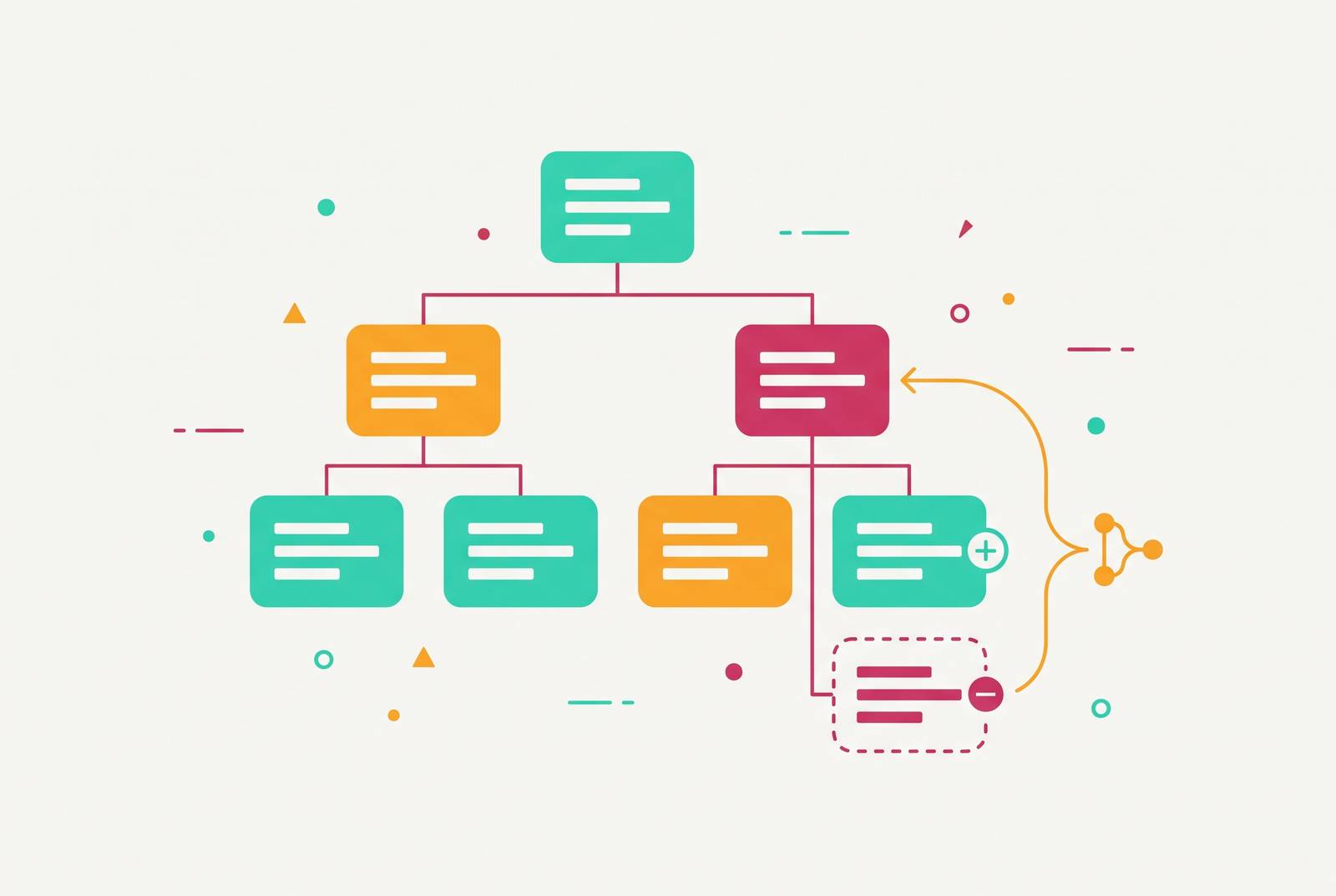
A site plan should be something a team can read, compare and ship through pull requests after sign-off. For buyers, the standard is docs-as-code. The deliverable needs a version history, clear fields for every page, a review process and a way to test whether the resulting site earns visibility. Its usefulness depends on the system around it.
Why a site map delivered as a diagram decays the moment work starts
A Figma diagram or slide-deck node map can look complete at sign-off and fall out of step with the site within weeks. A developer adds a page, renames a route or removes a section, while the approved picture stays unchanged. The gap can grow without anyone noticing. Stakeholders still believe they share a plan, but navigation decisions and content briefs now describe different versions of the site.
A diagram alone has no mechanism that makes each structural change visible and attributable. Comparing two pictures depends on someone spotting the difference without a record of what changed. When AI-citation architecture is planned from that same picture, it too rests on a site that no longer exists.
What the docs-as-code model actually means for a site map
Docs-as-code means using the same controls for changes to documents as for changes to software. Plain-text files live in Git, a system that records versions and who changed them. Proposed edits go through pull requests, where other people review them before they merge into the accepted version. Publishing can then happen automatically. For a buyer, the essential idea is simple enough. Changes to the plan go through review, so someone no longer has to remember to write down what was said in a conversation.
Applied to site planning, the document might be sitemap.md or an equivalent structured text file. A stakeholder’s addition, a page rename or a navigation change produces a diff, which shows the differences between versions. The change has an author and a review history. That is a stronger record than an email thread or a comment attached to a drawing, because the proposed edit and the accepted plan belong to the same process.
Can a reviewer see exactly which routes and page descriptions changed without reconstructing the plan by eye? Version history makes those differences available for inspection. Establishing that the file matches the live site requires a second mechanism, an audit that compares the recorded structure with what has actually been built.
What a versioned site map looks like in a real pull request
PR #149 provides a concrete example of that mechanism. The merged pull request changed the site’s own SITE-MAP.md and replaced a stale hand-written claim in CLAUDE.md. That file had described “14 section cards”, while the audit found 21. Rather than substitute another count that could become stale, the change pointed to SITE-MAP.md as the document of record.
The audit script was wired into a session-start hook to run at the beginning of each working session. Each session therefore began with a current audit. The distinction is important for a buyer evaluating the artifact. The site map was generated from actual site structure, with drift flagged rather than left for someone to discover during a later review.
A buyer should expect evidence of this kind of workflow. A merged pull request shows the model in use, while the audit explains how the record stays connected to the site. Neither requires the marketing team to learn how to build an audit script.
The schema a versioned site map must carry for each page node
A perfectly versioned list of routes is still only a list. To become a useful planning instrument, the file needs a schema, which is a defined set of fields for every page node. At minimum, those fields are route, buyer question, page family, menu position, GEO/AEO intent and build status. Together, they describe where a page lives, why it exists, how visitors find it and whether it has been built.
The buyer-question field is the most revealing test. Each page needs a sentence explaining the question it answers, the evidence it provides and what the visitor does next. If two pages produce nearly identical sentences, the overlap is visible before anyone drafts them. Either the content belongs together or one page needs a more specific audience or purpose. Different titles do not resolve the same underlying job.
A page should answer one primary question, with related follow-up questions handled in subsections. A page trying to answer more than three distinct questions is too broad and should be split or restructured. Page families need similar discipline. Product, use case, industry and resource groupings help only when each dimension lets a visitor answer a different question, rather than encounter the same sales copy under another label.
The schema also needs to express the funnel logic. Every page should have a single primary intent, a single audience and a single next step. Its fields should state the primary conversion goal, the secondary goal, the next logical step in the buyer journey and a fallback path for visitors who are not ready to convert. If these cannot be stated clearly, the plan leaves a structural ambiguity for the developer or content team to work around.
Why the site map must designate which pages serve Google and which serve AI answer engines
GEO and AEO deal with how a brand gets seen in generative and answer engines, including whether those engines use the brand’s content as a source. The buyer does not need to learn all the terms. The practical requirement is that the page-node schema distinguishes Google organic intent from AI-citation intent, rather than leaving the distinction in a separate strategy document.
The two purposes call for different kinds of pages. Commercial category pages, high-intent comparisons and transactional product pages serve Google organic discovery. Definitions, entity relationship pages and brand authority signals help answer engines identify who a brand is and what it is known for. This is not just a choice of wording. It affects which pages belong in the plan and what evidence each needs to provide.
Answer engines draw on training data, live retrieval and the entity graph. Training data changes slowly and cannot be edited retroactively, while live retrieval offers a faster, controllable route to source material. The entity graph depends on machine-readable identity signals, such as a Wikidata entry, Google Knowledge Graph ID or schema markup. A missing Wikidata entry can disadvantage a brand in structured knowledge systems, but it does not make the brand unrecognizable to a language model.
Recognition alone does not make a page citation-ready. A page can be indexed yet have few clear statements that stand on their own and that an engine can extract without contradicting one another. A sentence that depends on surrounding paragraphs is less useful for that purpose than a fact that stands on its own. The schema can therefore identify “phantom” pages, built primarily to supply citable facts. Definitions and original data belong in this category, with the latter giving an engine a source to attribute information that exists nowhere else.
These decisions belong before the build, in the same fields that define audience and next step. Otherwise, a content team has to retrofit citation intent into pages designed for another job. An explicit designation gives the team a clearer test of the draft. Does this page need to help someone choose a product, establish an entity relationship or supply a definition that can be quoted without its surrounding context?
How the site map becomes the brief an AI content pipeline operates against
Once those fields are complete, the site map can supply the brief for an AI content pipeline. What the buyer asks establishes what to answer, the audience sets whom to address, and the intent designation explains the page’s role. The next step connects the answer to the visitor’s journey. A separate brief document is no longer needed to restate those decisions.
That changes where review needs to happen, too. The site map goes straight into the brief-review checkpoint, where review identifies missing or unclear fields before anyone writes a draft. An unclear audience is then a planning defect to resolve before writing begins. The same applies when what the buyer asks and the stated next step do not fit together.
The lesson for buyers is to test whether the schema actually constitutes a brief. A navigation diagram that someone must reinterpret by hand does not meet that standard, even if its page titles are clear. The page node needs enough information to direct the draft without a second document translating its purpose. Versioning then makes changes to that purpose reviewable through the same process as changes to routes and navigation.
How to measure whether the site map is producing AI visibility, not just pages
A completed page is an output. For pages meant for AI citation, tracking needs to cover brand mentions, citations and AI referral traffic as well as position on a results page. Those signals answer a different question from build status. They show whether the planned content is appearing in the discovery channel it was designed to serve.
A practical cadence is to track the most important queries monthly in ChatGPT, Perplexity and Google AI Mode. That provides a signal about which pages are cited and which are passed over for a self-contained alternative from a competitor. The result gives the plan a feedback loop. Without it, a team can see that a page exists but not whether its intended citation role is working.
For buyers, this is also a test of the service being offered. Can the provider show which engines cite the brand today? A provider that claims to offer AEO or GEO but cannot track citations has not shown that it offers a citation architecture service. Ranking reports alone cannot close that gap. Measurement is the final acceptance criterion because it makes the plan’s discovery assumptions testable after publication.
The buyer’s checklist — seven questions to ask before signing a site-planning engagement
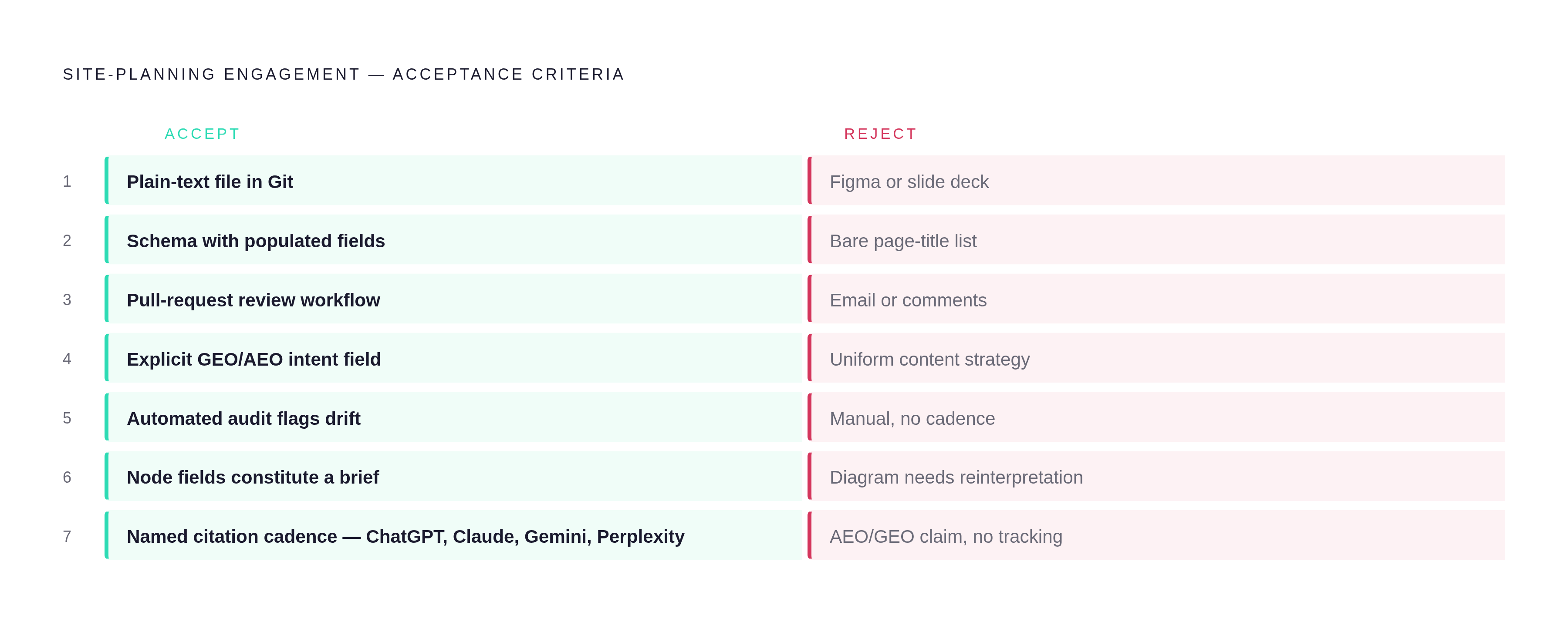
Is the site map delivered as a plain-text file in a Git repository, rather than only as a Figma diagram or slide deck? Accept a versioned file with a commit history. Reject a diagram with no change-tracking mechanism. The deliverable needs a record of its changes.
Does every page node use a schema that spells out its fields? Accept route, buyer question, page family, menu position, GEO/AEO intent and build status, with fields populated or explicitly marked as TBD with an owner. Reject a list of page titles that has no structured metadata. A blank field needs an accountable decision.
Do changes move through pull requests and review before merging? Accept a workflow that makes additions, renames and navigation changes visible as attributable diffs before they enter the accepted plan. Reject a process that handles change requests only through email or comments on a shared document. The review must connect to the actual file.
Does the schema show which pages are for Google organic and which are for AI answer-engine citation? Accept a clear GEO/AEO intent field that marks phantom-citation pages, such as definitions, original data and entity relationship pages, as their own category. Reject one content strategy applied uniformly across every page. Different discovery roles need an explicit designation.
What keeps the site map up to date after sign-off? Accept an audit that runs automatically, reads the structure of the actual site and flags drift, as shown in PR #149. Reject a manual update process without a defined cadence or owner.
Can each page node serve as the input specification for an AI content pipeline? Accept fields that together make up a brief, including audience, buyer question, intent and next step. Reject a navigation diagram that must be reinterpreted into briefs by hand. The production team should not have to reconstruct the plan’s decisions.
How will citation performance be measured across ChatGPT, Claude, Gemini and Perplexity? Accept a named measurement tool or cadence that produces citation data. Reject an AEO or GEO claim without citation-tracking capability. The final test is whether feedback can show which planned pages earn citations and which need another reviewed change.