An AEO grader grades pages, but the test that matters is whether AI answers name you: how a founder should read a grader score next to an unbranded-question answer test, and what to ask a vendor to hand over (the question list, the raw answers, the cited pages) so both are instruments you can rerun
Read a readiness score beside an unbranded answer test to see what's missing.

A page-readiness grader measures whether a page is fit to be used in an AI answer. An unbranded-question answer test measures whether the AI actually selects the brand. For a founder, the useful diagnosis comes from reading both together as distinct measures. With the checks, questions, raw answers, and cited pages in hand, a team can make that diagnosis again.
Why a grader score and an answer test are not measuring the same thing
The confusion starts with numbers that look interchangeable. Products marketed as AEO checkers include brand-level graders that assess how models represent a brand, page-level auditors that assess a URL’s structure, and technical readiness checkers that assess crawler access. These are different tests. A passing score on a landing page does not establish that the brand appears when someone asks an AI engine for recommendations in its category.
That distinction separates eligibility from actual selection. A founder who treats eligibility as visibility may keep working on the landing page and raise its score without ever checking whether the engine names the brand unprompted. Which layer needs work cannot be inferred from a number until the founder knows what produced it.
What a page-readiness grader actually scores, check by check
A page-level grader assesses the structural conditions that make a page eligible for citation. Its weighted categories check whether an AI crawler can reach the page and pull a useful answer cleanly from it. Answer-first structure is one such check. A section that opens with a standalone, quotable answer makes that answer easier to extract than a section that spends several paragraphs warming up, because engines extract passages.
Data extractability concerns how clearly the page presents its substance. Clean heading hierarchies, tables for comparison data, and short declarative sentences make passages easier to parse and reuse. Access comes before any of those advantages. Crawl-access checks examine robots.txt and meta directives for GPTBot, ClaudeBot, PerplexityBot, and Google-Extended, because a bot that cannot fetch the page cannot use its carefully arranged content.
Citation-worthiness asks whether the page offers something worth citing, including original statistics, definitions, examples, and quotable evidence. Structure alone cannot supply that substance. Foglift reports AI Readiness across eight structural dimensions and explicitly labels it “not a citation probability”. A letter grade or a 0-to-100 score therefore needs its category breakdown to be useful. The breakdown shows whether access, extraction, or evidence is weak, but the total hides which one needs work.
What the grader cannot see: the gap between eligibility and selection
A structurally sound page can still be absent from AI answers. The evidence runs through several distinct layers. Policy evidence shows that a crawler is free to access the page, while fetch evidence needs server logs that show it asked for the page. Content evidence shows that the page has structured content that can be indexed. Answer evidence shows that the brand appears in a relevant response, and business evidence shows referred sessions or attributable conversions.
A grader’s scope covers parts of the first three layers. Even there, permission to crawl is not proof of a fetch. Foglift states the boundary directly in its evidence table. “Technical readiness proves the page exposes usable structural signals. It does not prove that an engine selected or recommended it.” An answer test closes part of that gap, but an appearance still does not establish a conversion.
But if fixing every flag raises the grade, does that also make a citation more likely? It removes reasons to reject the page. Selection among eligible pages also depends on entity recognition, topical authority, and the sources an engine trusts for that category. Third-party content makes up much of the broad mix of sources used to build answers, so even a page with flawless structure needs a third-party footprint. The grader is useful precisely when its result is kept within that boundary.
How the unbranded-question answer test works and what it actually measures
An unbranded-question answer test runs category questions across live AI engines and records whether and how the brand appears spontaneously. The prompt must leave the choice open. “What are the best podcast hosting platforms?” asks the engine to choose from its representation of the market. “Tell me about Acme Podcast Hosting” supplies the entity in advance and asks the engine to describe it. The second tests recognition.
The headline measure is the share of answers in a defined prompt panel that include the brand. Brand mentions divided by total AI answers in the tracked set gives that visibility score. But presence alone leaves important questions unresolved. Was the brand recommended first, placed in the middle, or mentioned at the end, and which competitors appeared with it? The full answer also reveals whether the description was accurate.
Cited URLs connect this test back to page readiness. They show whether an answer draws on the brand’s own pages or on sources elsewhere, so they help locate the layer behind an appearance. A difference between web-enabled and native, no-retrieval answers can signal that owned pages are not surfacing during retrieval, but the cited pages are needed to interpret that gap. The result shows how an engine answered under the test’s conditions, which limits what it can say about visibility elsewhere.
Reading the grader score and the answer test together as a diagnostic grid
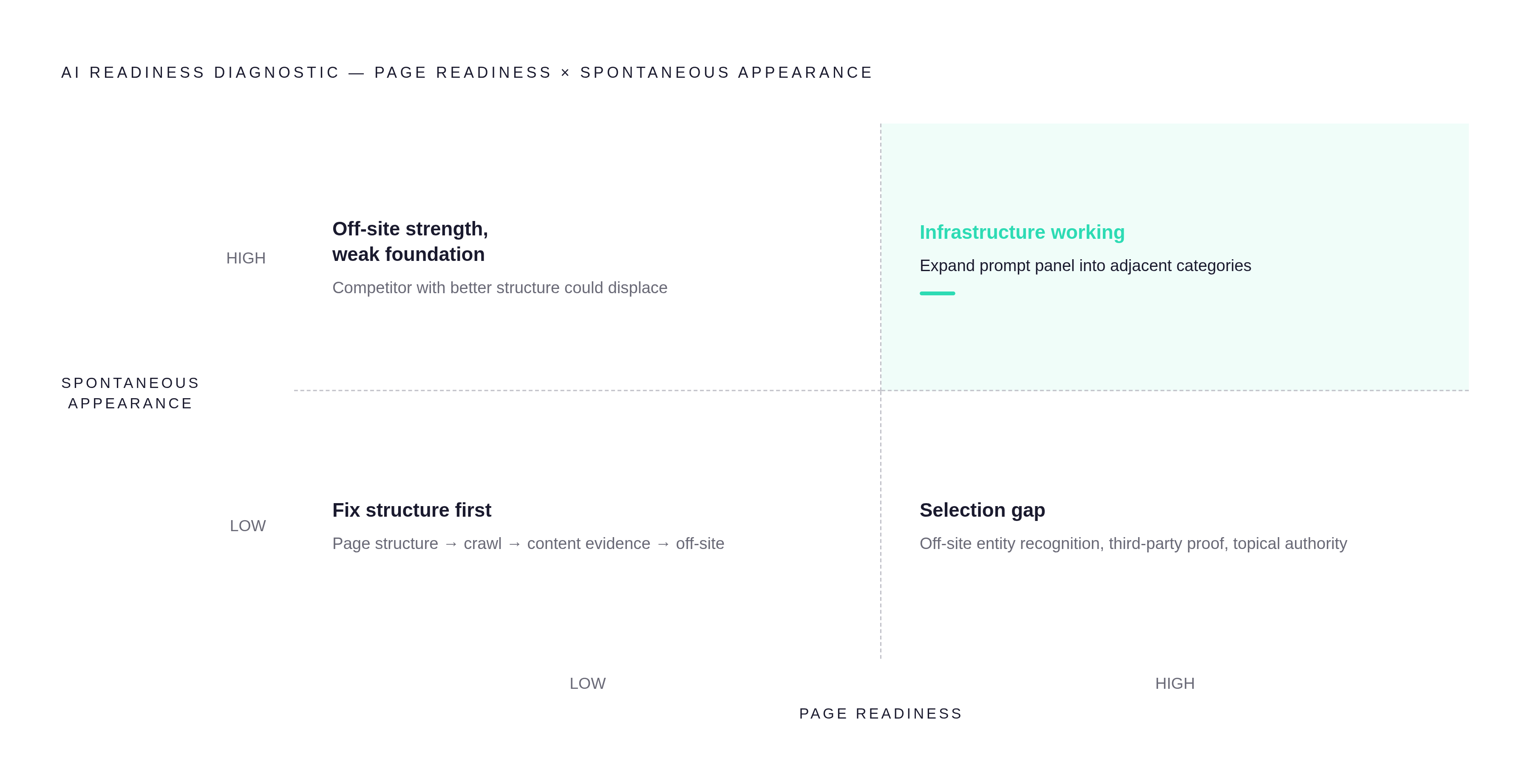
The two results form a simple diagnostic grid, with readiness on one axis and spontaneous appearance on the other. High readiness and high appearance means the page infrastructure is working and the brand is being selected. The page needs upkeep, with no structural repairs to make. Expanding the prompt panel into adjacent categories can then expose gaps beyond the questions where the brand already appears. That expansion should remain distinguishable from the fixed panel used to track change.
High readiness and low appearance indicates a selection gap: the page is ready but the engine is not choosing the brand. The work likely lies in off-site entity recognition, third-party proof, or content topicality, with little to gain from more cosmetic changes to the page. Earned mentions, reviews, and a stronger third-party citation footprint help the brand at that layer. Page-level tools make the first kind of work easier to see and act on, which helps explain why teams can fix readiness while neglecting selection.
Low readiness and high appearance means the brand shows up even though the page has weak foundations. A strong off-site presence can help the brand show up, but weaknesses in the page structure put that result at risk. A competitor with better page structure could displace it. In this quadrant, fixing the page strengthens the owned foundations beneath a brand that engines already select.
When readiness and appearance are both low, both layers need work. Start with page structure because it is faster to fix and unblocks the crawl and content evidence layers before off-site campaigns. This grid directs effort without making either score a substitute for the other. It also explains their different clocks, with grading tied to meaningful page changes and answer testing tied to a fixed monthly panel.
Why most vendor reports collapse the two instruments into one number — and how to tell
A single “AEO score” or “AI visibility score” becomes hard to act on when a report blends page readiness with answer-test results. Which part improved, and why? A chart cannot answer that if the vendor cannot produce the specific prompt, engine, timestamp, full response, and cited pages behind it. The archived run is the evidence object. Without it, the buyer cannot inspect what the chart summarizes.
Two further substitutions deserve attention, namely fetches presented as citations and branded prompts presented as spontaneous visibility. A crawler request proves a fetch. Likewise, a dashboard showing the brand in an answer establishes little about competitive selection if the question supplied its name. For that display to support a repeatable unbranded test, the questions must be available, responses archived in full, and the same prompts available to run again. A screenshot serves as an illustration.
What to demand from any vendor before signing: the question list, the raw answers, the cited pages
Before signing, a founder should ask for the full prompt list. Does it have unbranded category questions, branded recognition questions, or both, and how much of the list is each kind? The distinction must remain visible in the results. The vendor should also say whether it uses the same list for each run. If the panel shifts, a changed score cannot by itself show a trend in the same underlying test.
The next request is the full response from every engine for every prompt, with each run’s timestamp. A summary saying that the brand was mentioned is not enough to audit recommendation position, factual accuracy, or competitor co-mentions. Historical answers must remain retrievable and unedited. Generating a fresh response when someone opens the dashboard does not preserve what the engine said before. Timestamps also place responses in context as models change.
Each answer should come with the specific URLs of the pages it cites. Are they owned pages, third-party review sites, forums, or competitor pages? That mix helps show where to spend next. If the answer cites a third-party page rather than the landing page that was graded, the landing page’s score does not explain that citation. LLM Pulse’s AEO Grader frames citation strength as whether the brand is cited as a primary source or as one of many supporting links, a distinction the buyer cannot inspect without the URLs.
A founder should also ask the vendor to rerun a prompt from its own report during the call. The purpose is to test whether the procedure can be repeated and whether the reported result survives while allowing variation in live responses. The grader needs an equivalent transparency check. Ask for the category breakdown and failed checks behind the total. VectraSEO’s AEO Grader presents failures “critical-first so you fix the highest-impact gaps before the cosmetic ones”, showing how a decomposed score can guide action.
Turning both instruments into a repeatable measurement loop
With those artifacts in hand, the founder can connect page changes to later answer results. The loop begins with a recorded baseline, a grader-identified fix, and another grade after a meaningful edit such as new schema, restructured headings, or refreshed content. The notes’ timing allows a few days for changes to propagate before engines refresh their grounding data. Scheduled checks complement those change-triggered runs. VectraSEO recommends monthly grading for a normal page and weekly grading for a high-value conversion page as a starting point.
The answer test uses the same fixed monthly panel whether or not the site has changed. That independence is important because model updates can alter answers without any edit to the brand’s pages. After a fix has propagated, comparing the same prompts before and after connects the two instruments. If readiness improves but appearance does not, the gain in eligibility points to spending next on off-site work and ending repeated changes to a page that is already ready.
Off-site work means earning mentions in sources engines already cite for the target category, which may include review platforms, industry publications, forums, or directories. The aim is a third-party citation footprint on trusted pages. The cited URLs make that work concrete. They also turn the vendor relationship from waiting for a verdict into examining evidence. A founder who holds the prompt list, raw answers, and cited pages owns a rerunnable instrument. A founder waiting for the next quarterly report does not.