Rules, goals and layers: where marketing automation should stay deterministic and where an agent layer earns its place
Keep rules for repeatable steps and agents for changing data, with approval gating live changes.

Marketing automation and agents belong in the same system, but they should not control the same decisions. For growth engineers and technical marketers, the useful distinction is where predictable execution is essential, where adaptive reasoning earns its place, and who approves the point at which a proposed action changes something live.
Why the rules-versus-goals framing leaves growth engineers with the wrong question
Consider a tracking-tag failure that hides four days of spend until someone spots the problem too late. The spending continued while the information needed to judge it was missing. A fixed workflow can respond to a condition someone anticipated, but it cannot reason beyond the path its designer supplied. What happens when the data no longer describes the situation the rules were built for?
Marketing automation executes predefined if–then rules, while agentic marketing receives an objective and determines an execution path that can change with the data. A conversational interface does not turn fixed logic into an agent, because the underlying system still follows a human-designed workflow. Autonomous planning changes who decides the steps.
Should the same system that investigates missing information also be free to change budgets, publish claims, or alter transactional messages? Those decisions call for different controls, even when they contribute to the same marketing objective. Replacing every rule with reasoning would let the system make choices in steps that work well because they leave no room for choice. The boundary belongs inside the pipeline, based on which steps need reversibility, auditability, or judgment when some information is missing.
The five-point test that separates a real agent from AI-enhanced automation
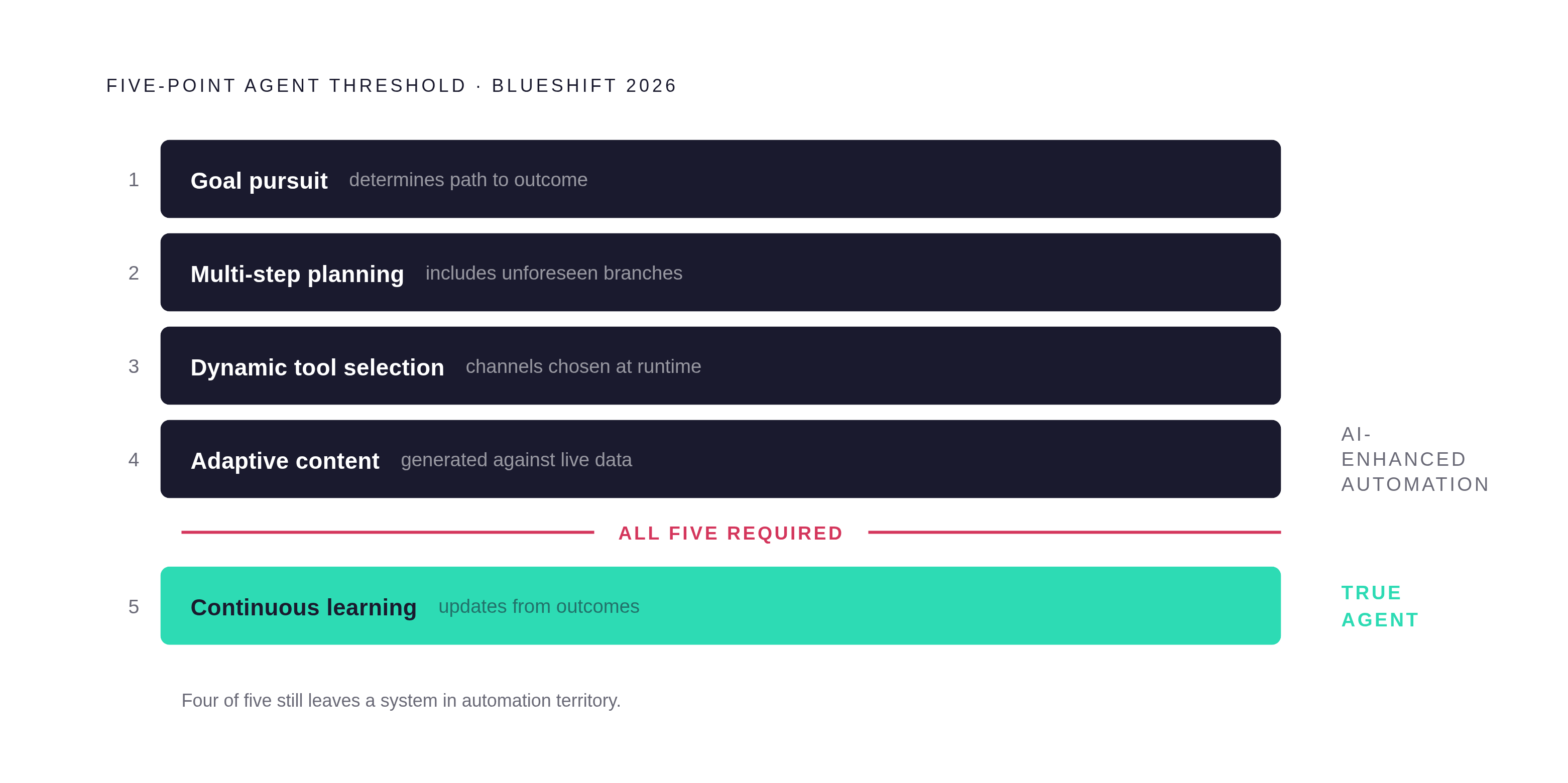
The word “agent” needs a stricter definition before it can guide that boundary. Blueshift’s 2026 framework sets out five requirements, all of which must be present for a system to qualify. Partial capability is not the same thing. A tool that meets only some of them is AI-enhanced automation, even if its interface makes the work feel autonomous.
The first requirement is pursuing a goal. The system determines how to reach the outcome. The second is multi-step planning that the system does on its own, including branches the marketer did not foresee. These requirements separate deciding what to do from completing an assigned task. A system can do a complex task without choosing where it fits in a larger plan.
The third requirement is selecting tools and channels dynamically, rather than remaining locked to the channel specified in a workflow. The fourth is generating and adapting content against live data. The fifth is learning continuously from outcomes. Under that definition, A/B testing runs as part of the ongoing work.
Does the AI recommend the next step, or take it? Send-time optimization remains automation when someone has specified the rule, while writing three headline variants and surfacing them is assistance if a human must put them live. Taking the step is the agentic case, subject to whatever permissions govern it. Once a system meets all five requirements, its design must spell out who controls what it does.
Where rule-based automation should stay deterministic
Some parts of a marketing pipeline should be built to fail that test. Order confirmations, unsubscribe processing, and regulatory disclosures do not become better because a system can invent a different execution path. Their purpose depends on repeatability. Deterministic automation is the correct choice where the same inputs should produce the same result, and where a reviewer must be able to establish exactly what fired and why.
High-volume, low-variance sequences benefit from the same rule firing correctly millions of times. Early-stage programs can also need dependable workflows. In compliance-critical work, the control surface is especially important because permission to act is different from permission to suggest. Health claims, financial advice, and synthetic endorsements cannot be treated as ordinary opportunities for experimentation.
A simple diagnostic is the rule “if ROAS drops below 2x, pause this ad set”. The condition and response can be specified, tested, and repeated. If that repeatability is the purpose of the step, reasoning adds unnecessary variance. An agent could instead reason forward from the signal, but a mistaken interpretation could spread across more actions faster than a misconfigured rule. More discretion creates a broader responsibility for containing error.
What about putting a human approval gate on the agent? That can help, but approval does not make the reasoning process equivalent to a logged rule execution. A compliance reviewer still needs to distinguish what the system proposed, what a human accepted, and which action was permitted to follow. Nor does human approval alone make an action reversible. The answer lies in separating proposal, authorization, and execution, rather than asking one agent to provide every form of control.
How the agent layer sits above existing automation
An agent layer can make adaptive decisions while the automation underneath it continues to execute fixed steps. Humans set goals and guardrails, and check results. The agent determines strategy, tactics, and an execution path within those limits. The rules remain in place. Transactional, compliance-critical, and high-volume work does not need to be rebuilt as autonomous reasoning.
Budget pacing makes this relationship concrete. An agent holding a spending goal spots overspend, drafts a reallocation, and asks for approval before anything moves. Approval sits between the proposed change and its live effect. This is autonomy bounded by a checkpoint, rather than a choice between a fully manual workflow and unrestricted execution.
An agent can coordinate across CRM, analytics, email, ad platforms, and CMS without a human manually synchronizing each system. It can also adapt personalization to an individual’s behavior history, context, and predicted intent. That requires access to changing state. The four-stage loop of goal assignment, autonomous planning, cross-channel execution, and continuous learning operates above the existing automation.
This also changes the human job. Checking whether an agent chose a sound route differs from checking whether a predefined workflow ran as it should. A team needs control over the actions the agent may take independently and those it must surface for approval. The pipeline must also make those boundaries available for the team to enforce.
What to ask for — scriptable steps, outcome measurement, approval on the result
For a team building or buying a pipeline, the first requirement is a clear division between scriptable work and outcome-driven work. A step belongs in the automation layer when its full execution path can be written in advance and the correct output is the same for the same inputs. Do not pay for reasoning where none is needed. Giving that work to an agent introduces variance without improving the decision. Judge the step on its own, regardless of how advanced the platform around it looks.
Reserve the agent layer for an end state whose path depends on incomplete or changing data. That end state might be a trial sign-up rate, a reactivation threshold, or a share-of-voice target. Specify the outcome and the limits together. An agent should work backward from that goal and execute within the authority the team has granted, rather than treating the goal as permission to do anything that might help. A measurable objective is not a substitute for permissions.
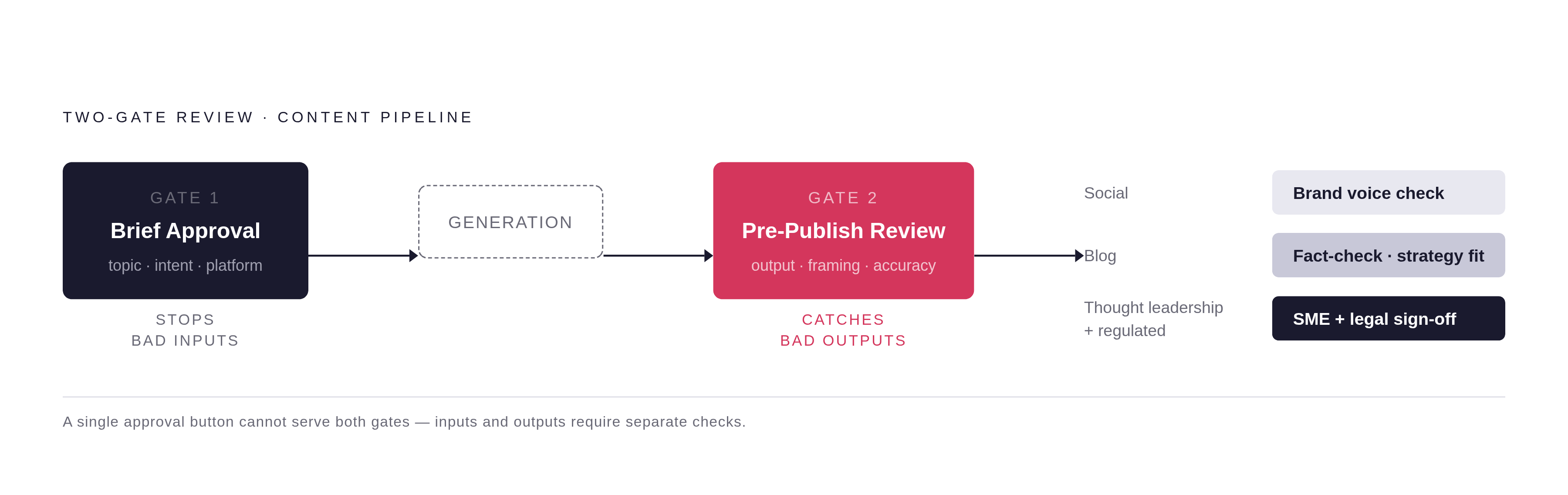
Require approval on the result at side-effect boundaries. The pipeline should let the team choose which actions need human authorization before they fire and which may run unsupervised. Two review gates apply across pipeline types. Brief approval establishes the topic, intent, and platform target before generation begins, while pre-publish review examines the actual output before it goes live. The first prevents work from starting with an unsuitable framing, and the second checks what that framing produced.
Match those reviews to the content’s stakes. Social content needs a check of its brand voice, while blog content needs fact-checking and a review of how well it fits the strategy. Thought leadership and regulated categories need a review by a subject-matter expert as well as legal sign-off. These are different review jobs. A generic approval button does not establish that the right judgment has been applied to the result.
Require tool access as well as approval controls. Every pipeline capability should be reachable by an agent through an API. The Model Context Protocol is an open standard for connecting AI tools to outside data and tools, allowing an agent to work with live systems. Without that access, a conversational interface can conceal a workflow that still depends on manual handoffs. Finally, require each layer’s output to be instrumented, because access and authority alone cannot show whether the pipeline is improving.
Measuring whether the architecture is working — what to instrument at each layer
At the automation layer, the central measure is rule execution fidelity. Did the rule fire when it should, and remain inactive when it should not? A rule can run correctly while the program still misses its marketing goal, so checking the rule itself is needed alongside checking how well the whole program does. Separating those measures helps distinguish a failure to follow instructions from a failure in the instructions chosen.
At the agent layer, measurement starts with achievement of the stated outcome. Activity volume does not establish success. More generated content or more executed actions cannot stand in for the trial sign-up rate, reactivation threshold, or other end state the agent was assigned. Its decisions must be evaluated on whether they advanced that goal within the permitted limits.
Human review gates need their own signals, including approval rate and revision rate at each checkpoint. A high revision rate at pre-publish review is a signal that the upstream brief approval gate is not working. Error propagation also needs measurement, including how far a bad decision traveled before a gate caught it and the resulting blast radius.
For content pipelines concerned with AI-answer-engine visibility, the output also needs to be measured where it is meant to appear. Citation rate per engine per prompt set is the percentage of runs in which the brand is named at all. Share of voice per engine per prompt set measures how often the brand is mentioned compared with the category as a whole. Engines must be measured separately because the sources they cite barely overlap across platforms. Pooling those results obscures the differences the pipeline needs to respond to.
The measurement layer must make these signals queryable through an API. That gives the publishing system a way to read its own citation signal and adjust, closing the loop between action and outcome. Reporting becomes part of the working system. Over time, those signals provide evidence for whether each layer has the right authority and whether its checkpoints are effective. A layered architecture pays off when marketing runs as an engineering discipline, instrumented, measured, and changed on evidence.