Content QA Integration in CI/CD Pipelines for Dev-Tool Teams
Automated content checks in CI/CD pipelines catch accuracy and structure defects before publication.
Dev-tool teams can bring documentation and technical posts into CI/CD instead of publishing them through a separate process with fewer checks. The case for doing so is straightforward. Automated checks for accuracy, structure, and AI-legibility, paired with human approval where judgment is needed, can turn content into assets that can be reliably cited. Citation measurement then shows whether that discipline is producing results.
Why content deserves the same quality gates code already gets
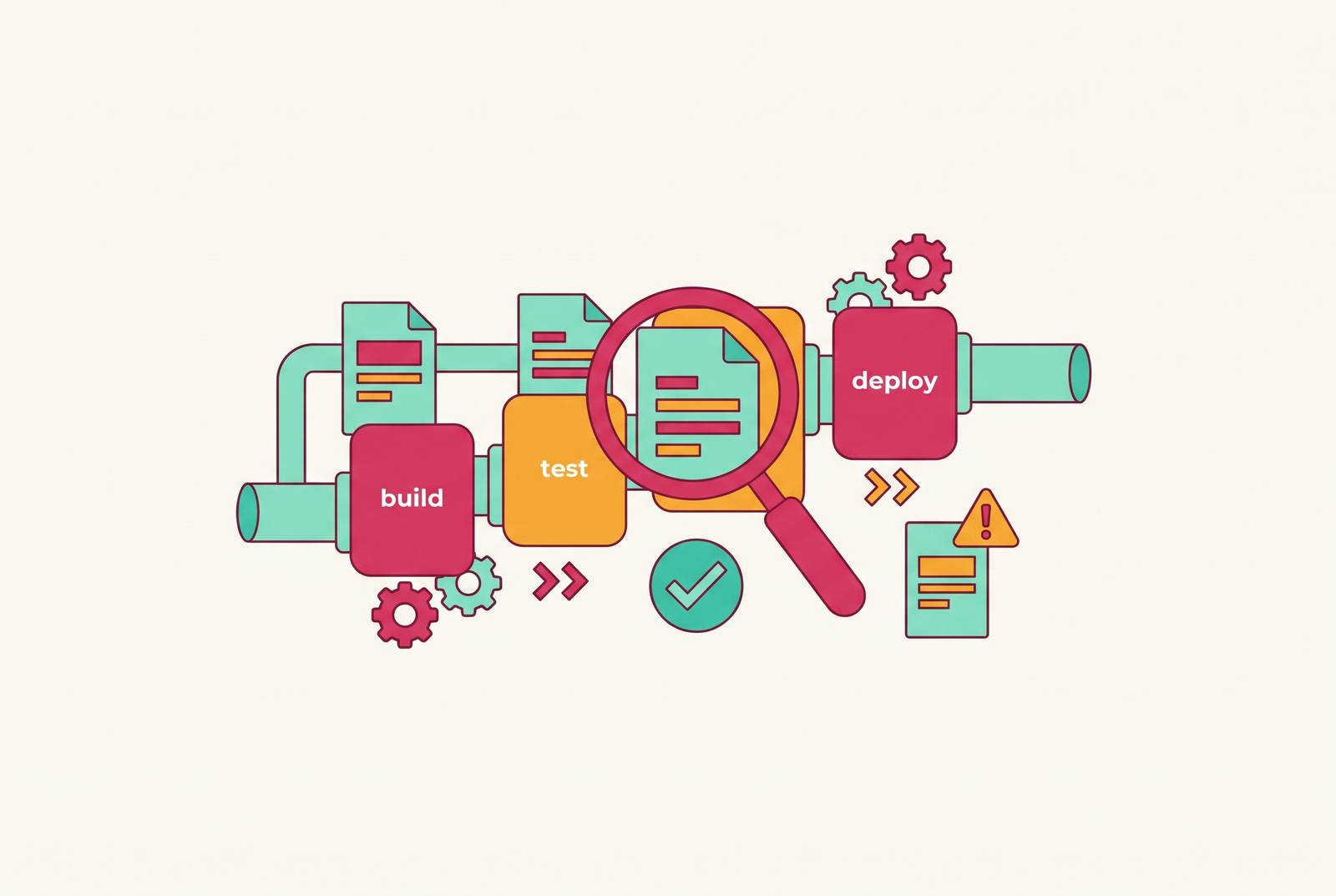
Linting, security scanning, and test automation run through platforms such as GitHub Actions, GitLab CI/CD, Jenkins, and CircleCI, catching defects before deployment. Those checks run automatically on every push as part of the path to production. Content can follow the same pattern, moving from source through build, validation, and deployment rather than taking an unguarded route around the pipeline.
Yet documentation, API references, changelogs, and technical posts often ship without the same kind of gate. This is not simply a difference in editorial taste. A hallucinated code sample reaches an engineer who may try to use it, while an inaccurate capability claim can shape an integration decision. Both are defects in a customer-facing artifact. Treating them as writing problems rather than release risks leaves a gap that the code pipeline cannot close.
Why has that gap been easier to accept? Content has long lacked a clear failure mode that teams can measure, the kind that makes an automated code check feel needed. AI answer engines now add one. A page that cannot be cited by ChatGPT, Claude, Gemini, or Perplexity fails a job it is increasingly expected to do, even if it has been published successfully and reads well enough to its author.
How AI answer engines read content differently than search crawlers did
Traditional search makes ranking in a list of links the visible objective. An AI answer engine has another task, which is to compose an answer and select sources that support it. That changes what useful content looks like. Keyword coverage alone does not supply a passage the engine can lift with confidence. A clear question followed by a direct answer in the first two or three sentences, then supporting detail, makes that passage easier to extract.
Consider the structure of an integration guide. If the opening explains the product category, offers broad background, and delays the actual answer, the useful passage sits beneath a preamble. The reader may tolerate that route. An engine composing a specific answer needs the conclusion and its support to be readily available. Moving the direct answer forward makes the page easier to use as evidence, while adding more keywords just ties it more closely to a topic.
Generative Engine Optimization, or GEO, names the practice of structuring content and building brand authority so that AI platforms select, cite, and surface a brand. Its target is inclusion within the synthesized answer. Inline citations, statistics, quotations from credible sources, and readable prose can each raise a source’s share of that answer, while promotional tone can reduce it. Domain authority still plays a role. A well-ranked page still needs the structure of a well-formed answer source.
Google’s 2026 guide to optimizing for generative AI search explicitly challenges the idea that teams need special GEO tactics. Google advises prioritizing effective SEO and ignoring tactics such as content chunking or unnecessary llms.txt files. That is a real disagreement, especially for AI Overviews. It argues against treating every proposed AI optimization as a requirement, but it does not argue against clear answers, accurate attribution, or descriptive prose. A pipeline that checks for those qualities can follow Google’s guidance without using the disputed tactics.
A direct answer can remain part of an intact page, and an inline citation should support a claim. Those are concrete editorial properties. Their presence or absence can become a lint-rule target, much as a code linter flags an unused import, without pretending that passing the rule guarantees selection by an engine.
What a content QA gate actually checks at commit time
An answer-extractability check asks whether the page answers its own question within the first two or three sentences, before moving into supporting detail. An inline-citation check asks whether factual claims point to named, linkable sources. Neither check proves that the answer is true. Together, however, they expose two specific defects for review, which are a buried conclusion and a claim without an attributable basis.
A tone check flags the point where explanation becomes promotion by looking for superlatives, unsubstantiated claims, and marketing language where the page should be descriptive. This gives reviewers a narrower question than whether the prose feels polished, because they can examine the flagged claim and decide whether it informs the reader or merely praises the product.
The schema check looks for the relevant JSON-LD markup, including Organization with sameAs and knowsAbout, Article with author and publication date, and FAQPage for FAQ sections. The crawler-access check examines robots.txt permissions for the bots named in the indexing policy, including GPTBot, ChatGPT-User, PerplexityBot, ClaudeBot, and Google-Extended. These configuration checks bring the intended machine-facing structure and access policy into content review at commit time.
Review depth should then follow the risk of the page. An internal draft can use a single reviewer and automated structural checks, while customer-facing copy needs a structured checklist review as well. API docs, integration guides, and capability claims need a workflow in which more than one person approves the work, with an audit trail. The distinction is familiar from code review. A small configuration change and a production-facing API may both pass through CI, but they do not necessarily require the same approval threshold.
Automation can identify several pages needing updates, but it cannot determine which deserve attention before a release. Nor can it supply product memory, including why a feature was designed a certain way, what a changelog promised, or which earlier decision a page reverses. Those decisions need people with the relevant context. Full automation should mean that routine checks happen automatically while the workflow retains judgment where it is essential.
How Strapi wired this into a working documentation pipeline
Strapi’s documentation team built this pattern into Inki, an open-source Claude Code plugin in the strapi/documentation repository. The plugin includes a library of skills, 6 review agents, 8 page templates, 9 authoring guides, and a catalog of documented mistakes. One command chains four families of work, namely Research, Write, Review, and Submit. Approval gates separate the stages. The author approves the research before writing begins and the draft before the pull request opens, so the workflow does not treat generated output as permission to advance.
The key design choice is what moves between stages. Inki passes a document with a stable format rather than relying on a conversation or hidden AI state. The same file can be a work order for a human, a rationale for a reviewer, and an input for an agent. That makes a handoff practical. A human editor can take over a stage without losing the context that explains what the work is meant to achieve.
This resembles the role of YAML and version-controlled configuration in code pipelines. Human readers and AI agents work from the same source of truth, so there is no separate explanation to maintain for each. The approval gate is consequently a genuine stop. When an AI output is wrong, the next stage can stop the mistake from carrying over even though the previous stage has finished running.
Other tools approach different parts of the same workflow. Promptless monitors pull requests, Slack threads, and support tickets for documentation triggers, then drafts suggested updates for human review when a change warrants them. GitBook allows its Assistant to draw on documentation, video guides, blog posts, and other connected sources. Inki organizes staged authoring and review, Promptless connects change detection to reviewable updates, and GitBook illustrates how the source material available to an assistant can extend beyond published documentation.
Where phantom-site and third-party surfaces fit into the citation strategy
A brand’s own site, built to documentation standards, can do a lot to earn citations in Claude and in AI answers on technical topics. It does not cover every engine equally well. Reddit accounts for a large share of Perplexity and Google AI Overviews citations but is effectively absent from Claude, while YouTube leads on Gemini, Perplexity, and AI Overviews but barely registers on Claude. The distribution changes the strategy. A brand publishing only on its own domain can be well positioned for one engine while leaving important citation surfaces untouched elsewhere.
The “phantom site” layer describes third-party surfaces that establish brand authority beyond the owned domain. It includes press coverage that names the brand with category terms, review-site profiles used for “best of” queries, and thought-leadership placements such as bylines and expert commentary. These placements serve different reader needs. What connects them is that the brand appears within another domain’s content, rather than asking its own website to provide every signal of relevance and authority.
That wider distribution does not remove the need for QA. A guest post still benefits from a direct answer, accurate inline citations, and an informational tone. The same lint rules apply to content prepared for an external publication, even though an earned placement is not an owned page. This extends the scope of the discipline. The quality standard follows the content rather than stopping at the boundary of the documentation repository.
AI-assisted scale makes the human checkpoint especially important. The model-collapse concern is that undifferentiated AI-generated text feeds a low-quality loop, while model developers aggressively filter that text out. More output is not automatically more useful evidence. Human review therefore has a role in off-site placements as well as documentation, preventing volume from becoming a substitute for accurate, distinctive content. Whether that reviewed content actually earns citations, however, remains a measurement question.
Measuring whether the pipeline is actually producing citations
A content QA pipeline that never measures results is like a test suite that runs but never reports failures. It can show that a process happened without showing whether the process achieved its purpose. Citation monitoring supplies that missing feedback. The difficulty is that only a small fraction of domains appear across multiple engines’ top citation sources simultaneously, so visibility on one engine is not a reliable proxy for visibility on another.
Is the brand named in AI answers, and is it cited with a link? Which engines name it, and for which queries? Did a change to the content change the citation rate? These questions separate recognition from attribution and connect an observed result to the content work being evaluated, rather than treating any mention as proof that the pipeline is effective.
Using a fixed set of queries keeps the scope of that evaluation the same. Tracking mentions across ChatGPT, Claude, Gemini, and Perplexity against those queries is the content equivalent of running a test suite against a defined regression set. The results need to remain engine-specific. A brand cited on Claude but absent from Perplexity needs a different response from one absent across both, and an aggregate visibility figure can conceal that distinction. Measurement gives the team evidence for where to direct content effort.
API-based citation monitoring can also feed results back into the existing CI/CD infrastructure, so teams can get that feedback without checking a separate dashboard by hand. Standing watchers can draft when a relevant change occurs, while the measurement layer shows whether the resulting publication changed AI visibility.