A marketing workflow is only a loop if the weekly decision is written down as code: how a technical founder turns "review, then decide" into an inspectable, agent-callable step instead of a board of finished tasks
Encoding the weekly review as typed code makes marketing decisions repeatable.
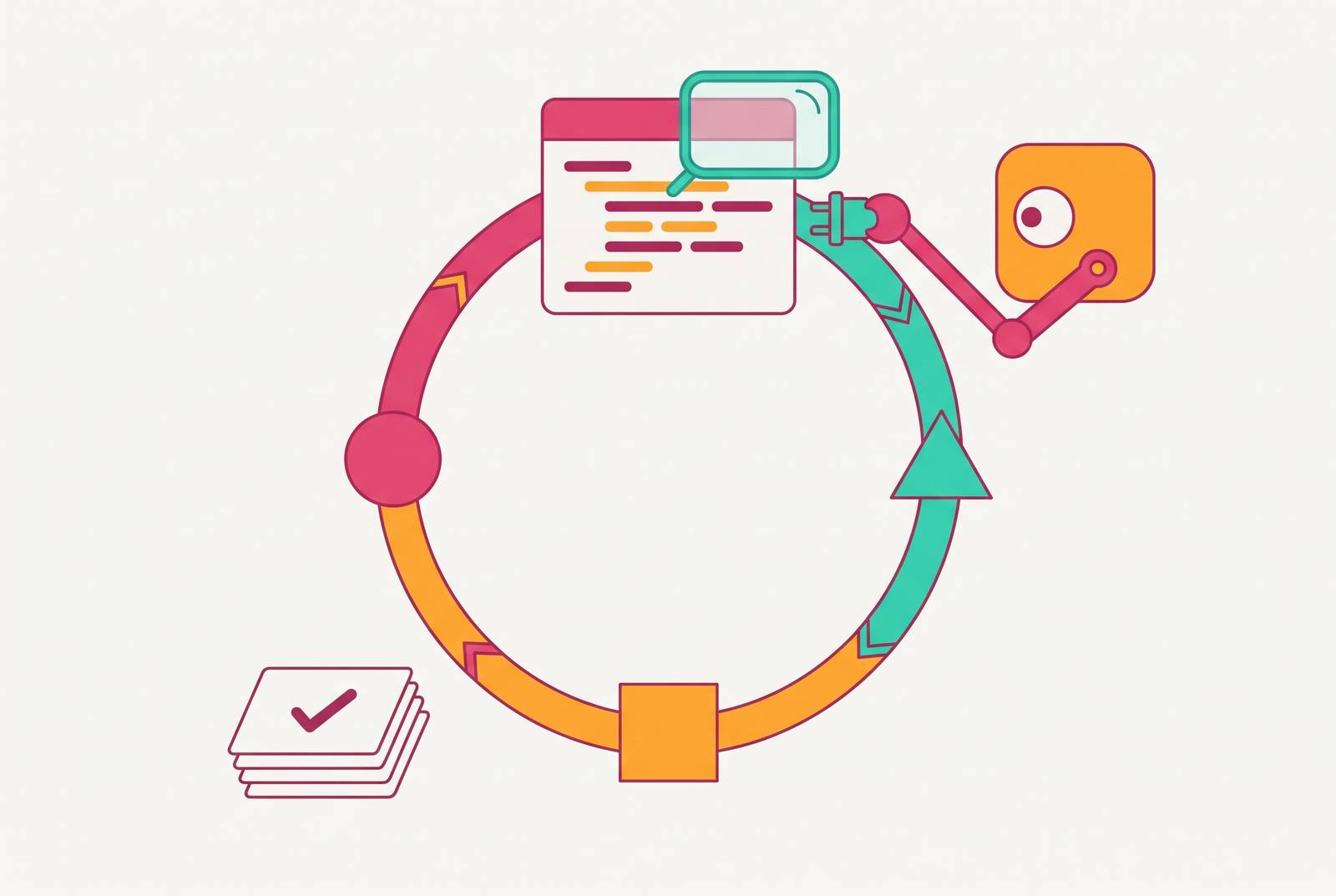
A marketing workflow becomes a loop only when its weekly decision survives the meeting as callable code. For a technical founder, that means turning “review, then decide” into a named state with explicit inputs, typed outputs, and rules a human can override. The aim is not to automate judgment away, but to make it inspectable and reusable when the next week’s signals arrive.
Why a completed task card is not a loop
The weekly review ends with a verbal decision to prioritize one platform and close a content gap. Someone updates the board, the team does the work, and the task card closes. Next Monday, the signal has moved. The team must decide again which platform deserves attention, using an imperfect memory of what drove the last choice. The board records completion, but it does not preserve the reasoning as something the next cycle can run.
A judgment left in someone’s head or a closed Jira ticket has no callable entry point, even if the ticket describes what happened. An agent cannot re-enter the decision, and a diff cannot show how its governing rules changed. A state machine offers an alternative by giving the review-and-decide step a durable place in the workflow, instead of leaving it as a conversation between automated tasks.
What makes a decision re-entrant: the properties code has that judgment calls don't
A typed decision function provides three properties that ephemeral judgment lacks, namely executable, inspectable, and stateful behavior. Executable means the output becomes an operation with formally verifiable outcomes. Inspectable means intermediate computation appears in structured traces a harness can read and store, while changes to the logic appear in a diff. Stateful means the program preserves progress in a modifiable form across cycles, so the next decision inherits the previous output. All three properties belong in the implementation. A Python function that reads weekly citation-rate data, compares it with a threshold, returns a typed ContentDecision, and retains its state can provide them. A sticky note saying “double down on Perplexity content” provides none.
The state machine model: what it means to treat "review, then decide" as a named state
A named state is more than a checklist step. It defines the conditions under which a decision can happen, the data it needs, and the transitions it can authorize. The review-and-decide state becomes eligible when observable preconditions are met: citation data is fresh, platform-specific mention rates have been computed, and the threshold comparison has run. If the inputs are not ready, neither the human nor the agent has a sound basis for entering the decision state.
The core contract can be as small as review_and_decide(DecisionInputs, ThresholdConfig, PriorState) -> ContentDecision. The signature makes the boundary concrete. The structured inputs it takes include platform-specific mention rates, competitor citation share, content freshness scores, and format-performance data. Its output names the target platform, the gap to close, the format, and the confidence level. These fields replace a verbal summary with an artifact that the next part of the system can consume.
If confidence falls below the configured threshold, the system escalates to human review before the transition fires. Above the threshold, an agent can execute the transition autonomously within its permissions. The same state can then accept fresh inputs next week without anyone reconstructing its criteria from memory. For a technical founder, this extends infrastructure-as-code practice one layer up from environment configs, CI/CD pipelines, and feature flags to the rules governing marketing work.
Why the weekly GEO decision is specifically hard to leave un-encoded
AI citation signals make this architecture especially useful because they are non-stationary. A brand visible in one response may disappear in the next, so a snapshot can lose its relevance before the team acts. What, then, should persist from the review? Not a belief that last Monday’s answer remains true, but the criteria that produced it. Encoded criteria can run again against new signals even as those signals change.
Pratyush Kumar’s Generative Engine Optimization at Scale: Measuring Brand Visibility Across AI Search Engines, submitted in 2026 as arXiv:2606.20065, found that visibility differs by platform and brand maturity. Global household names appeared at a first-visibility rate roughly six times higher than niche brands, with established mid-market brands between them. Niche brands appeared in only about 11% of relevant AI answers on their first tracking run. The study also found low platform source overlap, so success on one engine cannot stand in for success on another.
The retrieval systems explain why aggregation loses useful detail. ChatGPT uses Bing’s search index, while Perplexity uses lexical and vector retrieval over its own crawled web index, and Google AI Overviews draws from Google’s own index. They are not one surface. The decision function therefore needs mention rate, citation rate, and AI share of voice for each engine, measured against a fixed baseline so it can tell week-over-week change apart from prompt-to-prompt noise. A Monday review can examine those numbers, but only a versioned decision artifact preserves the criteria for the next run.
What the decision function should actually encode: inputs, thresholds, and the format signal
The input struct starts with platform-specific mention and citation rates for ChatGPT, Perplexity, Gemini, and Claude. Each is measured against a fixed baseline set before the first cycle runs. The baseline gives change a reference point. Content freshness scores and competitor citation share belong in the same declared input contract from the start, instead of coming in as extra context halfway through a meeting. The decision rule gives a gap a competitor already holds higher priority than one neither brand holds.
Format performance adds another observable input to that rule. The study identified ranked “best-of” listicles as the most-cited format, accounting for roughly a fifth of citations across the prompt responses analyzed. That is a testable preference. The function can compare the signal with the current content mix when choosing a format for a particular gap.
Source distribution also belongs in the contract. The study found that roughly three-quarters of AI citations go to corporate websites, with YouTube leading non-corporate sources ahead of Reddit, editorial media, and Wikipedia. Off-site placement coverage should therefore be a named field. Thresholds turn these observations into operative rules, with a Perplexity mention rate below X triggering one transition and a rate above X but a citation rate below Y triggering another. X and Y are configuration values to be set, and no research findings here supply them. Versioning them in the repo lets a human change the decision boundary before the next cycle runs.
Where the human stays in the loop and what the override looks like in code
This sounds like removing humans from marketing decisions. In fact, the architecture gives human judgment a specific intervention point at the threshold configuration and the typed output before a transition fires. The human override is a first-class, versioned operation. Changing a threshold, rejecting an output, or pinning a transition to manual-only becomes a commit in the same history as the decisions it governs. A reviewer can inspect the change rather than search for a verbal exception to the rules.
That placement also changes the unit of review. Instead of supervising every intermediate agent action, the human asks whether the output meets the spec and whether the transition should proceed. Escalation is enforced in code through a rule such as confidence < T, which halts the transition and sends the decision for review. A standing instruction in a team wiki cannot enforce that boundary. The threshold itself remains open to human revision, so the mechanism preserves judgment without requiring someone to repeat it at every sub-step.
Permissions need equally explicit enforcement in the orchestration layer. Policy-as-code sets action limits, data-access rules, token scopes, and environment restrictions, including preventing a sandboxed agent from posting to a production channel or exporting data outside approved regions. Without that gate, unreviewed AI output can become “shadow content” in production. The two-pass pipeline offers a useful parallel. A human approves the outline before draft generation, concentrating review on the angle and thesis.
Building the loop in practice: the four-layer stack a technical founder already knows how to wire
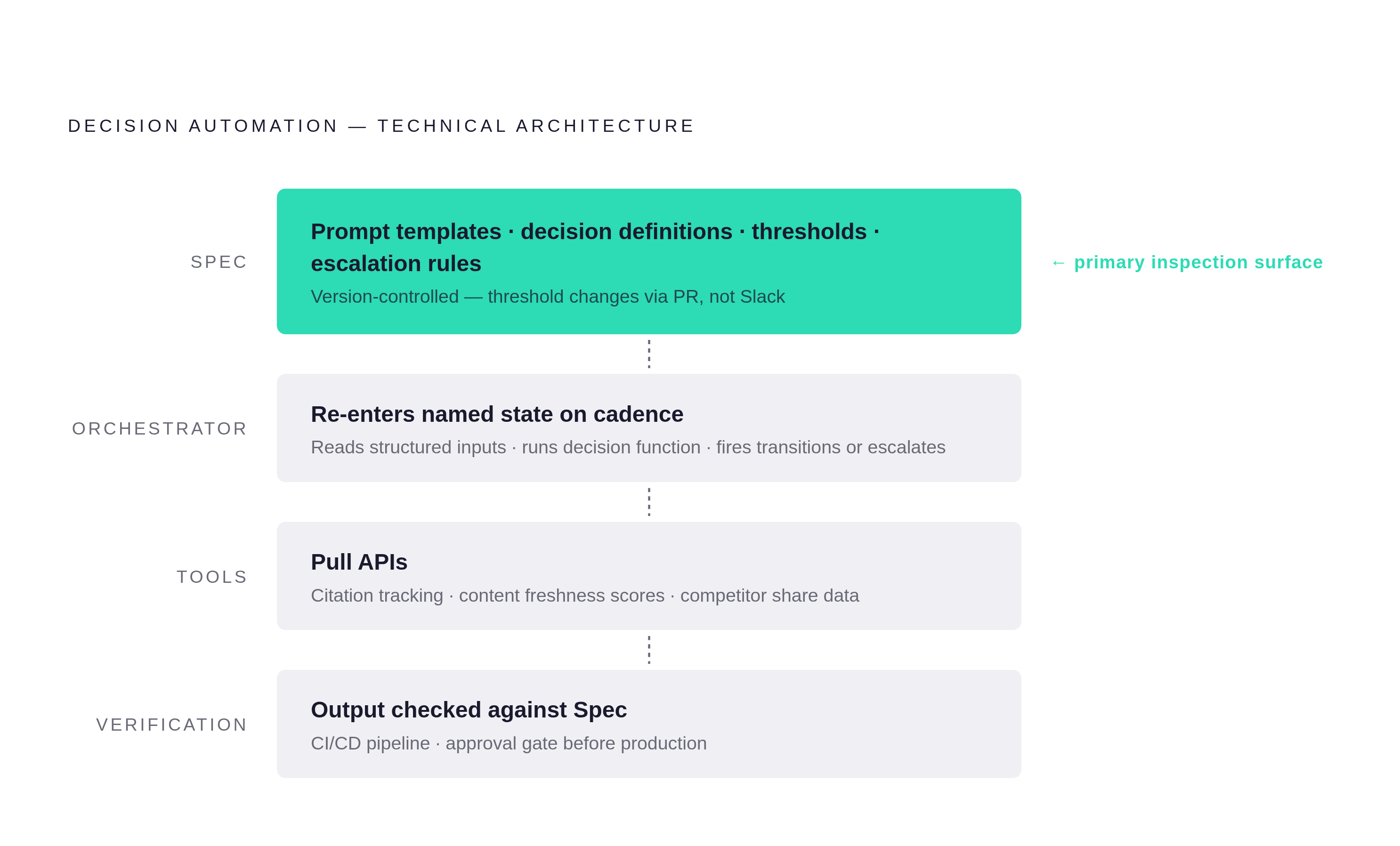
For a technical founder building this system, the stack has four layers, namely spec, orchestrator, tools, and verification. The decision function belongs in the spec layer, where parameterized prompt templates and other decision definitions are kept in version control. This is the primary inspection surface. Threshold changes and escalation rules go through PRs instead of Slack messages, so they get the same review as code changes.
The orchestrator re-enters the named state on cadence, reads the structured inputs, and runs the decision function. It then fires the permitted transition or surfaces the output for human review under the escalation rules. Its authority comes from the spec. The tools layer gets the measurements through pull APIs, which provide per-engine citation tracking, content freshness scores, and competitor share data. A dashboard someone must interpret and transcribe leaves a manual dependency where the state expects a structured input.
Verification checks that the output artifact meets the spec before it goes into production. Content can then pass through CI/CD with an approval gate, making it reproducible, auditable, and deployable under the declared rules. Review remains part of the pipeline. The speed advantage over a twelve-tab tool-switching process comes from removing the reconstruction cost at the start of each cycle.
Every capability in this stack should be reachable through an API, including the decision function. Otherwise, the agent cannot complete the loop. If a person must click a button in a UI to initiate the judgment, the workflow still lacks an agent-callable decision boundary. That separates an interface for human inspection from a required manual trigger. The architecture is complete only when the same declared contract lets an agent run the decision and a human step in.
What the loop looks like after two quarters of compounding
After two quarters, the encoded model has a history of typed decisions, a record of which thresholds produced which outcomes, and a diff log showing when and why the strategy changed. Those records feed into later decisions, while the ephemeral model loses judgment each time someone leaves, switches context, or misses a Monday meeting. This does not promise a steadily rising citation share, because models rebalance for diversity and freshness rather than simply reinforcing a fixed citation history. The accumulated advantage is a reusable decision process that supports publishing cadence and citation history despite that volatility, especially for niche brands starting with less visibility. Both models still require a weekly hour of attention. The asymmetry is whether that hour produces a versioned artifact the next cycle can build on or a closed task card it cannot call.