A one-page marketing strategy is only a strategy if it can be revised on evidence: how early B2B teams turn three objectives into instrumented bets
Write each objective as a bet with an owner, signal, and kill trigger.

A one-page marketing strategy works only if evidence can change it. For early B2B teams, that means writing three objectives as bets, each with an owner, a hypothesis, a signal, and a revision trigger. Founder-led selling, channel experiments, and AI visibility then become questions the team can test.
Why a one-page strategy without revision triggers is just a wish list
The team completes its one-page strategy, agrees on the objectives, and gets back to work. Weeks later, the page has not changed. Sales calls have raised doubts about the target buyer, and a channel has shown weaker signals than expected, but the team has kept the plan unchanged. The document looks firm because it says what the priorities are. It never says what would make those priorities wrong.
That omission is costly for an early B2B team. With small samples, ideal customer profiles, or ICPs, that change fast, and little data, the first plan is especially likely to need changes. Yet an objective without a failure condition can survive any result, because more activity always looks like a possible answer. What would persuade the team to stop?
What makes an objective a falsifiable bet rather than a goal
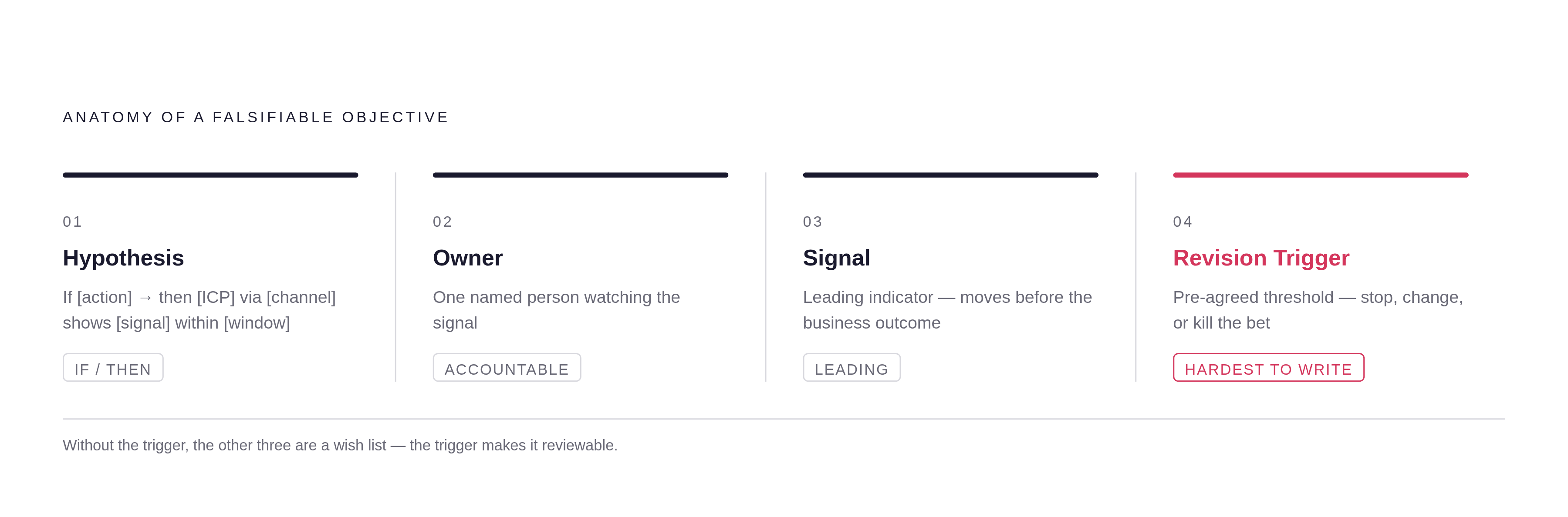
“Grow pipeline” gives the team a direction, but it does not identify a claim that evidence could overturn. A falsifiable bet does both. Its hypothesis takes a plain if/then form, specifying an action, an ICP, a channel, an expected signal, and a time window. The team can then distinguish a promising approach from one that needs to change, without abandoning the broader goal of growth.
The owner is one named person whose accountability is limited to watching the signal, leaving responsibility for the outcome separate. That distinction keeps the role focused on evidence. The signal is a leading indicator expected to move before the business outcome does. The revision trigger is the threshold, agreed before results arrive, at which the team stops, changes, or kills the bet. Together, these parts make an objective reviewable.
The trigger is usually the hardest part to write. It requires agreement on what “not working” looks like while enthusiasm is still high. Without that agreement, every review can reopen the question of whether disappointing evidence is conclusive yet. Three objectives provide enough room for demand, pipeline, and a newer surface such as AI visibility, while keeping each bet small enough to have a real owner and signal.
Objective one: founder-led selling as a learning instrument, not a revenue line
Founder-led sales is the dominant go-to-market motion before scale and remains significant into growth. That gives it a place on many early teams’ one-pagers. But treating it only as a revenue source misses half its output. The founder needs to produce customers and a documented process that another person can run.
If the founder uses message variant Y in discovery calls with ICP segment X, the qualified-call rate should reach threshold Z within N weeks. The named owner watches qualified-call rate and stage-conversion rate by message variant, logged weekly in the CRM. Individual calls can suggest questions, but repeated patterns across a cohort are the signal. One encouraging conversation is not a repeatable sales process.
The CRM becomes a learning ledger alongside its role as a pipeline dashboard. Loss reasons by segment, message variants tested, and stage conversion by ICP cut give the review something more useful than a count of open deals. If qualified-call rate stays below the agreed threshold after two full cohorts, the trigger calls for changing either the ICP definition or the message while keeping the channel unchanged.
There is also a trigger for revising the whole objective. Most founders should keep selling personally until they have closed enough customers to document a repeatable process. At that point, the objective shifts from “learn the message” to “transfer the process.” This is a different decision from revising one message variant. Without a handoff criterion, the founder can remain the only person who can close, even as the team keeps calling that dependence progress.
Objective two: channel experiment written as a time-boxed, budget-capped hypothesis
At the zero-to-first-10-customers stage, a channel experiment is a search for signal. Which message lands, which ICP converts, and which channel provides the fastest feedback? Those questions change the budget discussion. The team needs to determine how much it can afford to invest to validate a channel. The cap bounds the cost of learning.
For outbound, the hypothesis specifies ICP segment X, message Y, a defined weekly volume, and N weeks. It also names a reply-rate threshold and a cost-per-qualified-meeting threshold. The owner watches those readings and pipeline created, rather than treating impressions or followers as proof of progress. The time box and budget cap give the experiment boundaries. Without them, the team can keep spending on a weak test with no end in sight.
The team agrees on what to change and in what order before it starts spending. If reply rate and cost per qualified meeting miss their thresholds after the capped investment, the team changes the message before changing the channel. If two message variants fail, it changes the ICP definition before changing the channel. But are early samples reliable enough for that decision? The hypothesis needs a minimum cohort size so that two calls do not become a verdict.
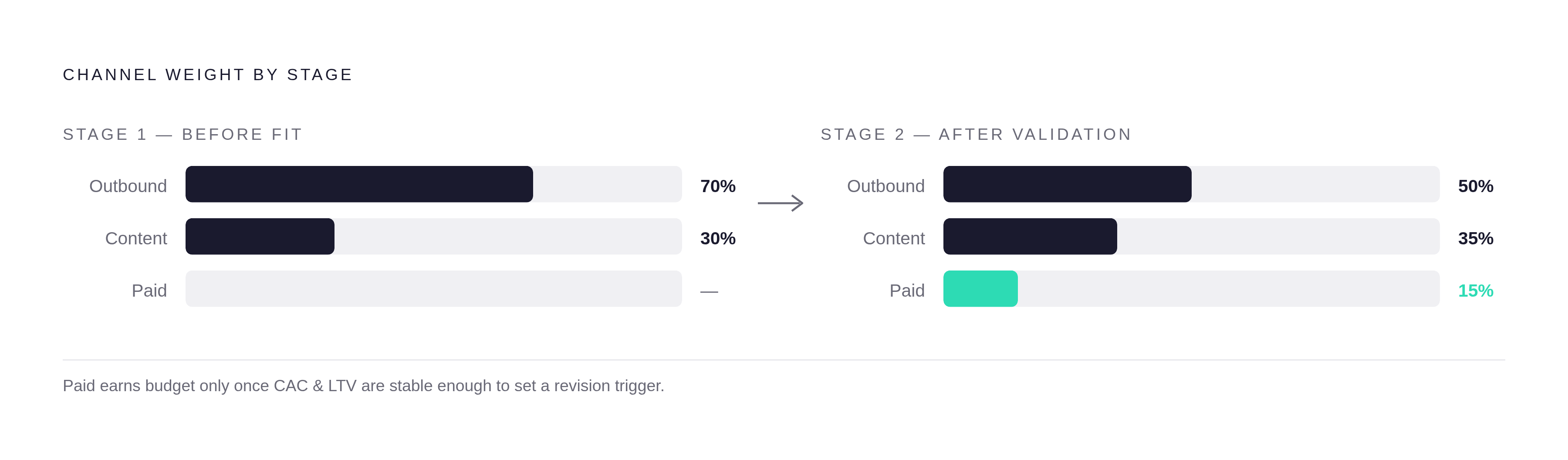
Channel mix should follow the resulting evidence. Before product-market fit, outbound receives most of the weight because it helps test the message, with founder content as the secondary bet. As outbound validates the message and content generates inbound signals, the balance can shift. Paid becomes a more useful bet for scaling once customer acquisition cost and lifetime value are steady enough for the team to set a revision trigger it can use.
This also requires separating momentum from business results. Organic visits, newsletter growth, and CTA clicks can show how things move from week to week. Opportunities influenced, meeting-to-opportunity conversion, sales-cycle length, win rate, and expansion show whether that movement becomes growth. A rise in the first group does not settle the second question.
Objective three: AI visibility written as a measurable, revisable bet on brand presence in answer engines
AI answer engines, including ChatGPT, Perplexity, Gemini, Google AI Overviews, and Claude, sit between buyers and traditional search results. A brand can rank first in Google yet miss intent traffic if AI-generated answers do not cite it. Traditional search performance cannot settle this question. “Appear in AI results” therefore needs its own hypothesis.
If the team publishes topically authoritative, quotable content and builds review profiles and structured citations, the brand should appear in answers to its top 20 commercial buyer prompts within N weeks. The named owner tracks three distinct readings. Mention Rate shows how often answers name the brand, while Citation Rate shows how often they link to the domain. Share of Model compares the brand’s appearances with those of named competitors across the same prompts.
The team runs the top 20 commercial prompts in ChatGPT, Perplexity, Gemini, and Google AI Overviews monthly and logs appearances. Rankings and click-through rate cannot substitute for this record. The overlap between ChatGPT citations and Google’s top results is small, so content built for traditional search does not automatically win AI citations. That is why this objective needs a separate signal.
The revision trigger concerns the content’s usefulness for extraction as well as its volume. If Mention Rate and Citation Rate do not improve after the first measurement cycle, the team audits quotability before adding content. Standalone sentences give an answer engine short passages it can extract without relying on a full paragraph for context. If off-domain signals are absent, the next change is to build them before publishing more on-site material.
This monthly measurement cycle also limits the weekly review. A week without a new prompt run does not establish that visibility has stalled. The latest reading remains the latest reading. Weekly decisions can follow the agreed work and revision conditions without pretending that every signal refreshes weekly. A measurable strategy needs an honest clock as well as a metric.
How the multi-stage content pipeline connects all three bets to a weekly review cadence
The three bets need a pipeline that can produce, publish, and measure content at the pace of the strategy review. Otherwise, the meeting keeps revisiting old evidence. A multi-stage pipeline uses AI to draft and people to review, so that new material can help with message tests, channel experiments, and AI visibility work. Its value is not simply faster output. It gives the strategy a way to act on what the previous review learned.
Human review remains a condition of publication. Google’s guidance says it is critical for people to fact-check and review AI-generated content before publishing it. Unreviewed output can become “shadow content” that undermines SEO and AI citation credibility. Faster drafting makes the review stage more important to the quality of what reaches buyers and answer engines.
Review tiers can reduce bottlenecks without turning automated checks into editorial approval. Content with critical failures, including factual errors and policy violations, should go to auto-reject. Clean content can auto-pass the automated checks, while borderline cases go into a queue for human review with the risky parts highlighted.
The pipeline also needs revision triggers of its own. A first-pass yield below 70% points to problems with the prompt or model earlier in the pipeline. A human review rate that climbs too high signals that guardrails need recalibration because too much content is landing in the borderline queue. These readings help distinguish a strategy problem from a production problem. Weak output should not automatically be treated as evidence that the market hypothesis is wrong.
The measurement stage should automatically bring together the qualified-call rate, cost per qualified meeting, and AI mention and citation readings before the meeting. The AI readings still follow their monthly protocol. Meeting time can then go toward interpreting the signals.
Running the weekly review as a decision, not a status update
On Monday morning, each owner brings the latest signal reading against the agreed revision trigger. The evidence is already available. For each objective, the team decides whether to continue, change one variable, or kill the bet and replace it. A review of founder-sales might lead to a change in the message, while a channel test keeps running until it reaches its minimum cohort. The AI visibility bet may still be waiting for its next measurement cycle.
The team cannot quietly move a deadline in the meeting without also changing the hypothesis. Deferring the trigger would remove the constraint it was meant to impose. Nor can the team change two variables at once, because changing both message and channel makes the resulting signal harder to attribute. A fourth objective does not enter the page during the review. The constraint of three protects the attention each bet needs.
Early teams may feel they move too quickly for a weekly ritual. But the cadence is a minimum evidence cycle that allows faster action. Without it, a bet that stopped making sense in week three can consume a quarter before the drift becomes visible. The review stays short because its job is to decide. A one-pager earns its brevity when those decisions revise it, rather than leaving it short because the hard parts were omitted.