What a podcast booking agency's ranked shortlist should hand you: the show-level data a technical founder should own before a single pitch goes out
Six show-level fields and two logs that make agency outreach auditable.

A podcast booking agency’s ranked shortlist should give a technical founder the data they need to judge each show before a single pitch goes out. That means audience composition, guest policy, and a scored case for fit, alongside names and download estimates. The shortlist, pitch log, and reply log should form an asset the founder can inspect, use, and export.
Why a ranked shortlist without show-level data is not a deliverable
Founders expect a ranked shortlist to show where their buyers listen. What agencies commonly hand over instead is a list of shows, followed by a count of bookings. Placement volume is not evidence of audience fit. For a technical founder, that gap can mean reaching people who might take the next step or ending up with just another recording.
A niche show with a small, loyal audience of practitioners who follow recommendations can outperform a mass-appeal show many times its size. But how can a founder judge that trade-off without audience data? A rank alone cannot explain the choice. The sections below define the fields that must be populated before outreach and the records needed as replies and appearances follow. The ownership test applies throughout, because every field the agency won’t export is a field you don’t own.
What makes show selection genuinely hard: the pool narrows fast once quality filters apply
The apparent abundance of podcasts hides a much smaller addressable pool. Applying ideal customer profile, or ICP, fit, recent publishing activity, and evidence of outside guests together leaves only a small fraction of the starting universe. Reach narrows the pool further. Among hundreds of thousands of actively publishing podcasts, only a small share meet the audience thresholds useful for B2B targeting.
Even then, a technology label does not identify a buying committee. Technology audiences tend to skew younger and predominantly male, but those broad demographic patterns cannot establish whether a particular show reaches the right job functions or seniority levels. Categories are too coarse for that decision. Business and entrepreneurship labels have the same limitation, because they describe a subject.
A meaningful share of feeds that appear active have published nothing for over a year, and past guest evidence does not protect against that problem. A stale database can send outreach toward shows that will never record, wasting effort and risking the founder’s credibility with hosts in adjacent shows. Recency therefore needs its own evidence. Because the viable pool is small and stale data can misdirect outreach, targeting happens when the shortlist is built, before pitching begins.
The six fields that belong in every row of the shortlist itself
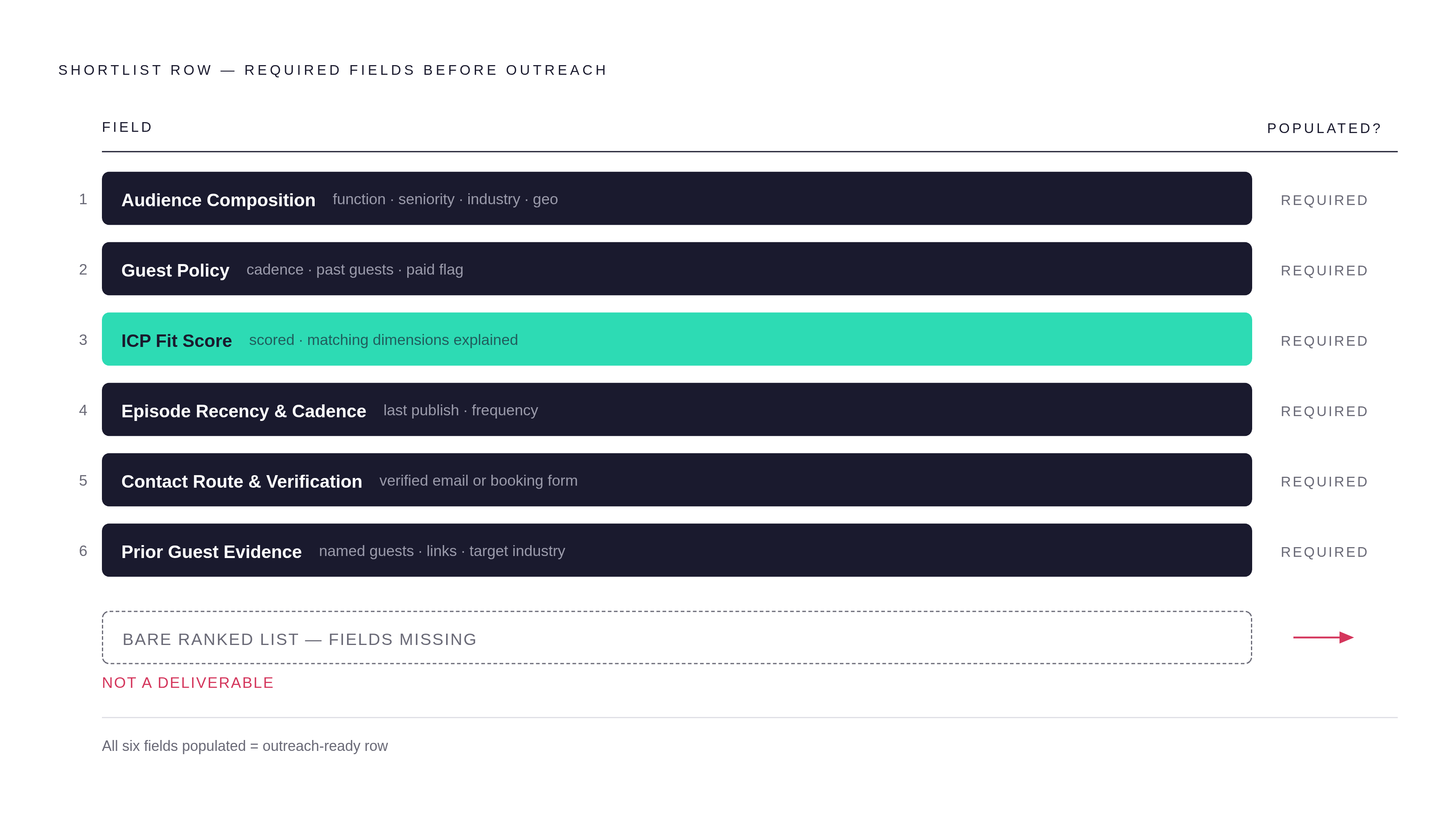
Audience composition is the first field, with job function, seniority, industry, and geographic concentration where available. Downloads cannot stand in for those dimensions. Rephonic aggregates estimated listener counts, audience demographics, contact details, past guests, and rankings across millions of podcasts. Podchaser Pro has more than twenty first-party audience demographic dimensions for each show. These tools establish what a show-level data layer can contain, while the founder needs the relevant details in a spreadsheet or CRM export.
Guest policy is the second field, which shows whether a show often books outside guests and what supports that view. A list of past guests and the booking cadence help show whether interviews are a regular part of the show or it rarely takes someone new. Paid or sponsored placements also belong here. Whether an appearance requires payment is a condition of the opportunity to establish before approving it.
The ICP fit score is the third field, and it needs an explanation of which audience dimensions match and which do not. A category tag is not a score. Without the scoring method, the founder cannot check why one show ranks above another. Episode recency and cadence are the fourth field, with the last publish date and how often the show publishes kept separate from the total episode count. A show with four hundred episodes that last published nine months ago may be dormant, even with that large an archive.
Contact route and verification status make up the fifth field, using a verified host or producer email or booking form. Unverified details add friction across a fifty-show list. Prior guest evidence is the sixth field, which names guests from the target industry or buyer persona, with links where possible. This also lets the founder and agency judge the host’s interview style and whether the message fits. All six fields belong in the founder’s exportable row before outreach begins.
What the pitch log must carry: the fields that make outreach auditable
Once outreach begins, the shortlist needs a corresponding pitch log that shows the state of every show. Was the targeting weak, or did the agency fail to work the list? Pitch acceptance in this market is low, and most pitches receive no reply. The log gives the founder a way to examine effort without treating every silence as proof that a show was poorly chosen.
Pitch date and version belong in the record, together with the recipient. Those fields identify which pitch variant was sent, when it went out, and to whom. Without them, comparing variants becomes guesswork. The personalization tier should also show whether high-ICP-fit shows received customized pitches. Tiering is an operational choice about how effort is allocated.
Follow-up cadence and status make that effort visible over time. The log should show how many touches occurred, their dates, and whether the show has not replied, declined, entered a conversation, or booked. Decline reasons belong there when the host provides them. A topic mismatch points toward a different adjustment from a complaint that the pitch was generic, so combining both under “declined” loses useful feedback.
Approval and execution also need distinct records. Kitcaster’s approval portal model lets clients review every show before a pitch goes out, creating a safeguard against brand misalignment. The pitch log supplies the complementary record of what was sent on the founder’s behalf, making it an accountability instrument.
What the reply log must carry: the fields that connect appearances to pipeline signals
A booking is where much agency reporting stops, but it is not where the founder’s conversion economics end. Downloads, subscribers, and chart position describe an audience, while its movement toward a buying conversation requires separate tracking. The reply log needs to bridge that gap. Its post-pitch fields should link each appearance to when it airs, responses that can be tracked, and signals from the accounts the founder wants to reach.
Recording date and air date need their own fields because the time between them affects planning. A founder working toward a launch window needs both dates alongside the “booked” status. Episode-level tracking must also be set up before recording. The agency should assign a UTM or other tracking parameter tied to the specific show, so that a later pipeline signal can be attributed to that appearance.
The guest-to-next-conversation rate records how many listeners from a show took a defined next step. That step might be a landing page visit, a demo request, or a reply to the founder’s call to action. The definition needs to be explicit. Otherwise, the same label could cover very different kinds of response, which makes it hard to tell how shows compare.
Days from recording to the first pipeline signal adds a view of how quickly the audience responds, independent of download count. Buying committee coverage then records which known target accounts had a contact engage after the episode aired. For a technical founder selling into accounts, an agency reporting only downloads is reporting the wrong layer.
How AI answer-engine visibility changes what show-level data means
A respected podcast can offer a second form of exposure beyond its listening audience. When the recording becomes an indexed transcript on the host’s domain, it creates a durable third-party citation that AI answer engines can use when assessing a founder’s topical authority. The publishing format changes the opportunity.
The distinction is between a claim made on the founder’s own site and the same claim appearing on a host’s domain. The first is marketing, while the second is third-party evidence. The citation surface depends on whether the host publishes the conversation in a form that answer engines can retrieve.
An indexable HTML transcript on the episode page turns the recording into thousands of words of question-and-answer text. That format offers passages suited to retrieval and quotation. A PDF or transcript buried behind a player widget does not provide the same citation value. Host domain authority therefore becomes another show-level data point to track, while indexed HTML transcript publication becomes a vetting criterion.
This also changes what the founder needs to measure. Search ranking position does not show whether an AI answer actually names or cites the founder, so citation monitoring, brand mentions in generated content, and referral traffic from AI platforms require separate instrumentation. Ahrefs Brand Radar tracks how often a brand appears across AI platforms, including Google AI Overviews. Do ChatGPT, Claude, Gemini, and Perplexity name and cite the founder, or did the appearance produce only an episode page that ranks?
How to audit the agency you are evaluating against these data requirements
For a founder evaluating an agency, the practical next step is to ask for evidence of this infrastructure before committing. Can the agency show a sample shortlist row with audience demographics, ICP fit score, episode recency, and contact verification status filled in? A sample makes the process inspectable. An agency unable to produce one has not demonstrated the research process it describes, and vague promises of “high-quality shows” cannot fill that gap.
The next question concerns the rules behind the ranking. What are the explicit show selection criteria, including minimum episode count, minimum audience size, recency threshold, guest acceptance rate, and an ICP overlap floor? The agency’s selection criteria should reveal whether it chooses shows by audience fit or download numbers, and whether its criteria match the founder’s goals. Any paid or sponsored appearance should also be identified, including whether it will be labeled.
What does the pitch log look like, and will the founder have real-time access or receive only a monthly summary? What fields does the reply log contain, and how does it connect appearances to pipeline signals? These are different tests of the service.
Can the founder export the full shortlist, pitch log, and reply log in a portable format at the end of the engagement? Access during the contract is not enough. Portability distinguishes an asset built for the founder from a proprietary database managed on the founder’s budget.
Finally, does the agency track or help with host domain authority, the format in which transcripts are published, and citations in AI answer engines? Most agencies have no answer to this question in 2026. That absence is informative rather than disqualifying on its own, because it identifies a measurement layer the founder will need to instrument independently.
A founder who arrives with these questions already written down can evaluate more than a promise of bookings. The agency must show what supports its rankings, what records its work, and what remains available when the engagement ends. A ranked shortlist is only as valuable as its show-level data, and every field the agency won’t export is a field the founder doesn’t own.