Pull Request to Blog Post Automation for Dev Tool Teams
Automated drafts from pull requests let dev teams publish while engineering context is still fresh.

Pull request to blog post automation gives dev-tool teams a way to turn shipped work into useful public explanations while the details are still fresh. The hard part is building content infrastructure that preserves the engineering evidence, adds context, requires human review, and measures whether the published result reaches developers.
Why the merged pull request is the most accurate technical document a dev-tool team produces
A merged pull request contains a precise account of a change, yet only a small part of that account typically reaches a published post. The engineer closest to the work has described the problem, explained the decision, and supplied the code. The diff, description, and linked issue together provide a brief, a rationale, and proof that an author would otherwise spend days reconstructing.
Changelog entries compress context after the fact, release notes pass through a marketing filter, and Confluence pages go stale. In Slack, the reasons behind a change are scattered across conversations. The PR anchors the explanation to the actual change. For a dev-tool team, its intended readers are also developers, so the gap between the source material and the public audience is unusually small.
What the hand-off from PR to blog post actually costs when it stays manual
The manual process starts when someone sees a merged PR with a change for readers to learn about. Someone then briefs an author, who gathers context, produces a draft, and sends it for review. Each step has to wait for another person to take it on. By publication, the feature may be weeks old, even though the evidence needed to explain it was available at merge.
For a team merging multiple PRs per week, that delay repeats across every release cycle. A high-cadence engineering team can therefore support a low-cadence content operation without anyone doing their individual job badly. The hand-off is the recurring failure. A post published three weeks after merge enters a search and answer-engine environment where a competitor may already have established a useful explanation of the topic.
Delay also changes the substance of the post. When an author works from a product manager’s summary of an engineer’s explanation, technical distinctions can disappear before drafting begins. The resulting article may reflect someone’s understanding of the change and misrepresent what the code does. More writing capacity does not repair that loss. The solution is a redesigned path from the source to the draft, with fewer opportunities for context to fall away.
How to read a pull request as a content brief
A well-structured PR already contains the five elements of a content brief, including audience context, a problem statement, a solution description, technical evidence, and scope boundaries. Its title supplies a working topic label. Its description explains why the change was needed, and the linked issue often states the user’s problem in the reporter’s own words. The diff and inline comments supply the technical substance.
But does every merged PR have something for readers to learn? A PR that ships a new API parameter with a migration guide provides a customer-facing change, an explanation, and a path to adoption. A PR that updates a dependency version does not provide the same content signal. The filter should keep bug fixes, chores, docs-only changes, and internal refactors out of this pipeline. Forcing them through generation produces articles solely because work happened.
Labels and milestones help make that distinction before drafting. Where engineers apply labels consistently, rules can identify qualifying changes. Where labels are uneven, a model can classify the description, or the filter can combine both approaches. Selection is a quality gate in its own right. It decides whether the rest of the system explains what readers can do with a change or makes a story out of routine maintenance.
The five stages that convert a filtered PR into a publishable draft
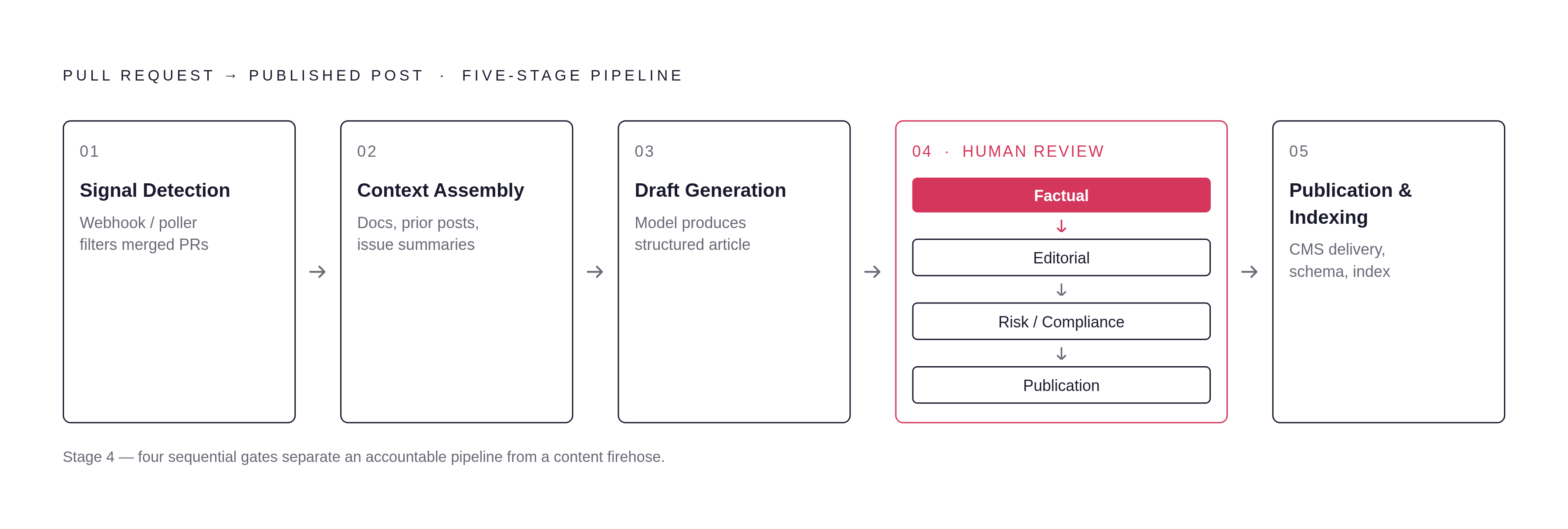
The first stage, signal detection, watches the repository through a webhook or scheduled poller and applies the filter to merged PRs. A qualifying PR enters the pipeline with its title, description, diff, labels, linked issues, author, merge timestamp, and target branch attached. Nothing has been written for publication yet.
The second stage, context assembly, adds what the PR cannot explain by itself. The pipeline retrieves relevant product documentation, prior posts about the feature area, public product positioning, and a summary of the linked issue thread. This supplies the wider frame for the change. Without it, a model has to infer how a local code change fits the product, which invites factual drift. The output is a source package containing both the selected PR and the context needed to explain it accurately.
The third stage, draft generation, turns that package into an article with a set structure. The model works against a template that sets voice, structure, and audience register, with a direct answer near the top, a technical explanation, and an account of what the change means for the reader. A code example or configuration snippet belongs in the draft when the PR includes one. The template sets the structure before review, so reviewers can start without having to rebuild the article. More advanced implementations also render components from the diff in a sandbox before generating copy, grounding descriptions in real behavior.
The fourth stage, structured human review, names the draft’s state and the person who owns it. Four gates follow in sequence. The factual gate checks every claim against the diff and documentation, with uncertain claims labeled or removed. The editorial gate checks voice, structure, clarity, and audience fit, while the risk and compliance gate checks legal, brand, and policy constraints. The publication gate then confirms that the final artifact is the reviewed version and has the correct metadata, slug, tags, and CMS destination.
The EU AI Act gives that review architecture a regulatory context. Its transparency provisions, applicable from August 2026, include an exemption from certain disclosure requirements for AI-generated or manipulated text on topics of public interest. The exemption has two cumulative conditions. The text must undergo human review or editorial control, and a natural or legal person must hold editorial responsibility for publication. This shows that review gates matter more and more in law, though the rules do not cover every AI-assisted product post.
The fifth stage, publication and indexing, delivers the approved artifact to the CMS through an API, applies metadata and schema markup, and submits the post for indexing. WordPress REST, Webflow CMS API, and Ghost Admin API provide possible delivery routes. API delivery avoids the manual copy-paste step that introduces formatting errors. Article schema can identify the author and publication date, while FAQPage schema applies where the post answers a discrete question. Google’s AI features documentation says no special schema is needed to appear in AI Overviews or AI Mode, so markup serves as supporting structure.
Where human review fits and why removing it changes what the pipeline produces
The objection to automation is understandable. Does connecting a repository to a model simply create a faster way to publish AI output? It does if the system ends at generation. A human-reviewed pipeline includes the brief, research, drafting, verification, editorial review, compliance, publication, and monitoring, with named states, owners, permissions, and recovery paths. Those controls distinguish a content pipeline from a content firehose.
A common failure occurs between generation and review. A draft leaves one stage without being put into a named review state, so it either waits with no end in sight or moves toward publication before anyone approves it. A policy saying that someone should review it is not enough. The pipeline should make publication structurally impossible until the review gate has passed. Every AI-generated element should remain reviewable and reversible before it ships.
That control need not turn review into open-ended editing. A reviewer asked to read “for quality” has to decide what quality means each time, while a fixed checklist makes the task repeatable. The template has already supplied the structure. The reviewer can therefore concentrate on confirming the evidence, the explanation, and the publication conditions. Removing that stage changes the product from an accountable explanation into unchecked generated text.
Why the published post is a citation asset, not just a documentation artifact
A published explanation of an API parameter does two jobs. It documents the change for developers, and it gives AI answer engines a specific source they can retrieve and cite. A post on a narrow technical topic can answer a specific question that a broad product description cannot, so as the blog grows, it does more than keep a record of releases.
Search ranking and AI citation are different outcomes, however. A page built mainly around keyword density may show up in search results without being used as a source in a ChatGPT or Perplexity answer. A direct answer near the opening and short, self-contained sections make the explanation easier to extract. These features also help the human reader. The publication stage can enforce that structure without assuming that any particular format guarantees a citation.
Timing and tone affect the opportunity as well. Publishing close to merge supplies a recent explanation while the change is still new, rather than leaving the public account behind the product. A technical description also gives an answer engine more to draw on than sales language does. What changed, which problem it solves, and where its limits lie are all questions the PR can help answer. The source evidence is therefore not just a safeguard against errors but the basis of the post’s usefulness as a citation asset.
That usefulness still has to be demonstrated. A well-structured article is eligible to help an answer, but publication alone does not show that an engine has retrieved it or linked to it. A brand mention alone also cannot show that the answer drew on this particular post.
How to measure whether the pipeline is producing AI-visible content, not just published content
AI answers are non-deterministic, so the same prompt can return a different list of brands each time it runs. One check cannot show a pattern that the team can trust. The team needs a protocol that asks the same questions again and again and records how the answers change.
For a team building that protocol, the starting point is a fixed set of 50–200 buying-intent prompts relevant to the product. The set can include questions such as “best API testing framework” and “how to set up X integration,” run on a schedule against ChatGPT, Copilot, Gemini, and Perplexity. Each answer needs four observations, namely whether the brand appears, its position, the sentiment of the mention, and whether the engine cites a link to the site. Those observations measure different kinds of presence. Tracking each one on its own keeps a positive mention from being taken as proof that the engine used a PR-derived post as a source.
A citation is especially useful because it links to a specific page and can generate referral traffic. A mention shows that the brand appears, even without that link. Perplexity’s real-time web crawling and inline citations make the connection between a published explanation and a linked answer particularly direct. Even then, the existence of a link is not proof that the answer represents the source accurately.
The strongest objection is that citations fluctuate as models retrain and context windows shift. That instability is a reason to measure repeatedly. A scheduled protocol can reveal drops that a one-time check would miss and give the team a basis for adjusting the content. The complete loop is PR → draft → review → publish → measure → adjust. Until the results feed back into the process, the team has automated publishing, but has not finished building its content infrastructure.