Is the AI answer that names your rival really sticky? How a technical B2B buyer can test the "harder to unseat" claim with unprompted buyer questions, repeated runs and a rerun after one change
Three simple tests show whether a rival's AI visibility holds up.

An AI answer naming a rival establishes visibility, while the rival’s resistance to being unseated remains to be tested. For a technical B2B buyer, that distinction is testable. Three experiments can measure the rival’s advantage by testing whether it holds up through ordinary buyer questions, repeated runs and one targeted content change.
Why AI answer engines have become the first stop in B2B vendor research
A buyer can start weighing vendors in an AI-generated summary before reaching a vendor’s website. That gives the answer an early role in shaping the shortlist. A brand left out may never get evaluated. Its website, ads and sales team may have no opportunity to correct the omission because the buyer has already found a plausible set of options.
This is why answer engine optimization, or AEO, has a different job from search engine optimization. SEO helps pages become indexed and authoritative, while AEO shapes content so an engine can extract and attribute it as an answer. Winning one does not automatically win the other. But a competitor’s screenshot of ChatGPT naming its product establishes only one outcome from a probabilistic process. Does the same result appear in other answers?
What "harder to unseat" actually claims and why the claim is testable
“Harder to unseat” makes a stronger claim than “often mentioned.” It suggests that repeated naming reinforces a rival’s position until that position becomes entrenched. If that is true, the rival should appear across different phrasings of a buyer’s question. Its presence should also resist a competitor’s targeted content change. Those are observable implications.
The distinction is between recurrence and reinforcement. A brand appearing repeatedly establishes a pattern, but repetition alone does not show that earlier mentions caused later ones. How reliably does the brand appear, under which conditions, and how much does that pattern change when new evidence becomes available?
The testing protocol tackles those questions with three experiments that use unprompted buyer questions, repeated runs and a rerun after one content change. The first tests breadth across buyer language, the second estimates frequency, and the third tests resistance to a challenge. None requires proprietary tooling. Together, they let a buyer distinguish a strong position on a particular question and engine from a claim of broad category authority.
What the data on AI answer consistency actually shows
AI answer consistency is not simply high or low. Within a single prompt-engine pair, a brand named in one answer tends to appear again in the next answer checked that day, while a brand left out tends to be left out again. Persistence is real within those narrow conditions. Yet estimates from three runs can differ a lot from those based on many more, so a quick check can give the wrong impression of strength.
The category also changes the interpretation. Within one engine, answers for Software and SaaS are more consistent than those for more fragmented categories such as HR/staffing or Legal. Stable, well-indexed vendor sets make a persistent shortlist more plausible. That gives a buyer a reason to expect meaningful differences in patterns across categories.
Engine differences complicate the picture further. Brand overlap between ChatGPT and Gemini on the same questions is much lower than overlap across repeated answers within one engine. Citation behavior also differs sharply, with Perplexity citing brands more frequently than ChatGPT. During a period when it was measured, the share of ChatGPT’s answers that had external citations also fell sharply. A check may therefore pick up an answer drawn from internal memory.
For the buyer running a test, these patterns argue against a blended “AI visibility” score. An average can conceal strength on one engine and absence on another. Mentions and citations also need separate treatment because a named vendor is not necessarily linked. Measure how often a brand appears on a particular prompt-engine pair, with enough runs to show how much the answers vary.
Experiment one: unprompted buyer questions that reveal whether a rival genuinely owns a category
Start the test by writing the questions a buyer would ask before choosing vendors to compare. “Unprompted” here means unprompted by a brand name. A suitable question is “what tools help B2B SaaS teams track AI mention rates”. By contrast, asking how a named competitor compares with alternatives inserts that competitor into the answer before discovery has begun. The distinction changes what the test measures.
Build the question set around the buyer’s problem and job-to-be-done, using different phrasings of the same need. Keep vendor names out of every question. The purpose is to find out whether the rival surfaces through the category itself or only when the question supplies its name. Branded comparisons can be useful later in buying, but they flatter a rival’s position when used as evidence of unprompted discovery.
Run the same question set separately across ChatGPT, Gemini, Perplexity and Claude. In a spreadsheet, give each response its own row and identify its question and engine. Record every vendor named, its order of appearance, whether a citation link accompanies it and the exact language used to describe its value. Specific descriptions can reveal details that a “positive” or “negative” label and a mention count both miss.
A rival named first across most phrasings, described consistently and supported by a URL has a stronger discovery position than one appearing sporadically with vague descriptions. The wording offers another clue. Clear, consistent content can give an engine language and framing to reuse, so track whether the engine reuses a precise description in later runs. Engine disagreement is also a finding to preserve in the analysis. At this stage, though, each response is just one observation, and more are needed for a frequency estimate.
Experiment two: repeated runs of the same prompt to measure consistency, not presence
To estimate that frequency, repeat each unprompted question on the same engine and record the results in the same way. Use the same wording for every run in a set. Otherwise, changes in phrasing and changes between outputs become tangled together. The first experiment asks whether the rival appears across questions, while this one asks how reliably it appears when the question stays the same.
For each prompt-engine pair, work out mention rate as the share of runs that name the rival. Calculate first-position rate as the share that place it first, and citation rate as the share that attach a URL to its name. Also check how much the set of vendors changes between runs. These measures answer different questions. A rival can appear often without leading the answer, or lead it without receiving a citation.
Repeated questions across four engines demand real time. A simple script querying an API can reduce the collection work, without requiring a dedicated visibility platform. Three runs are too thin a basis for a confident conclusion, so the aim is a frequency estimate drawn from many more observations.
A high mention rate with little variation supports a strong position on that particular pairing. A moderate rate with substantial variation suggests the screenshot may reflect a good draw. Strong performance on ChatGPT but weak performance on Perplexity indicates engine-specific visibility. None of those findings justifies extending the result to questions or engines outside the test.
The mention-citation gap also changes the commercial interpretation. Frequent naming without links may support recall without sending traffic, while a citation without prominence may offer a route to a site without establishing broad consideration. The practical output is a frequency table for each engine and prompt, with mention, first-position and citation rates. That table becomes the baseline for testing whether a rival’s advantage can move.
Experiment three: one content change, then a rerun — testing whether the advantage is actually durable
To challenge the baseline, publish one substantive piece on a question where the rival dominates. This is the most consequential experiment because it introduces a competitive change. The piece should answer the target question with original evidence, such as a named data point, a documented process or a specific sourced claim. A homepage update or tag change is not the intervention being tested. The experiment tests whether a useful new source can shift the established pattern.
Original evidence gives the page a reason to be selected beyond restating what the model already knows. A proprietary finding, named case or specific comparison gives the page something of its own. Aggarwal et al.’s GEO: Generative Engine Optimization, published at ACM KDD 2024, tested nine optimization methods. The study found that quotations from credible sources and clear statistics produced the strongest gains in a source’s share of the generated answer, while readability improvements produced a smaller positive lift. That supports an evidence-led page.
To make the evidence extractable, answer the target question in the first several words after a question-based heading. Use short declarative paragraphs while giving each section enough substance to develop its answer. Short paragraphs need not mean sparse sections. Include FAQPage or QAPage schema to make the question-answer relationship machine-readable, and display and maintain a “last updated” date. These choices support a page designed to supply an answer rather than leave the engine to assemble one from a long discussion.
Rerun the same repeated-run protocol two to four weeks after publication, allowing time for indexing and for the retrieval pool to reflect the new page. Testing at week two and week four can show whether the change is growing or leveling off. Keep the comparison anchored to the original prompt-engine pairs. A different question would test where the rival stands on something else, so the baseline would offer less help with the comparison.
If the rival’s mention and first-position rates remain unchanged, its advantage has survived this intervention under the tested conditions. That could be because it has more authoritative sources, covers more of the topic or has more third-party citations. The result does not identify which explanation is responsible. Nor does it show that every future challenge will fail. It establishes resistance to this piece, on these questions and engines, over this interval.
A rise in the challenger’s mention rate, a fall in the rival’s first-position rate or adoption of the challenger’s category framing points toward a more fragile advantage. The measured change is more informative than whether one new answer looks encouraging. Distribution can also affect the result because third-party publisher pages account for most AI citations. One or two earned-media placements may move the estimate faster than publishing only on the owned site.
This is the definitive test in a bounded sense. It turns “harder to unseat” into a before-and-after comparison without pretending that one intervention proves a universal rule. An unchanged rate supports durability, while a shift exposes an opening. The only honest answer to the competitive claim is the measured result, stated within the conditions that produced it.
What the three experiments together reveal about where AI visibility actually lives
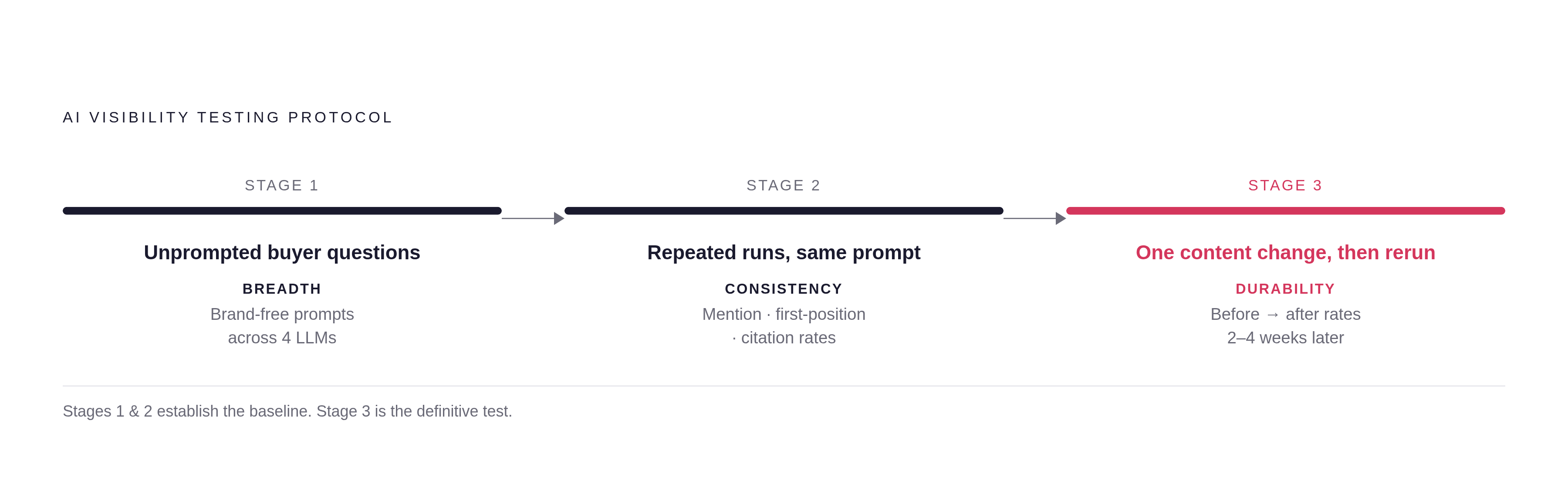
The three experiments separate breadth, consistency and resistance to change. A truly sticky rival keeps its place across different unprompted questions, repeated runs and a targeted piece published by a competitor. A fragile position breaks somewhere along that sequence. It may depend on one phrasing, fluctuate between runs or lose prominence after new evidence appears. Those weaknesses call for different interpretations of “AI authority.
Owned pages are only part of the source network an engine draws from. Because most citations point to third-party publishers, an owned-site-only strategy leaves much of that network untouched. Earned distribution expands the places where evidence can be found and cited. The testing framework makes that architectural question concrete by showing which engines, questions and citation patterns remain weak.
AEO and generative engine optimization therefore require both content work and continuing measurement. Retrieval, trust and citation are distinct but related outcomes, and the experiments probe their visible effects. Freshness adds an ongoing obligation because citations decline as pages age. Publish and refresh regularly, then measure whether that work sustains the position. A strong answer today is a result to explain.